
Поделиться


 Common-IT-Abbreviations-Your-Essential-Guide.pdf
Common IT
 Abbreviations: Your
Essential Guide
Abbreviations: Your
Essential Guide
Demystifying the language of technology for clarity and confidence.
Why IT Abbreviations Matter
 IT professionals rely on acronyms to
quickly convey complex concepts, saving time and streamlining discussions in
fast-paced environments.
IT professionals rely on acronyms to
quickly convey complex concepts, saving time and streamlining discussions in
fast-paced environments.
 |
From cybersecurity protocols to network configurations, these abbreviations are pervasive in every facet of IT, making comprehension crucial.
Mastering IT language opens doors to deeper understanding and effective collaboration.

 IT: Information
Technology
IT: Information
TechnologyAt its core, IT encompasses the entire spectrum of computing. This vast field includes everything from software development and data management to network infrastructure and cybersecurity.
IT serves as the foundational pillar for all modern digital operations, enabling businesses and individuals to process, store, and exchange information efficiently.
It is the very bedrock
upon which all other IT abbreviations and specialized concepts are built,
forming the essential framework of the digital world.
CPU & RAM: The Computer’s Brain and
Memory
These two components are the heartbeat of any computing device, working in tandem to deliver performance.

 Often called the
"brain" of the computer, the CPU executes RAM is the computer's
short-term memory. It temporarily instructions, performs calculations, and
manages the flow stores data that the CPU needs to access quickly for active
of data. Its processing power dictates how quickly tasks processes and
running applications. More RAM means are completed. smoother multitasking.
Often called the
"brain" of the computer, the CPU executes RAM is the computer's
short-term memory. It temporarily instructions, performs calculations, and
manages the flow stores data that the CPU needs to access quickly for active
of data. Its processing power dictates how quickly tasks processes and
running applications. More RAM means are completed. smoother multitasking.
API & DNS: Connecting Systems and the Internet
These abbreviations represent critical mechanisms that enable different software systems to communicate and allow users to access websites seamlessly.

An API defines a set of rules and protocols for how software components The DNS acts as the internet's phonebook. When you type a website name should interact. It's like a menu that allows different applications to request like "google.com" into your browser, DNS translates that human-readable services from each other, enabling seamless data exchange and functionality name into a machine-readable IP address (e.g., 172.217.160.142) so your sharing without direct access. browser knows where to find the website's server.
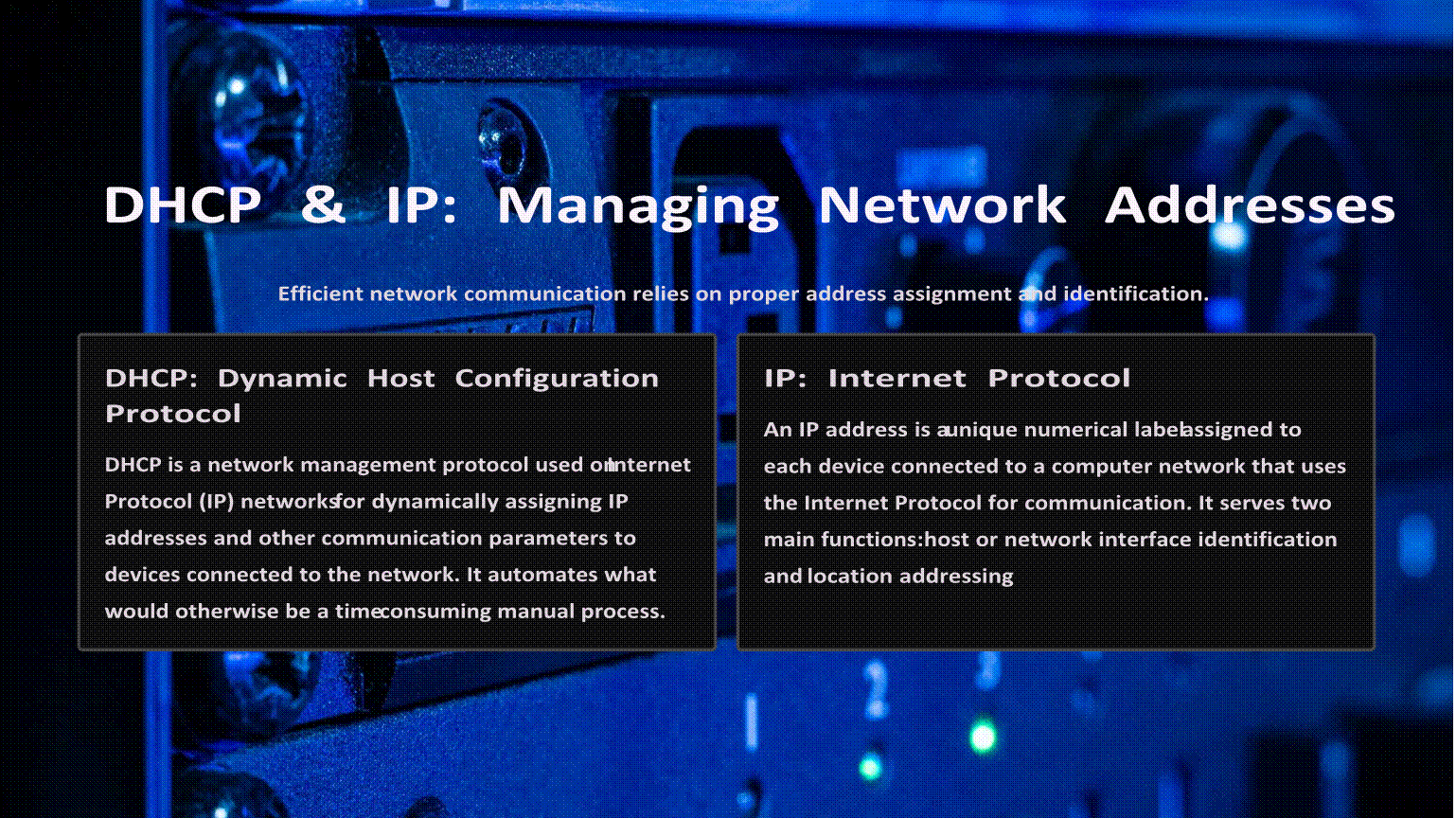
2FA & MFA: Securing Access
Bolstering digital defenses requires more than just a password. These methods add layers of security to protect your accounts.
 2FA: Two-Factor
Authentication
2FA: Two-Factor
Authentication This security method
requires two distinct forms of identification to verify a user's identity.
Typically, this involves something you know (like a password) and something you
have (like a code sent to your phone or a hardware token).
This security method
requires two distinct forms of identification to verify a user's identity.
Typically, this involves something you know (like a password) and something you
have (like a code sent to your phone or a hardware token).
 MFA: Multi-Factor Authentication
MFA expands on 2FA by demanding two or more verification factors from independent categories. This could include a combination of knowledge (password), possession (phone), and inherence (biometrics like a fingerprint or face scan), providing a significantly stronger security posture.
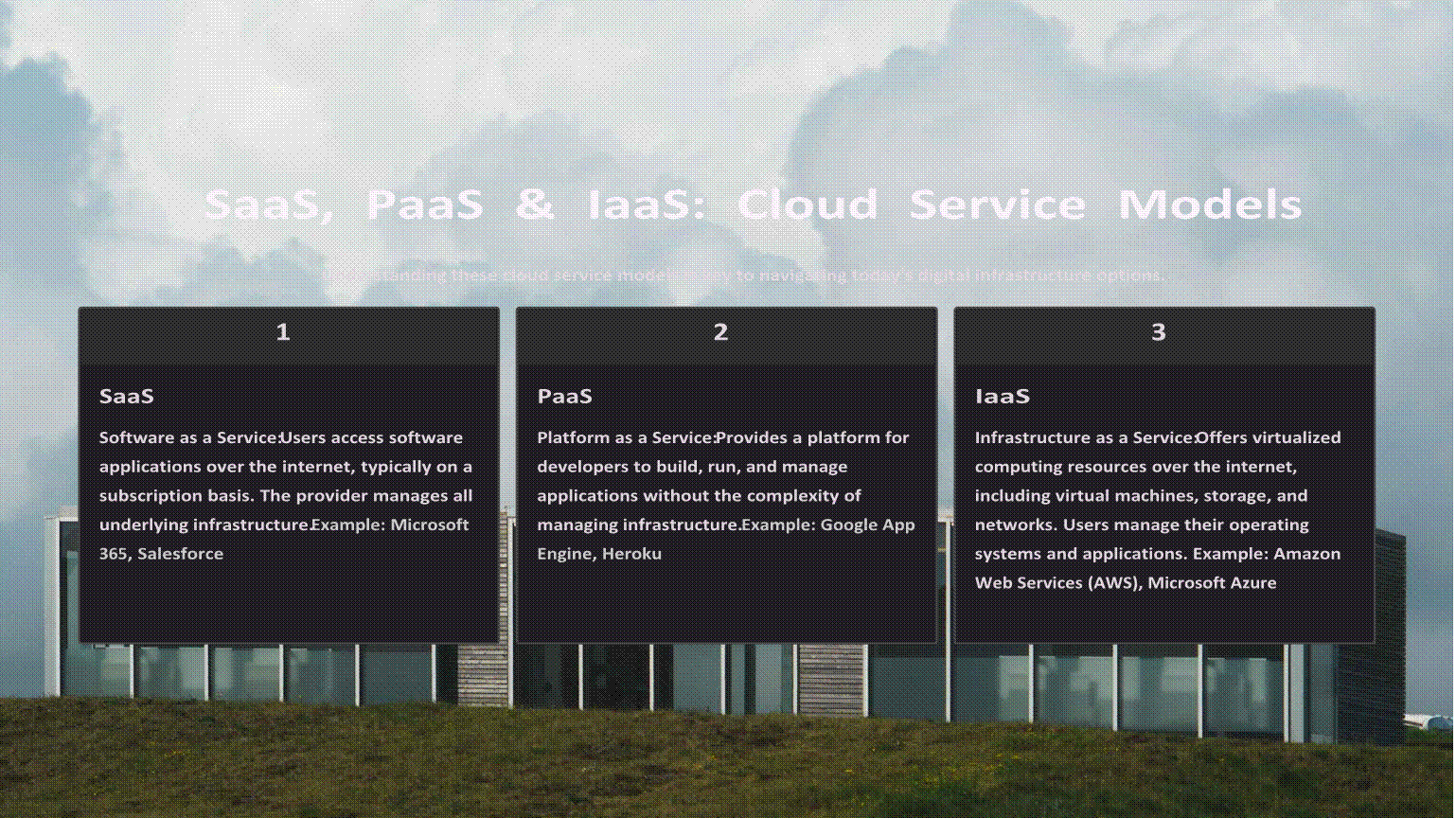
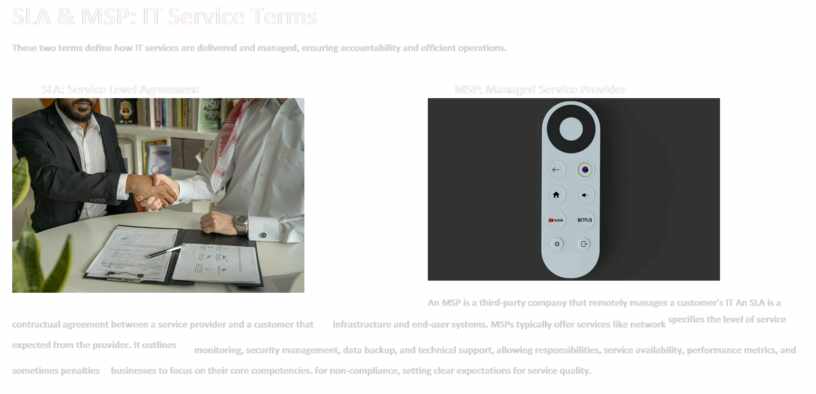
SLA & MSP: IT Service Terms
These two terms define how IT services are delivered and managed, ensuring accountability and efficient operations.

An MSP is a third-party company that remotely manages a customer's IT An SLA is a contractual agreement between a service provider and a customer that infrastructure and end-user systems. MSPs typically offer services like network specifies the level of service expected from the provider. It outlines monitoring, security management, data backup, and technical support, allowing responsibilities, service availability, performance metrics, and sometimes penalties businesses to focus on their core competencies. for non-compliance, setting clear expectations for service quality.
Mastering IT
Abbreviations Empowers
You
 Bridge the
Communication Gap
Bridge the
Communication Gap
 |
The IT landscape evolves rapidly, and so does its language. Staying curious and updated ensures you remain relevant and effective in a dynamic field.
Your ability to decode complex IT concepts starts here. Each new abbreviation mastered is a step towards becoming a more knowledgeable and valuable professional.
Your IT journey starts now!


Материалы на данной страницы взяты из открытых источников либо размещены пользователем в соответствии с договором-офертой сайта. Вы можете сообщить о нарушении.


