
Поделиться


 8.docx
План-конспект урока английского языка
Тема урока: В магазине
Дата урока:_____________
Класс :8-А,8-Б
Планируемые результаты (УУД):
Личностные:
- проявляют интерес к учебному предмету ;
- самостоятельно определяют мотив учебной деятельности и смысла учения;
- положительно относятся к процессу познания, в ситуации общения и сотрудничества делают выбор, какой поступок совершить;
- понимают причины успеха/неуспеха в учебной деятельности. Проводят самоанализ и самоконтроль результатов.
Предметные:
- учиться выделять один предмет из группы;
- применять полученные знания для решения задач;
Метапредметные (П,Р,К)
Познавательные:
- уметь анализировать, обобщать;
- умение осуществлять информационный поиск, сбор и выделение существенной
информации из различных информационных источников;
- умение использовать знаково-символические средства для создания моделей
изучаемых объектов и процессов, схем решения учебно-познавательных и практических
задач.
Регулятивные:
- организовывают себя на уроке;
- определяют и формулируют цель на уроке;
- планируют свою деятельность в соответствии с поставленной учебной задачей и условиями ее реализации;
- следуют плану, оценивают результаты решения поставленных задач;
- возвращаются к пунктам плана, осуществляют познавательную и личностную рефлексии.
Коммуникативные:
- с достаточной полнотой и точностью выражают свои мысли, слушают и понимают речь других;
- договариваются и приходят к общему решению в совместной деятельности.
Тип урока: комбинированный
Оборудование: мульт.доска,ноутбук,проектор,рабочая тетрадь,словарная тетрадь,учебник,презентация
Ход урока
1. Начало урока:
Приветствие
T: Good morning, dear students! I am glad to see you today. Tell me please what the date is today?
S1: Today is Tuesday, the 25nd of October.
T: Thank you. Who is absent today?
S1: Students reply who is absent.
T: Now we are ready to start.
Введение в тему
T: Let’s open the books on p. 28. Look at the photos and the headline of the text. Can you guess what the topic of today’s lesson is?
S1: Is it about shopping?
T: Right you are. So before we start I want you to discuss your shopping habits together in pairs for 5 minutes. You need to ask each other the questions you see on the board and give answers. Then you will tell me what you learnt from your partner.
Discussion follows.
· Do you like shopping? For what kinds of things?
· Have you ever spent too much money? What did you buy?
· How long do you usually shop for?
· Are you a bargain hunter?
· Do you prefer to shop online or to buy things in person?
Чтение – 10 минут
T: Well done! As you have read the title of the text, do you have any ideas what this holiday could be?
S1: It can be about voluntary work.
S2: It can be about not buying anything at all during some period of time.
T: You could be right, let’s find it out.
S3: It is about a holiday when people buy nothing during a specific day.
T: That’s the correct answer. When did this holiday appear? (1993) How many countries do celebrate it? (55) Why do people celebrate it? (to make people stop and think how their spending habits affect the planet) Would you like to celebrate such a holiday? Why?
Now you are going to know what students do during this holiday. You are going to work in pairs, the first variant (point out) will read the text about Montreal and the second variant (point out as well) will read the text about Birmingham. After both of you read the texts, you need to ask each other the following questions (show them on the board):
1. Where did the students celebrate it?
2. Did the students need to prepare for the holiday? How?
3. What’s the aim of the celebration?
Elicit a few answers.
Введение в грамматическую тему урока
T: In the texts you have read you have come across two tenses that are the focus of our lesson. Can you find some examples?
S1: We have been working hard on it all week.
S2: We have decided to buy simple things.
(написать предложения на доске)
T: Which of the situations has finished?
S1: The second one.
T: What can you say about the first statement?
S2: It’s still lasting.
T: Absolutely right. Let’s compare the tenses [Приложение 1].
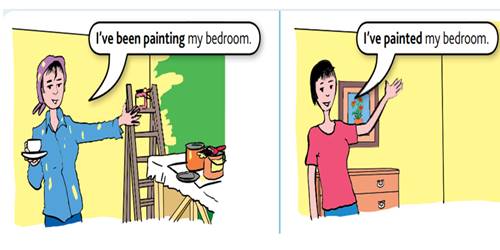
So as you see, we use Present Perfect Continuous when we talk about the actions which are in progress, like in this picture, we see a woman who is still painting the walls. We use Present Perfect to express the actions which have been fulfilled as we see another woman who has already painted the walls. Looking at the examples in the texts, can you try and figure out the structure of the tenses?
Students: say the structures, the teacher writes them down in all forms and students do the same.
Выполнение грамматических упражнений
T: Let’s drill the rule and do ex.1 and 2 on p.140. Read the sentences and put the verbs in brackets into the PPS or PPC.
Рефлексия.Подведение итогов
Our lesson
is about to end. What did you learn today?
S1: We revised Present Perfect and Present Perfect Continuous Tenses.
S2: We found out that a “Buy nothing holiday” exists.
T: Thank you for being so active during the lesson! Your homework will be to learn the new words and do task 2 on p.40 and task 3 on p.140. Have a great day! Godbye!
Материалы на данной страницы взяты из открытых источников либо размещены пользователем в соответствии с договором-офертой сайта. Вы можете сообщить о нарушении.


