
Поделиться



 MODAL VERBS.docx
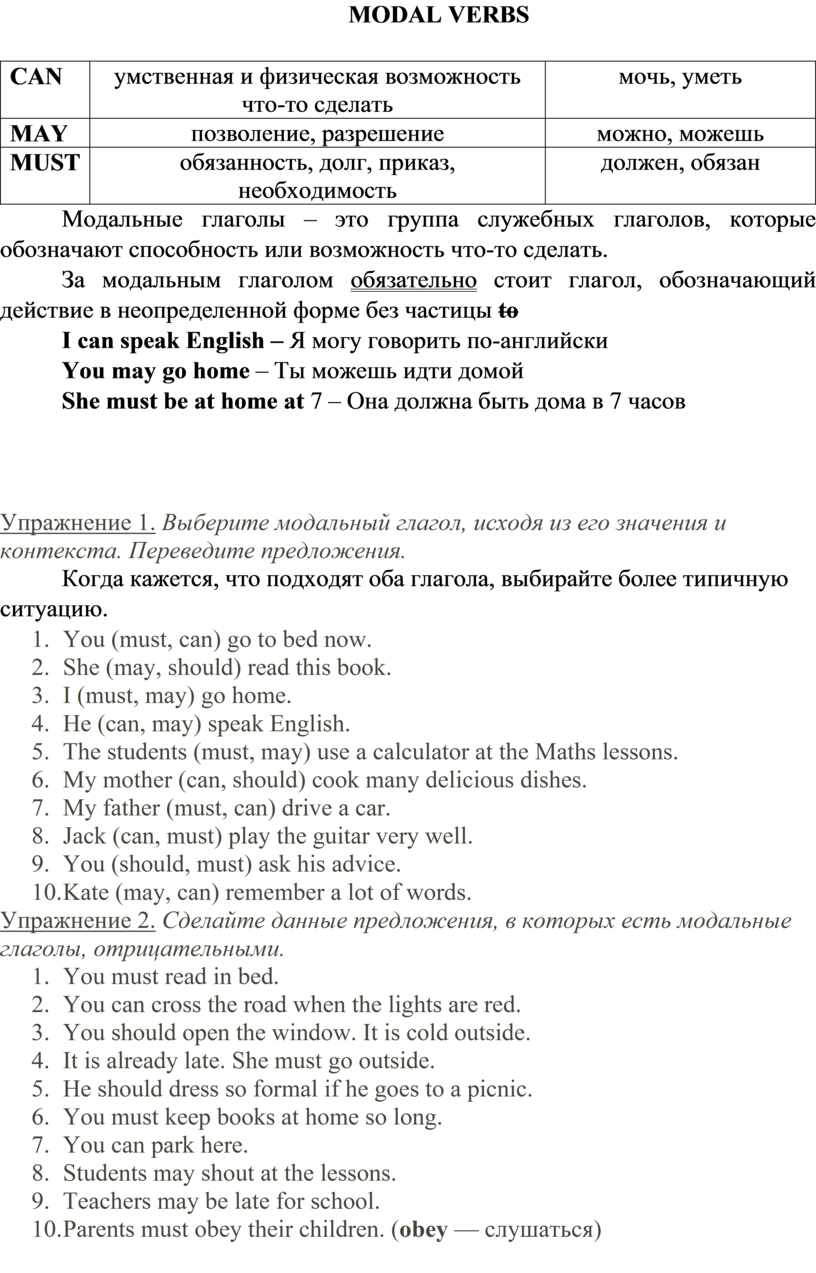
MODAL VERBS
|
CAN |
умственная и физическая возможность что-то сделать |
мочь, уметь |
|
MAY |
позволение, разрешение |
можно, можешь |
|
MUST |
обязанность, долг, приказ, необходимость |
должен, обязан |
Модальные глаголы – это группа служебных глаголов, которые обозначают способность или возможность что-то сделать.
За
модальным глаголом обязательно стоит глагол, обозначающий действие в
неопределенной форме без частицы to
I can speak English – Я могу говорить по-английски
You may go home – Ты можешь идти домой
She must be at home at 7 – Она должна быть дома в 7 часов
Упражнение 1. Выберите модальный глагол, исходя из его значения и контекста. Переведите предложения.
Когда кажется, что подходят оба глагола, выбирайте более типичную ситуацию.
1. You (must, can) go to bed now.
2. She (may, should) read this book.
3. I (must, may) go home.
4. He (can, may) speak English.
5. The students (must, may) use a calculator at the Maths lessons.
6. My mother (can, should) cook many delicious dishes.
7. My father (must, can) drive a car.
8. Jack (can, must) play the guitar very well.
9. You (should, must) ask his advice.
10. Kate (may, can) remember a lot of words.
Упражнение 2. Сделайте данные предложения, в которых есть модальные глаголы, отрицательными.
1. You must read in bed.
2. You can cross the road when the lights are red.
3. You should open the window. It is cold outside.
4. It is already late. She must go outside.
5. He should dress so formal if he goes to a picnic.
6. You must keep books at home so long.
7. You can park here.
8. Students may shout at the lessons.
9. Teachers may be late for school.
10. Parents must obey their children. (obey — слушаться)
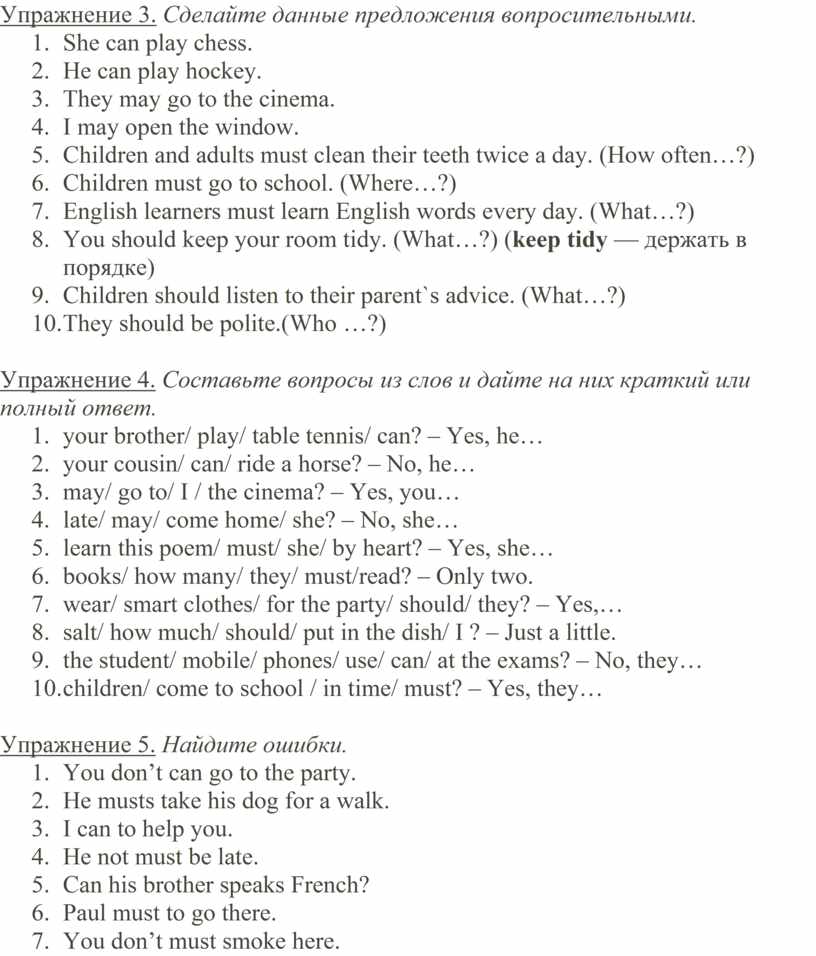
Упражнение 3. Сделайте данные предложения вопросительными.
1. She can play chess.
2. He can play hockey.
3. They may go to the cinema.
4. I may open the window.
5. Children and adults must clean their teeth twice a day. (How often…?)
6. Children must go to school. (Where…?)
7. English learners must learn English words every day. (What…?)
8. You should keep your room tidy. (What…?) (keep tidy — держать в порядке)
9. Children should listen to their parent`s advice. (What…?)
10. They should be polite.(Who …?)
Упражнение 4. Составьте вопросы из слов и дайте на них краткий или полный ответ.
1. your brother/ play/ table tennis/ can? – Yes, he…
2. your cousin/ can/ ride a horse? – No, he…
3. may/ go to/ I / the cinema? – Yes, you…
4. late/ may/ come home/ she? – No, she…
5. learn this poem/ must/ she/ by heart? – Yes, she…
6. books/ how many/ they/ must/read? – Only two.
7. wear/ smart clothes/ for the party/ should/ they? – Yes,…
8. salt/ how much/ should/ put in the dish/ I ? – Just a little.
9. the student/ mobile/ phones/ use/ can/ at the exams? – No, they…
10. children/ come to school / in time/ must? – Yes, they…
Упражнение 5. Найдите ошибки.
1. You don’t can go to the party.
2. He musts take his dog for a walk.
3. I can to help you.
4. He not must be late.
5. Can his brother speaks French?
6. Paul must to go there.
7. You don’t must smoke here.
Материалы на данной страницы взяты из открытых источников либо размещены пользователем в соответствии с договором-офертой сайта. Вы можете сообщить о нарушении.


