Поделиться



 Spotlight_7_1b_Better_safe_than_sorry_interactive.pptx
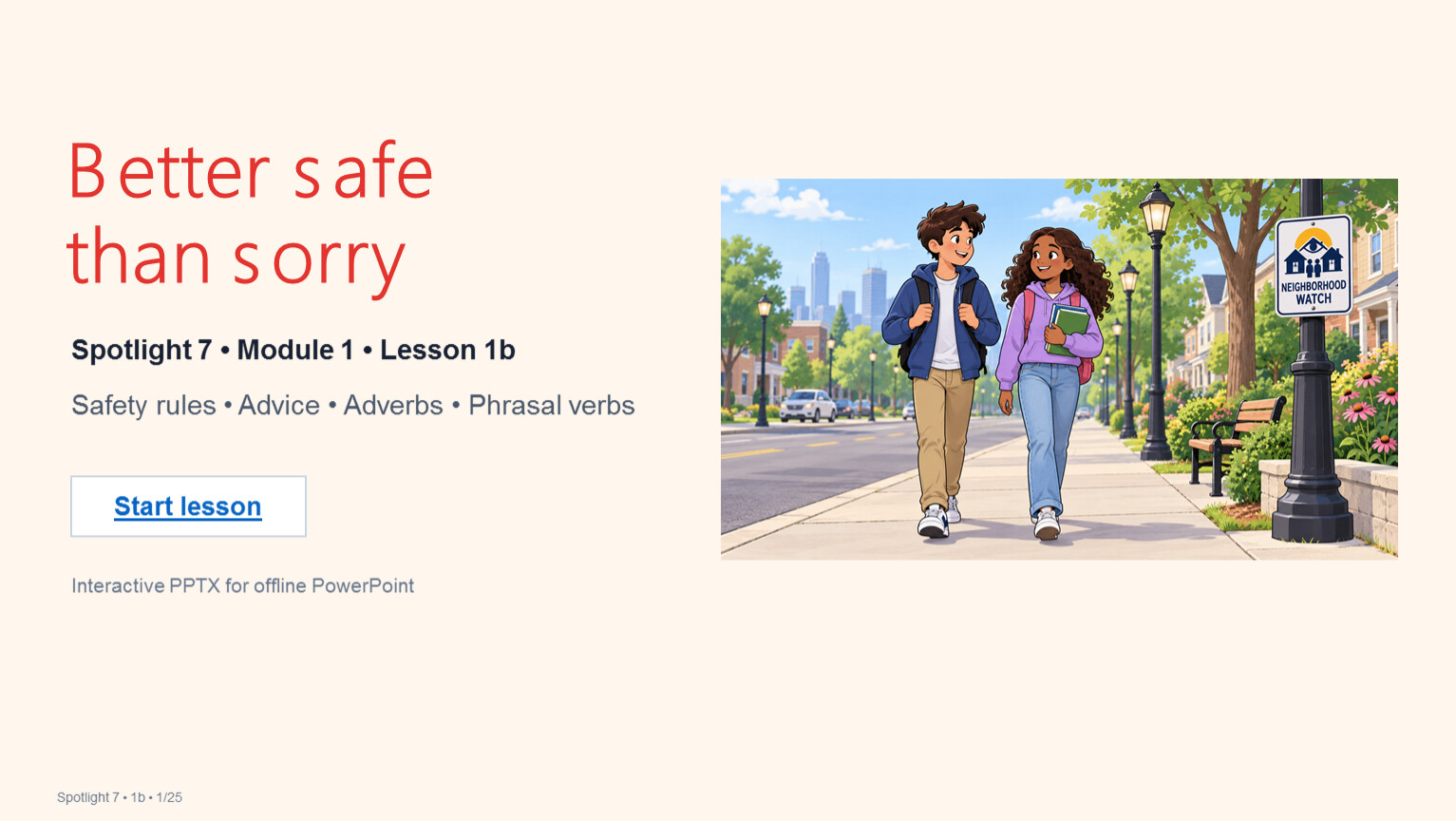
Better safe
than sorry
Spotlight 7 • Module 1 • Lesson 1b
Safety rules • Advice • Adverbs • Phrasal verbs
Start lesson
Interactive PPTX for offline PowerPoint
Spotlight 7 • 1b • 1/25
Lesson map
Based only on the two attached pages. Module title is not shown on these pages.
Spotlight 7 • 1b • 2/25
Material found on the pages
Textbook: Spotlight 7
Module: 1; Lesson: 1b
Lesson title: Better safe than sorry
Main theme: safety rules at home and in the street
Click a section
Vocabulary & safety rules
Reading & listening
Grammar: should / adverbs
Phrasal verbs & speaking
Writing + exit ticket
Next →
⌂ Home

Today we will…
Clear lesson goals for students
Spotlight 7 • 1b • 3/25
⌂ Home
Next →
understand and use safety vocabulary
read a short dialogue about burglar alarms and keys
give advice with should / shouldn’t
form adverbs from adjectives correctly
use phrasal verbs with run
write a short safety leaflet
Work modes: individual • pairs • teams

Warm-up: Big city safety
Think • Pair • Share
Spotlight 7 • 1b • 4/25
⌂ Home
Next →
Do you live in a big city?
Discuss in pairs:
What can be dangerous at home?
What can be dangerous in the street?
What should teenagers do to stay safe?
Use: I think we should… / We shouldn’t…

Vocabulary: safety rules at home
Look, read, and say the rule.
Spotlight 7 • 1b • 5/25
⌂ Home
Next →
Key words & phrases
peephole — глазок
door chain — дверная цепочка
stranger’s ID — удостоверение незнакомца
switched on — включённый
keys — ключи
Mini practice: Say one safety rule using should or shouldn’t.
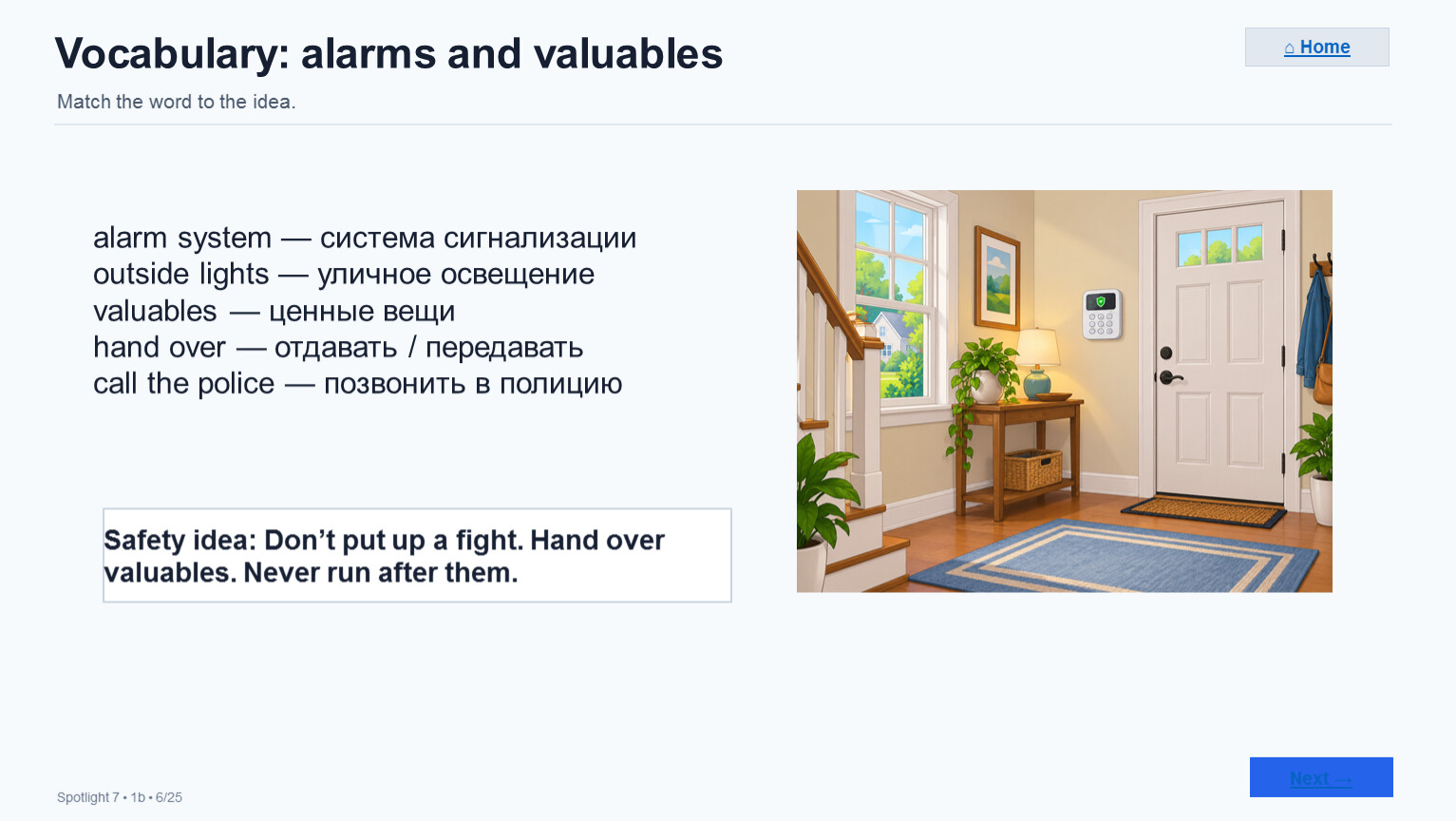
Vocabulary: alarms and valuables
Match the word to the idea.
Spotlight 7 • 1b • 6/25
⌂ Home
Next →
alarm system — система сигнализации
outside lights — уличное освещение
valuables — ценные вещи
hand over — отдавать / передавать
call the police — позвонить в полицию
Safety idea: Don’t put up a fight. Hand over valuables. Never run after them.
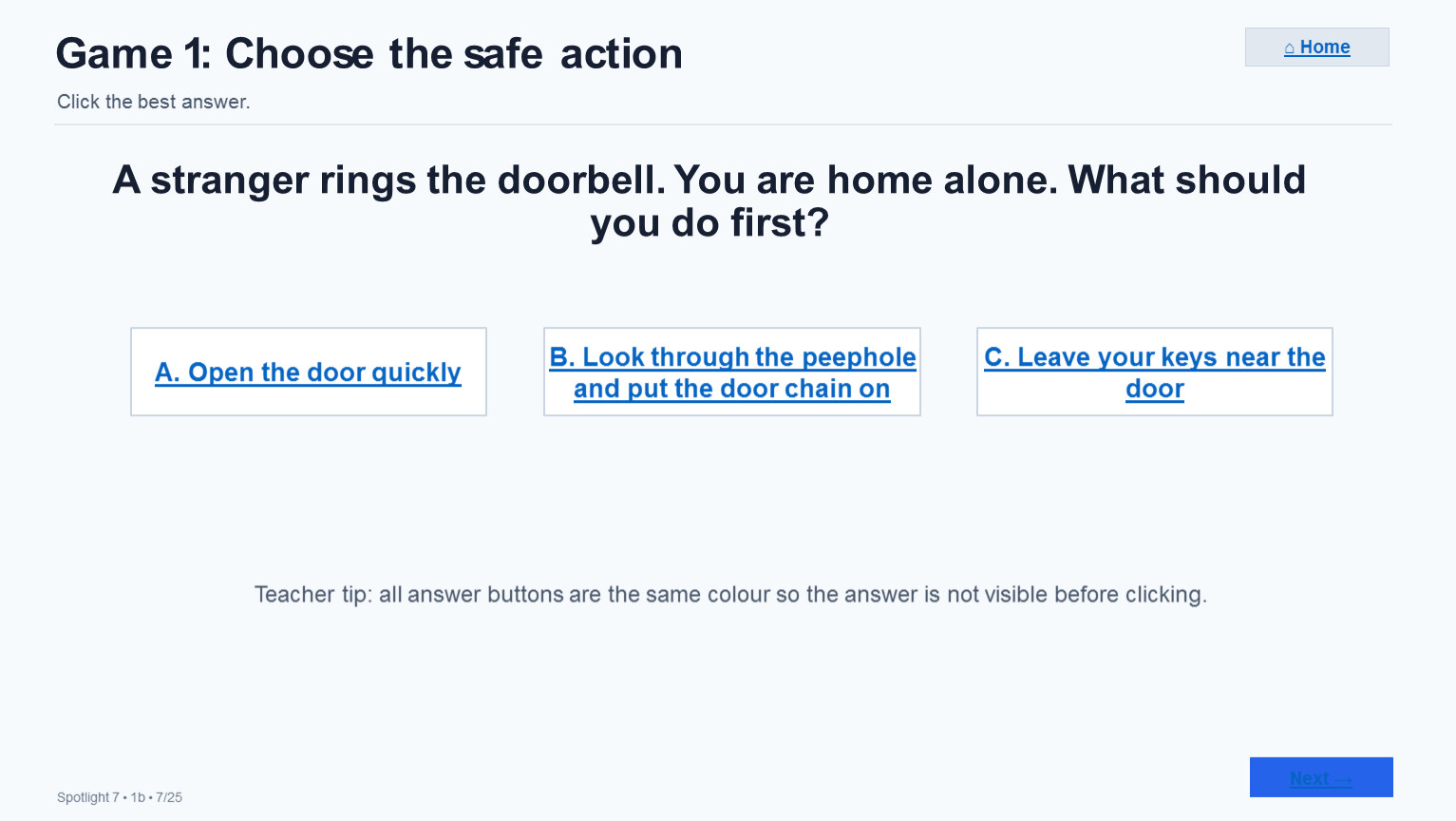
Game 1: Choose the safe action
Click the best answer.
Spotlight 7 • 1b • 7/25
⌂ Home
A stranger rings the doorbell. You are home alone. What should you do first?
A. Open the door quickly
B. Look through the peephole and put the door chain on
C. Leave your keys near the door
Teacher tip: all answer buttons are the same colour so the answer is not visible before clicking.
Next →
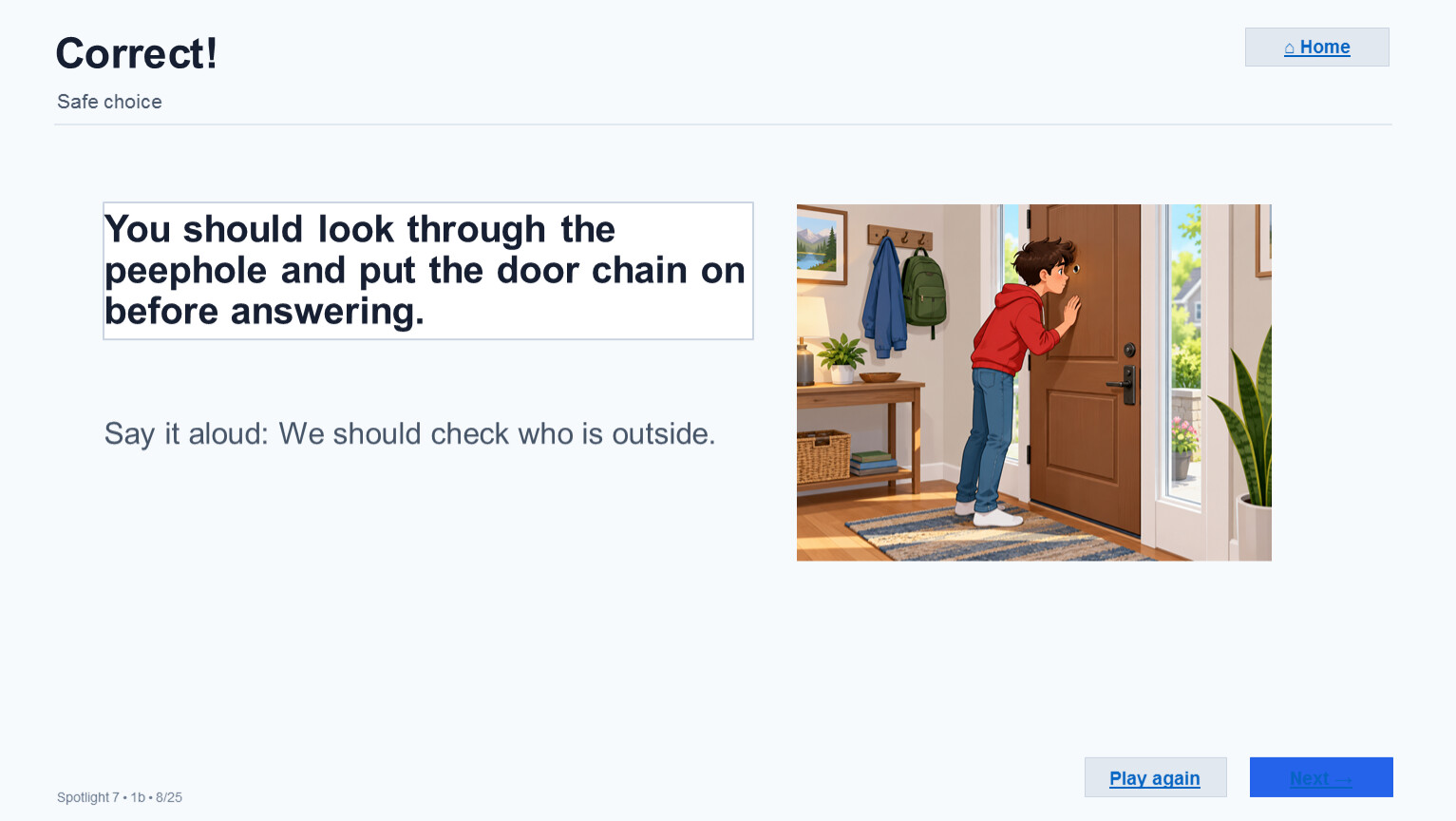
Correct!
Safe choice
Spotlight 7 • 1b • 8/25
⌂ Home
You should look through the peephole and put the door chain on before answering.
Say it aloud: We should check who is outside.
Play again
Next →
Try again
Think about the rule.
Spotlight 7 • 1b • 9/25
⌂ Home
The safest action is to check the visitor before opening the door.
Hint: Use the peephole and the door chain.
Back to question
Next →
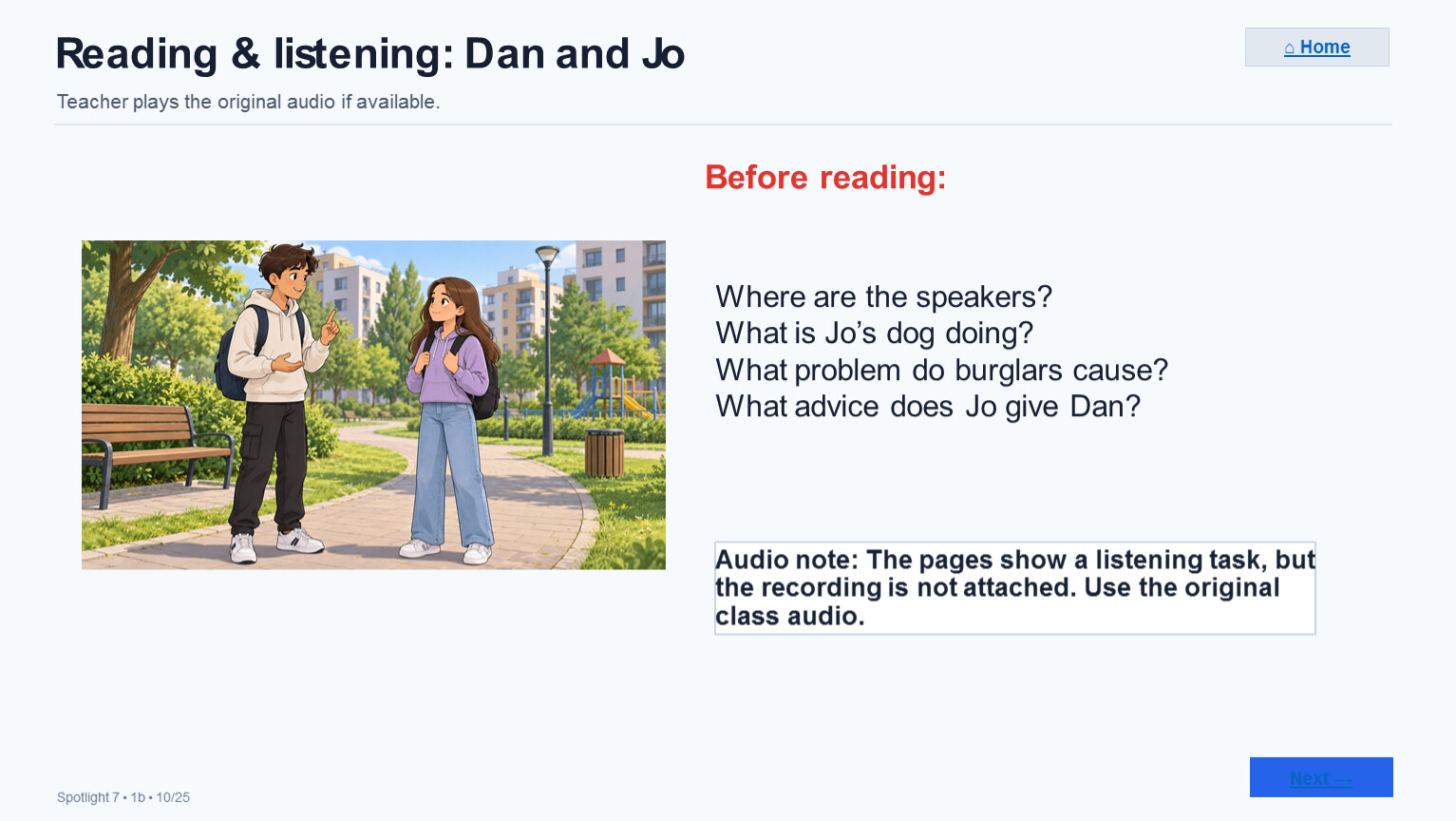
Reading & listening: Dan and Jo
Teacher plays the original audio if available.
Spotlight 7 • 1b • 10/25
⌂ Home
Next →
Before reading:
Where are the speakers?
What is Jo’s dog doing?
What problem do burglars cause?
What advice does Jo give Dan?
Audio note: The pages show a listening task, but the recording is not attached. Use the original class audio.
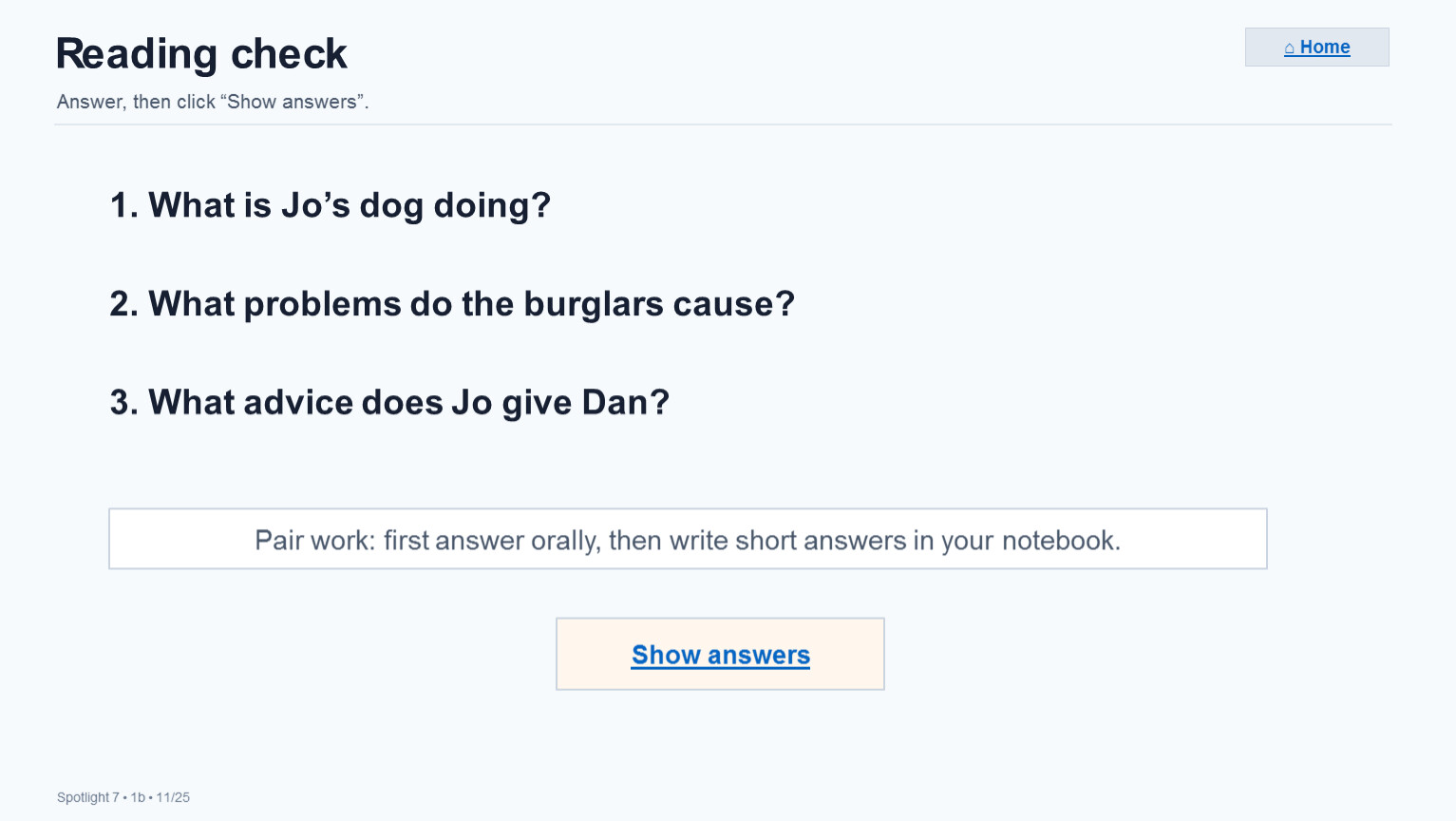
Reading check
Answer, then click “Show answers”.
Spotlight 7 • 1b • 11/25
⌂ Home
1. What is Jo’s dog doing?
2. What problems do the burglars cause?
3. What advice does Jo give Dan?
Pair work: first answer orally, then write short answers in your notebook.
Show answers
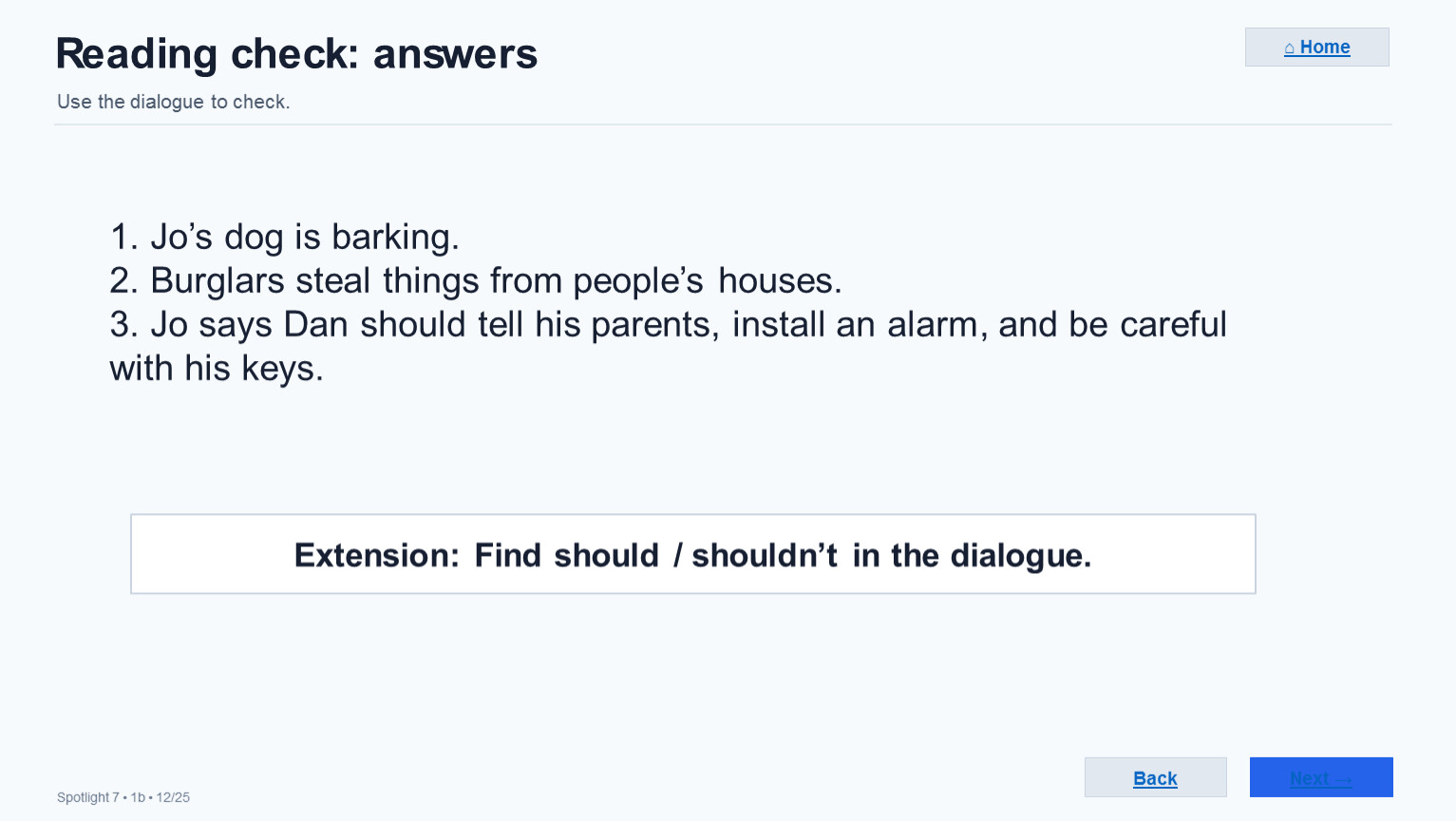
Reading check: answers
Use the dialogue to check.
Spotlight 7 • 1b • 12/25
⌂ Home
Back
Next →
1. Jo’s dog is barking.
2. Burglars steal things from people’s houses.
3. Jo says Dan should tell his parents, install an alarm, and be careful with his keys.
Extension: Find should / shouldn’t in the dialogue.
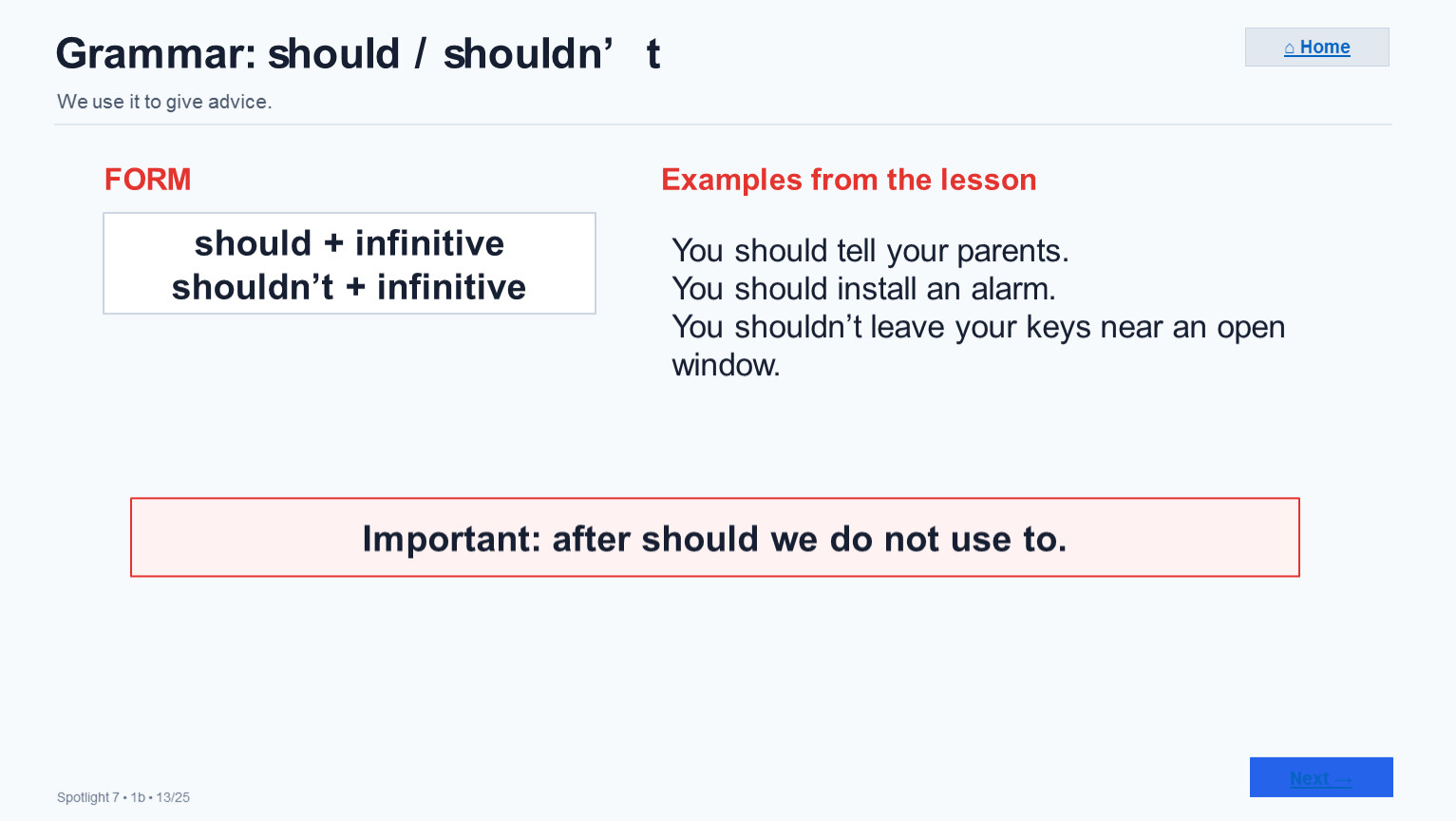
Grammar: should / shouldn’t
We use it to give advice.
Spotlight 7 • 1b • 13/25
⌂ Home
Next →
FORM
should + infinitive
shouldn’t + infinitive
Examples from the lesson
You should tell your parents.
You should install an alarm.
You shouldn’t leave your keys near an open window.
Important: after should we do not use to.
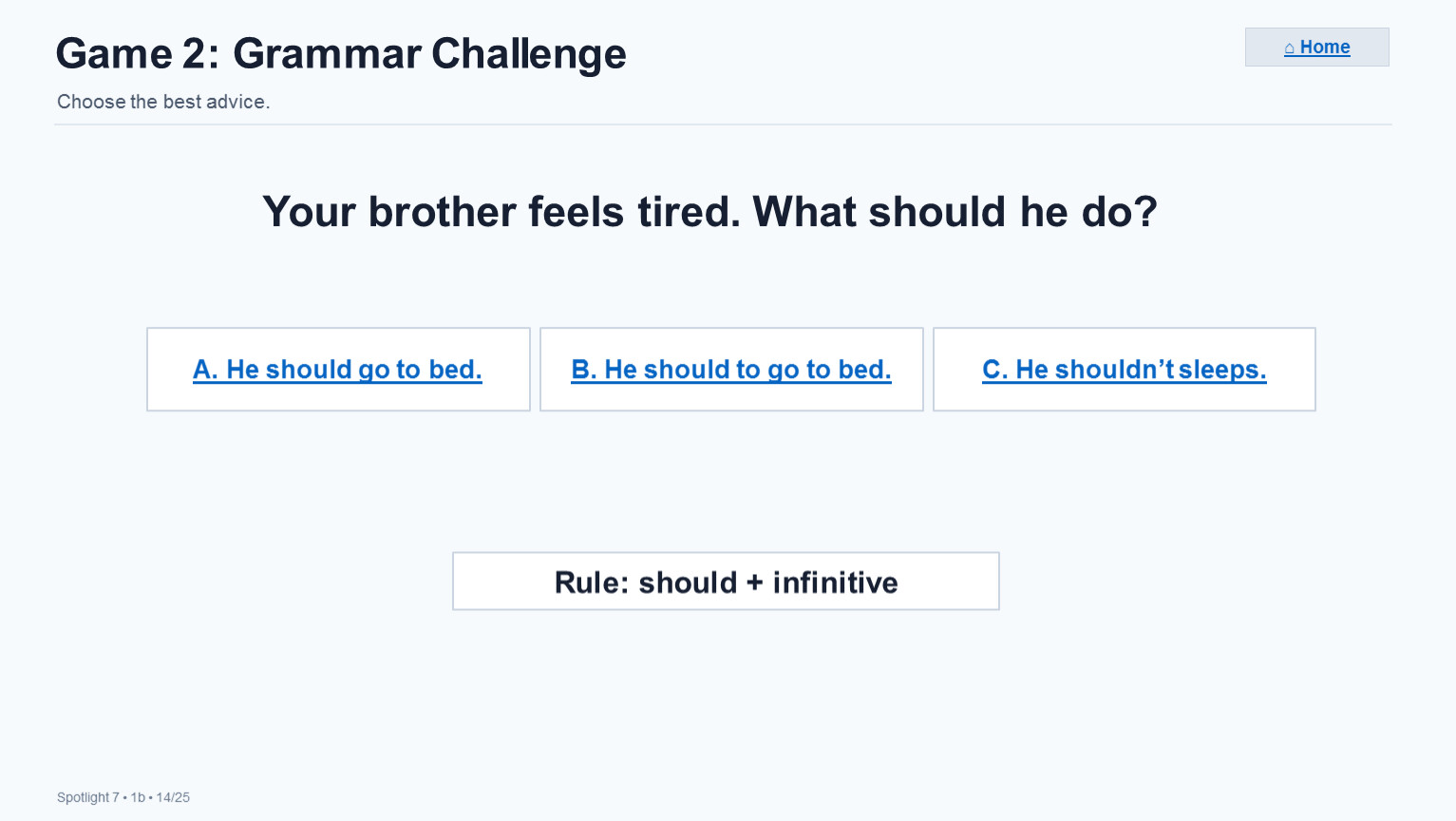
Game 2: Grammar Challenge
Choose the best advice.
Spotlight 7 • 1b • 14/25
⌂ Home
Your brother feels tired. What should he do?
A. He should go to bed.
B. He should to go to bed.
C. He shouldn’t sleeps.
Rule: should + infinitive
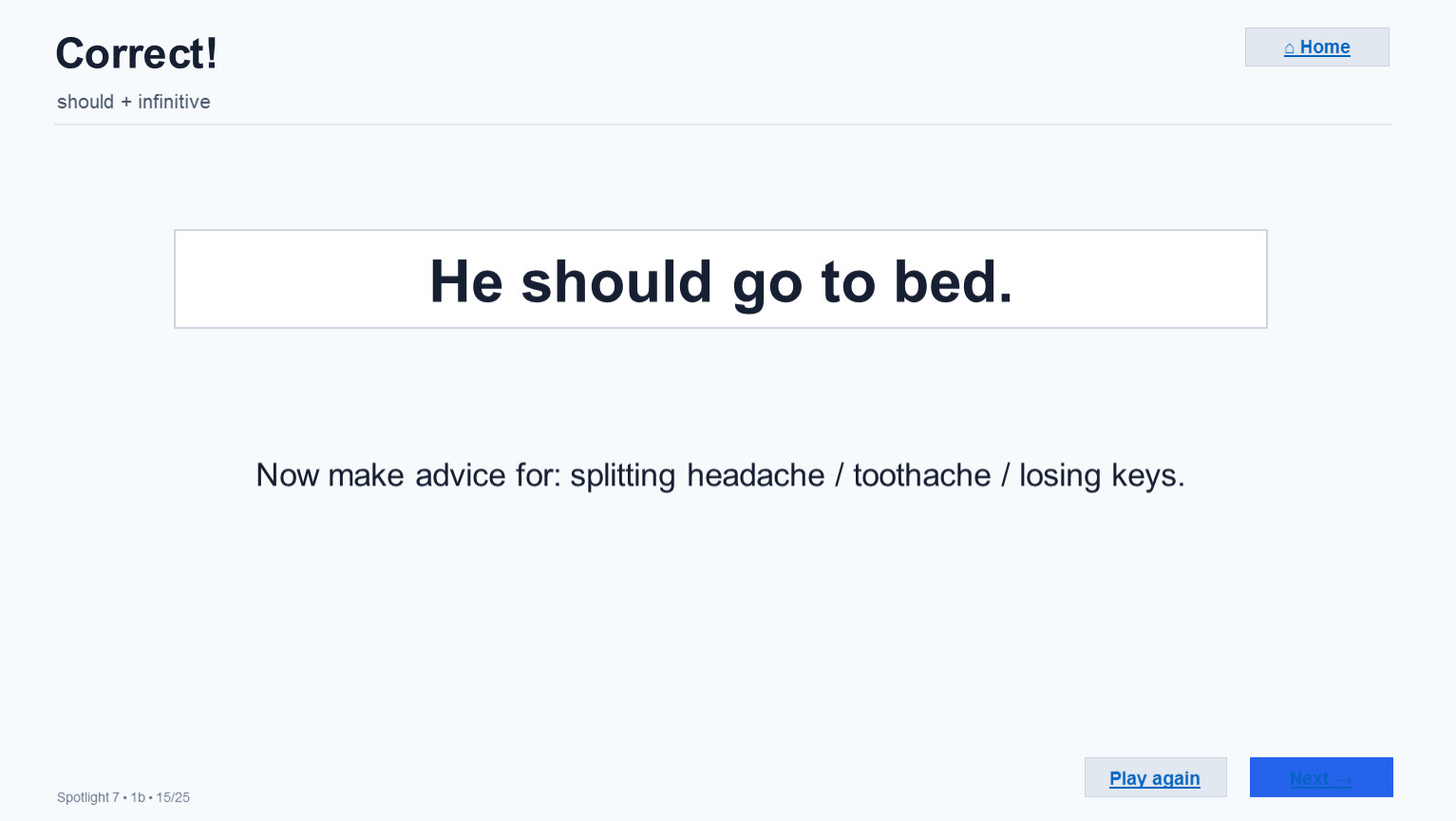
Correct!
should + infinitive
Spotlight 7 • 1b • 15/25
⌂ Home
He should go to bed.
Now make advice for: splitting headache / toothache / losing keys.
Play again
Next →
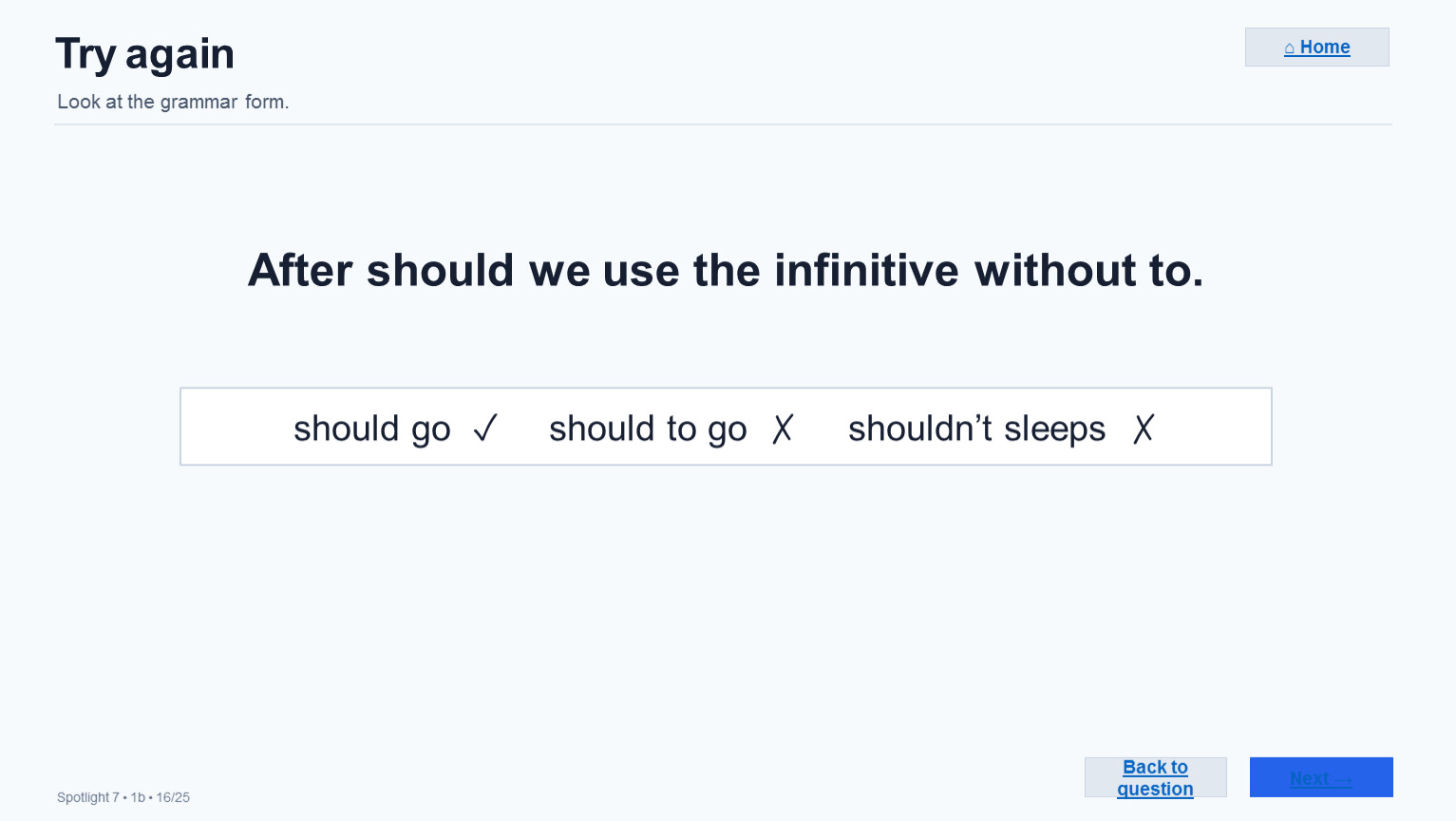
Try again
Look at the grammar form.
Spotlight 7 • 1b • 16/25
⌂ Home
After should we use the infinitive without to.
should go ✓ should to go ✗ shouldn’t sleeps ✗
Back to question
Next →
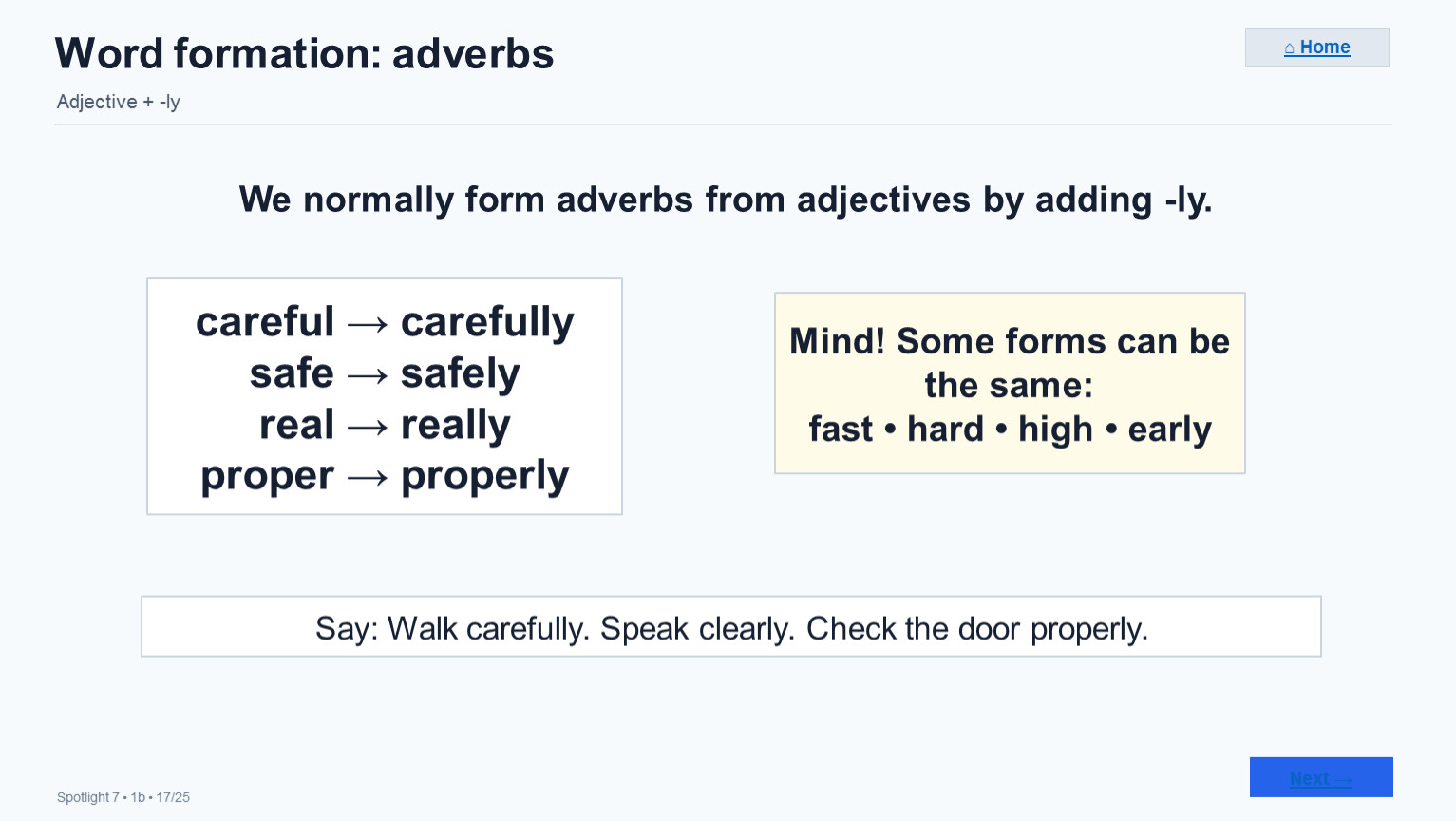
Word formation: adverbs
Adjective + -ly
Spotlight 7 • 1b • 17/25
⌂ Home
Next →
We normally form adverbs from adjectives by adding -ly.
careful → carefully
safe → safely
real → really
proper → properly
Mind! Some forms can be the same:
fast • hard • high • early
Say: Walk carefully. Speak clearly. Check the door properly.
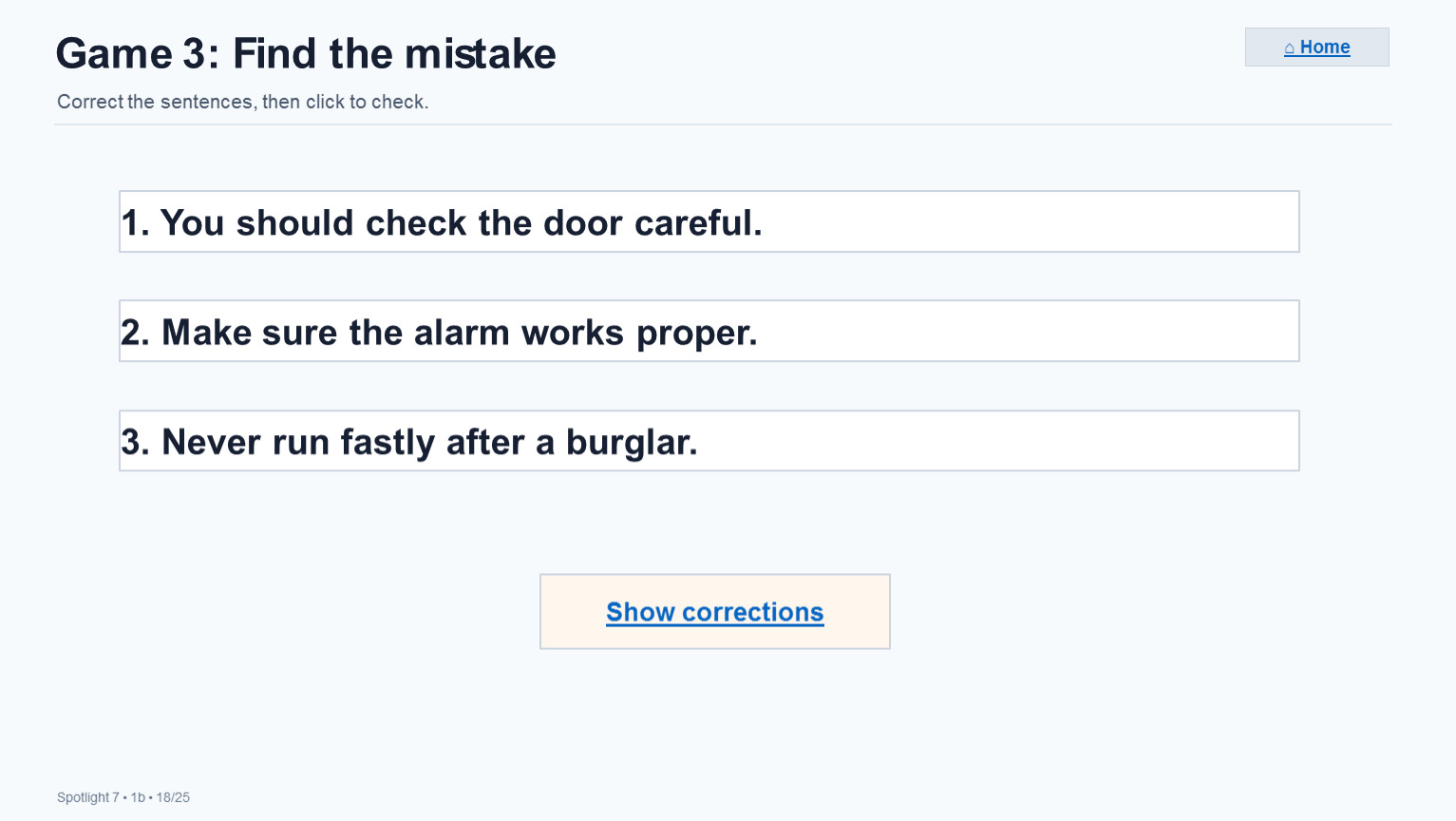
Game 3: Find the mistake
Correct the sentences, then click to check.
Spotlight 7 • 1b • 18/25
⌂ Home
1. You should check the door careful.
2. Make sure the alarm works proper.
3. Never run fastly after a burglar.
Show corrections

Find the mistake: corrections
Check spelling and meaning.
Spotlight 7 • 1b • 19/25
⌂ Home
Back
Next →
1. You should check the door carefully.
2. Make sure the alarm works properly.
3. Never run fast after a burglar.
Why? carefully/properly are adverbs; fast stays the same.
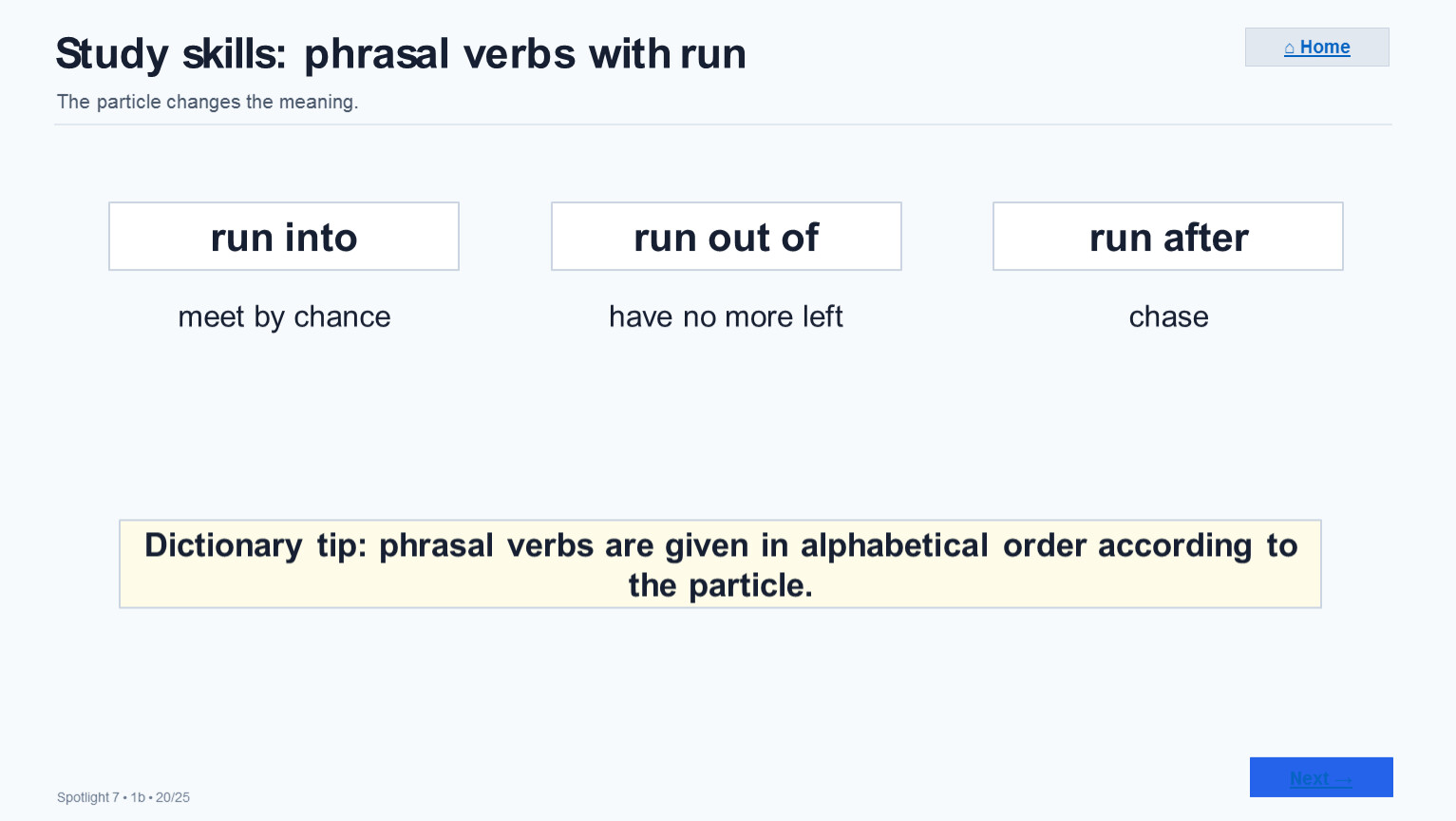
Study skills: phrasal verbs with run
The particle changes the meaning.
Spotlight 7 • 1b • 20/25
⌂ Home
Next →
run into
meet by chance
run out of
have no more left
run after
chase
Dictionary tip: phrasal verbs are given in alphabetical order according to the particle.

Game 4: Matching Game
Match each sentence to the meaning.
Spotlight 7 • 1b • 21/25
⌂ Home
1. Dan ran into Jo on his way home.
2. He ran out of milk.
3. The police are running after a robber.
A. chase
B. meet by chance
C. no more left
Show matches
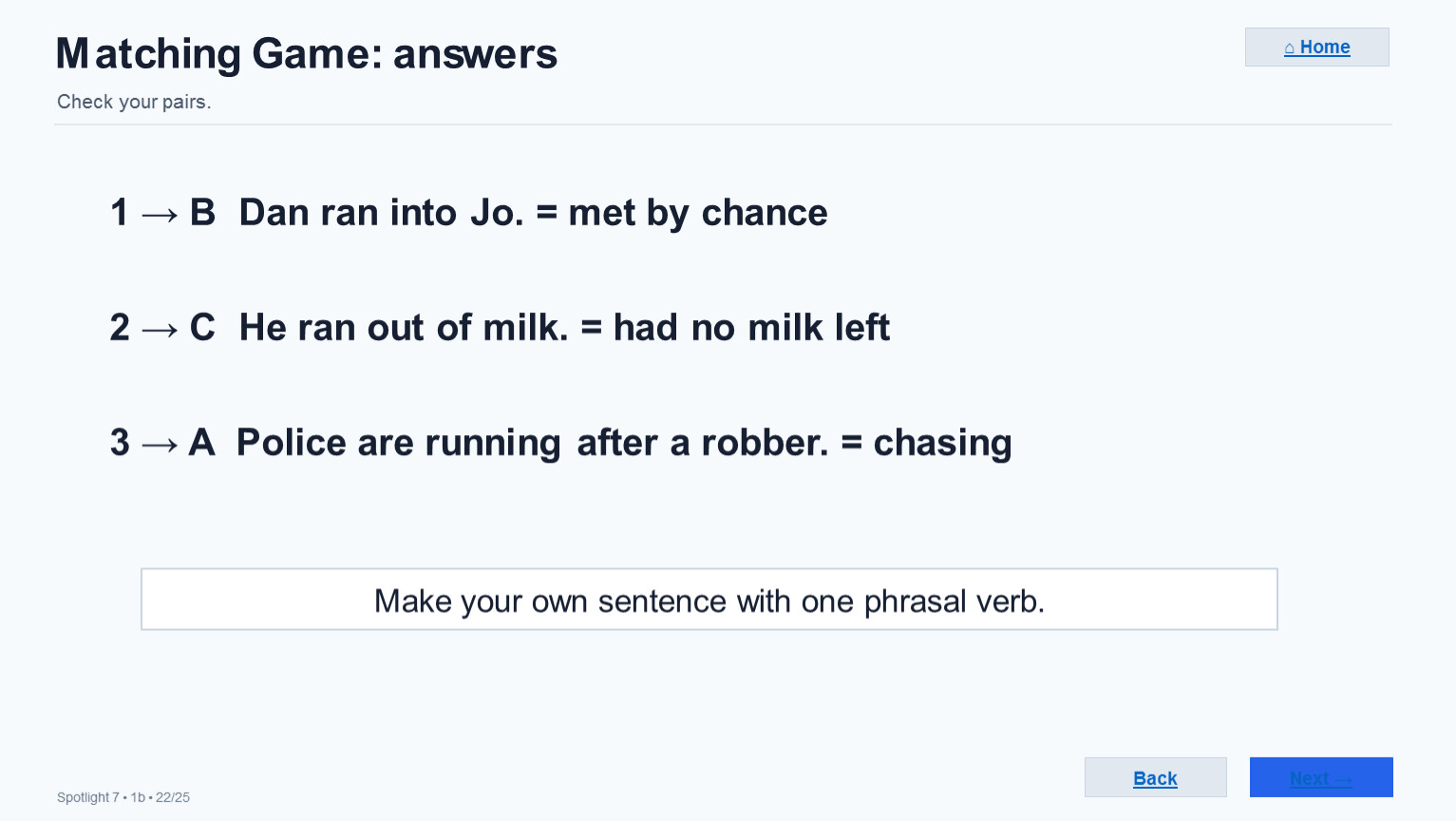
Matching Game: answers
Check your pairs.
Spotlight 7 • 1b • 22/25
⌂ Home
Back
Next →
1 → B Dan ran into Jo. = met by chance
2 → C He ran out of milk. = had no milk left
3 → A Police are running after a robber. = chasing
Make your own sentence with one phrasal verb.
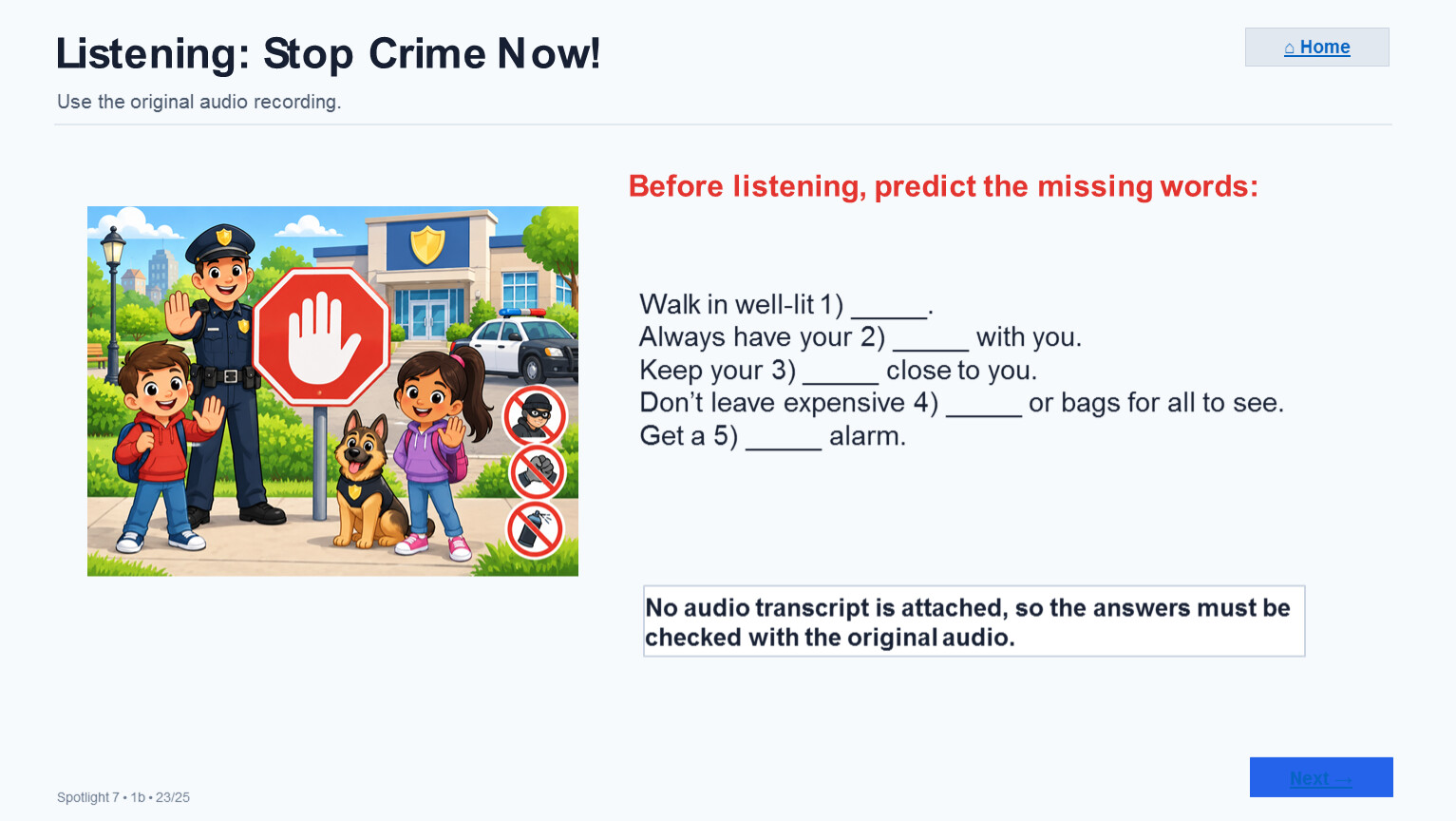
Listening: Stop Crime Now!
Use the original audio recording.
Spotlight 7 • 1b • 23/25
⌂ Home
Next →
Before listening, predict the missing words:
Walk in well-lit 1) _____.
Always have your 2) _____ with you.
Keep your 3) _____ close to you.
Don’t leave expensive 4) _____ or bags for all to see.
Get a 5) _____ alarm.
No audio transcript is attached, so the answers must be checked with the original audio.
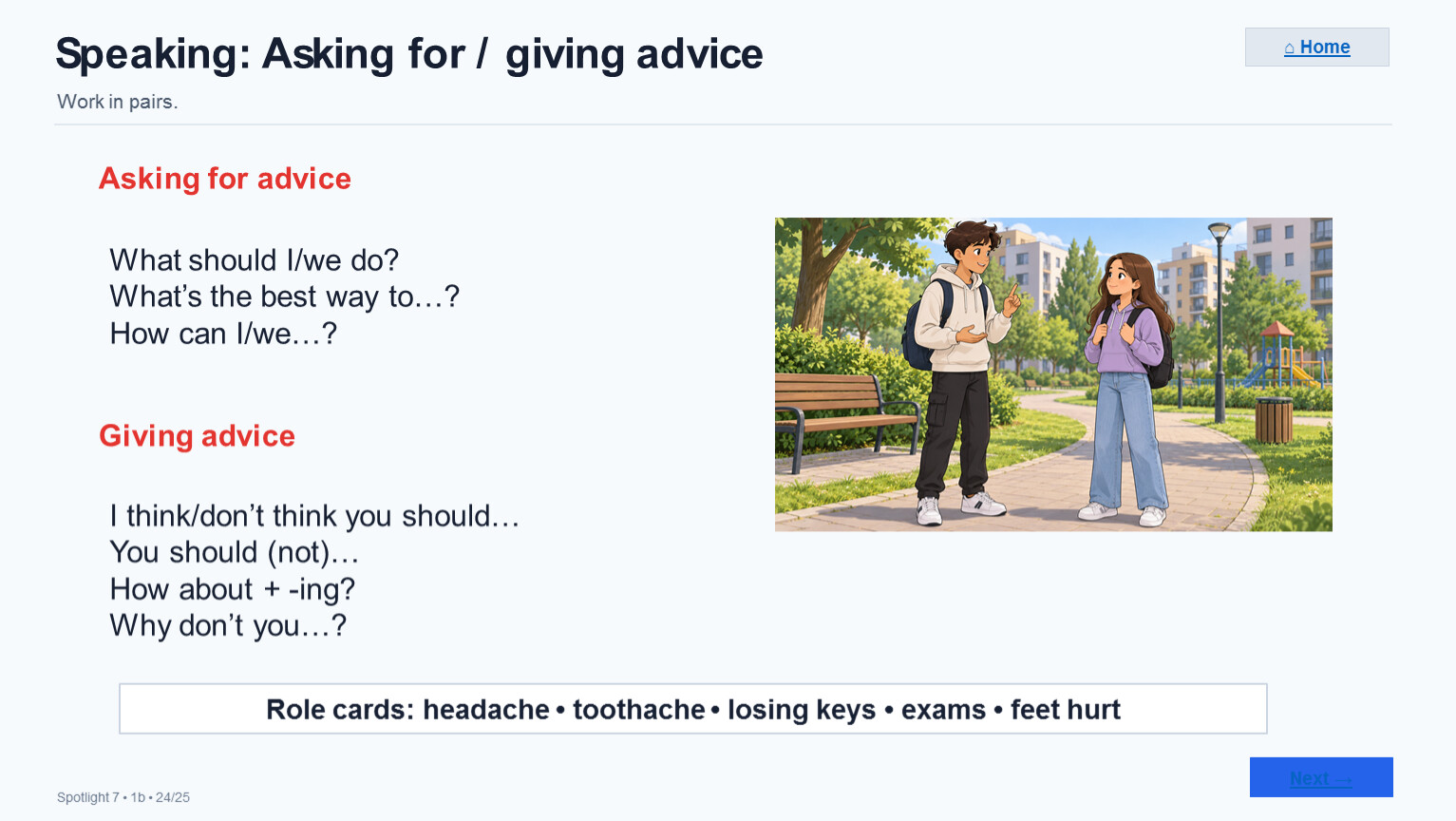
Speaking: Asking for / giving advice
Work in pairs.
Spotlight 7 • 1b • 24/25
⌂ Home
Next →
Asking for advice
What should I/we do?
What’s the best way to…?
How can I/we…?
Giving advice
I think/don’t think you should…
You should (not)…
How about + -ing?
Why don’t you…?
Role cards: headache • toothache • losing keys • exams • feet hurt

Writing & Exit Ticket
A short leaflet giving advice
Spotlight 7 • 1b • 25/25
⌂ Home
Portfolio task:
Write a leaflet giving advice on how to protect yourself in the streets. Use ideas from the listening task.
Checklist
3–5 safety rules
should / shouldn’t
at least 2 adverbs
clear title and neat design
Exit ticket: One new word + one safety rule + one grammar point I can use.
Материалы на данной страницы взяты из открытых источников либо размещены пользователем в соответствии с договором-офертой сайта. Вы можете сообщить о нарушении.