
Поделиться



 Разработка урока по английскому языку для 10 класса.docx
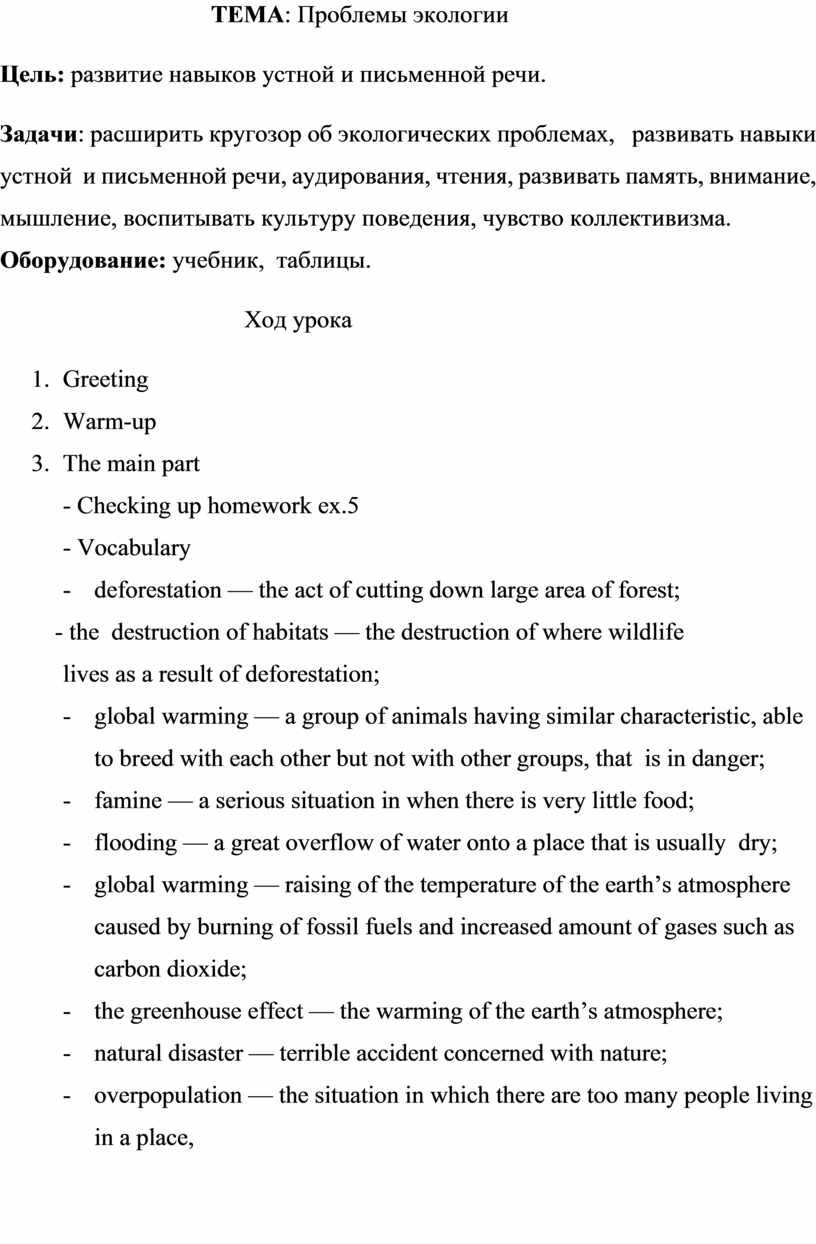
ТЕМА: Проблемы экологии
Цель: развитие навыков устной и письменной речи.
Задачи: расширить кругозор об экологических проблемах, развивать навыки устной и письменной речи, аудирования, чтения, развивать память, внимание, мышление, воспитывать культуру поведения, чувство коллективизма.
Оборудование: учебник, таблицы.
Ход урока
1. Greeting
2. Warm-up
3. The main part
- Checking up homework ex.5
- Vocabulary
- deforestation — the act of cutting down large area of forest;
- the destruction of habitats — the destruction of where wildlife
lives as a result of deforestation;
- global warming — a group of animals having similar characteristic, able to breed with each other but not with other groups, that is in danger;
- famine — a serious situation in when there is very little food;
- flooding — a great overflow of water onto a place that is usually dry;
- global warming — raising of the temperature of the earth’s atmosphere caused by burning of fossil fuels and increased amount of gases such as carbon dioxide;
- the greenhouse effect — the warming of the earth’s atmosphere;
- natural disaster — terrible accident concerned with nature;
- overpopulation — the situation in which there are too many people living in a place,
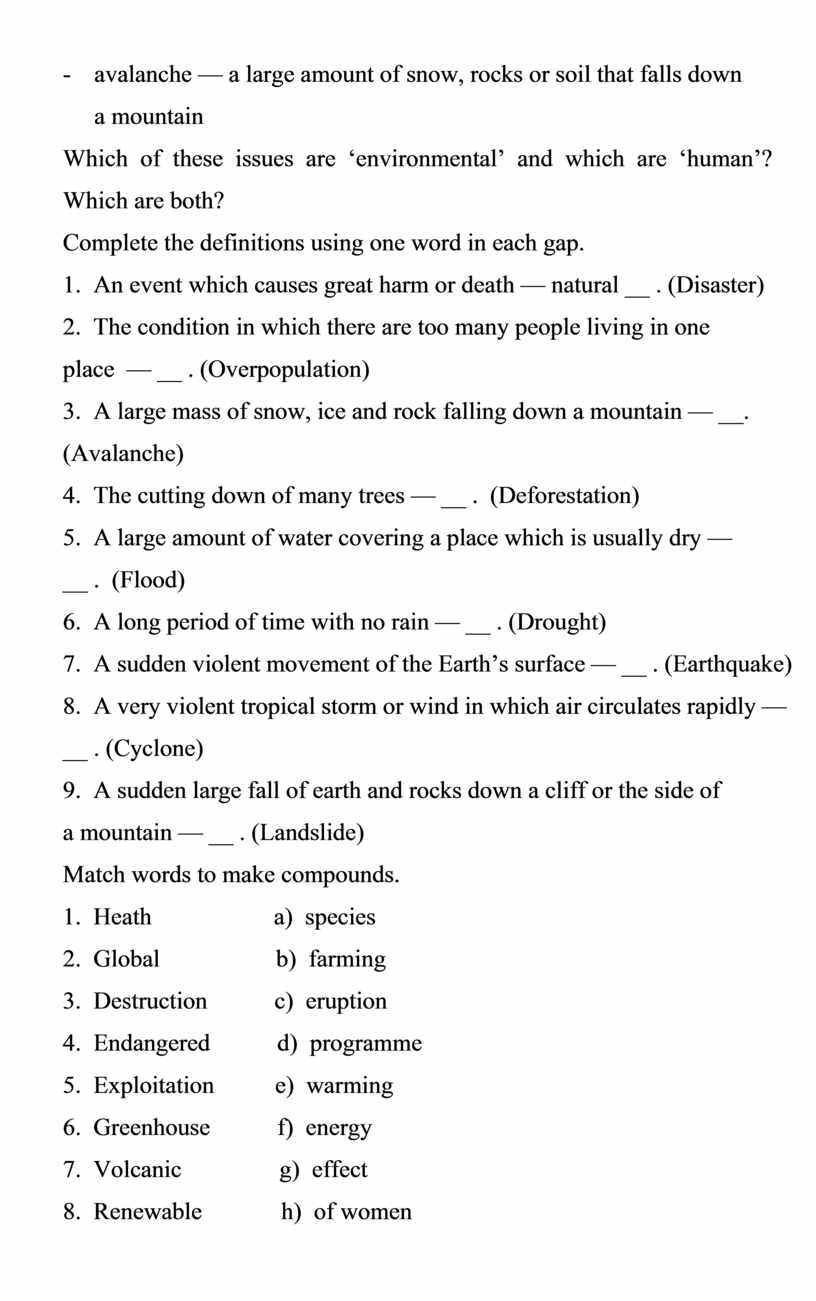
- avalanche — a large amount of snow, rocks or soil that falls down
a mountain
Which of these issues are ‘environmental’ and which are ‘human’? Which are both?
Complete the definitions using one word in each gap.
1. An event which causes great harm or death — natural __ . (Disaster)
2. The condition in which there are too many people living in one
place — __ . (Overpopulation)
3. A large mass of snow, ice and rock falling down a mountain — __.
(Avalanche)
4. The cutting down of many trees — __ . (Deforestation)
5. A large amount of water covering a place which is usually dry —
__ . (Flood)
6. A long period of time with no rain — __ . (Drought)
7. A sudden violent movement of the Earth’s surface — __ . (Earthquake)
8. A very violent tropical storm or wind in which air circulates rapidly — __ . (Cyclone)
9. A sudden large fall of earth and rocks down a cliff or the side of
a mountain — __ . (Landslide)
Match words to make compounds.
1. Heath a) species
2. Global b) farming
3. Destruction c) eruption
4. Endangered d) programme
5. Exploitation e) warming
6. Greenhouse f) energy
7. Volcanic g) effect
8. Renewable h) of women
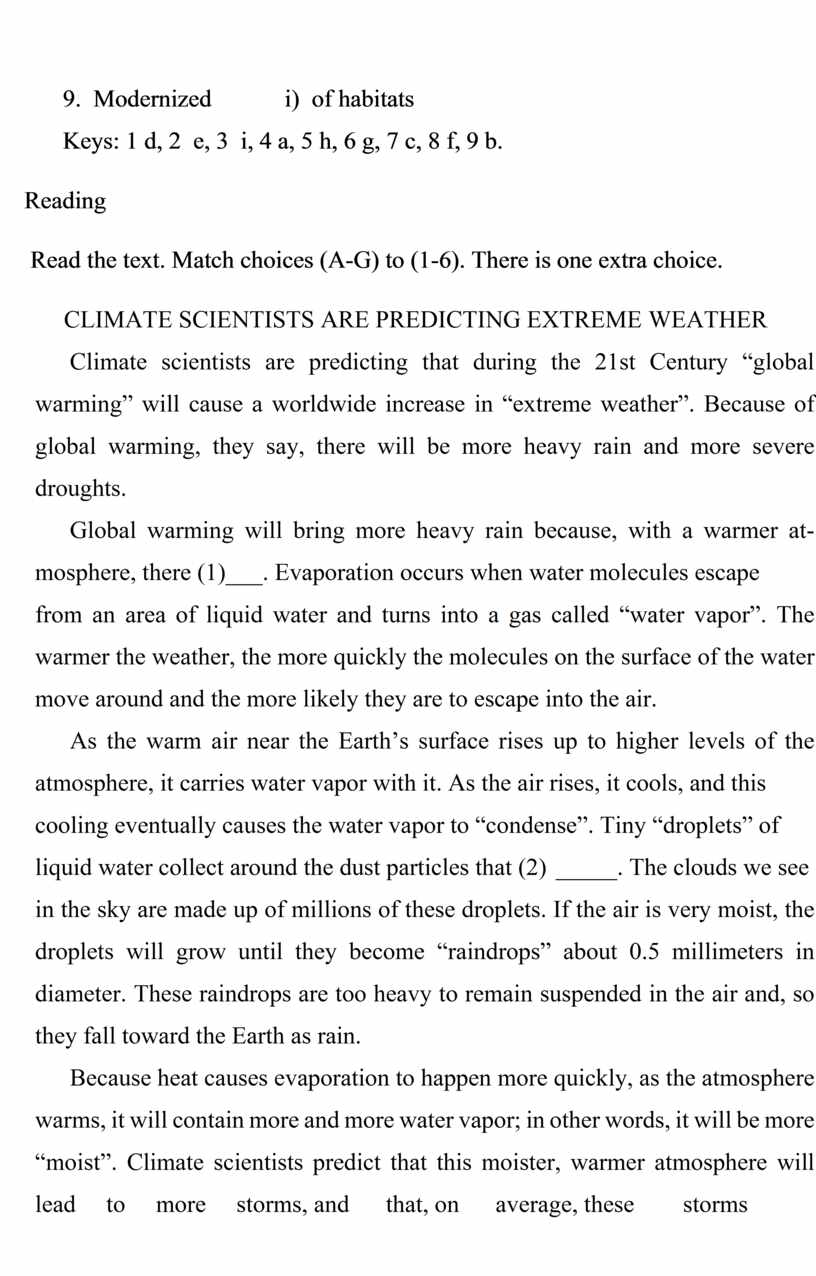
9. Modernized i) of habitats
Keys: 1 d, 2 e, 3 i, 4 a, 5 h, 6 g, 7 c, 8 f, 9 b.
Reading
Read the text. Match choices (A-G) to (1-6). There is one extra choice.
CLIMATE SCIENTISTS ARE PREDICTING EXTREME WEATHER
Climate scientists are predicting that during the 21st Century “global warming” will cause a worldwide increase in “extreme weather”. Because of global warming, they say, there will be more heavy rain and more severe droughts.
Global warming will bring more heavy rain because, with a warmer atmosphere, there (1)___. Evaporation occurs when water molecules escape
from an area of liquid water and turns into a gas called “water vapor”. The warmer the weather, the more quickly the molecules on the surface of the water move around and the more likely they are to escape into the air.
As the warm air near the Earth’s surface rises up to higher levels of the atmosphere, it carries water vapor with it. As the air rises, it cools, and this
cooling eventually causes the water vapor to “condense”. Tiny “droplets” of
liquid water collect around the dust particles that (2) _____. The clouds we see
in the sky are made up of millions of these droplets. If the air is very moist, the droplets will grow until they become “raindrops” about 0.5 millimeters in diameter. These raindrops are too heavy to remain suspended in the air and, so they fall toward the Earth as rain.
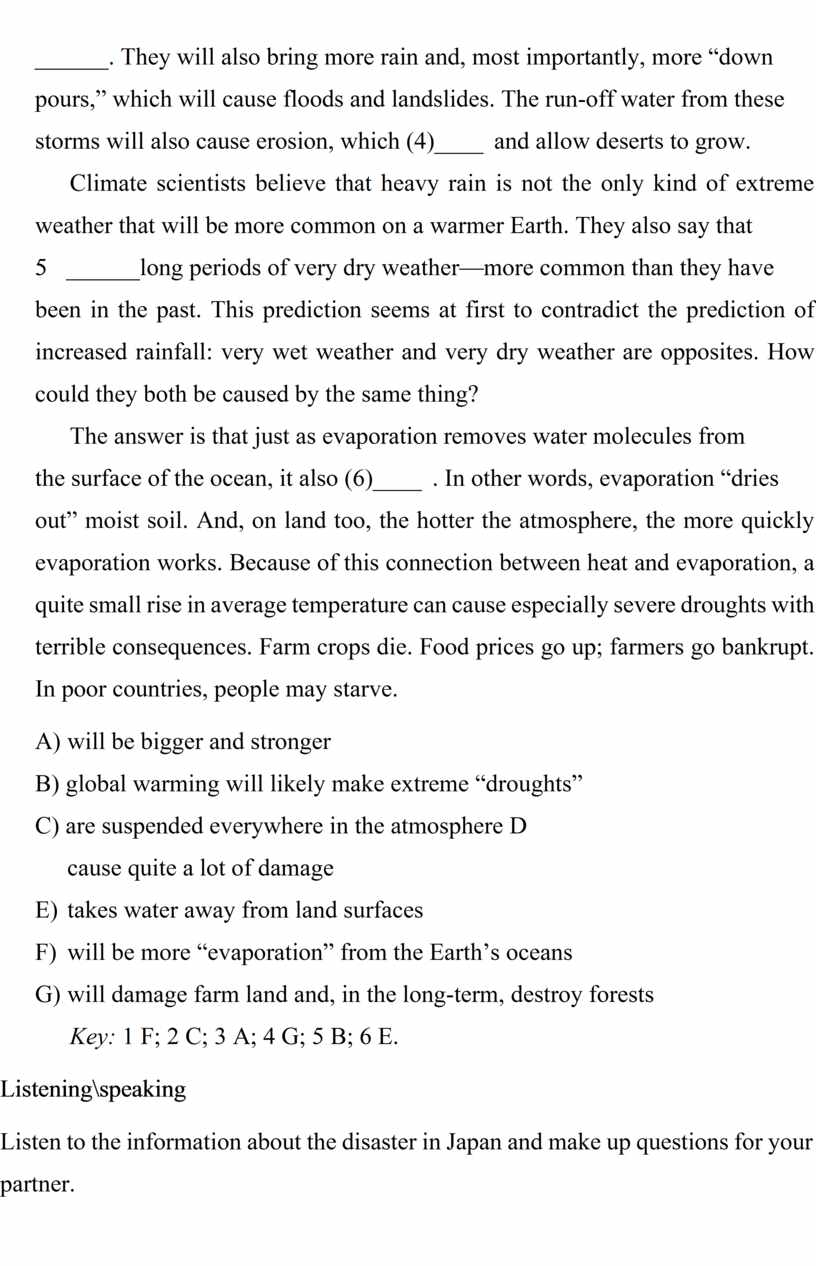
Because heat causes evaporation to happen more quickly, as the atmosphere warms, it will contain more and more water vapor; in other words, it will be more “moist”. Climate scientists predict that this moister, warmer atmosphere will lead to more storms, and that, on average, these storms
______. They will also bring more rain and, most importantly, more “down
pours,” which will cause floods and landslides. The run-off water from these
storms will also cause erosion, which (4)____ and allow deserts to grow.
Climate scientists believe that heavy rain is not the only kind of extreme weather that will be more common on a warmer Earth. They also say that
5 ______long periods of very dry weather—more common than they have
been in the past. This prediction seems at first to contradict the prediction of increased rainfall: very wet weather and very dry weather are opposites. How could they both be caused by the same thing?
The answer is that just as evaporation removes water molecules from
the surface of the ocean, it also (6)____ . In other words, evaporation “dries
out” moist soil. And, on land too, the hotter the atmosphere, the more quickly evaporation works. Because of this connection between heat and evaporation, a quite small rise in average temperature can cause especially severe droughts with terrible consequences. Farm crops die. Food prices go up; farmers go bankrupt. In poor countries, people may starve.
A) will be bigger and stronger
B) global warming will likely make extreme “droughts”
C) are suspended everywhere in the atmosphere D cause quite a lot of damage
E) takes water away from land surfaces
F) will be more “evaporation” from the Earth’s oceans
G) will damage farm land and, in the long-term, destroy forests
Key: 1 F; 2 C; 3 A; 4 G; 5 B; 6 E.
Listening\speaking
Listen to the information about the disaster in Japan and make up questions for your partner.
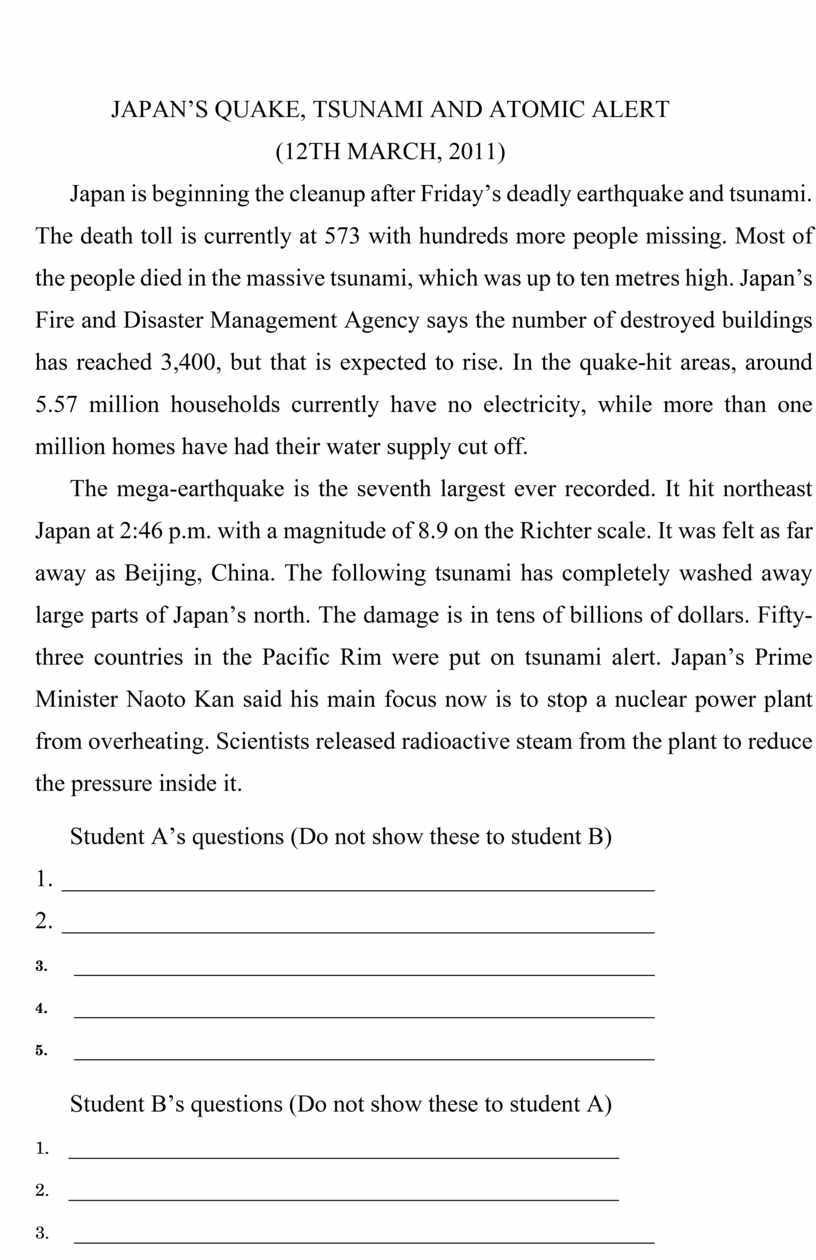
JAPAN’S QUAKE, TSUNAMI AND ATOMIC ALERT
(12TH MARCH, 2011)
Japan is beginning the cleanup after Friday’s deadly earthquake and tsunami. The death toll is currently at 573 with hundreds more people missing. Most of the people died in the massive tsunami, which was up to ten metres high. Japan’s Fire and Disaster Management Agency says the number of destroyed buildings has reached 3,400, but that is expected to rise. In the quake-hit areas, around 5.57 million households currently have no electricity, while more than one million homes have had their water supply cut off.
The mega-earthquake is the seventh largest ever recorded. It hit northeast Japan at 2:46 p.m. with a magnitude of 8.9 on the Richter scale. It was felt as far away as Beijing, China. The following tsunami has completely washed away large parts of Japan’s north. The damage is in tens of billions of dollars. Fifty-three countries in the Pacific Rim were put on tsunami alert. Japan’s Prime Minister Naoto Kan said his main focus now is to stop a nuclear power plant from overheating. Scientists released radioactive steam from the plant to reduce the pressure inside it.
Student A’s questions (Do not show these to student B)
1. ______________________________________________
2. ______________________________________________
3. _____________________________________________
4. _____________________________________________
5. _____________________________________________
Student B’s questions (Do not show these to student A)
1. _____________________________________________
2. _____________________________________________
3. _____________________________________________
4. _____________________________________________
5._______________________________________________
What’s worse: natural disasters or manmade disasters?
Writing ex. 6
4. Summary
5. Homework ex.7


Материалы на данной страницы взяты из открытых источников либо размещены пользователем в соответствии с договором-офертой сайта. Вы можете сообщить о нарушении.


