
Поделиться



 TASKS to Sherlock Holmes doc.doc
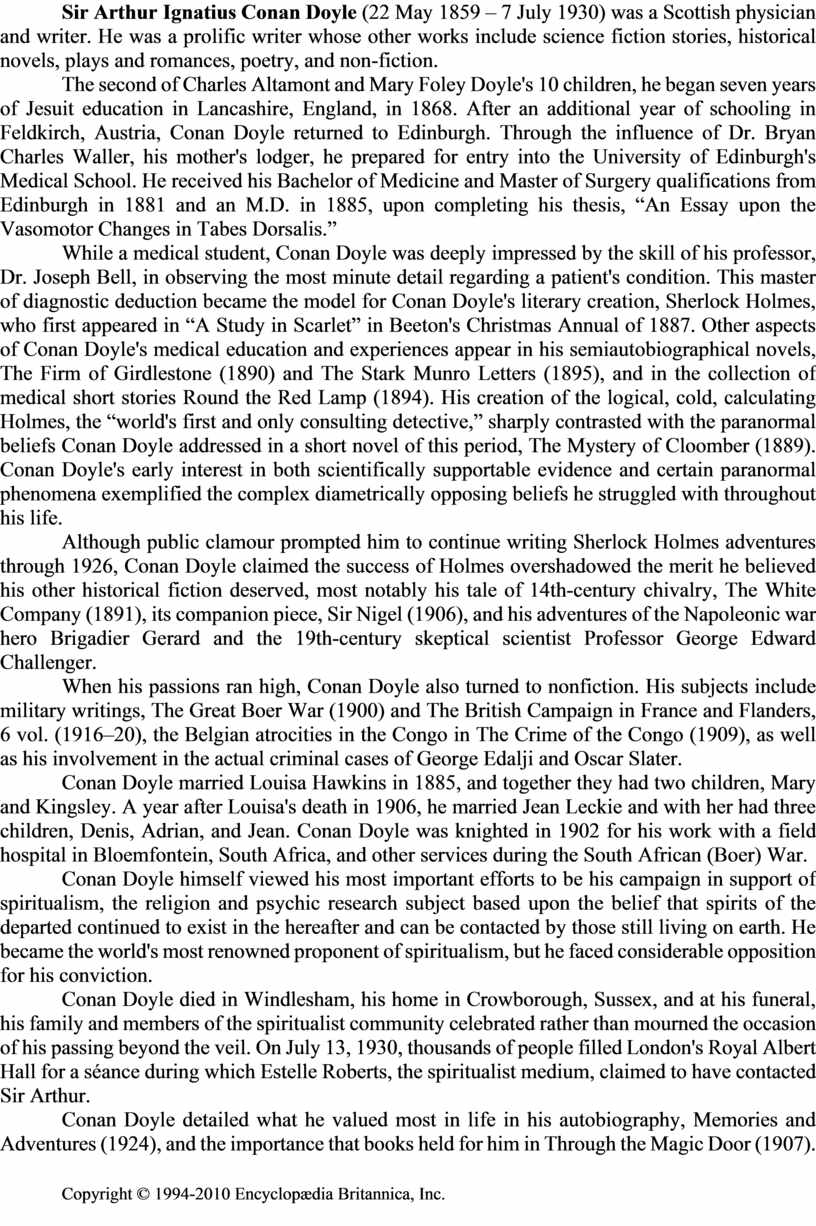
Sir Arthur Ignatius Conan Doyle (22 May 1859 – 7 July 1930) was a Scottish physician and writer. He was a prolific writer whose other works include science fiction stories, historical novels, plays and romances, poetry, and non-fiction.
The second of Charles Altamont and Mary Foley Doyle's 10 children, he began seven years of Jesuit education in Lancashire, England, in 1868. After an additional year of schooling in Feldkirch, Austria, Conan Doyle returned to Edinburgh. Through the influence of Dr. Bryan Charles Waller, his mother's lodger, he prepared for entry into the University of Edinburgh's Medical School. He received his Bachelor of Medicine and Master of Surgery qualifications from Edinburgh in 1881 and an M.D. in 1885, upon completing his thesis, “An Essay upon the Vasomotor Changes in Tabes Dorsalis.”
While a medical student, Conan Doyle was deeply impressed by the skill of his professor, Dr. Joseph Bell, in observing the most minute detail regarding a patient's condition. This master of diagnostic deduction became the model for Conan Doyle's literary creation, Sherlock Holmes, who first appeared in “A Study in Scarlet” in Beeton's Christmas Annual of 1887. Other aspects of Conan Doyle's medical education and experiences appear in his semiautobiographical novels, The Firm of Girdlestone (1890) and The Stark Munro Letters (1895), and in the collection of medical short stories Round the Red Lamp (1894). His creation of the logical, cold, calculating Holmes, the “world's first and only consulting detective,” sharply contrasted with the paranormal beliefs Conan Doyle addressed in a short novel of this period, The Mystery of Cloomber (1889). Conan Doyle's early interest in both scientifically supportable evidence and certain paranormal phenomena exemplified the complex diametrically opposing beliefs he struggled with throughout his life.
Although public clamour prompted him to continue writing Sherlock Holmes adventures through 1926, Conan Doyle claimed the success of Holmes overshadowed the merit he believed his other historical fiction deserved, most notably his tale of 14th-century chivalry, The White Company (1891), its companion piece, Sir Nigel (1906), and his adventures of the Napoleonic war hero Brigadier Gerard and the 19th-century skeptical scientist Professor George Edward Challenger.
When his passions ran high, Conan Doyle also turned to nonfiction. His subjects include military writings, The Great Boer War (1900) and The British Campaign in France and Flanders, 6 vol. (1916–20), the Belgian atrocities in the Congo in The Crime of the Congo (1909), as well as his involvement in the actual criminal cases of George Edalji and Oscar Slater.
Conan Doyle married Louisa Hawkins in 1885, and together they had two children, Mary and Kingsley. A year after Louisa's death in 1906, he married Jean Leckie and with her had three children, Denis, Adrian, and Jean. Conan Doyle was knighted in 1902 for his work with a field hospital in Bloemfontein, South Africa, and other services during the South African (Boer) War.
Conan Doyle himself viewed his most important efforts to be his campaign in support of spiritualism, the religion and psychic research subject based upon the belief that spirits of the departed continued to exist in the hereafter and can be contacted by those still living on earth. He became the world's most renowned proponent of spiritualism, but he faced considerable opposition for his conviction.
Conan Doyle died in Windlesham, his home in Crowborough, Sussex, and at his funeral, his family and members of the spiritualist community celebrated rather than mourned the occasion of his passing beyond the veil. On July 13, 1930, thousands of people filled London's Royal Albert Hall for a séance during which Estelle Roberts, the spiritualist medium, claimed to have contacted Sir Arthur.
Conan Doyle detailed what he valued most in life in his autobiography, Memories and Adventures (1924), and the importance that books held for him in Through the Magic Door (1907).
Copyright © 1994-2010 Encyclopædia Britannica, Inc.
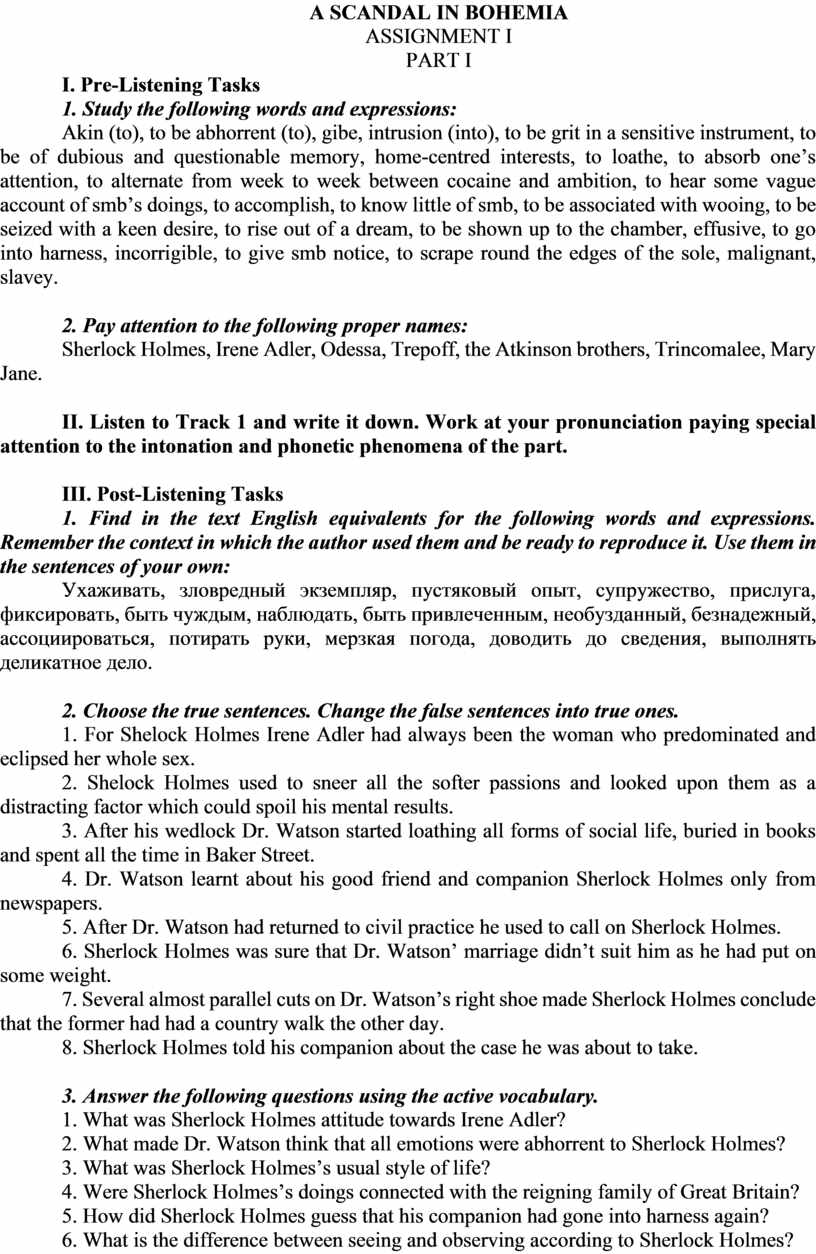
A SCANDAL IN BOHEMIA
ASSIGNMENT I
PART I
I. Pre-Listening Tasks
1. Study the following words and expressions:
Akin (to), to be abhorrent (to), gibe, intrusion (into), to be grit in a sensitive instrument, to be of dubious and questionable memory, home-centred interests, to loathe, to absorb one’s attention, to alternate from week to week between cocaine and ambition, to hear some vague account of smb’s doings, to accomplish, to know little of smb, to be associated with wooing, to be seized with a keen desire, to rise out of a dream, to be shown up to the chamber, effusive, to go into harness, incorrigible, to give smb notice, to scrape round the edges of the sole, malignant, slavey.
2. Pay attention to the following proper names:
Sherlock Holmes, Irene Adler, Odessa, Trepoff, the Atkinson brothers, Trincomalee, Mary Jane.
II. Listen to Track 1 and write it down. Work at your pronunciation paying special attention to the intonation and phonetic phenomena of the part.
III. Post-Listening Tasks
1. Find in the text English equivalents for the following words and expressions. Remember the context in which the author used them and be ready to reproduce it. Use them in the sentences of your own:
Ухаживать, зловредный экземпляр, пустяковый опыт, супружество, прислуга, фиксировать, быть чуждым, наблюдать, быть привлеченным, необузданный, безнадежный, ассоциироваться, потирать руки, мерзкая погода, доводить до сведения, выполнять деликатное дело.
2. Choose the true sentences. Change the false sentences into true ones.
1. For Shelock Holmes Irene Adler had always been the woman who predominated and eclipsed her whole sex.
2. Shelock Holmes used to sneer all the softer passions and looked upon them as a distracting factor which could spoil his mental results.
3. After his wedlock Dr. Watson started loathing all forms of social life, buried in books and spent all the time in Baker Street.
4. Dr. Watson learnt about his good friend and companion Sherlock Holmes only from newspapers.
5. After Dr. Watson had returned to civil practice he used to call on Sherlock Holmes.
6. Sherlock Holmes was sure that Dr. Watson’ marriage didn’t suit him as he had put on some weight.
7. Several almost parallel cuts on Dr. Watson’s right shoe made Sherlock Holmes conclude that the former had had a country walk the other day.
8. Sherlock Holmes told his companion about the case he was about to take.
3. Answer the following questions using the active vocabulary.
1. What was Sherlock Holmes attitude towards Irene Adler?
2. What made Dr. Watson think that all emotions were abhorrent to Sherlock Holmes?
3. What was Sherlock Holmes’s usual style of life?
4. Were Sherlock Holmes’s doings connected with the reigning family of Great Britain?
5. How did Sherlock Holmes guess that his companion had gone into harness again?
6. What is the difference between seeing and observing according to Sherlock Holmes?
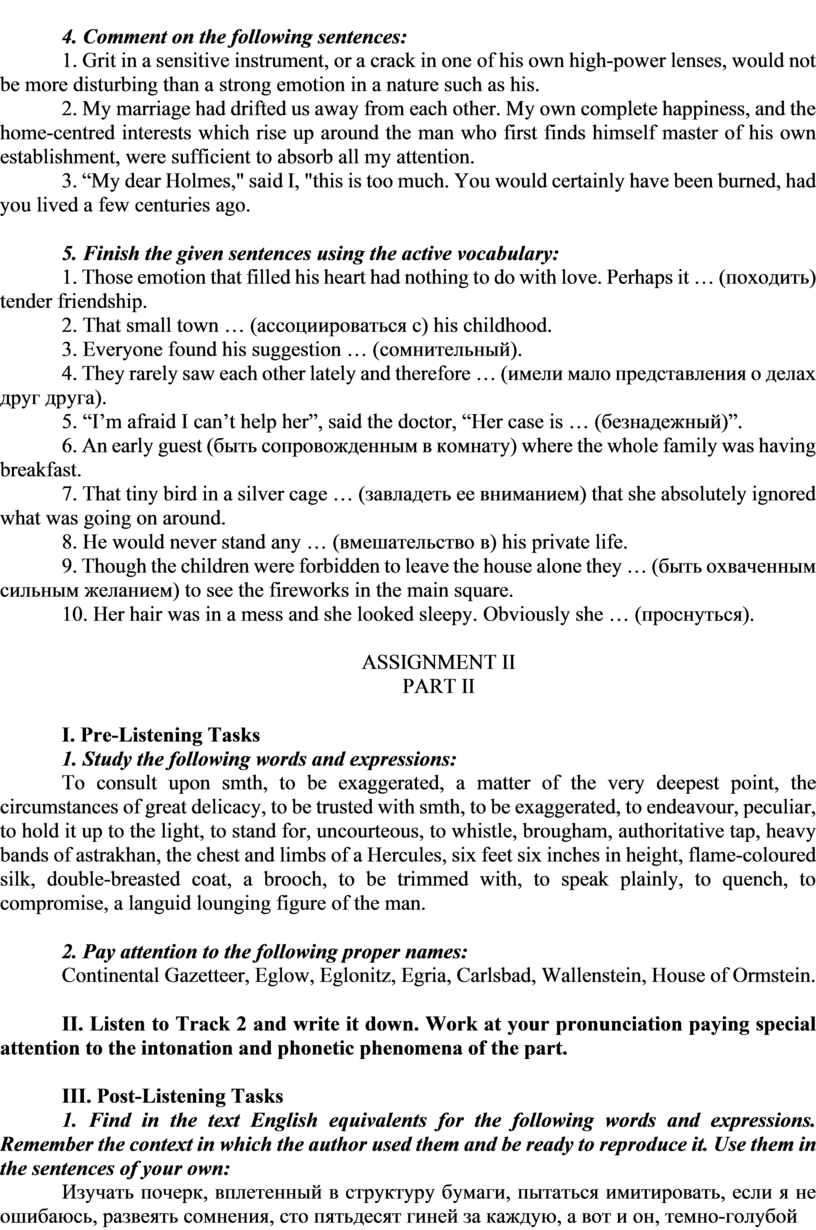
4. Comment on the following sentences:
1. Grit in a sensitive instrument, or a crack in one of his own high-power lenses, would not be more disturbing than a strong emotion in a nature such as his.
2. My marriage had drifted us away from each other. My own complete happiness, and the home-centred interests which rise up around the man who first finds himself master of his own establishment, were sufficient to absorb all my attention.
3. “My dear Holmes," said I, "this is too much. You would certainly have been burned, had you lived a few centuries ago.
5. Finish the given sentences using the active vocabulary:
1. Those emotion that filled his heart had nothing to do with love. Perhaps it … (походить) tender friendship.
2. That small town … (ассоциироваться с) his childhood.
3. Everyone found his suggestion … (сомнительный).
4. They rarely saw each other lately and therefore … (имели мало представления о делах друг друга).
5. “I’m afraid I can’t help her”, said the doctor, “Her case is … (безнадежный)”.
6. An early guest (быть сопровожденным в комнату) where the whole family was having breakfast.
7. That tiny bird in a silver cage … (завладеть ее вниманием) that she absolutely ignored what was going on around.
8. He would never stand any … (вмешательство в) his private life.
9. Though the children were forbidden to leave the house alone they … (быть охваченным сильным желанием) to see the fireworks in the main square.
10. Her hair was in a mess and she looked sleepy. Obviously she … (проснуться).
ASSIGNMENT II
PART II
I. Pre-Listening Tasks
1. Study the following words and expressions:
To consult upon smth, to be exaggerated, a matter of the very deepest point, the circumstances of great delicacy, to be trusted with smth, to be exaggerated, to endeavour, peculiar, to hold it up to the light, to stand for, uncourteous, to whistle, brougham, authoritative tap, heavy bands of astrakhan, the chest and limbs of a Hercules, six feet six inches in height, flame-coloured silk, double-breasted coat, a brooch, to be trimmed with, to speak plainly, to quench, to compromise, a languid lounging figure of the man.
2. Pay attention to the following proper names:
Continental Gazetteer, Eglow, Eglonitz, Egria, Carlsbad, Wallenstein, House of Ormstein.
II. Listen to Track 2 and write it down. Work at your pronunciation paying special attention to the intonation and phonetic phenomena of the part.
III. Post-Listening Tasks
1. Find in the text English equivalents for the following words and expressions. Remember the context in which the author used them and be ready to reproduce it. Use them in the sentences of your own:
Изучать почерк, вплетенный в структуру бумаги, пытаться имитировать, если я не ошибаюсь, развеять сомнения, сто пятьдесят гиней за каждую, а вот и он, темно-голубой плащ, наброшенный на плечи, придерживаемый брошью на шее, сапоги, расширенные от голенища, великолепие варвара, широкополая шляпа, глубокий грубый голос.
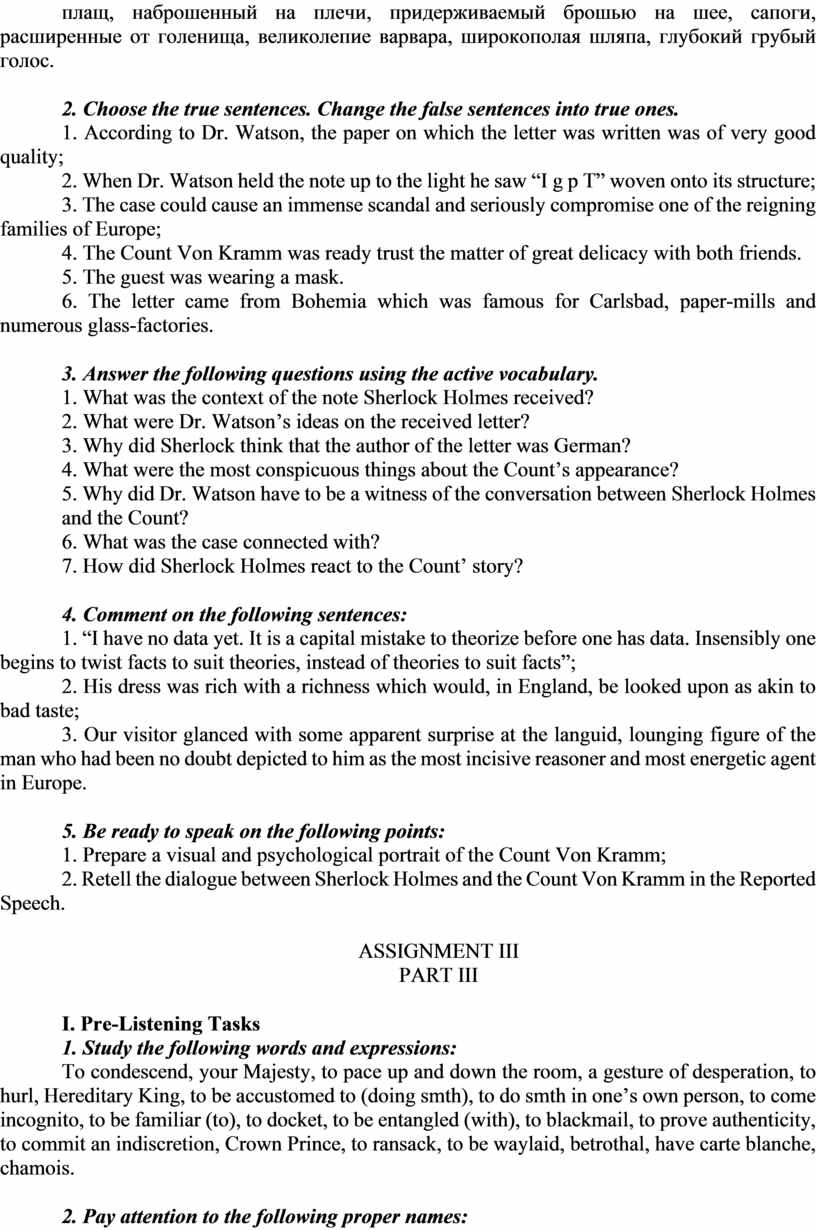
2. Choose the true sentences. Change the false sentences into true ones.
1. According to Dr. Watson, the paper on which the letter was written was of very good quality;
2. When Dr. Watson held the note up to the light he saw “I g p T” woven onto its structure;
3. The case could cause an immense scandal and seriously compromise one of the reigning families of Europe;
4. The Count Von Kramm was ready trust the matter of great delicacy with both friends.
5. The guest was wearing a mask.
6. The letter came from Bohemia which was famous for Carlsbad, paper-mills and numerous glass-factories.
3. Answer the following questions using the active vocabulary.
1. What was the context of the note Sherlock Holmes received?
2. What were Dr. Watson’s ideas on the received letter?
3. Why did Sherlock think that the author of the letter was German?
4. What were the most conspicuous things about the Count’s appearance?
5. Why did Dr. Watson have to be a witness of the conversation between Sherlock Holmes and the Count?
6. What was the case connected with?
7. How did Sherlock Holmes react to the Count’ story?
4. Comment on the following sentences:
1. “I have no data yet. It is a capital mistake to theorize before one has data. Insensibly one begins to twist facts to suit theories, instead of theories to suit facts”;
2. His dress was rich with a richness which would, in England, be looked upon as akin to bad taste;
3. Our visitor glanced with some apparent surprise at the languid, lounging figure of the man who had been no doubt depicted to him as the most incisive reasoner and most energetic agent in Europe.
5. Be ready to speak on the following points:
1. Prepare a visual and psychological portrait of the Count Von Kramm;
2. Retell the dialogue between Sherlock Holmes and the Count Von Kramm in the Reported Speech.
ASSIGNMENT III
PART III
I. Pre-Listening Tasks
1. Study the following words and expressions:
To condescend, your Majesty, to pace up and down the room, a gesture of desperation, to hurl, Hereditary King, to be accustomed to (doing smth), to do smth in one’s own person, to come incognito, to be familiar (to), to docket, to be entangled (with), to blackmail, to prove authenticity, to commit an indiscretion, Crown Prince, to ransack, to be waylaid, betrothal, have carte blanche, chamois.
2. Pay attention to the following proper names:
Wilhelm Gottsreich Sigismond von Ormstein, Grand Duke of Cassel-Felstein, New Jersey, Warsaw, Clotilde Lothman von Saxe-Meningen, Briony Lodge.
II. Listen to Track 3 and write it down. Work at your pronunciation paying special attention to the intonation and phonetic phenomena of the part.
III. Post-Listening Tasks
1. Find in the text English equivalents for the following words and expressions. Remember the context in which the author used them and be ready to reproduce it. Use them in the sentences of your own:
Нетерпимо посмотреть, провести рукой по лбу, привыкнуть к чему-либо, писать компрометирующие письма, именно так, подделка, личная печать, быть безумным, вор-взломщик, обыскивать дом, говорить с упреком, угрожать, стальное сердце, давать неограниченные полномочия, написать небрежно расписку.
2. Choose the true sentences. Change the false sentences into true ones.
1. The name of Irene Adler wasn’t familiar to Sherlock Holmes;
2. The King came incognito from Warsaw for the purpose of consulting Sherlock Holmes;
3. The King intended to return some compromising letters which he had written to Irene Adler;
4. At first Sherlock Holmes thought that his client’s problem was easy to solve;
5. Irine Adler could easily prove authenticity of the letters because she had stolen some the King’s note-paper and seal;
6. Dr. Watson was to visit his companion at 4 o’clock the other day to have a chat on the case.
3. Answer the following questions using the active vocabulary.
1. Why did the guest decide to tear his mask?
2. What made the King of Bohemia conceal his real name and position?
3. What was the purpose of the King’s visit?
4. What definition did Sherlock Holmes give to Irene Adler?
5. How did the King describe his wife-to-be?
6. What were Irene Adler’s plan concerning the photograph?
7. How much money did Sherlock Holmes get for taking the case?
4. Translate using the topical vocabulary from Parts I, II, III.
1. «Ты постоянно опаздываешь», сказала она с упреком. 2. В витрине магазина она увидела красивое пальто, отороченное мехом норки. 3. Его экипаж был запряжен белыми лошадьми. Тысяча гиней за каждую. 4. Она вздрогнула, услышав властный стук в дверь, а затем знакомый грубый голос. 5. Что означает эта аббревиатура? 6. Не преувеличивай, это только простуда. 7. Уже неделю стояла мерзкая погода. 8. Откровенно говоря, я не могу доверить тебе это деликатное дело. 9. Мне нужно проконсультироваться с тобой по очень важному вопросу. 10. Я никогда не допущу вмешательства в дела нашей компании. 11. Эта брошь отлично подойдет к твоему двубортному пиджаку. 12. Эксперт изучит почерк и развеет все наши сомнения относительно автора письма. 13. Он был охвачен сильным желанием вернуться в свой родной город. 14. Он старался мыслить как его наставник. 15. Он мало знал о жизни в деревне. 16. Богемное общество было ему чуждо. Он питал отвращение к бесконечным светским вечерам и пустым разговорам. 17. Я даю вам неограниченные полномочия в решении этого вопроса. 18. Я очень жалею, что не послушал твоего совета и впутался в это безнадежное дело. 19. Изумруд в этом ожерелье – искусная подделка. 20. Воры обыскали весь особняк, но так и не нашли личной печати президента компании. 21. Мне доложили о том, что он приехал в Париж инкогнито. Уверен, что скоро он вам позвонит с целью шантажа. 22. Будучи еще кронпринцем, Чарльз привык тщательно записывать все события в дневник. 23. Мы совершили опрометчивый поступок, когда сообщили наше местонахождение. 24. Она в ярости швырнула замшевый кошелек на пол.
5. Give a brief summery of Part III using its topical vocabulary.
ASSIGNMENT IV
PART IV
I. Pre-Listening Tasks
1. Study the following words and expressions:
Inquiry, to be surrounded (by/with), the exalted station of the client, incisive reasoning, groom, side-whiskered, to emerge tweed-suited, sympathy, freemasonry, bijou, preposterous, to be of interest, mews, ostler, to lend a hand (in), to receive in exchange, ominous, the former, the latter, aquiline, moustache.
2. Pay attention to the following proper names:
Briony Lodge, Chubb lock, Godfrey Norton.
II. Listen to Track 4 and write it down. Work at your pronunciation paying special attention to the intonation and phonetic phenomena of the part.
III. Post-Listening Tasks
1. Find in the text English equivalents for the following words and expressions. Remember the context in which the author used them and be ready to reproduce it. Use them in the sentences of your own:
Ровно в три часа, вытянуть ноги перед камином, продолжение, вынуждать, следить за ходом мыслей, торопиться, тонкие методы, распутывать сложные хитросплетения, неизменный успех, заметить что-то интересное, передать на хранение, с видом человека, который чувствовал себя как дома.
2. Think of 5 true and 5 false statements based on the content of the part. Let your partner guess which of them are right and correct the false statements.
3. Answer the following questions using the active vocabulary.
1. What did Sherlock Holmes look like when Dr. Watson saw him?
2. Who helped Sherlock Holmes to get all the necessary information on the case?
3. What did Sherlock Holmes find out about Godfrey Norton?
4. What can you say about Godfrey Norton’s appearance?
5. In what case was Sherlock Holmes going to turn his attention to the Temple and to Briony Lodge?
6. What was Mr. Norton’s behavior in Irene Adler’s House?
7. Where did Mr. Norton hurry after visiting Irene Adler?
4. Comment on the following sentences:
1. Apart from the nature of the investigation which my friend had on hand, there was something in his masterly grasp of a situation, and his keen, incisive reasoning, which made it a pleasure to me to study his system of work;
2. She has turned all the men's heads down in that part. She is the daintiest thing under a bonnet on this planet.
5. Be ready to speak on the following point:
Sherlock Holmes’s adventure as a groom.
ASSIGNMENT V
PART V
I. Pre-Listening Tasks
1. Study the following words and expressions:
Landau, buckle, to perch, a surpliced clergyman, to expostulate, to lounge, aisle, to vouch (for), to be menaced, to be formidable, amiable.
2. Pay attention to the following proper names:
The Church of St. Monica
II. Listen to Track 5 and write it down. Work at your pronunciation paying special attention to the intonation and phonetic phenomena of the part.
III. Post-Listening Tasks
1. Find in the text English equivalents for the following words and expressions. Remember the context in which the author used them and be ready to reproduce it. Use them in the sentences of your own:
Пальто, застегнутое наполовину, потертый, витать в воздухе, помогать в связывании узами, абсурдное положение, шафер, внезапно уехать, принять меры с моей стороны, находиться, водопроводчик, по сигналу, мешковатые брюки.
2. Answer the following questions using the active vocabulary.
1. How did Sherlock Holmes get to the church? Was he first to arrive?
2. What was going in the church when Sherlock Holmes entered it?
3. What was funny about the story which happened to Sherlock Holmes?
4. Were the newly-weds going to depart soon?
5. What was Sherlock Holmes’s plan for the evening?
6. What was Dr. Watson’s role?
7. How did Sherlock Holmes change his appearance for the coming event?
3. Comment on the following sentences:
1. It was the most preposterous position in which I ever found myself in my life, and it was the thought of it that started me laughing just now.
2. The stage lost a fine actor, even as science lost an acute reasoner, when he became a specialist in crime.
4. Translate using the topical vocabulary from Parts IV, V.
1. В углу висело потертое пальто, в котором он часто выгуливал собаку. 2. В переулке показалась мужская фигура в мешковатых штанах и наполовину застегнутой рубахе. Они не сразу узнали своего старого знакомого. 3. Угроза забастовок витала в воздухе. Нужны были срочные меры со стороны правительства. 4. Я не могу ручаться за этого человека. 5. Когда невеста шла по проходу к алтарю, где ее ждали жених и шафер, все восхищено на нее смотрели. 6. Я оказался в абсурдном положении, когда он отказался от своих слов. 7. Все полеты до Праги отменены, и наши планы на выходные оказались под угрозой. 8. По сигналу машины рванули вперед. 9. После тяжелого дня он с удовольствием вытянул ноги перед камином и налил бокал любимого вина. 10. Маленькая, изящная вилла была окружена вишневыми и яблоневыми деревьями. 11. Мы нашли его в конюшне, где он помогал конюху чистить любимого пони своей дочери. 12. Их связывали долгие дружеские отношения. Именно поэтому он передал ему на хранения все ценные бумаги, когда собирался уезжать. 13. Ровно в пять часов в ресторан вошел мужчина около двух метров ростом. На нем был твидовый костюм и галстук в тон. 14. Ему удалось распутать все хитросплетения, благодаря чему эта история получила неожиданное продолжение. 15. В карьере ей сопутствует неизменный успех. 16. Что я получу в обмен за эту ценную информацию? 17. Я навел справки о нашем клиенте. Он занимает довольно высокое положение в обществе. 18. Она внимательно следила за ходом его мыслей. 19. Кто этот мужчина с орлиным носом и пронзительным взглядом? 20. Его колкие аргументы вынудили мены признать, что он прав.
5. Prepare a summery of Part V.
ASSIGNMENT VI
PART VI
I. Pre-Listening Tasks
1. Study the following words and expressions:
Succinct description, on the contrary, to flirt, scissors-grinder, averse, to be inclined, to resolve, the curve of the avenue, loafer, lounger, flushed and struggling men, scuffle, compunction, treachery, ulster.
II. Listen to Track 6 and write it down. Work at your pronunciation paying special attention to the intonation and phonetic phenomena of the part.
III. Post-Listening Tasks
1. Find in the text English equivalents for the following words and expressions. Remember the context in which the author used them and be ready to reproduce it. Use them in the sentences of your own:
Сумерки, представлять, бездельник, местонахождение, утаивание, доверять самому себе, броситься вперед, потасовка, лаконичное описание, оттолкнуть локтем, сжать волю в кулак, предотвращать, задыхаться, ложная тревога, клубиться.
2. Answer the following questions using the active vocabulary:
1. Did Sherlock Holmes and Dr. Watson come on time to Irene Adler’s villa?
2. What was going on around Irene Adler’s villa?
3. Why did the photograph become a double-edged weapon now?
4. Why was Sherlock Holmes sure that Irene Adler didn’t carry the photograph with her?
5. What made Sherlock Holmes think Irene Adler was keeping the photograph in her own house?
6. What happened when Irene Adler’s carriage came round the curve of the avenue?
7. Was Sherlock Holmes seriously injured in the scuffle?
8. How did Sherlock Homes get into the house?
9. Was Dr. Watson seized with compunction when assisting Sherlock Holmes?
10. What role did a smoke-rocket play in the story?
11. Don’t you think it’s the blackest … (предательство) to act like this.
3. Comment on the following sentences:
1. Women are naturally secretive, and they like to do their own secreting.
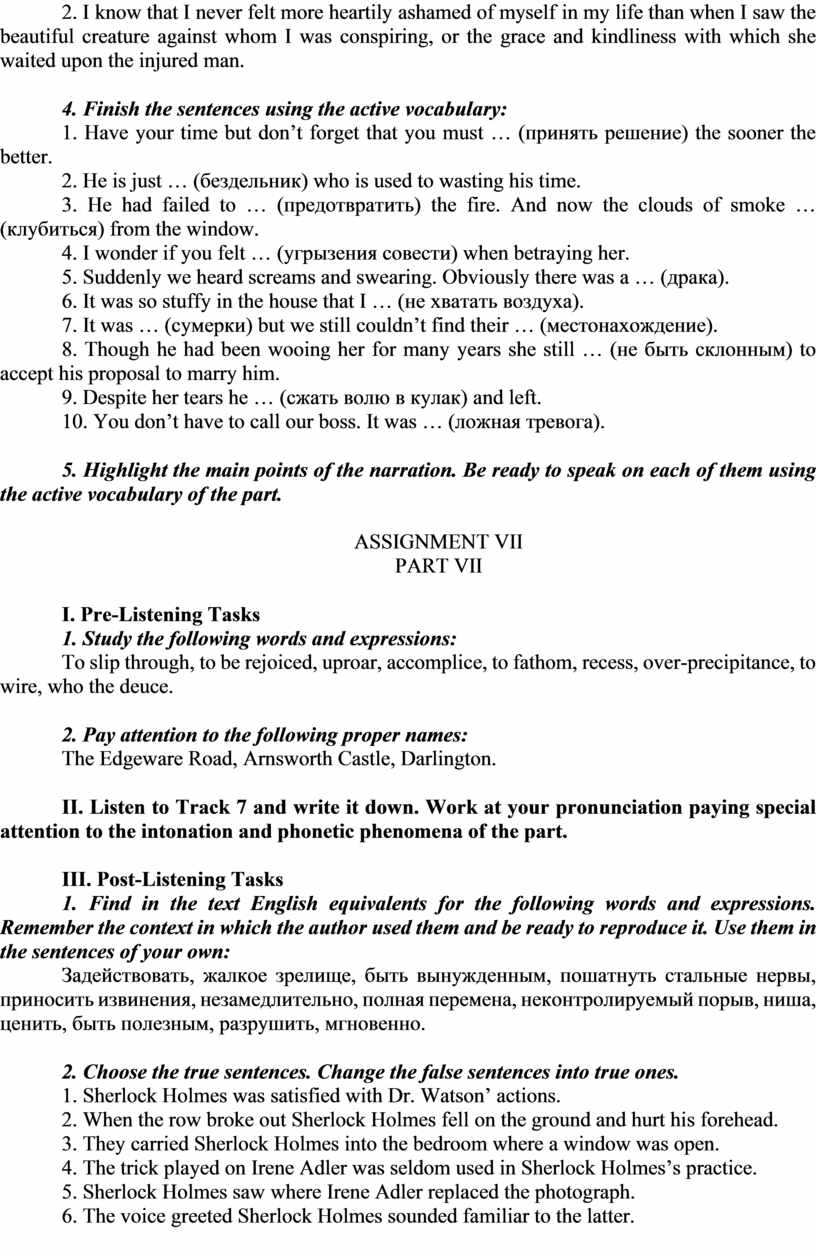
2. I know that I never felt more heartily ashamed of myself in my life than when I saw the beautiful creature against whom I was conspiring, or the grace and kindliness with which she waited upon the injured man.
4. Finish the sentences using the active vocabulary:
1. Have your time but don’t forget that you must … (принять решение) the sooner the better.
2. He is just … (бездельник) who is used to wasting his time.
3. He had failed to … (предотвратить) the fire. And now the clouds of smoke … (клубиться) from the window.
4. I wonder if you felt … (угрызения совести) when betraying her.
5. Suddenly we heard screams and swearing. Obviously there was a … (драка).
6. It was so stuffy in the house that I … (не хватать воздуха).
7. It was … (сумерки) but we still couldn’t find their … (местонахождение).
8. Though he had been wooing her for many years she still … (не быть склонным) to accept his proposal to marry him.
9. Despite her tears he … (сжать волю в кулак) and left.
10. You don’t have to call our boss. It was … (ложная тревога).
5. Highlight the main points of the narration. Be ready to speak on each of them using the active vocabulary of the part.
ASSIGNMENT VII
PART VII
I. Pre-Listening Tasks
1. Study the following words and expressions:
To slip through, to be rejoiced, uproar, accomplice, to fathom, recess, over-precipitance, to wire, who the deuce.
2. Pay attention to the following proper names:
The Edgeware Road, Arnsworth Castle, Darlington.
II. Listen to Track 7 and write it down. Work at your pronunciation paying special attention to the intonation and phonetic phenomena of the part.
III. Post-Listening Tasks
1. Find in the text English equivalents for the following words and expressions. Remember the context in which the author used them and be ready to reproduce it. Use them in the sentences of your own:
Задействовать, жалкое зрелище, быть вынужденным, пошатнуть стальные нервы, приносить извинения, незамедлительно, полная перемена, неконтролируемый порыв, ниша, ценить, быть полезным, разрушить, мгновенно.
2. Choose the true sentences. Change the false sentences into true ones.
1. Sherlock Holmes was satisfied with Dr. Watson’ actions.
2. When the row broke out Sherlock Holmes fell on the ground and hurt his forehead.
3. They carried Sherlock Holmes into the bedroom where a window was open.
4. The trick played on Irene Adler was seldom used in Sherlock Holmes’s practice.
5. Sherlock Holmes saw where Irene Adler replaced the photograph.
6. The voice greeted Sherlock Holmes sounded familiar to the latter.
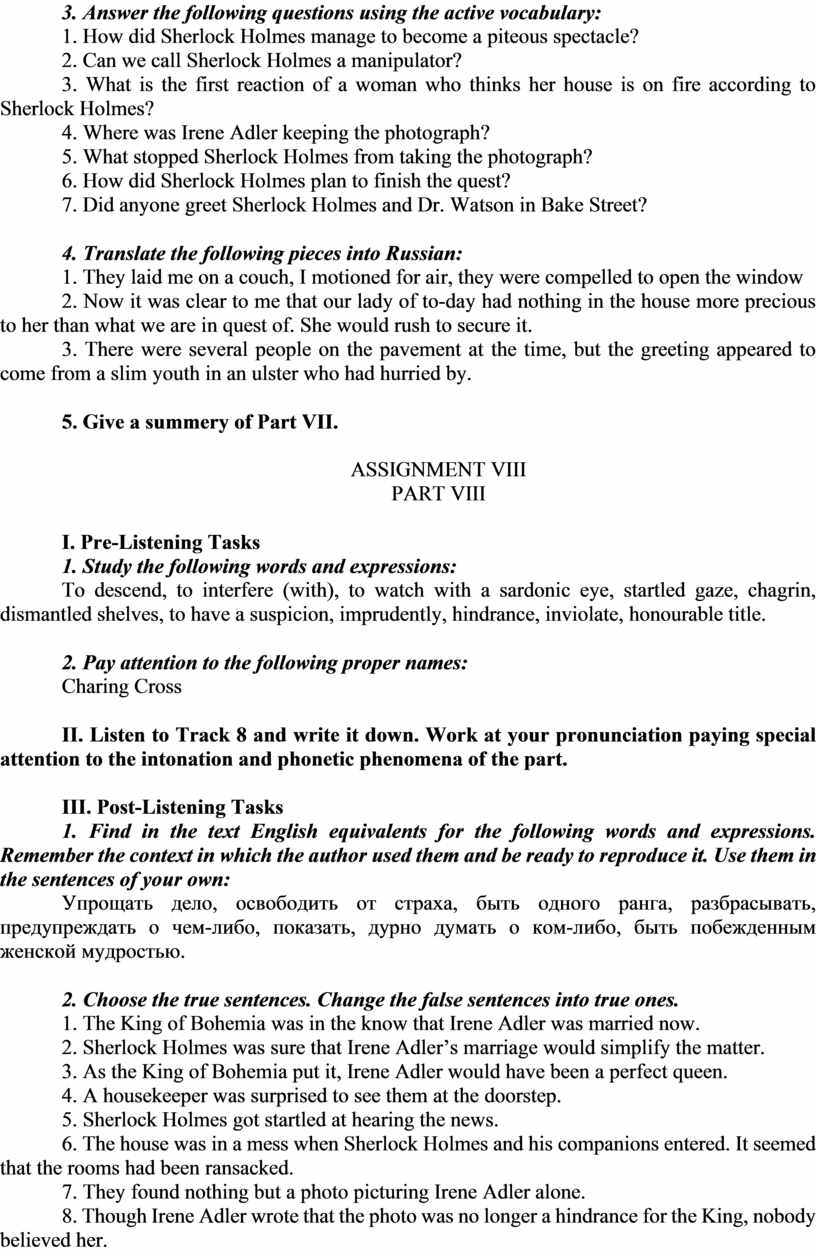
3. Answer the following questions using the active vocabulary:
1. How did Sherlock Holmes manage to become a piteous spectacle?
2. Can we call Sherlock Holmes a manipulator?
3. What is the first reaction of a woman who thinks her house is on fire according to Sherlock Holmes?
4. Where was Irene Adler keeping the photograph?
5. What stopped Sherlock Holmes from taking the photograph?
6. How did Sherlock Holmes plan to finish the quest?
7. Did anyone greet Sherlock Holmes and Dr. Watson in Bake Street?
4. Translate the following pieces into Russian:
1. They laid me on a couch, I motioned for air, they were compelled to open the window
2. Now it was clear to me that our lady of to-day had nothing in the house more precious to her than what we are in quest of. She would rush to secure it.
3. There were several people on the pavement at the time, but the greeting appeared to come from a slim youth in an ulster who had hurried by.
5. Give a summery of Part VII.
ASSIGNMENT VIII
PART VIII
I. Pre-Listening Tasks
1. Study the following words and expressions:
To descend, to interfere (with), to watch with a sardonic eye, startled gaze, chagrin, dismantled shelves, to have a suspicion, imprudently, hindrance, inviolate, honourable title.
2. Pay attention to the following proper names:
Charing Cross
II. Listen to Track 8 and write it down. Work at your pronunciation paying special attention to the intonation and phonetic phenomena of the part.
III. Post-Listening Tasks
1. Find in the text English equivalents for the following words and expressions. Remember the context in which the author used them and be ready to reproduce it. Use them in the sentences of your own:
Упрощать дело, освободить от страха, быть одного ранга, разбрасывать, предупреждать о чем-либо, показать, дурно думать о ком-либо, быть побежденным женской мудростью.
2. Choose the true sentences. Change the false sentences into true ones.
1. The King of Bohemia was in the know that Irene Adler was married now.
2. Sherlock Holmes was sure that Irene Adler’s marriage would simplify the matter.
3. As the King of Bohemia put it, Irene Adler would have been a perfect queen.
4. A housekeeper was surprised to see them at the doorstep.
5. Sherlock Holmes got startled at hearing the news.
6. The house was in a mess when Sherlock Holmes and his companions entered. It seemed that the rooms had been ransacked.
7. They found nothing but a photo picturing Irene Adler alone.
8. Though Irene Adler wrote that the photo was no longer a hindrance for the King, nobody believed her.
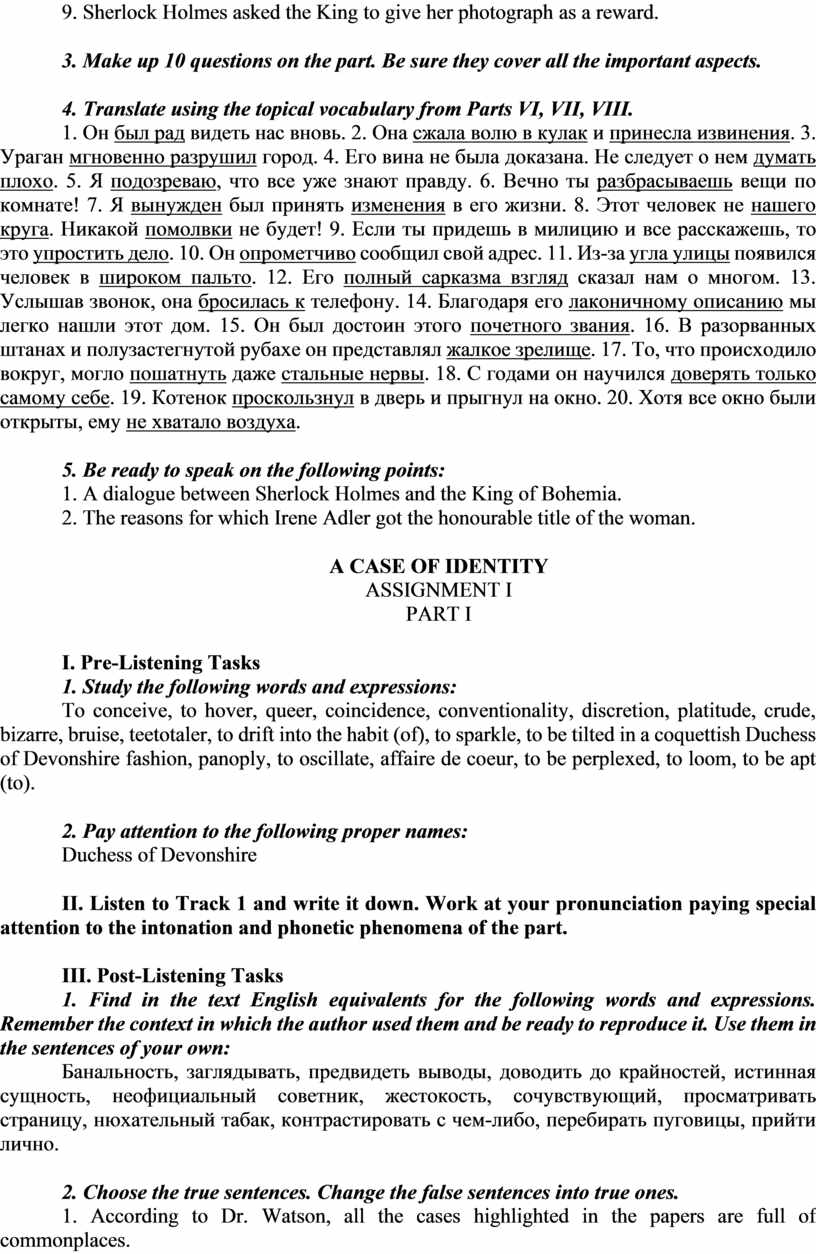
9. Sherlock Holmes asked the King to give her photograph as a reward.
3. Make up 10 questions on the part. Be sure they cover all the important aspects.
4. Translate using the topical vocabulary from Parts VI, VII, VIII.
1. Он был рад видеть нас вновь. 2. Она сжала волю в кулак и принесла извинения. 3. Ураган мгновенно разрушил город. 4. Его вина не была доказана. Не следует о нем думать плохо. 5. Я подозреваю, что все уже знают правду. 6. Вечно ты разбрасываешь вещи по комнате! 7. Я вынужден был принять изменения в его жизни. 8. Этот человек не нашего круга. Никакой помолвки не будет! 9. Если ты придешь в милицию и все расскажешь, то это упростить дело. 10. Он опрометчиво сообщил свой адрес. 11. Из-за угла улицы появился человек в широком пальто. 12. Его полный сарказма взгляд сказал нам о многом. 13. Услышав звонок, она бросилась к телефону. 14. Благодаря его лаконичному описанию мы легко нашли этот дом. 15. Он был достоин этого почетного звания. 16. В разорванных штанах и полузастегнутой рубахе он представлял жалкое зрелище. 17. То, что происходило вокруг, могло пошатнуть даже стальные нервы. 18. С годами он научился доверять только самому себе. 19. Котенок проскользнул в дверь и прыгнул на окно. 20. Хотя все окно были открыты, ему не хватало воздуха.
5. Be ready to speak on the following points:
1. A dialogue between Sherlock Holmes and the King of Bohemia.
2. The reasons for which Irene Adler got the honourable title of the woman.
A CASE OF IDENTITY
ASSIGNMENT I
PART I
I. Pre-Listening Tasks
1. Study the following words and expressions:
To conceive, to hover, queer, coincidence, conventionality, discretion, platitude, crude, bizarre, bruise, teetotaler, to drift into the habit (of), to sparkle, to be tilted in a coquettish Duchess of Devonshire fashion, panoply, to oscillate, affaire de coeur, to be perplexed, to loom, to be apt (to).
2. Pay attention to the following proper names:
Duchess of Devonshire
II. Listen to Track 1 and write it down. Work at your pronunciation paying special attention to the intonation and phonetic phenomena of the part.
III. Post-Listening Tasks
1. Find in the text English equivalents for the following words and expressions. Remember the context in which the author used them and be ready to reproduce it. Use them in the sentences of your own:
Банальность, заглядывать, предвидеть выводы, доводить до крайностей, истинная сущность, неофициальный советник, жестокость, сочувствующий, просматривать страницу, нюхательный табак, контрастировать с чем-либо, перебирать пуговицы, прийти лично.
2. Choose the true sentences. Change the false sentences into true ones.
1. According to Dr. Watson, all the cases highlighted in the papers are full of commonplaces.
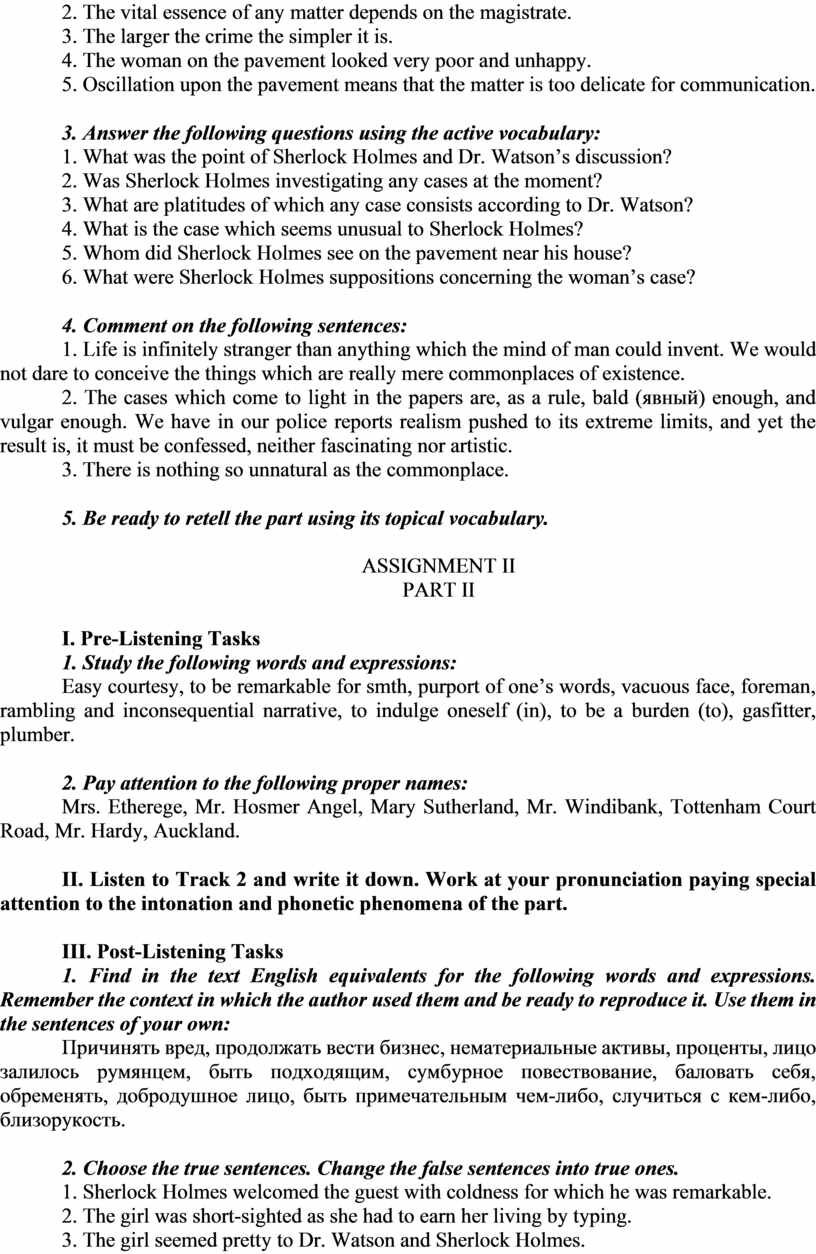
2. The vital essence of any matter depends on the magistrate.
3. The larger the crime the simpler it is.
4. The woman on the pavement looked very poor and unhappy.
5. Oscillation upon the pavement means that the matter is too delicate for communication.
3. Answer the following questions using the active vocabulary:
1. What was the point of Sherlock Holmes and Dr. Watson’s discussion?
2. Was Sherlock Holmes investigating any cases at the moment?
3. What are platitudes of which any case consists according to Dr. Watson?
4. What is the case which seems unusual to Sherlock Holmes?
5. Whom did Sherlock Holmes see on the pavement near his house?
6. What were Sherlock Holmes suppositions concerning the woman’s case?
4. Comment on the following sentences:
1. Life is infinitely stranger than anything which the mind of man could invent. We would not dare to conceive the things which are really mere commonplaces of existence.
2. The cases which come to light in the papers are, as a rule, bald (явный) enough, and vulgar enough. We have in our police reports realism pushed to its extreme limits, and yet the result is, it must be confessed, neither fascinating nor artistic.
3. There is nothing so unnatural as the commonplace.
5. Be ready to retell the part using its topical vocabulary.
ASSIGNMENT II
PART II
I. Pre-Listening Tasks
1. Study the following words and expressions:
Easy courtesy, to be remarkable for smth, purport of one’s words, vacuous face, foreman, rambling and inconsequential narrative, to indulge oneself (in), to be a burden (to), gasfitter, plumber.
2. Pay attention to the following proper names:
Mrs. Etherege, Mr. Hosmer Angel, Mary Sutherland, Mr. Windibank, Tottenham Court Road, Mr. Hardy, Auckland.
II. Listen to Track 2 and write it down. Work at your pronunciation paying special attention to the intonation and phonetic phenomena of the part.
III. Post-Listening Tasks
1. Find in the text English equivalents for the following words and expressions. Remember the context in which the author used them and be ready to reproduce it. Use them in the sentences of your own:
Причинять вред, продолжать вести бизнес, нематериальные активы, проценты, лицо залилось румянцем, быть подходящим, сумбурное повествование, баловать себя, обременять, добродушное лицо, быть примечательным чем-либо, случиться с кем-либо, близорукость.
2. Choose the true sentences. Change the false sentences into true ones.
1. Sherlock Holmes welcomed the guest with coldness for which he was remarkable.
2. The girl was short-sighted as she had to earn her living by typing.
3. The girl seemed pretty to Dr. Watson and Sherlock Holmes.
4. Mr. Windibank didn’t want to find out what had happened to her father.
5. Miss Mary Sutherland and her stepfather were almost of the same age.
6. Mr. Hardy forced the girl’s mother to sell their business.
7. Miss Mary Sutherland wasn’t a burden to her family as she earned enough.
8. Miss Sutherland met Mr. Hosmer Angel at a gasfitters’ball.
3. Answer the following questions using the active vocabulary:
1. What did Sherlock Holmes say about Miss Mary Sutherland at first sight?
2. Why did Miss Mary Sutherland come to Sherlock Holmes in such a hurry?
3. What did the girl look like?
4. Did the family get enough money for their business? Prove it.
5. Did Miss Mary Sutherland go out often? Prove it.
4. Paraphrase using the active vocabulary of Parts II:
1. Actually she had a plain face though everyone admired her beauty. It was her character that attracted everyone.
2. Kelly’s family could hardly make both ends meet. So, the girl decided to find a job in order not to be dependant financially on her parents.
3. She was so happy that didn’t understand his intentions.
4. This person is not of your level. He can’t be your future husband.
5. I you keep on petting her so much your daughter will very spoilt.
6. He was a well-known pianist conspicuous for his amazing technique.
5. Tell about Miss Mary Sutherland and her story.
ASSIGNMENT III
PART III
I. Pre-Listening Tasks
1. Study the following words and expressions:
To shrug one’s shoulders, be happy in her own family circle, to be suggestive, quinsy, swollen glands, to wear tinted glasses against the glare, the Testament, to be in smb’s favour, to do something on the sly, to be pledged (to), to have notion, claret.
2. Pay attention to the following proper names:
Leadenhall Street, Bordeaux, St. Saviour, St. Pancras Hotel, Lyon Place, Camberwell.
II. Listen to Track 3 and write it down. Work at your pronunciation paying special attention to the intonation and phonetic phenomena of the part.
III. Post-Listening Tasks
1. Find in the text English equivalents for the following words and expressions. Remember the context in which the author used them and be ready to reproduce it. Use them in the sentences of your own:
Быть раздраженным, до востребования, рыдать, запечатанная книга, не иметь понятия, разрыдаться, пожимать плечами, сделать по-своему, попытка, сделать что-то исподтишка.
2. Make up 10 questions on the part.
3. Comment on the following sentences:
1. He used to say that a woman should be happy in her own family circle.
2. It has long been an axiom of mine that the little things are infinitely the most important.
4. Translate the sentences using the active vocabulary of Parts I, II, III:
1. Увидев, что она разрыдалась, он пожал плечами и вышел из комнаты, оставив ее одну. 2. Я понятия не имею, почему он решил поступить по-своему. 3. Джон учтиво предложил ей сесть в кресло возле камина. 4. Спустя минуту она начала сумбурный рассказ о вчерашнем вечере. 5. Будь с ним осторожна. Он может все сделать исподтишка, что навредит нашим планам. 6. В банке он открыл счет до востребования. 7. Она чувствовала себя обязанной за то, что он нашел ей работу. 8. Я не верю в совпадения. Это было бы слишком банально. 9. Ее лицо залилось румянцев, когда их глаза встретились. 10. Священник положил руку на Новый Завет и начал молитву. 11. Его бизнес приносит хорошие проценты. 12. Его жизнь для меня как запечатанная книга. Он все держит в секрете. 13. Врач говорит, что у тебя усилилась близорукость. Нам придется купить новые очки. 14. В детстве он часто болел ангиной и ему пришлось удалить гланды. 15. Я постучал в дверь и через мгновение в окошке появилось добродушное лицо моей старой знакомой. 16. Она привыкла себя баловать. Поэтому идея экономить ее сильно раздражала. 17. Эта квартира соответствовала их запросам и они решили ее купить. 18. Она предвидела, как закончится их разговор и уже сейчас нервно перебирала пуговицы на муфте. 19. Этот фильм, вероятно, будет иметь потрясающий успех. 20. Не впадай в крайности. Ты всегда была склонна к преувеличению. 21. У нее появилась привычка выпивать чашку крепкого кофе и просматривать свежую газету по утрам. 22. Она кокетливо сдвинула шляпу набок и вышла из ресторана. 23. Новые синяки и ссадины говорили о том, что он опять ввязался в драку. 24. Смысл его слов абсолютно сбил ее с толку. 25. Он часами наблюдал за чайками, парящими над морем.
5. Draw a plan of the girl’s story. Be ready to speak on every point if the plan.
ASSIGNMENT IV
PART IV
I. Pre-Listening Tasks
1. Study the following words and expressions:
Infinite languor, trite, slate-coloured, fringe, brickish red, bead, to have a general air of being fairly well-to-do, to venture, to have a quick eye for smth, sallow complexion, gaiters over elastic-sided boots, frock-coat, waistcoat, superscription, breach of promise, to quote, interim, to have solid grounds (for), to fathom, demeanour, to unravel.
2. Pay attention to the following proper names:
Andover, Balzac.
II. Listen to Track 4 and write it down. Work at your pronunciation paying special attention to the intonation and phonetic phenomena of the part.
III. Post-Listening Tasks
1. Find in the text English equivalents for the following words and expressions. Remember the context in which the author used them and be ready to reproduce it. Use them in the sentences of your own:
Кольца дыма, старо как мир, невидимый, золотые серьги, внешний вид, рискнуть предположить, быть застегнутым на две нижние пуговицы из пяти, быть запачканным чернилами, окунуть глубоко перо ручки, вернемся к делу, в розыске, болезненный цвет лица, бакенбарды, внизу письма, иметь основание (для), манера поведения, распутать.
2. Think of 5 true and 5 false statements based on the content of the part. Let your partner guess which of them are right and correct the false statements.
3. Answer the following questions using the active vocabulary:
1. What served as a counselor to Sherlock Holmes?
2. What details must always be noticed according to Sherlock Holmes?
3. How did Dr. Watson describe the woman’s appearance?
4. What are the most important details in a man’s and woman’s appearance?
5. What do half-buttoned boots say?
6. What detail did Sherlock Holmes find as striking about the letter?
7. Whom was Sherlock Holmes going to write on order to settle the matter?
4. Comment on the following statements:
1. Never trust to general impressions, my boy, but concentrate yourself upon details. My first glance is always at a woman's sleeve. In a man it is perhaps better first to take the knee of the trouser.
2. I felt that he must have some solid grounds for the assured and easy demeanour with which he treated the singular mystery which he had been called upon to fathom.
5. Be ready to speak on the following points:
1. Sherlock Holmes’s method of deduction applied to Miss Mary Sutherland.
2. The advertised description of Mr. Hosmer Angel.
ASSIGNMENT V
PART V
I. Pre-Listening Tasks
1. Study the following words and expressions:
Gravity, hydrochloric acid, the bisulphate of baryta, scoundrel, excitable, to succeed (in), transparent
II. Listen to Track 5 and write it down. Work at your pronunciation paying special attention to the intonation and phonetic phenomena of the part.
III. Post-Listening Tasks
1. Find in the text English equivalents for the following words and expressions. Remember the context in which the author used them and be ready to reproduce it. Use them in the sentences of your own:
Помеха, сойти с губ, мужчина среднего роста, гладковыбритый, с больным цветом лица, усесться в кресло, договориться на 5 часов, выносить сор из избы, преуспеть (в), уделить внимание, как крыса в ловушке.
2. Paraphrase using the active vocabulary of the part:
1. Hardly had I uttered a word when we heard a heavy knock on the door. 2. This villain must be sentenced to death. 3. He was a sound fellow of average height. 4. I want to keep this nuisance within our family circle. 5. I am not surprised to hear that. She has always been a nervous girl. 6. Here are a few books which I mentioned at my lecture. 7. We agreed to meet at 5 if I remember everything right. 8. His motive is obvious. 9. We don’t want this accident noised, you know. 10. He was blandly asked to sit in the arm-chair.
3. Choose the true sentences. Change the false sentences into true ones:
1. When Dr. Watson came in the morning he found Sherlock Holmes busy with chemical experiments.
2. There was no law which could punish the scoundrel.
3. Mr. James Windibank came to the meeting on time.
4. Mr. James Windibank was delighted to hear that Sherlock Homes would succeed in the case.
5. A typewriter has really quite as much individuality as a man's handwriting.
6. It was Mr. James Windibank who pretended to be Mr. Hosmer Angel.
4. Make up 10 questions on the part which cover all the important events.
5. Be ready to speak on the following points using the active vocabulary:
1. A psychological and visual portrait of Mr. James Windibank.
2. The typewriter and its relation to crime.
ASSIGNMENT VI
PART VI
I. Pre-Listening Tasks
1. Study the following words and expressions:
To collapse into a chair, to stammer, to huddle up, to preserve, to be evident, connivance, deception, cumbrous, fidelity, at any rate, whip, to end on a gallows, to profit, hinted at a disguise, trivial, to tally, to snatch a delusion.
2. Pay attention to the following proper names:
Hafiz, Horace.
II. Listen to Track 6 and write it down. Work at your pronunciation paying special attention to the intonation and phonetic phenomena of the part.
III. Post-Listening Tasks
1. Find in the text English equivalents for the following words and expressions. Remember the context in which the author used them and be ready to reproduce it. Use them in the sentences of your own:
Только между нами, заикаться, рухнуть на стул, закончить жизнь на виселице, избитый, предательство, опровергать, быть очевидным.
2. Think of 5 true and 5 false statements based on the content of the part. Let your partner guess which of them are right and correct the false statements.
3. Answer the following questions using the active vocabulary:
1. How did Sherlock Holmes characterize Mr. James Windibank’s trick?
2. Why wouldn’t Miss Sutherland remain single for a long time?
3. What did a clever stepfather do to prevent Miss Sutherland from going out?
4. What role did Miss Sutherland’s mother play in the story?
5. Why did Mr. James Windibank ask Miss Sutherland to give vows of fidelity upon a Testament?
6. Why was her stepfather the only person who profited by Mr. Angel’s disappearance?
7. How did Sherlock Holmes explain his unwillingness to tell Miss Sutherland the truth?
4. Translate the following sentences using the active vocabulary of Parts IV, V, VI:
1. В церкви они принесли клятвы верности друг другу. 2. Услышав новость, она без сознания упала в кресло. 3. Он заикается самого детства. 4. Только между нами, она никогда не забудет этого предательства. Все ее поступки – очевидное притворство. 5. Твоя история банальна. Это происходит с каждым 6. Я тороплюсь. У меня назначена встреча на 5 вечера в кафе. 7. Когда ее тайна раскрылась, она почувствовала себя в ловушке. 8. Я сразу распознаю ложь. 9. У меня есть все основания получить эту должность. 10. Этот контракт выгоден для нашей компании. 11. Рубашку, запачканную чернилами, нужно сначала замочить, а затем постирать с отбеливателем. 12. Отец не потворствовал капризам своей дочери. 13. Думаю, отпуск у моря хорошо повлиял на ее здоровье. Во всяком случае, она избавилась от болезненного цвета лица. 14. Взгляни на фото мужчины, который сейчас в розыске. Он среднего роста, густые усы, пронизывающие глаза. 15. Его вызывающая манера поведения всех раздражала.
5. Be ready to speak on the following point:
The story of Mr. Angel’s disappearance as Sherlock Holmes saw it.
Материалы на данной страницы взяты из открытых источников либо размещены пользователем в соответствии с договором-офертой сайта. Вы можете сообщить о нарушении.


