
Поделиться


 разработка за май.pdf
TeMa yp0Ra: «The English-speaking countries: Canada, Australia, New Zealand».
THIT ypoKa: ypoK rrpmv1eHeHH¶ 3HaHHM, YMeHHM, 1--10b1KOB.
 ypoKa:
1.Yqe6Hb1e.• POBHBaTb HaBb1KH KOMMYHHKaTHBHOñ KOMnerreH1-1HP1 yqa111Hxcq B MOHOJIOrnqeCKOñ pet-IH, ayAHP0BaHHH HTeHHH.
2. Pa3BHBmorune: aKTHBH3HPOBaTb Y110Tpe6J1eHHe neKCHKH no rreMe, pac111HP¶Tb CJIOBaPHb1ñ 3anac.
3. BocnwraTeJ1bHb1e.• CflOC06CTBOBaTb 03HaKOMjreHH1-O C HHO¶3b1HHOìí KYJ1bTypoìí H pac1-unpeHH}0 Kpyrœopa yqaluuxcq cpencTBaMH
HHOCTpaHHoro 13b1Ka.
060pyA0BaHHe:
I.
2. Pa3aaTOHHb1ï1 MaTepuaJ1.
3. JIHCT 6YMarn C KPOCCBOPAOM.
Xon yp0Ka:
1. OPraHH3aUHOHHb1Ü MOMeHT. IIPUBeTCTBHe. Tervra ypoKa.
2. 00HeTnqeCRafl
3apqmca. 00HerrnqecKaq 0Tpa60TKa  HOBaHHñ no TeMe.•
Canada, Australia, New Zealand, Ottawa, Canberra, Wellington, Commonwealth, the
Mackenzie, the Yukon, the St Lawrence River, Vancouver, Montreal, Halifax, the GovernorGeneral, Quebec (CJ10Ba Harmcar-lbl Ha AOCKe).
3. PegeBafl 3apflAKa•. T: Children, you know much about Canada, Australia and New Zealand. Imagine that I'm a reporter and have some information about these three countries, but I'm not sure if it is true. Your task is to agree or disagree with my statements (pe)KHM T-PI P2 P3.. .Pn).
l. All Great lakes are situated in Canada. (-) 2. The north ofCanada near the Arctic is tundra. (+)
3. There are two hot deserts in Australia. (+)
4. Australia is famous for its pigs. (-)
5. The greater part ofNew Zealand is well-watered. (+)
6. New Zealand consists offour large islands. (-)
7. The Commonwealth ofAustralia consists oftwo states and six territories. (-)
8. Machine-building became thefirst important industry in Canada. (+)
9. New Zealand's natural resources are not rich. (+)
4. T: Thank you for your answers. Now I'm going to describe a country. You are to guess it. This country is a member of the Commonwealth. It has mountains, high plains and low plains. It has several climatic regions. The people living in that country are fond of baseball, football, volley-ball, ice-hockey, tennis and other games. (Canada)
5. T:
Let's make up a short story about Canada. But all sentences are separated. You
are to read them in the right logical order.  pas3Äamcq KaPTOHKH,
Ha Ka)KAOü H3 KOTOPb1X HanncaH0 OAHO-ABa ITPWIO)ICHHÃ. YHa11-(Hecq tiHTarOT
rrpewroxeHH1 Apyr 3a ApyroM. Pe)KHM PI P2 P3...Pn).
pas3Äamcq KaPTOHKH,
Ha Ka)KAOü H3 KOTOPb1X HanncaH0 OAHO-ABa ITPWIO)ICHHÃ. YHa11-(Hecq tiHTarOT
rrpewroxeHH1 Apyr 3a ApyroM. Pe)KHM PI P2 P3...Pn).
l. Canada has an area ofnearly 10 million square kilometers.
2. There are many islands in the north of Canada.
3. Canada also has large rivers: the Mackenzie, the Yukon, and the St Lawrence River.
4. The central plains form the prairies.
5. The population of Canada is over 24 million people.
6. Canada is rich in metal ores, oil and gas.
7. The metal, machine-building, motor-car and ship-building industries are highly developed.
8. Canada 's main agricultural products are wheat, meat, some kinds of fruits and dairy products.
9. Canada 's largest ports are Vancouver, Montreal and Halifax.
10. Formally the head ofthe state is the King or Queen ofEngland, represented by the Governor-General.
11. The Federal Parliament consists ofthe Senate and the House of Commons.
12. In all the provinces there is a legislative assembly elected by the peoplefor 5 years.
6. T: Unlike other English-speaking countries Canada has two official languages.
What is the French-speaking province of Canada? PI, will you tell us a few words about the province of Quebec.
PI: Canada 's beginnings were French; and even now French is the language spoken by about onefifth ofCanadians. Canada has two official languages — English and French. The St Lawrence Valley was the heart ofthe French colony in North America up to the middle ofthe 18h century. The St Lawrence River, from Montreal to the GulfofSt Lawrence, may still be called a French river. Quebec is the home ofthe French Canadian nation, and Quebec City is the capital ofthe province. Quebec is Canada 's largest province. Montreal, the main St Lawrence port, is the second largest French city in the world — after Paris. French Canada still keeps some of its old traditions, but it is a mistake to say that
Quebec is very differentfrom the rest ofCanada; every year the difference becomes less.
7. T: After the discovery of Canada many kings and navigators began to dream of the riches in this new country. But as for Australia, it was first used as a colony for convicts. They worked hard to make this country better. P2, will you recite a poem about their hard labour and then the translation into Russian made by some pupils of your class?
Old Botany Bay (By Mary Gilmore)
I'm old
Botany Bay
Stiffin thejoints,
Little to say;
I am he
Who paved the way
That you might walk
At your easy today;
I was the conscript
Sent to hell
To make in the desert The living well;
I bore the heat,
I blazed the track Furrowed and bloody Upon my back.
I split the rock
Ifelled the tree: The nation was Because ofme!
Old Botany Bay Taking the sun
From day to day...
Shame on the mouth
That would deny The knotted hands That set us high!
 cTapb1ìí BOTaHH b3ñ,
KpeflKHìí KaK CTaJ1b,
He ehtycb, xomb yõeù
3mo Mocmwz ðopoeu, qm06b1 Bbl, nomoMRt1, He cno»tanu Hoeu.
H — Kamop0£HZIR, TIocnaHHb1Ù g aÒ, qm06b1 cðenamb nycmb1Ht1 Lteemyuguù cad
Moù mnyacuù mpyÒ,
ICaK e cmpatuHOM CHe Ocmaeun cneð Kpoeaeblù Ha Moeù cmme.
 6319b1ean,
Uepeßb£ cpyõaa, M, ecnu 6 He B,
He 6bV10 6 u me6H.
Crnapbzù bomahtu B3ù
)Kugyg, xornb 6eù He 6eù. T1030P mouuy, qrno eÒpye 3a6bVZ, Kmo 3rny OÆCU3Hb EMY Ò06bVZ.
8, T: From that time life has greatly changed in
Australia. But nevertheless the living conditions in some parts of the country
are still very difficult. Let's read the text about Western Australia, the
driest part of the country.  pa3nawrc¶ JIHCTb1 c HaneqarraHHb1M
rreKCTOM "Western Australia" H 3aaaHH¶MH K Hew).
pa3nawrc¶ JIHCTb1 c HaneqarraHHb1M
rreKCTOM "Western Australia" H 3aaaHH¶MH K Hew).
1) LITeHHe rreKCTa no ue1101-1Ke (PI P2 P3.. .Pn).
2) Bblr10JIHeHHe 3aAaH1,1M nocne T-1TeH1,rq TeKCTa (YCTHO).
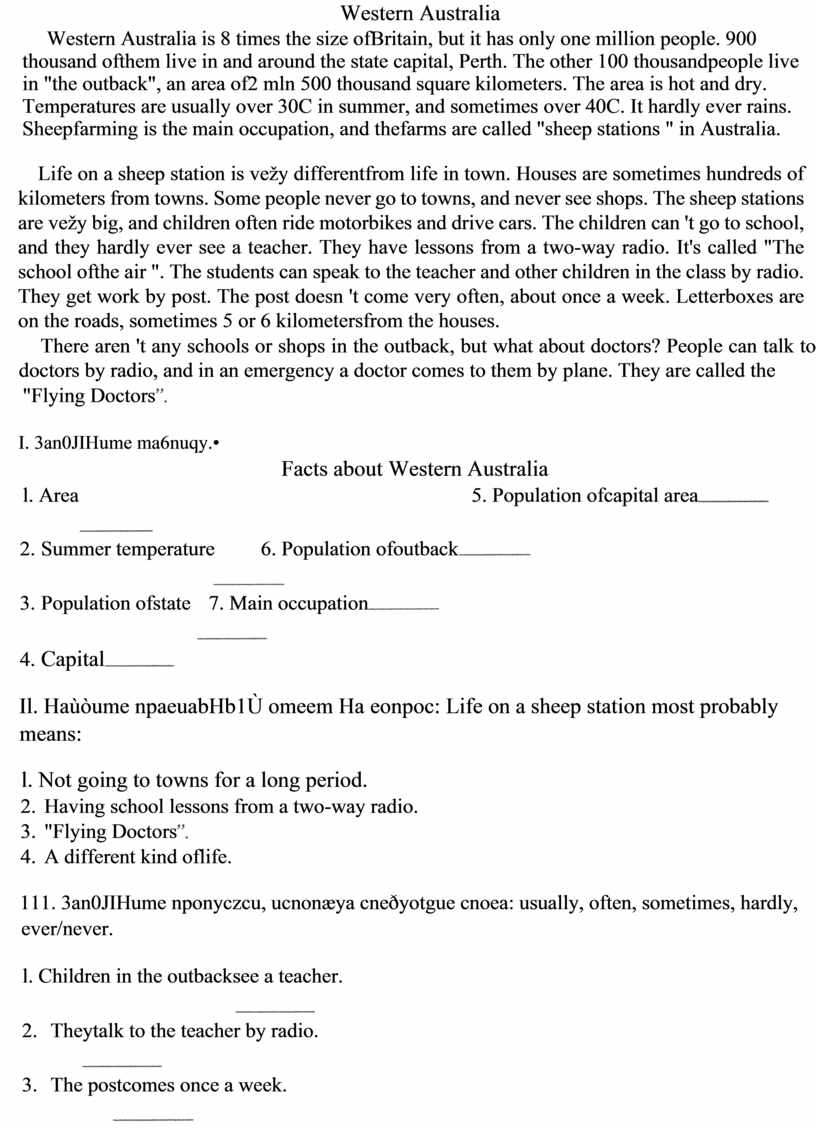
Western Australia is 8 times the size ofBritain, but it has only one million people. 900 thousand ofthem live in and around the state capital, Perth. The other 100 thousandpeople live in "the outback", an area of2 mln 500 thousand square kilometers. The area is hot and dry. Temperatures are usually over 30C in summer, and sometimes over 40C. It hardly ever rains. Sheepfarming is the main occupation, and thefarms are called "sheep stations " in Australia.
Life on a sheep station is vežy differentfrom life in town. Houses are sometimes hundreds of kilometers from towns. Some people never go to towns, and never see shops. The sheep stations are vežy big, and children often ride motorbikes and drive cars. The children can 't go to school, and they hardly ever see a teacher. They have lessons from a two-way radio. It's called "The school ofthe air ". The students can speak to the teacher and other children in the class by radio. They get work by post. The post doesn 't come very often, about once a week. Letterboxes are on the roads, sometimes 5 or 6 kilometersfrom the houses.
There aren 't any schools or shops in the outback, but what about doctors? People can talk to doctors by radio, and in an emergency a doctor comes to them by plane. They are called the
"Flying Doctors
I. 3an0JIHume ma6nuqy.•
l.
Area 5.
Population ofcapital area

2. Summer
temperature 6. Population ofoutback

3. Population
ofstate 7. Main occupation

4.
Capital
Il. Haùòume npaeuabHb1Ù omeem Ha eonpoc: Life on a sheep station most probably means:
l. Not going to towns for a long period.
2. Having school lessons from a two-way radio.
3. "Flying
Doctors
4. A different kind oflife.
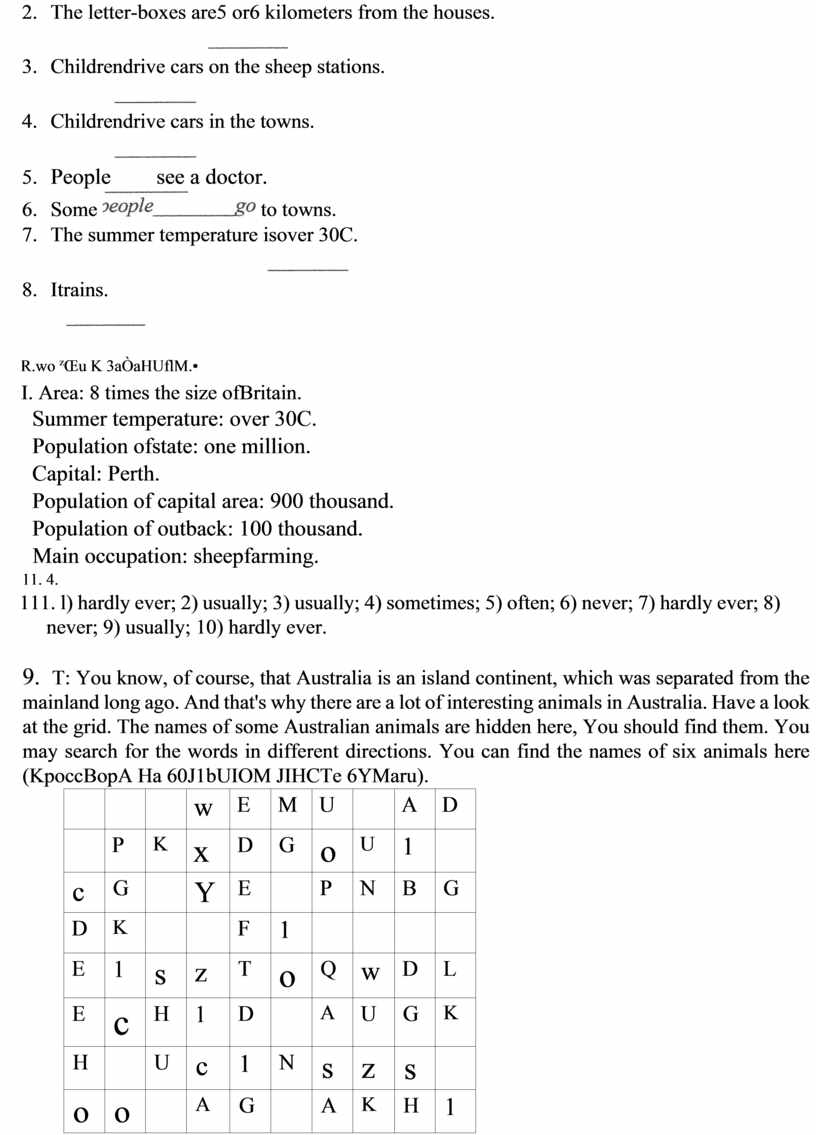
111. 3an0JIHume nponyczcu, ucnonæya cneðyotgue cnoea: usually, often, sometimes, hardly, ever/never.
l. Children in the outbacksee a teacher.

2. Theytalk to the teacher by radio.

3. The postcomes once a week.

4. The letter-boxes are5 or6 kilometers from the houses.

5. Childrendrive cars on the sheep stations.

6. Childrendrive cars in the towns.

7. People see a doctor.
8. Some
 to
towns.
to
towns.
9. The summer temperature isover 30C.

10. Itrains.

R.wo zŒu K 3aÒaHUflM.•
I. Area: 8 times the size ofBritain.
Summer temperature: over 30C.
Population ofstate: one million.
Capital: Perth.
Population of capital area: 900 thousand.
Population of outback: 100 thousand. Main occupation: sheepfarming.
11. 4.
111. l) hardly ever; 2) usually; 3) usually; 4) sometimes; 5) often; 6) never; 7) hardly ever; 8) never; 9) usually; 10) hardly ever.
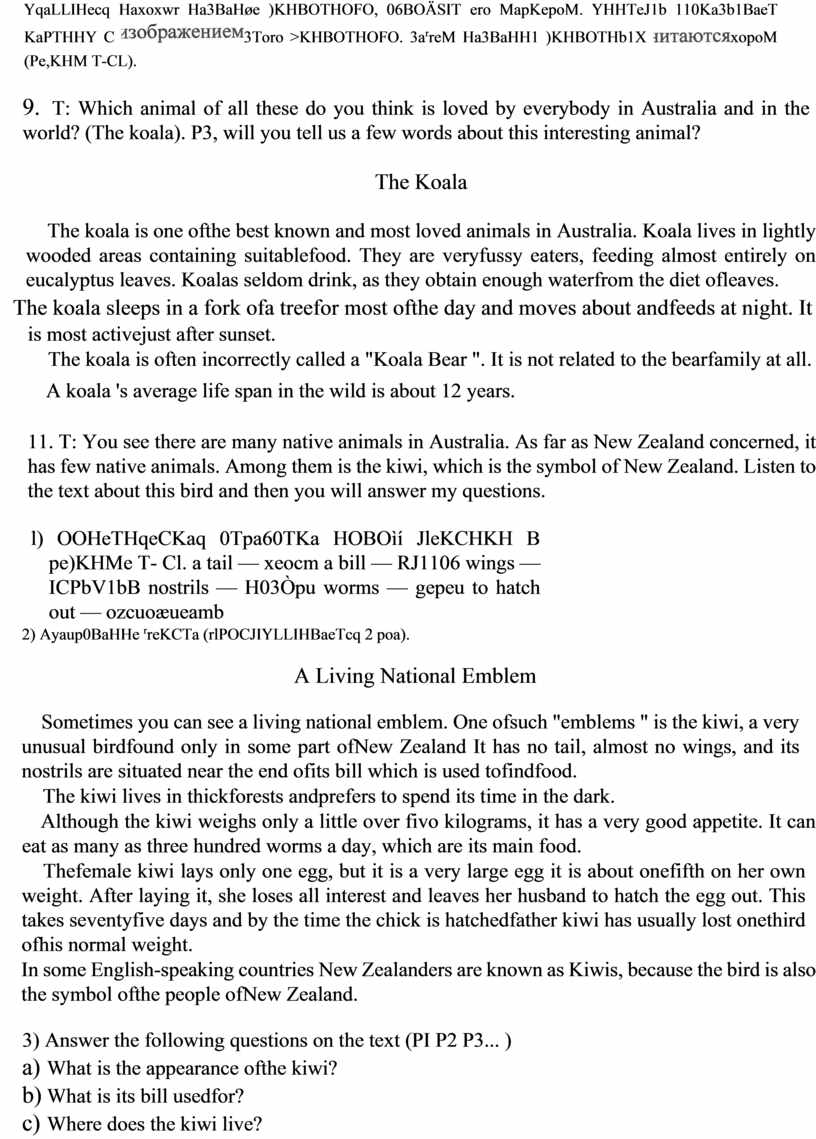
9. T: You know, of course, that Australia is an island continent, which was separated from the mainland long ago. And that's why there are a lot of interesting animals in Australia. Have a look at the grid. The names of some Australian animals are hidden here, You should find them. You may search for the words in different directions. You can find the names of six animals here (KpoccBopA Ha 60J1bUIOM JIHCTe 6YMaru).
|
|
|
|
w |
E |
M |
U |
|
A |
D |
|
|
P |
K |
x |
D |
G |
o |
U |
1 |
|
|
c |
G |
|
Y |
E |
|
P |
N |
B |
G |
|
D |
K |
|
|
F |
1 |
|
|
|
|
|
E |
1 |
s |
z |
T |
o |
Q |
w |
D |
L |
|
E |
c |
H |
1 |
D |
|
A |
U |
G |
K |
|
H |
|
U |
c |
1 |
N |
s |
z |
s |
|
|
o |
o |
|
A |
G |
|
A |
K |
H |
1 |
YqaLLIHecq Haxoxwr Ha3BaHøe
)KHBOTHOFO, 06BOÄSIT ero MapKepoM. YHHTeJ1b 110Ka3b1BaeT KaPTHHY C  3Toro >KHBOTHOFO. 3arreM
Ha3BaHH1 )KHBOTHb1X
3Toro >KHBOTHOFO. 3arreM
Ha3BaHH1 )KHBOTHb1X  xopoM (Pe,KHM T-CL).
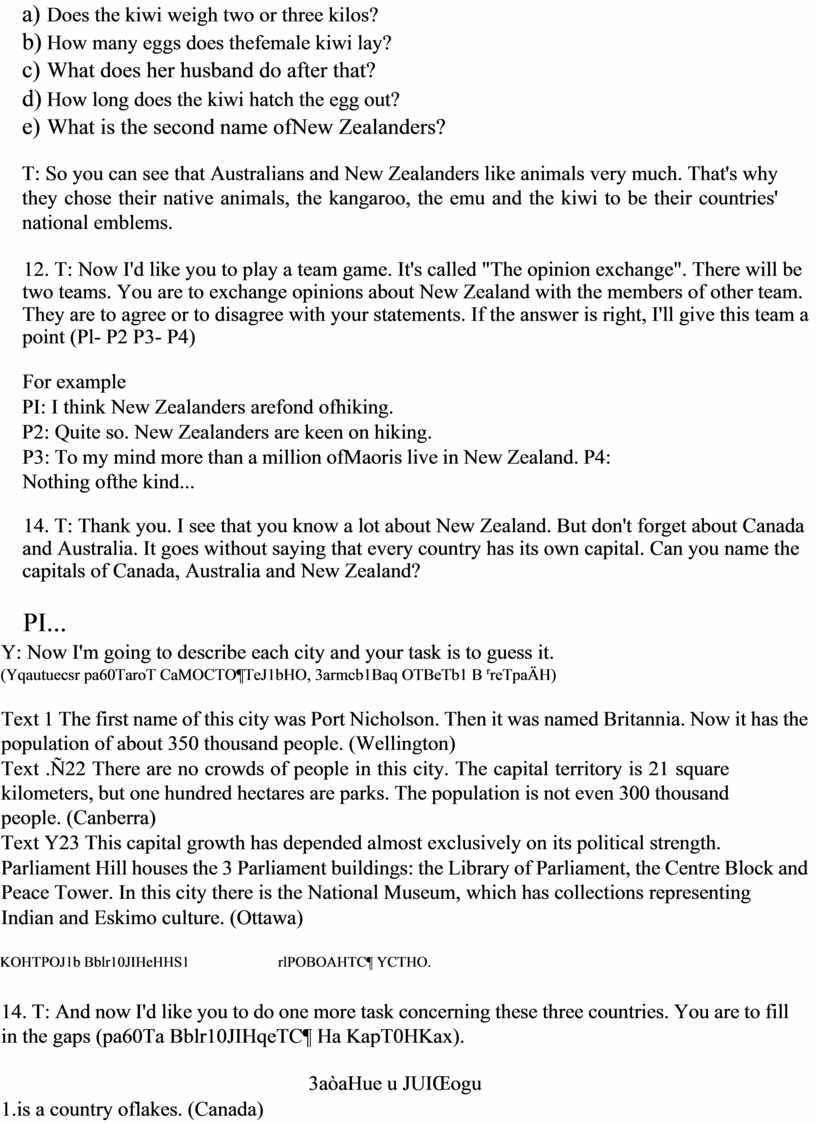
10.T: Which animal of all these do you think is loved by everybody in Australia and in the world? (The koala). P3, will you tell us a few words about this interesting animal?
The koala is one ofthe best known and most loved animals in Australia. Koala lives in lightly wooded areas containing suitablefood. They are veryfussy eaters, feeding almost entirely on eucalyptus leaves. Koalas seldom drink, as they obtain enough waterfrom the diet ofleaves.
The koala sleeps in a fork ofa treefor most ofthe day and moves about andfeeds at night. It
is most activejust after sunset.
The koala is often incorrectly called a "Koala Bear ". It is not related to the bearfamily at all.
A koala 's average life span in the wild is about 12 years.
11. T: You see there are many native animals in Australia. As far as New Zealand concerned, it has few native animals. Among them is the kiwi, which is the symbol of New Zealand. Listen to the text about this bird and then you will answer my questions.
l) OOHeTHqeCKaq 0Tpa60TKa HOBOìí JleKCHKH B pe)KHMe T- Cl. a tail — xeocm a bill — RJ1106 wings — ICPbV1bB nostrils — H03Òpu worms — gepeu to hatch out — ozcuoæueamb
2) Ayaup0BaHHe rreKCTa (rlPOCJIYLLIHBaeTcq 2 poa).
Sometimes you can see a living national emblem. One ofsuch "emblems " is the kiwi, a very unusual birdfound only in some part ofNew Zealand It has no tail, almost no wings, and its nostrils are situated near the end ofits bill which is used tofindfood.
The kiwi lives in thickforests andprefers to spend its time in the dark.
Although the kiwi weighs only a little over fivo kilograms, it has a very good appetite. It can eat as many as three hundred worms a day, which are its main food.
Thefemale kiwi lays only one egg, but it is a very large egg it is about onefifth on her own weight. After laying it, she loses all interest and leaves her husband to hatch the egg out. This takes seventyfive days and by the time the chick is hatchedfather kiwi has usually lost onethird ofhis normal weight.
In some English-speaking countries New Zealanders are known as Kiwis, because the bird is also the symbol ofthe people ofNew Zealand.
3) Answer the following questions on the text (PI P2 P3... )
a) What is the appearance ofthe kiwi?
b) What is its bill usedfor?
c) Where does the kiwi live?
d) Does the kiwi weigh two or three kilos?
e) How many eggs does thefemale kiwi lay?
f) What does her husband do after that?
g) How long does the kiwi hatch the egg out?
h) What is the second name ofNew Zealanders?
T: So you can see that Australians and New Zealanders like animals very much. That's why they chose their native animals, the kangaroo, the emu and the kiwi to be their countries' national emblems.
12. T: Now I'd like you to play a team game. It's called "The opinion exchange". There will be two teams. You are to exchange opinions about New Zealand with the members of other team. They are to agree or to disagree with your statements. If the answer is right, I'll give this team a point (Pl- P2 P3- P4)
For example
PI: I think New Zealanders arefond ofhiking.
P2: Quite so. New Zealanders are keen on hiking.
P3: To my mind more than a million ofMaoris live in New Zealand. P4: Nothing ofthe kind...
14. T: Thank you. I see that you know a lot about New Zealand. But don't forget about Canada and Australia. It goes without saying that every country has its own capital. Can you name the capitals of Canada, Australia and New Zealand?
PI...
Y: Now I'm going to describe each city and your task is to guess it.
(Yqautuecsr pa60TaroT CaMOCTO¶TeJ1bHO, 3armcb1Baq OTBeTb1 B rreTpaÄH)
Text 1 The first name of this city was Port Nicholson. Then it was named Britannia. Now it has the population of about 350 thousand people. (Wellington)
Text .Ñ22 There are no crowds of people in this city. The capital territory is 21 square kilometers, but one hundred hectares are parks. The population is not even 300 thousand people. (Canberra)
Text Y23 This capital growth has depended almost exclusively on its political strength.
Parliament Hill houses the 3 Parliament buildings: the Library of Parliament, the Centre Block and Peace Tower. In this city there is the National Museum, which has collections representing
Indian and Eskimo culture. (Ottawa)
KOHTPOJ1b Bblr10JIHeHHS1 rlPOBOAHTC¶ YCTHO.
14. T: And now I'd like you to do one more task concerning these three countries. You are to fill in the gaps (pa60Ta Bblr10JIHqeTC¶ Ha KapT0HKax).
3aòaHue u JUIŒogu
1.is a country oflakes. (Canada)

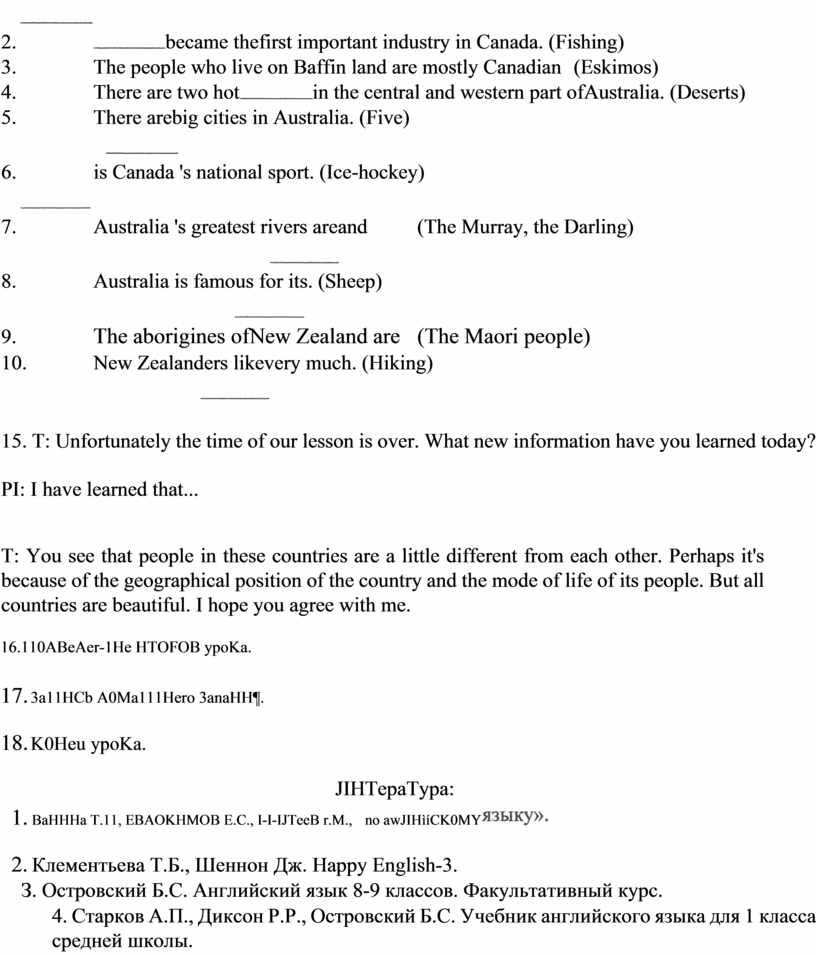
2.
 became thefirst important industry in
Canada. (Fishing)
became thefirst important industry in
Canada. (Fishing)
3. The people who live on Baffin land are mostly Canadian (Eskimos)
4.
There are two hot in the central and western part
ofAustralia. (Deserts)
in the central and western part
ofAustralia. (Deserts)
5. There arebig cities in Australia. (Five)

6. is Canada 's national sport. (Ice-hockey)

7. Australia 's greatest rivers areand (The Murray, the Darling)

8. Australia is famous for its. (Sheep)

9. The aborigines ofNew Zealand are (The Maori people)
10. New Zealanders likevery much. (Hiking)

15. T: Unfortunately the time of our lesson is over. What new information have you learned today?
PI: I have learned that...
T: You see that people in these countries are a little different from each other. Perhaps it's because of the geographical position of the country and the mode of life of its people. But all countries are beautiful. I hope you agree with me.
16.110ABeAer-1He HTOFOB ypoKa.
17. 3a11HCb A0Ma111Hero 3anaHH¶.
18. K0Heu ypoKa.
JIHTepaTypa:
1. BaHHHa T.11, EBAOKHMOB E.C.,
I-I-IJTeeB r.M., no awJIHìíCK0MY
2. Клементьева Т.Б., Шеннон Дж. Нарру English-3.
З. Островский Б.С. Английский язык 8-9 классов. Факультативный курс.
4. Старков А.П., Диксон Р.Р., Островский Б.С. Учебник английского языка для 1 класса средней школы.
Материалы на данной страницы взяты из открытых источников либо размещены пользователем в соответствии с договором-офертой сайта. Вы можете сообщить о нарушении.


