
Поделиться



 history of theatre.docx
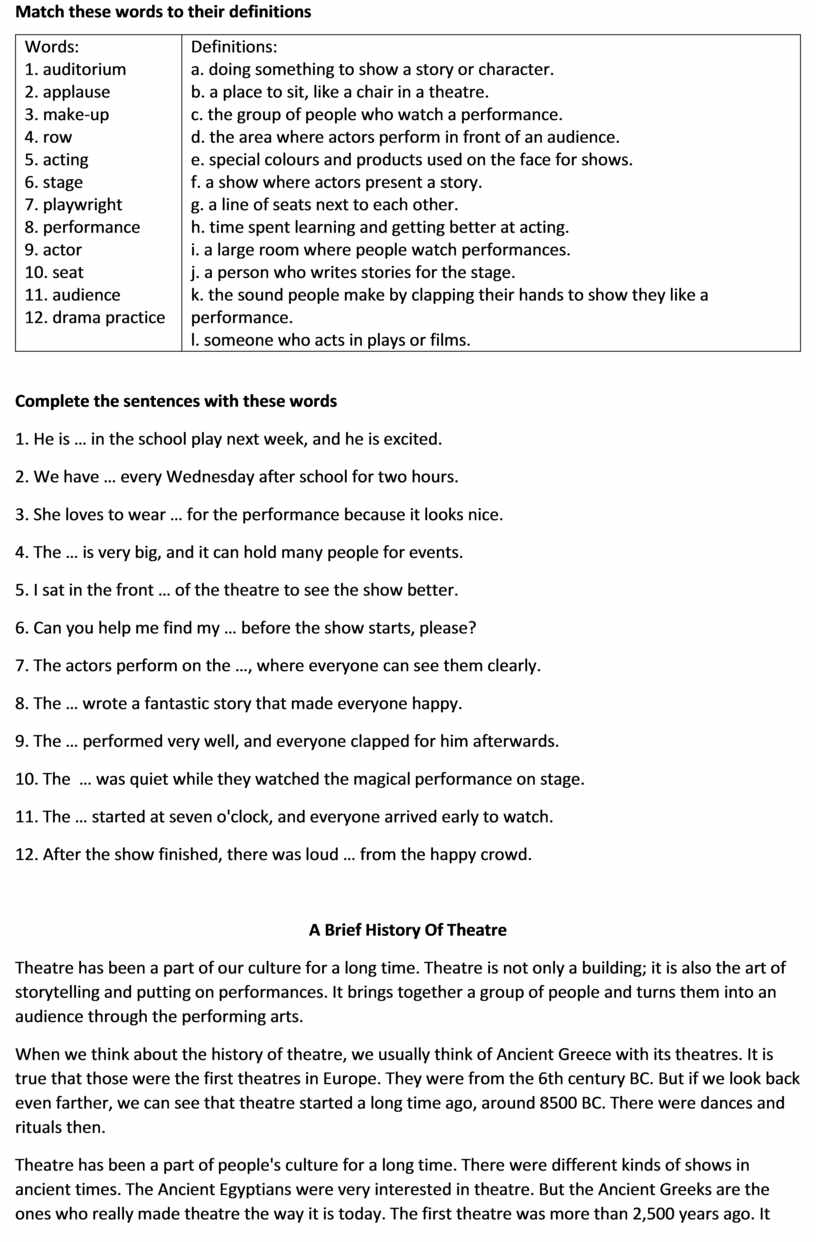
Match these words to their definitions
|
Words: 1. auditorium 2. applause 3. make-up 4. row 5. acting 6. stage 7. playwright 8. performance 9. actor 10. seat 11. audience 12. drama practice |
Definitions: a. doing something to show a story or character. b. a place to sit, like a chair in a theatre. c. the group of people who watch a performance. d. the area where actors perform in front of an audience. e. special colours and products used on the face for shows. f. a show where actors present a story. g. a line of seats next to each other. h. time spent learning and getting better at acting. i. a large room where people watch performances. j. a person who writes stories for the stage. k. the sound people make by clapping their hands to show they like a performance. l. someone who acts in plays or films. |
Complete the sentences with these words
1. He is … in the school play next week, and he is excited.
2. We have … every Wednesday after school for two hours.
3. She loves to wear … for the performance because it looks nice.
4. The … is very big, and it can hold many people for events.
5. I sat in the front … of the theatre to see the show better.
6. Can you help me find my … before the show starts, please?
7. The actors perform on the …, where everyone can see them clearly.
8. The … wrote a fantastic story that made everyone happy.
9. The … performed very well, and everyone clapped for him afterwards.
10. The … was quiet while they watched the magical performance on stage.
11. The … started at seven o'clock, and everyone arrived early to watch.
12. After the show finished, there was loud … from the happy crowd.
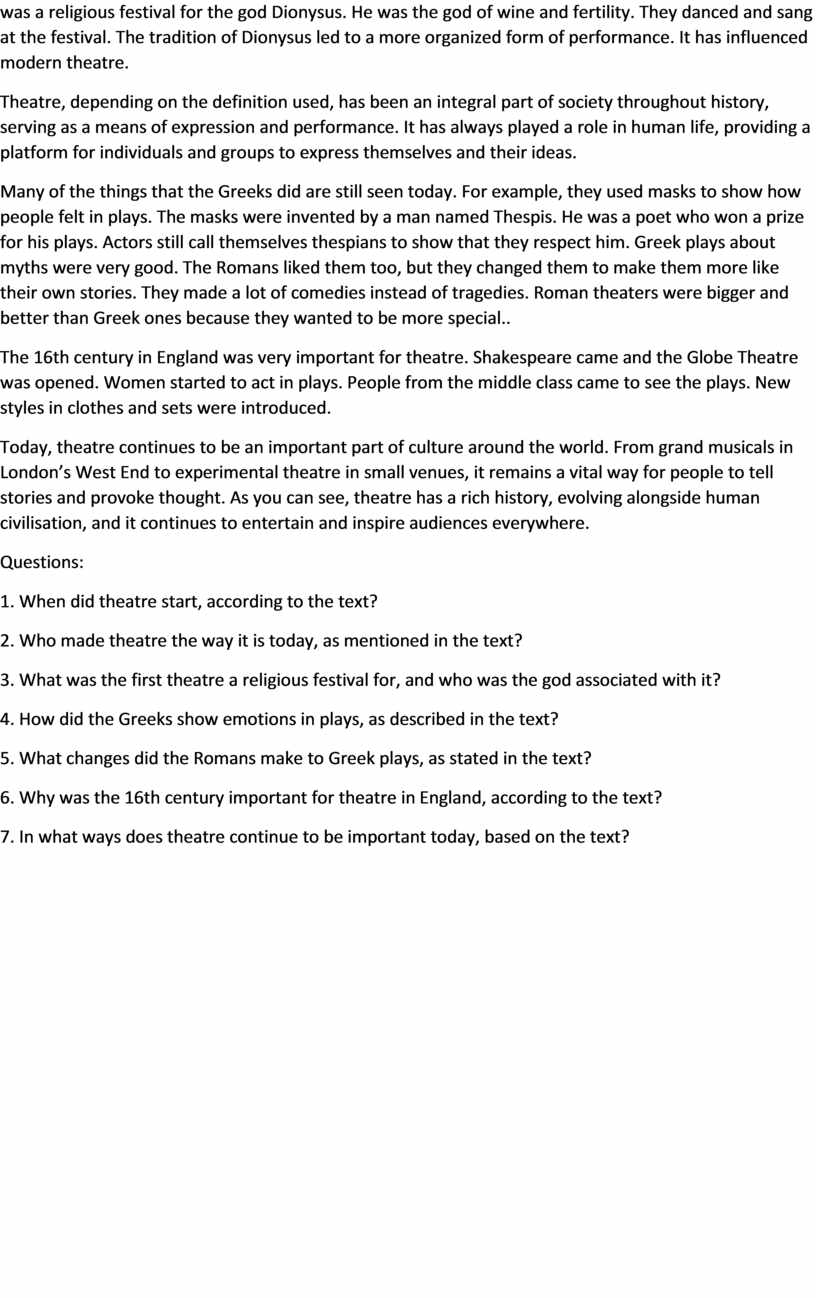
A Brief History Of Theatre
Theatre has been a part of our culture for a long time. Theatre is not only a building; it is also the art of storytelling and putting on performances. It brings together a group of people and turns them into an audience through the performing arts.
When we think about the history of theatre, we usually think of Ancient Greece with its theatres. It is true that those were the first theatres in Europe. They were from the 6th century BC. But if we look back even farther, we can see that theatre started a long time ago, around 8500 BC. There were dances and rituals then.
Theatre has been a part of people's culture for a long time. There were different kinds of shows in ancient times. The Ancient Egyptians were very interested in theatre. But the Ancient Greeks are the ones who really made theatre the way it is today. The first theatre was more than 2,500 years ago. It was a religious festival for the god Dionysus. He was the god of wine and fertility. They danced and sang at the festival. The tradition of Dionysus led to a more organized form of performance. It has influenced modern theatre.
Theatre, depending on the definition used, has been an integral part of society throughout history, serving as a means of expression and performance. It has always played a role in human life, providing a platform for individuals and groups to express themselves and their ideas.
Many of the things that the Greeks did are still seen today. For example, they used masks to show how people felt in plays. The masks were invented by a man named Thespis. He was a poet who won a prize for his plays. Actors still call themselves thespians to show that they respect him. Greek plays about myths were very good. The Romans liked them too, but they changed them to make them more like their own stories. They made a lot of comedies instead of tragedies. Roman theaters were bigger and better than Greek ones because they wanted to be more special..
The 16th century in England was very important for theatre. Shakespeare came and the Globe Theatre was opened. Women started to act in plays. People from the middle class came to see the plays. New styles in clothes and sets were introduced.
Today, theatre continues to be an important part of culture around the world. From grand musicals in London’s West End to experimental theatre in small venues, it remains a vital way for people to tell stories and provoke thought. As you can see, theatre has a rich history, evolving alongside human civilisation, and it continues to entertain and inspire audiences everywhere.
Questions:
1. When did theatre start, according to the text?
2. Who made theatre the way it is today, as mentioned in the text?
3. What was the first theatre a religious festival for, and who was the god associated with it?
4. How did the Greeks show emotions in plays, as described in the text?
5. What changes did the Romans make to Greek plays, as stated in the text?
6. Why was the 16th century important for theatre in England, according to the text?
7. In what ways does theatre continue to be important today, based on the text?
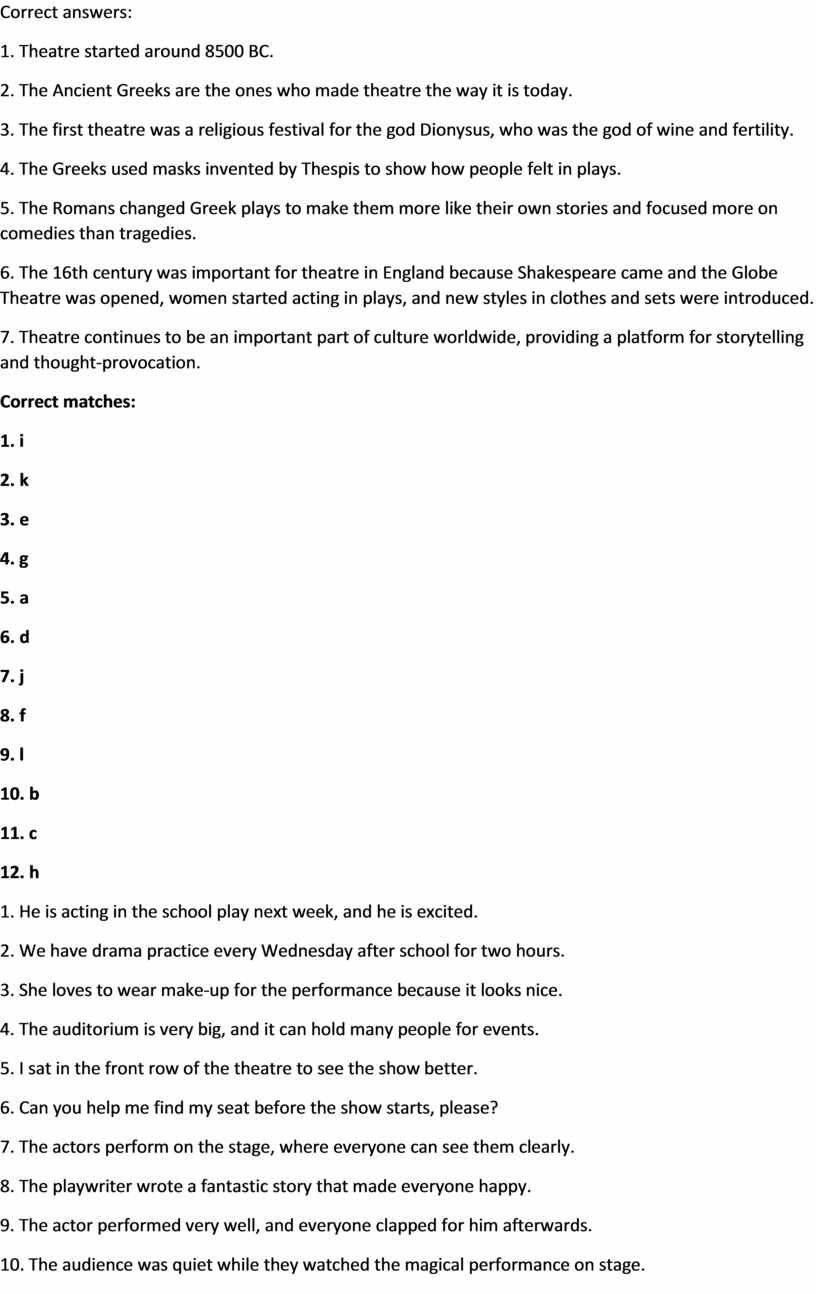
Correct answers:
1. Theatre started around 8500 BC.
2. The Ancient Greeks are the ones who made theatre the way it is today.
3. The first theatre was a religious festival for the god Dionysus, who was the god of wine and fertility.
4. The Greeks used masks invented by Thespis to show how people felt in plays.
5. The Romans changed Greek plays to make them more like their own stories and focused more on comedies than tragedies.
6. The 16th century was important for theatre in England because Shakespeare came and the Globe Theatre was opened, women started acting in plays, and new styles in clothes and sets were introduced.
7. Theatre continues to be an important part of culture worldwide, providing a platform for storytelling and thought-provocation.
Correct matches:
1. i
2. k
3. e
4. g
5. a
6. d
7. j
8. f
9. l
10. b
11. c
12. h
1. He is acting in the school play next week, and he is excited.
2. We have drama practice every Wednesday after school for two hours.
3. She loves to wear make-up for the performance because it looks nice.
4. The auditorium is very big, and it can hold many people for events.
5. I sat in the front row of the theatre to see the show better.
6. Can you help me find my seat before the show starts, please?
7. The actors perform on the stage, where everyone can see them clearly.
8. The playwriter wrote a fantastic story that made everyone happy.
9. The actor performed very well, and everyone clapped for him afterwards.
10. The audience was quiet while they watched the magical performance on stage.
11. The performance started at seven o'clock, and everyone arrived early to watch.
12. After the show finished, there was loud applause from the happy crowd.

Материалы на данной страницы взяты из открытых источников либо размещены пользователем в соответствии с договором-офертой сайта. Вы можете сообщить о нарушении.


