
Поделиться



 From ships to Shakespeare Uncovering the Historical Origins of English idioms..pptx

From ships to Shakespeare: Uncovering the Historical Origins of English idioms.
Nisenzon Miroslava, a 7th grade student
Scientific supervisor: Ruslan Gumerov
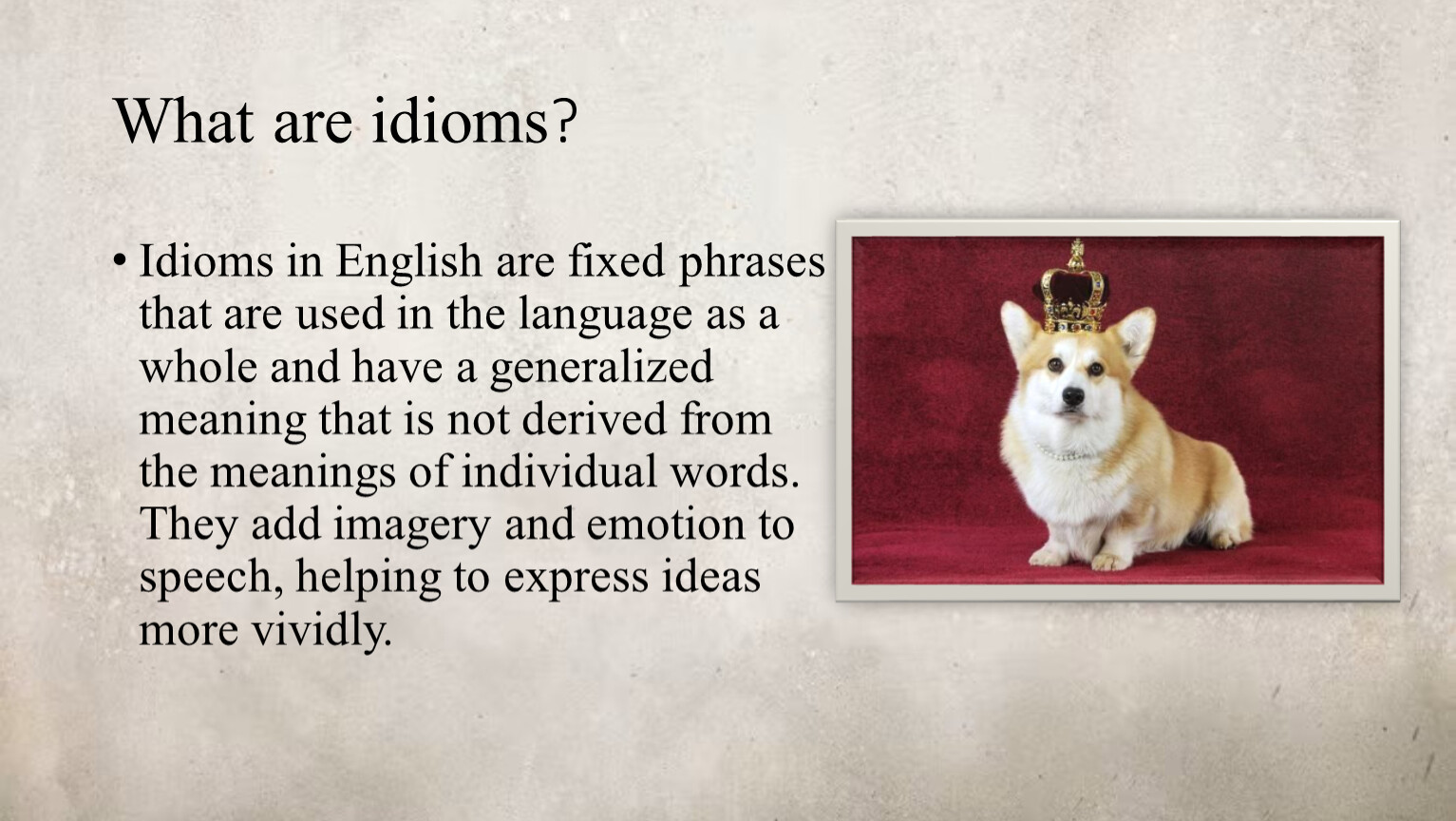
What are idioms?
Idioms in English are fixed phrases that are used in the language as a whole and have a generalized meaning that is not derived from the meanings of individual words. They add imagery and emotion to speech, helping to express ideas more vividly.

How do idioms appear?
Idioms in English have emerged from various sources and historical periods, reflecting the cultural, religious, literary, and social characteristics of society. Here are four sentences that briefly describe the main ways in which idioms have emerged.

Literary works have become a rich source of idioms.
For example: "Wild-goose chase" (a fruitless pursuit) first appears in William Shakespeare's play "Romeo and Juliet." It refers to a pointless or futile endeavor.

Idioms from the Bible
Biblical texts have enriched the English language with many stable expressions. These include: The apple of my eye ("the light of my eyes") is an expression found in the Bible (for example, in Psalm 16). It means something or someone very dear, valuable

Idioms that come from history.
Historical events have often become the basis for idioms. For example, the expression "to meet one's Waterloo" refers to facing an inevitable and devastating defeat, often after a series of successes. This is based on the Battle of Waterloo in 1815, where Napoleon was defeated.

An idiom related to seafarers.
An idiom related to seafarers: "Loose cannon" (an unpredictable, unreliable person) is related to maritime themes: in the 17th-19th centuries, ships were primarily armed with cannons, which could roll uncontrollably on the deck if their fastenings were loosened.

Why do you need to learn idioms?
Studying the idioms of other countries helps to gain a deeper understanding of the mentality and cultural characteristics of their native speakers.
Knowing idioms makes it easier to understand spoken language, as these expressions are often used in movies, TV shows, and everyday conversations.
Why do you need to learn idioms?
Using idioms makes your own speech more expressive and brings it closer to the level of native speakers.
Understanding idioms allows you to grasp the hidden meanings, jokes, and nuances of communication that are lost when phrases are taken literally.
Learning idioms from different languages broadens one's linguistic horizons and helps to see the unique ways of thinking in different cultures.

Conclusion
It can be concluded that idioms in English are not only linguistic constructions, but also important elements of cultural heritage. They reflect the history, traditions, social relations, and lifestyle of the people of Great Britain. The idiomatic composition of the language greatly influences the formation of collective mentality and ways of thinking.

Thank you for your attention
Материалы на данной страницы взяты из открытых источников либо размещены пользователем в соответствии с договором-офертой сайта. Вы можете сообщить о нарушении.


