Поделиться


 КИЛП_лекции.docx
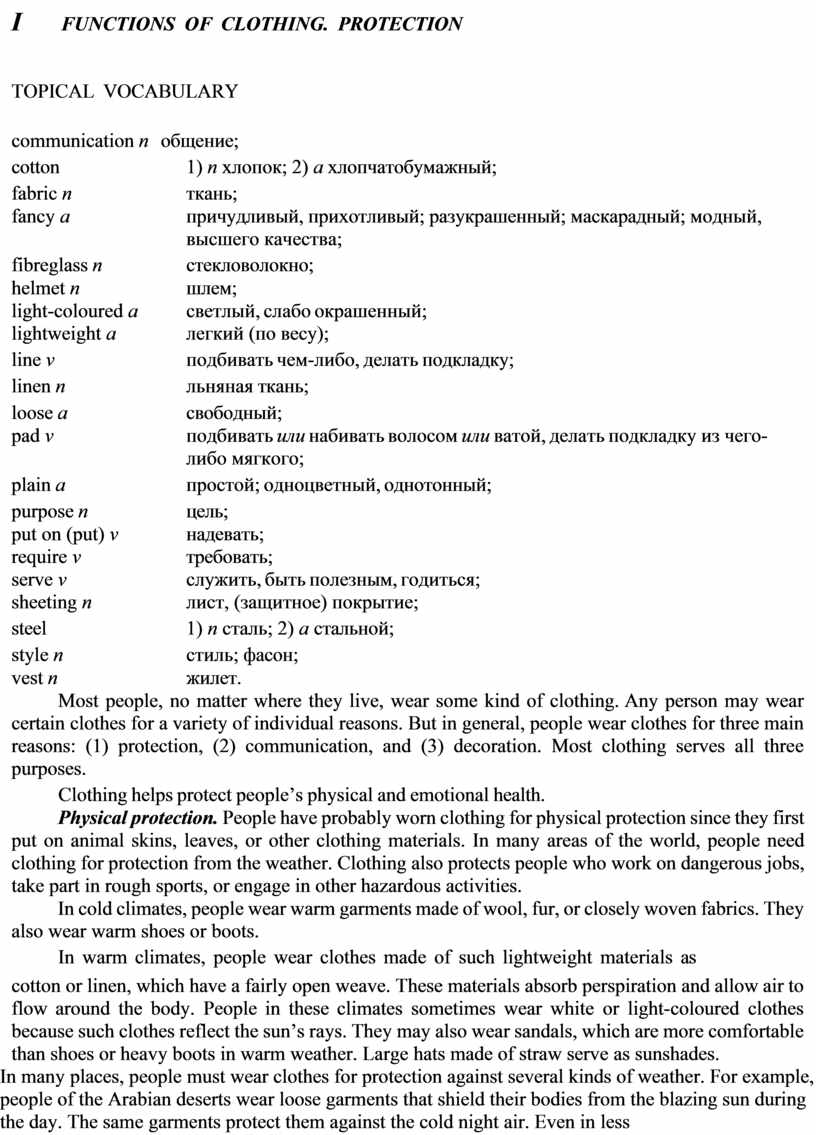
TOPICAL VOCABULARY
communication n общение;
cotton 1) n хлопок; 2) a хлопчатобумажный;
fabric n ткань;
fancy a причудливый, прихотливый; разукрашенный; маскарадный; модный, высшего качества;
fibreglass n стекловолокно;
helmet n шлем;
light-coloured a светлый, слабо окрашенный; lightweight a легкий (по весу);
line v подбивать чем-либо, делать подкладку;
linen n льняная ткань;
loose a свободный;
pad v подбивать или набивать волосом или ватой, делать подкладку из чего-либо мягкого;
plain a простой; одноцветный, однотонный;
purpose n цель;
put on (put) v надевать; require v требовать;
serve v служить, быть полезным, годиться; sheeting n лист, (защитное) покрытие;
steel 1) n сталь; 2) a стальной;
style n стиль; фасон;
vest n жилет.
Most people, no matter where they live, wear some kind of clothing. Any person may wear certain clothes for a variety of individual reasons. But in general, people wear clothes for three main reasons: (1) protection, (2) communication, and (3) decoration. Most clothing serves all three purposes.
Clothing helps protect people’s physical and emotional health.
Physical protection. People have probably worn clothing for physical protection since they first put on animal skins, leaves, or other clothing materials. In many areas of the world, people need clothing for protection from the weather. Clothing also protects people who work on dangerous jobs, take part in rough sports, or engage in other hazardous activities.
In cold climates, people wear warm garments made of wool, fur, or closely woven fabrics. They also wear warm shoes or boots.
In warm climates, people wear clothes made of such lightweight materials as
cotton or linen, which have a fairly open weave. These materials absorb perspiration and allow air to flow around the body. People in these climates sometimes wear white or light-coloured clothes because such clothes reflect the sun’s rays. They may also wear sandals, which are more comfortable than shoes or heavy boots in warm weather. Large hats made of straw serve as sunshades.
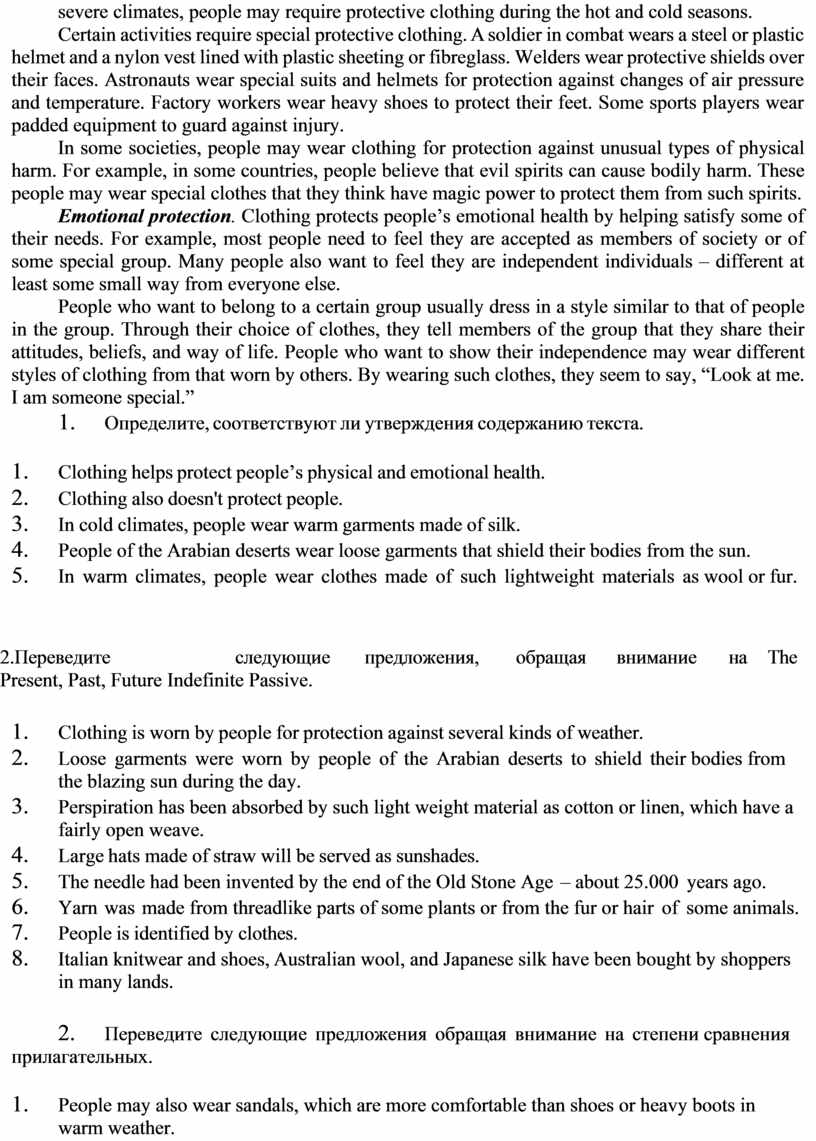
In many places, people must wear clothes for protection against several kinds of weather. For example, people of the Arabian deserts wear loose garments that shield their bodies from the blazing sun during the day. The same garments protect them against the cold night air. Even in less severe climates, people may require protective clothing during the hot and cold seasons.
Certain activities require special protective clothing. A soldier in combat wears a steel or plastic helmet and a nylon vest lined with plastic sheeting or fibreglass. Welders wear protective shields over their faces. Astronauts wear special suits and helmets for protection against changes of air pressure and temperature. Factory workers wear heavy shoes to protect their feet. Some sports players wear padded equipment to guard against injury.
In some societies, people may wear clothing for protection against unusual types of physical harm. For example, in some countries, people believe that evil spirits can cause bodily harm. These people may wear special clothes that they think have magic power to protect them from such spirits.
Emotional protection. Clothing protects people’s emotional health by helping satisfy some of their needs. For example, most people need to feel they are accepted as members of society or of some special group. Many people also want to feel they are independent individuals – different at least some small way from everyone else.
People who want to belong to a certain group usually dress in a style similar to that of people in the group. Through their choice of clothes, they tell members of the group that they share their attitudes, beliefs, and way of life. People who want to show their independence may wear different styles of clothing from that worn by others. By wearing such clothes, they seem to say, “Look at me. I am someone special.”
1. Определите, соответствуют ли утверждения содержанию текста.
1. Clothing helps protect people’s physical and emotional health.
2. Clothing also doesn't protect people.
3. In cold climates, people wear warm garments made of silk.
4. People of the Arabian deserts wear loose garments that shield their bodies from the sun.
5. In warm climates, people wear clothes made of such lightweight materials as wool or fur.
2.Переведите следующие предложения, обращая внимание на The Present, Past, Future Indefinite Passive.
1. Clothing is worn by people for protection against several kinds of weather.
2. Loose garments were worn by people of the Arabian deserts to shield their bodies from the blazing sun during the day.
3. Perspiration has been absorbed by such light weight material as cotton or linen, which have a fairly open weave.
4. Large hats made of straw will be served as sunshades.
5. The needle had been invented by the end of the Old Stone Age – about 25.000 years ago.
6. Yarn was made from threadlike parts of some plants or from the fur or hair of some animals.
7. People is identified by clothes.
8. Italian knitwear and shoes, Australian wool, and Japanese silk have been bought by shoppers in many lands.
2. Переведите следующие предложения обращая внимание на степени сравнения прилагательных.
1. People may also wear sandals, which are more comfortable than shoes or heavy boots in warm weather.
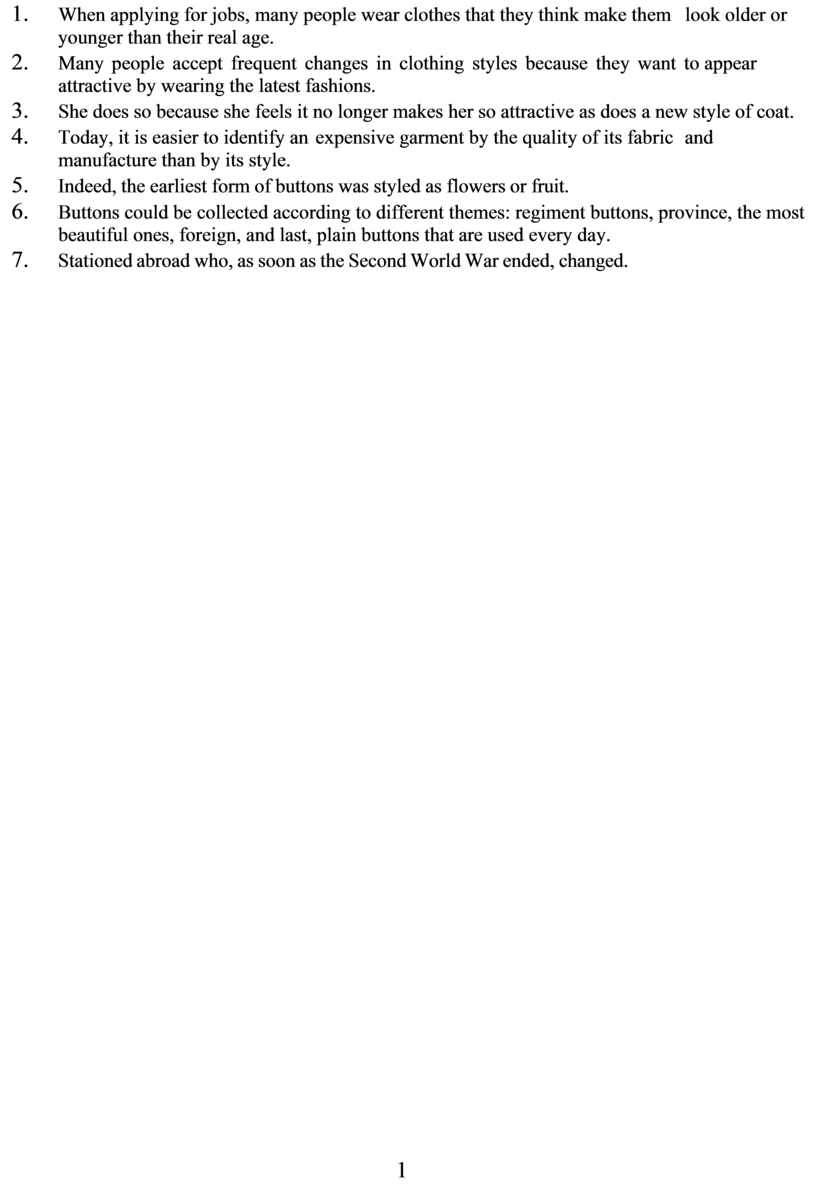
2. When applying for jobs, many people wear clothes that they think make them look older or younger than their real age.
3. Many people accept frequent changes in clothing styles because they want to appear attractive by wearing the latest fashions.
4. She does so because she feels it no longer makes her so attractive as does a new style of coat.
5. Today, it is easier to identify an expensive garment by the quality of its fabric and manufacture than by its style.
6. Indeed, the earliest form of buttons was styled as flowers or fruit.
7. Buttons could be collected according to different themes: regiment buttons, province, the most beautiful ones, foreign, and last, plain buttons that are used every day.
8. Stationed abroad who, as soon as the Second World War ended, changed.
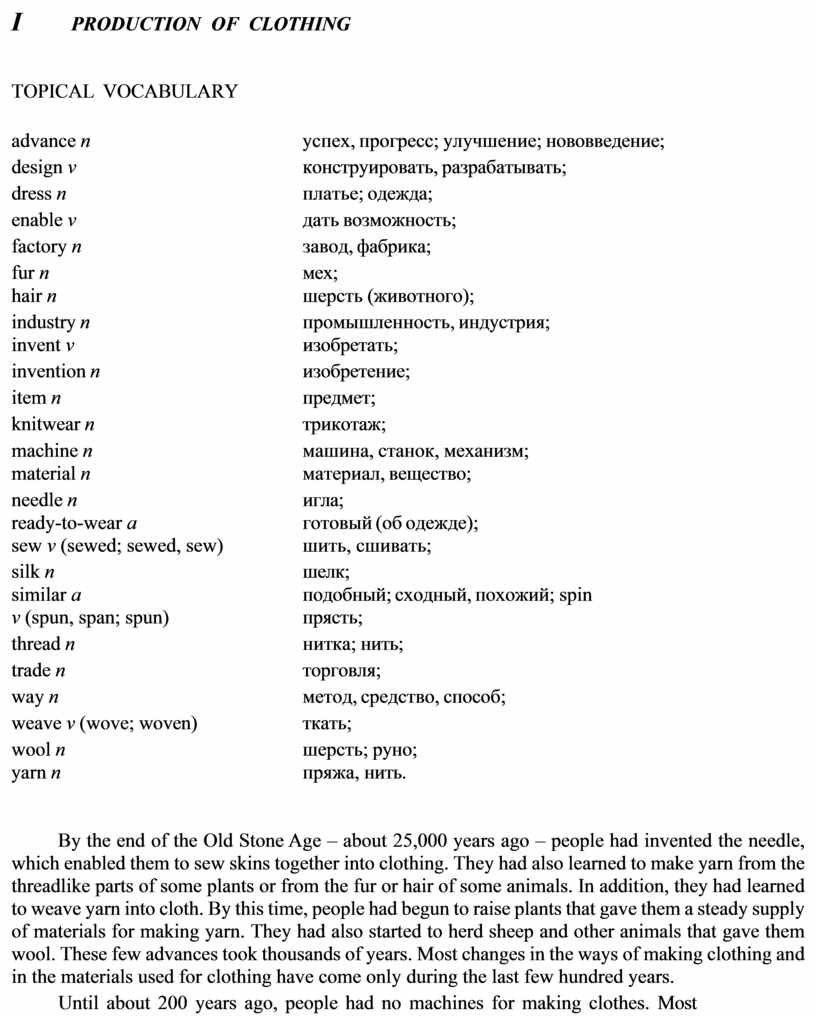
TOPICAL VOCABULARY
advance n успех, прогресс; улучшение; нововведение;
design v конструировать, разрабатывать;
dress n платье; одежда;
enable v дать возможность;
factory n завод, фабрика;
fur n мех;
hair n шерсть (животного);
industry n промышленность, индустрия;
invent v изобретать;
invention n изобретение;
item n предмет;
knitwear n трикотаж;
machine n машина, станок, механизм;
material n материал, вещество;
needle n игла;
ready-to-wear a готовый (об одежде); sew v (sewed; sewed, sew) шить, сшивать;
silk n шелк;
similar a подобный; сходный, похожий; spin v (spun, span; spun) прясть;
thread n нитка; нить;
trade n торговля;
way n метод, средство, способ;
weave v (wove; woven) ткать;
wool n шерсть; руно;
yarn n пряжа, нить.
By the end of the Old Stone Age – about 25,000 years ago – people had invented the needle, which enabled them to sew skins together into clothing. They had also learned to make yarn from the threadlike parts of some plants or from the fur or hair of some animals. In addition, they had learned to weave yarn into cloth. By this time, people had begun to raise plants that gave them a steady supply of materials for making yarn. They had also started to herd sheep and other animals that gave them wool. These few advances took thousands of years. Most changes in the ways of making clothing and in the materials used for clothing have come only during the last few hundred years.
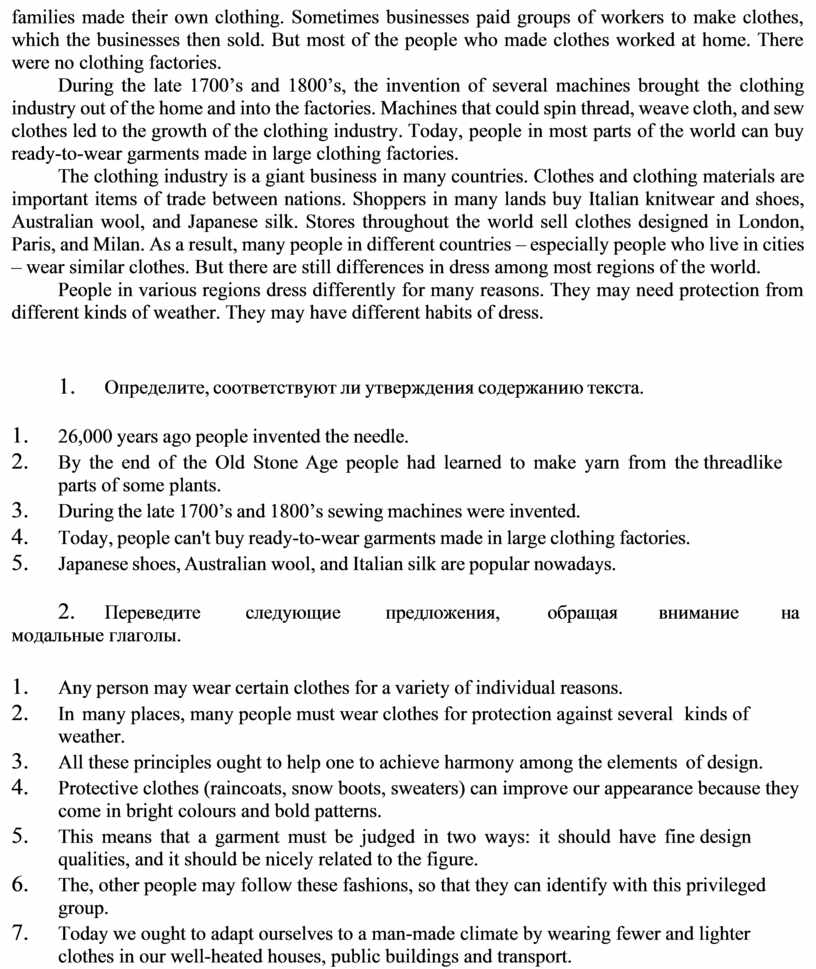
Until about 200 years ago, people had no machines for making clothes. Most
families made their own clothing. Sometimes businesses paid groups of workers to make clothes, which the businesses then sold. But most of the people who made clothes worked at home. There were no clothing factories.
During the late 1700’s and 1800’s, the invention of several machines brought the clothing industry out of the home and into the factories. Machines that could spin thread, weave cloth, and sew clothes led to the growth of the clothing industry. Today, people in most parts of the world can buy ready-to-wear garments made in large clothing factories.
The clothing industry is a giant business in many countries. Clothes and clothing materials are important items of trade between nations. Shoppers in many lands buy Italian knitwear and shoes, Australian wool, and Japanese silk. Stores throughout the world sell clothes designed in London, Paris, and Milan. As a result, many people in different countries – especially people who live in cities – wear similar clothes. But there are still differences in dress among most regions of the world.
People in various regions dress differently for many reasons. They may need protection from different kinds of weather. They may have different habits of dress.
1. Определите, соответствуют ли утверждения содержанию текста.
1. 26,000 years ago people invented the needle.
2. By the end of the Old Stone Age people had learned to make yarn from the threadlike parts of some plants.
3. During the late 1700’s and 1800’s sewing machines were invented.
4. Today, people can't buy ready-to-wear garments made in large clothing factories.
5. Japanese shoes, Australian wool, and Italian silk are popular nowadays.
2. Переведите следующие предложения, обращая внимание на модальные глаголы.
1. Any person may wear certain clothes for a variety of individual reasons.
2. In many places, many people must wear clothes for protection against several kinds of weather.
3. All these principles ought to help one to achieve harmony among the elements of design.
4. Protective clothes (raincoats, snow boots, sweaters) can improve our appearance because they come in bright colours and bold patterns.
5. This means that a garment must be judged in two ways: it should have fine design qualities, and it should be nicely related to the figure.
6. The, other people may follow these fashions, so that they can identify with this privileged group.
7. Today we ought to adapt ourselves to a man-made climate by wearing fewer and lighter clothes in our well-heated houses, public buildings and transport.
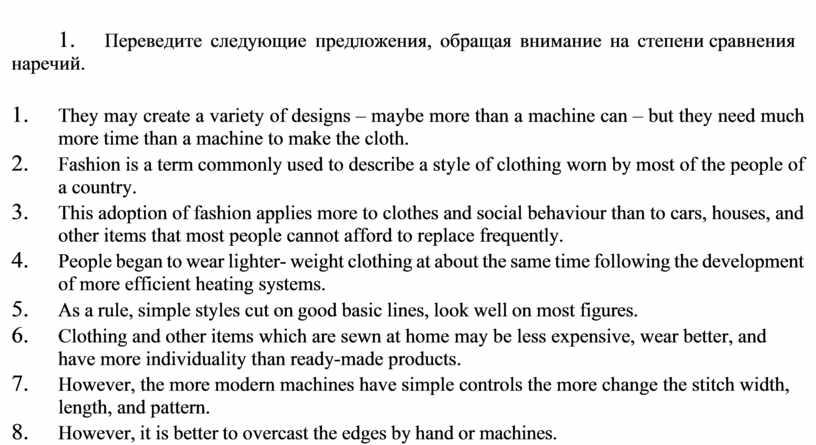
3. Переведите следующие предложения, обращая внимание на степени сравнения наречий.
1. They may create a variety of designs – maybe more than a machine can – but they need much more time than a machine to make the cloth.
2. Fashion is a term commonly used to describe a style of clothing worn by most of the people of a country.
3. This adoption of fashion applies more to clothes and social behaviour than to cars, houses, and other items that most people cannot afford to replace frequently.
4. People began to wear lighter- weight clothing at about the same time following the development of more efficient heating systems.
5. As a rule, simple styles cut on good basic lines, look well on most figures.
6. Clothing and other items which are sewn at home may be less expensive, wear better, and have more individuality than ready-made products.
7. However, the more modern machines have simple controls the more change the stitch width, length, and pattern.
8. However, it is better to overcast the edges by hand or machines.
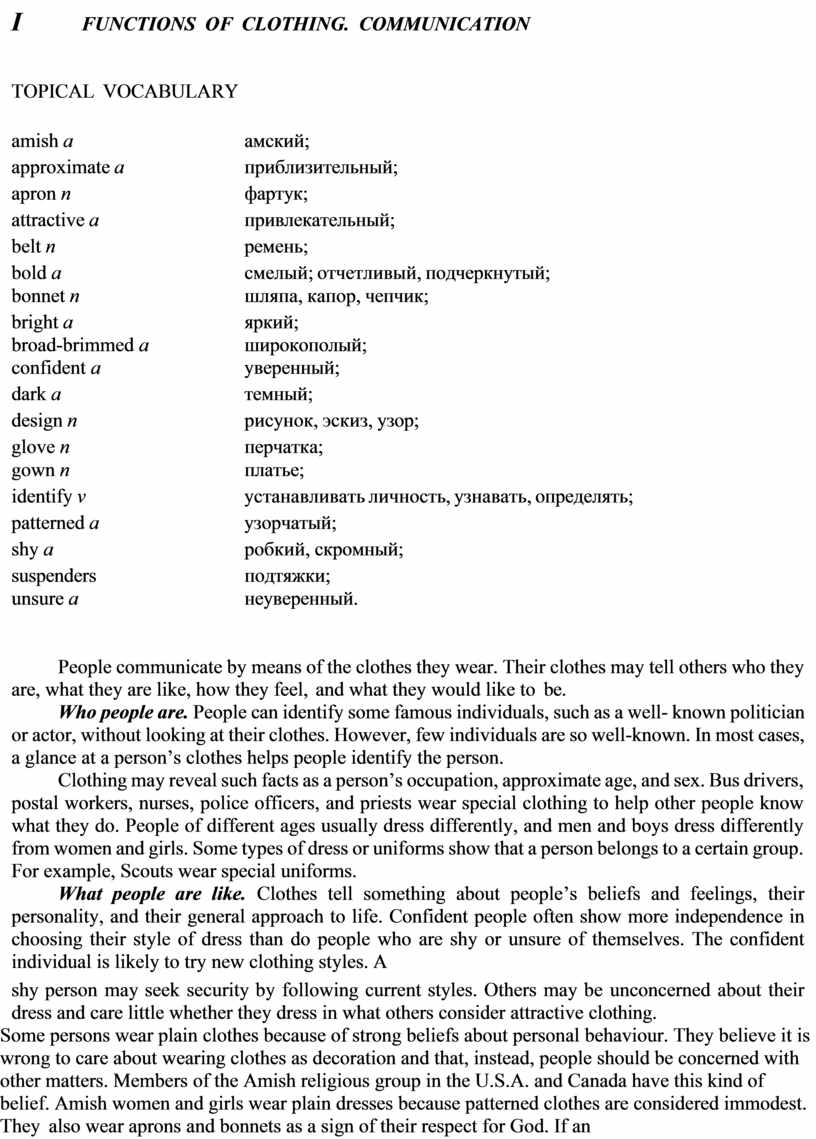
TOPICAL VOCABULARY
amish a амский;
approximate a приблизительный;
apron n фартук;
attractive a привлекательный;
belt n ремень;
bold a смелый; отчетливый, подчеркнутый;
bonnet n шляпа, капор, чепчик;
bright a яркий;
broad-brimmed a широкополый; confident a уверенный;
dark a темный;
design n рисунок, эскиз, узор;
glove n перчатка;
gown n платье;
identify v устанавливать личность, узнавать, определять;
patterned a узорчатый;
shy a робкий, скромный;
suspenders подтяжки;
unsure a неуверенный.
People communicate by means of the clothes they wear. Their clothes may tell others who they are, what they are like, how they feel, and what they would like to be.
Who people are. People can identify some famous individuals, such as a well- known politician or actor, without looking at their clothes. However, few individuals are so well-known. In most cases, a glance at a person’s clothes helps people identify the person.
Clothing may reveal such facts as a person’s occupation, approximate age, and sex. Bus drivers, postal workers, nurses, police officers, and priests wear special clothing to help other people know what they do. People of different ages usually dress differently, and men and boys dress differently from women and girls. Some types of dress or uniforms show that a person belongs to a certain group. For example, Scouts wear special uniforms.
What people are like. Clothes tell something about people’s beliefs and feelings, their personality, and their general approach to life. Confident people often show more independence in choosing their style of dress than do people who are shy or unsure of themselves. The confident individual is likely to try new clothing styles. A
shy person may seek security by following current styles. Others may be unconcerned about their dress and care little whether they dress in what others consider attractive clothing.
Some persons wear plain clothes because of strong beliefs about personal behaviour. They believe it is wrong to care about wearing clothes as decoration and that, instead, people should be concerned with other matters. Members of the Amish religious group in the U.S.A. and Canada have this kind of belief. Amish women and girls wear plain dresses because patterned clothes are considered immodest. They also wear aprons and bonnets as a sign of their respect for God. If an Amish woman is married, she wears a black bonnet. If she is single, she wears a white one. And they never wear jewellery or make-up. Men and boys wear dark-coloured suits, plain shirts, suspenders and black or straw broad-brimmed hats. Belts, sweaters, ties and gloves are forbidden.
How people feel. Clothing often helps communicate the mood of a person. People who are sad or upset may show little concern for their appearance. Clothing with bright colours and bold designs may indicate happiness. Such clothing may even brighten the mood of others who see a person wearing it.
In many societies, clothing of certain colours has special meanings. For example, people in mourning may wear black clothes. But colours may have different meanings in various societies. A colour worn for weddings in one country may be worn for funerals in another land. Brides in many countries wear white gowns. But people in India wear white clothes to mourn the dead.
What people want to be. People often wear clothes that they think make them appear a certain way. People may dress to hide their feelings or their age, or they may dress like people in some occupation. A person who feels sad may wear bright colours to hide this mood from others. Many children enjoy wearing the clothes of their mother or father to ‘’play grown-up’’. When applying for jobs, many people wear clothes that they think make them look older or younger than their real age. They may also dress as they think people holding a certain job should look.
1. Определите, соответствуют ли утверждения содержанию текста.
1. People communicate by means of the clothes they wear.
2. Bus drivers, postal workers, nurses, police officers, and priests don't wear special clothing.
3. Clothing often helps communicate the mood of a person.
4. Colours have the same meaning in different countries and societies.
5. A person who feels sad may wear bright colours to hide this mood from others.
2. Переведите следующие предложения, обращая внимание на эквиваленты модальных глаголов.
1. But the custom in Mexico is to wear straw hats with brims that tilt up.
2. Overseas, jeans had to wait slightly longer for their time to come.
3. Sheep were able to provide most of the wool that people use though such animals as the alpaca and various breeds of goats are also known to furnish wool.
4. Clothing manufacturers have to buy fabrics in large rolls called bolts.
5. Most sewers will be able to handle only one or two parts of a garment.
6. Napped fabrics, such as velvet and corduroy, have to be laid out with extra care so the nap runs in the same direction on all the pieces.
7. Therefore, we are unlikely to face a buttons deficit in the near future.
8. The main thing to remember when choosing buttons is that they are to be matched to the clothes, and not the other way around.
3. Переведите следующие предложения, обращая внимание на условные предложения с should, would.
1. You may have a dress which is pleasing in design, but if the colour combination was not attractive the effect of design should be lost.
2. If an Amish woman was married, she would wear a black bonnet.
3. Its use would become a custom if it was handed down from generation to generation.
4. The eye movement would have been smooth, if lines shapes, textures, and colours had been well organized.
5. You should purchase buttons made from uneven coconut, shells or polished wood, if you liked the warmth of hand-made objects.
6. If a fabric had been made of wool and nylon it would have been shrink- resistant because of the nylon content.
7. Mass production of clothing saves customers both the time it would take if they made the clothes themselves, and the money they would spend if their clothes were made by a dressmaker or tailor.
8. The buyers from stores should come to see them, if the designer made samples of the garments.
TOPICAL VOCABULARY
excellent a отличный;
expensive a дорогой;
fashion n мода; фасон, покрой;
pattern n модель; выкройка; рисунок, узор (на материи и т.п.); raincoat n плащ;
snow boots n зимние сапоги; sweater n свитер.
Most people want to wear clothing that makes them feel attractive – even if its chief purpose is protection or communication. Such protective clothes as raincoats, snow boots, and sweaters come in bright colours and bold patterns. Some women wear expensive furs more for beauty than for warmth. Even military uniforms are designed to improve the appearance of servicemen and servicewomen.
Many people accept frequent changes in clothing styles because they want to appear attractive by wearing the latest fashions. A woman may stop wearing an old coat that is still in excellent condition. She does so because she feels it no longer makes her so attractive as does a new style of coat.
Most people, no matter where they live, wear some kind of clothing. People wear clothes for three main reasons: protection, communication, decoration. Most clothing serves all three purposes.
Clothing helps protect people’s health. In many areas of the world, people need clothing for protection from the weather. In cold climates, people wear warm garments and warm shoes or boots. In warm climates, people wear clothes made of such light-weight materials. People in these climates sometimes wear white or light- coloured clothes, because such clothes reflect the sun’s rays. Clothing also protects people who work on dangerous jobs or take part in rough sports.
People communicate by the means of the clothes they wear. Clothing may reveal a person’s occupation, approximate age, and sex. Clothes tell something about people’s feelings and personality. Clothing helps communicate the mood of a person. For example, clothing with bright colours and bold designs may indicate happiness.
Most people want to wear clothing that makes them attractive. Many people wear clothes more for decoration than for protection. Protective clothes (raincoats, snow boots, sweaters) can improve our appearance because they come in bright colours and bold patterns.
1. Определите, соответствуют ли утверждения содержанию текста.
1. Most people want to wear clothing that makes them feel attractive.
2. People wear clothes for 2 main reasons: protection and communication.
3. People communicate by the means of the clothes they wear.
4. Clothing communicates the mood of a person.
5. Many people wear clothes more for decoration than for protection.
2. Переведите следующие предложения, обращая внимание на причастия I и II.
1. Applying for jobs, many people wear clothes that they think make them look older or younger than their real age.
2. A colour worn for weddings in one country may be worn for funerals in another land.
3. Added liability company Skitex Plus and join venture and limited liability company Belkastelplast are two leading Belarusian manufactures of findings, but buttons in particular.
4. Having been greatly improved sewing machines, people could do most sewing by machine.
5. Tacking stitches serve as a guide for permanent machine stitching.
6. An experienced sewer designing her own pattern.
7. Cutting out, and sewing of plaid, striped, and rapped fabrics require extra skill and time.
8. Having illustrated all the pieces that are enclosed.
3. Переведите следующие предложения, обращая внимание на указательные местоимения.
1. This stitch is used if the stitches must not show.
2. However, those modern machines have simple controls.
3. Such sewers should avoid fabrics with plaids, stripes, or nap.
4. These fabrics consist of manufactured fibres sometimes called synthetic.
5. Such clothing centres of the world are London, New York City, Paris, and Milan.
6. The same production is oriented to manufacture of a broad range of production.
7. Those buttons could be collected.
8. Today, such terms are used – buttonophilia and buttonistics.
TOPICAL VOCABULARY
affect v влиять;
artificial a искусственный;
available a доступный, имеющийся в наличии; brim n поля (шляпы);
common a общий; общепринятый, распространенный; create v создавать;
custom n обычай;
dye v окрашивать;
fibre n волокно;
hand-powered a с ручным управлением; leather n кожа (выделанная);
natural a естественный, природный, натуральный; nylon n нейлон;
print v набивать (ситец);
process n технологический процесс, прием, способ; rayon n искусственный шелк; вискоза;
slant down v загибаться вниз; spread v распространяться;
textile n (текстильное изделие); ткань;
tilt up v загибаться вверх;
vary v меняться, изменяться; разниться, расходиться; veil n вуаль;
yard n ярд (91,44 см).
For thousands of years, people in different parts of the world have worn different types of clothes. Today, the Western style of clothing – common in Europe, Canada and the United States – has spread throughout the world. But the clothing worn by different peoples still varies widely, especially among people who do not live in cities.
Why clothing varies. There are four main reasons for worldwide variety in clothing:
1) difference in the purposes for wearing clothes;
2) difference in the materials available for making clothes;
3) difference in ways of making clothes;
4) difference in clothing customs.
These differences result in clothing variety from continent to continent, from country to country, and even from person to person.
Purpose. People wear clothes for three basic purposes – protection, communication, and decoration. But people in various regions of the world often need different kinds of protection, especially if they live in different climates. People may also wear clothes that have a special meaning not understood by people of other countries. For example, many Muslim women wear veils in public because their religion requires them to hide their faces from strangers. In addition, people have different ideas about what makes clothing attractive.
Available materials. People in different countries may have different materials available for making clothes. For example, the people of France can wear clothes made from a much greater variety of materials than can the people of China. French stores sell garments made not only of such natural materials as cotton, fur, leather, silk, and wool, but also of such artificially made fibres as nylon and rayon. Most people in China must choose clothing made of cotton.
Ways of making clothes vary from country to country. Highly industrialized nations, such as Canada, Japan, the United States, and western European countries, use many kinds of machines and many processes to make clothes. For example, textile manufacturers in those countries can rapidly produce yards of cotton cloth woven many different ways. They can also dye and print the cloth and rapidly sew it into many different kinds of clothes.
People living in a village in India may have only hand-powered equipment for weaving cloth. They may create a variety of designs – maybe more than a machine can – but they need much more time than a machine to make the cloth. They would also have to sew clothes by hand.
Clothing customs affect styles. These customs develop in a country as generation after generation of children learns what clothes to wear. For example, a Mexican farmer and a Chinese farmer may wear clothes made from similar materials and by the same basic methods. They also may need their clothes for the same purpose. But the custom in Mexico is to wear straw hats with brims that tilt up. In China, custom calls for straw hats with brims that slant down.
1. Определите, соответствуют ли утверждения содержанию текста.
1. People wear clothes for three basic purposes — protection, communication, and decoration.
2. Muslim women don't wear veils in public.
3. People have different ideas about what makes clothing attractive.
4. Clothing customs can't affect styles.
5. A Mexican farmer and a Chinese farmer may wear clothes made from similar materials.
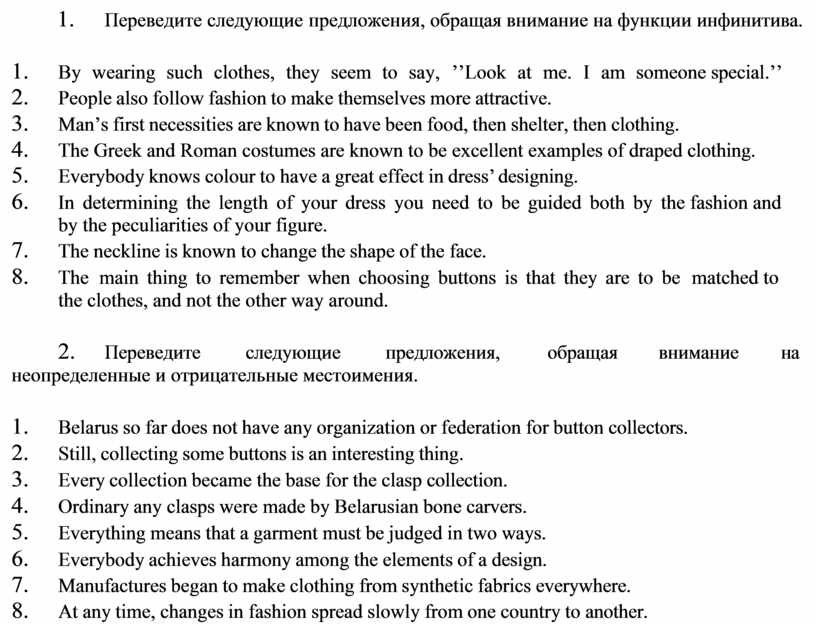
2. Переведите следующие предложения, обращая внимание на функции инфинитива.
1. By wearing such clothes, they seem to say, ’’Look at me. I am someone special.’’
2. People also follow fashion to make themselves more attractive.
3. Man’s first necessities are known to have been food, then shelter, then clothing.
4. The Greek and Roman costumes are known to be excellent examples of draped clothing.
5. Everybody knows colour to have a great effect in dress’ designing.
6. In determining the length of your dress you need to be guided both by the fashion and by the peculiarities of your figure.
7. The neckline is known to change the shape of the face.
8. The main thing to remember when choosing buttons is that they are to be matched to the clothes, and not the other way around.
3. Переведите следующие предложения, обращая внимание на неопределенные и отрицательные местоимения.
1. Belarus so far does not have any organization or federation for button collectors.
2. Still, collecting some buttons is an interesting thing.
3. Every collection became the base for the clasp collection.
4. Ordinary any clasps were made by Belarusian bone carvers.
5. Everything means that a garment must be judged in two ways.
6. Everybody achieves harmony among the elements of a design.
7. Manufactures began to make clothing from synthetic fabrics everywhere.
8. At any time, changes in fashion spread slowly from one country to another.
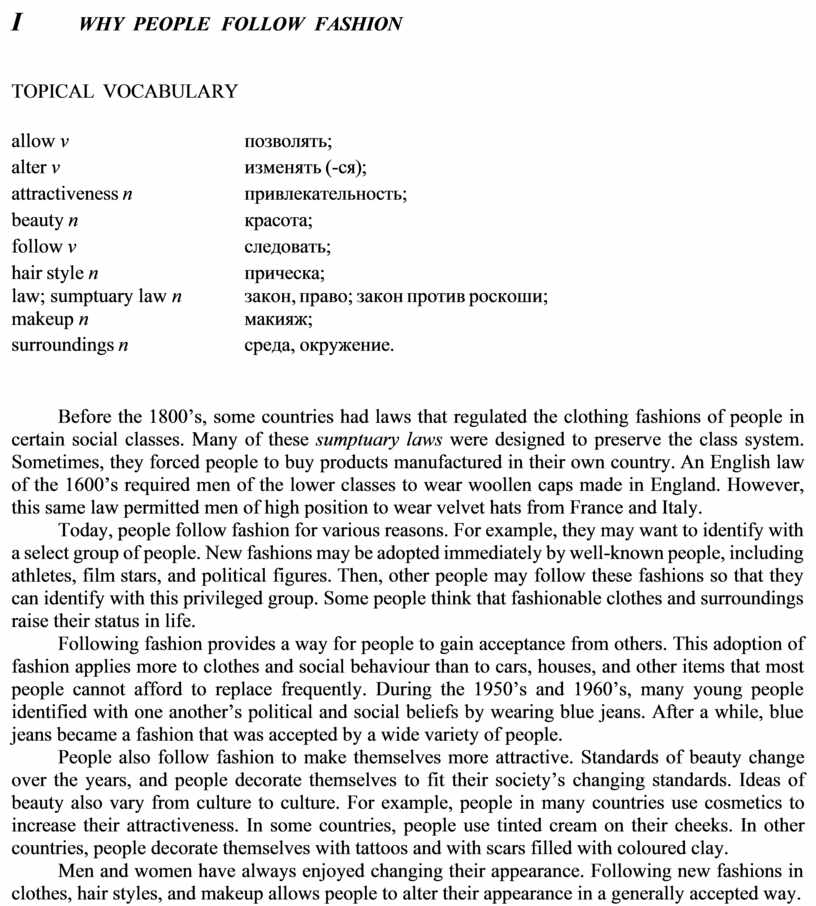
TOPICAL VOCABULARY
allow v позволять;
alter v изменять (-ся);
attractiveness n привлекательность;
beauty n красота;
follow v следовать;
hair style n прическа;
law; sumptuary law n закон, право; закон против роскоши; makeup n макияж;
surroundings n среда, окружение.
Before the 1800’s, some countries had laws that regulated the clothing fashions of people in certain social classes. Many of these sumptuary laws were designed to preserve the class system. Sometimes, they forced people to buy products manufactured in their own country. An English law of the 1600’s required men of the lower classes to wear woollen caps made in England. However, this same law permitted men of high position to wear velvet hats from France and Italy.
Today, people follow fashion for various reasons. For example, they may want to identify with a select group of people. New fashions may be adopted immediately by well-known people, including athletes, film stars, and political figures. Then, other people may follow these fashions so that they can identify with this privileged group. Some people think that fashionable clothes and surroundings raise their status in life.
Following fashion provides a way for people to gain acceptance from others. This adoption of fashion applies more to clothes and social behaviour than to cars, houses, and other items that most people cannot afford to replace frequently. During the 1950’s and 1960’s, many young people identified with one another’s political and social beliefs by wearing blue jeans. After a while, blue jeans became a fashion that was accepted by a wide variety of people.
People also follow fashion to make themselves more attractive. Standards of beauty change over the years, and people decorate themselves to fit their society’s changing standards. Ideas of beauty also vary from culture to culture. For example, people in many countries use cosmetics to increase their attractiveness. In some countries, people use tinted cream on their cheeks. In other countries, people decorate themselves with tattoos and with scars filled with coloured clay.
Men and women have always enjoyed changing their appearance. Following new fashions in clothes, hair styles, and makeup allows people to alter their appearance in a generally accepted way.
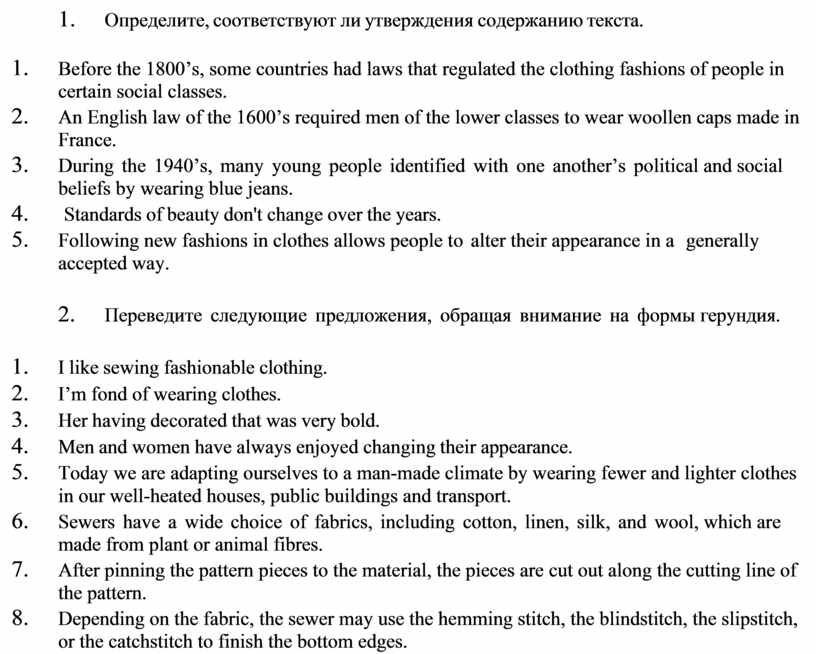
1. Определите, соответствуют ли утверждения содержанию текста.
1. Before the 1800’s, some countries had laws that regulated the clothing fashions of people in certain social classes.
2. An English law of the 1600’s required men of the lower classes to wear woollen caps made in France.
3. During the 1940’s, many young people identified with one another’s political and social beliefs by wearing blue jeans.
4. Standards of beauty don't change over the years.
5. Following new fashions in clothes allows people to alter their appearance in a generally accepted way.
2. Переведите следующие предложения, обращая внимание на формы герундия.
1. I like sewing fashionable clothing.
2. I’m fond of wearing clothes.
3. Her having decorated that was very bold.
4. Men and women have always enjoyed changing their appearance.
5. Today we are adapting ourselves to a man-made climate by wearing fewer and lighter clothes in our well-heated houses, public buildings and transport.
6. Sewers have a wide choice of fabrics, including cotton, linen, silk, and wool, which are made from plant or animal fibres.
7. After pinning the pattern pieces to the material, the pieces are cut out along the cutting line of the pattern.
8. Depending on the fabric, the sewer may use the hemming stitch, the blindstitch, the slipstitch, or the catchstitch to finish the bottom edges.
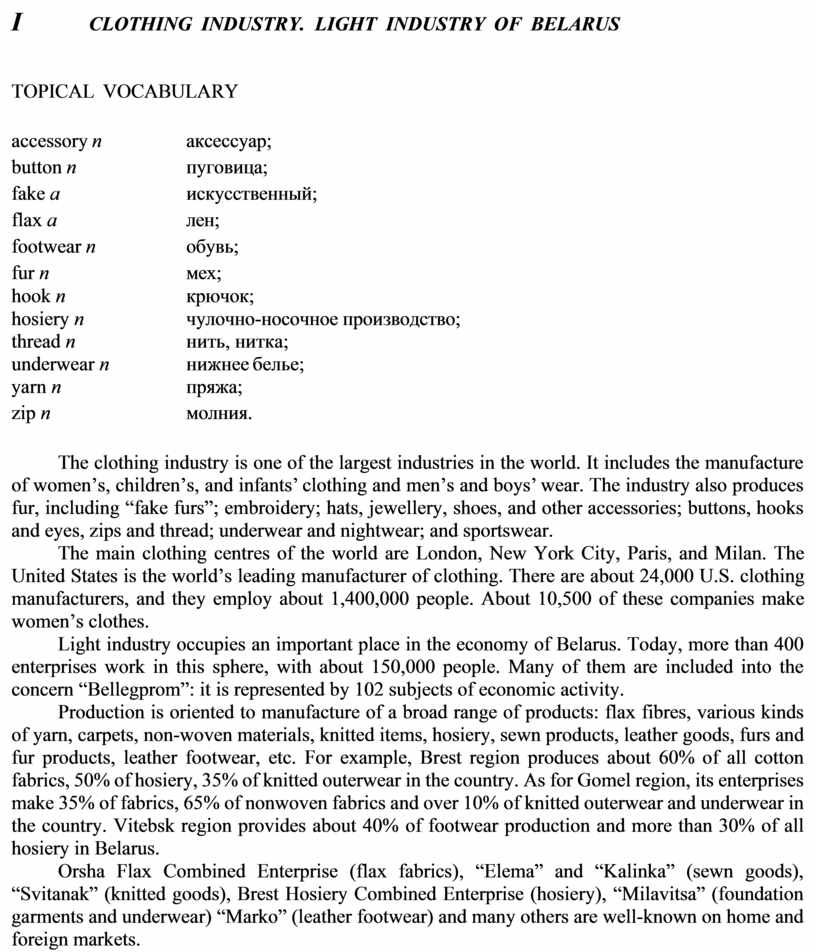
TOPICAL VOCABULARY
accessory n аксессуар;
button n пуговица;
fake a искусственный;
flax a лен;
footwear n обувь;
fur n мех;
hook n крючок;
hosiery n чулочно-носочное производство; thread n нить, нитка;
underwear n нижнее белье; yarn n пряжа;
zip n молния.
The clothing industry is one of the largest industries in the world. It includes the manufacture of women’s, children’s, and infants’ clothing and men’s and boys’ wear. The industry also produces fur, including “fake furs”; embroidery; hats, jewellery, shoes, and other accessories; buttons, hooks and eyes, zips and thread; underwear and nightwear; and sportswear.
The main clothing centres of the world are London, New York City, Paris, and Milan. The United States is the world’s leading manufacturer of clothing. There are about 24,000 U.S. clothing manufacturers, and they employ about 1,400,000 people. About 10,500 of these companies make women’s clothes.
Light industry occupies an important place in the economy of Belarus. Today, more than 400 enterprises work in this sphere, with about 150,000 people. Many of them are included into the concern “Bellegprom”: it is represented by 102 subjects of economic activity.
Production is oriented to manufacture of a broad range of products: flax fibres, various kinds of yarn, carpets, non-woven materials, knitted items, hosiery, sewn products, leather goods, furs and fur products, leather footwear, etc. For example, Brest region produces about 60% of all cotton fabrics, 50% of hosiery, 35% of knitted outerwear in the country. As for Gomel region, its enterprises make 35% of fabrics, 65% of nonwoven fabrics and over 10% of knitted outerwear and underwear in the country. Vitebsk region provides about 40% of footwear production and more than 30% of all hosiery in Belarus.
Orsha Flax Combined Enterprise (flax fabrics), “Elema” and “Kalinka” (sewn goods), “Svitanak” (knitted goods), Brest Hosiery Combined Enterprise (hosiery), “Milavitsa” (foundation garments and underwear) “Marko” (leather footwear) and many others are well-known on home and foreign markets.
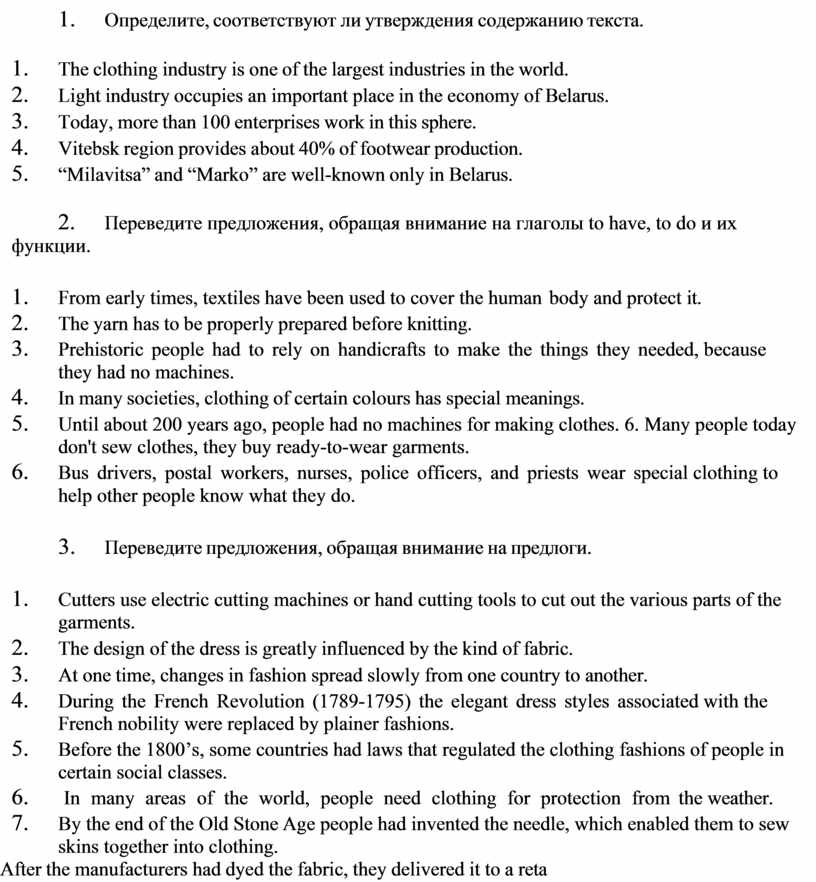
1. Определите, соответствуют ли утверждения содержанию текста.
1. The clothing industry is one of the largest industries in the world.
2. Light industry occupies an important place in the economy of Belarus.
3. Today, more than 100 enterprises work in this sphere.
4. Vitebsk region provides about 40% of footwear production.
5. “Milavitsa” and “Marko” are well-known only in Belarus.
2. Переведите предложения, обращая внимание на глаголы to have, to do и их функции.
1. From early times, textiles have been used to cover the human body and protect it.
2. The yarn has to be properly prepared before knitting.
3. Prehistoric people had to rely on handicrafts to make the things they needed, because they had no machines.
4. In many societies, clothing of certain colours has special meanings.
5. Until about 200 years ago, people had no machines for making clothes. 6. Many people today don't sew clothes, they buy ready-to-wear garments.
6. Bus drivers, postal workers, nurses, police officers, and priests wear special clothing to help other people know what they do.
3. Переведите предложения, обращая внимание на предлоги.
1. Cutters use electric cutting machines or hand cutting tools to cut out the various parts of the garments.
2. The design of the dress is greatly influenced by the kind of fabric.
3. At one time, changes in fashion spread slowly from one country to another.
4. During the French Revolution (1789-1795) the elegant dress styles associated with the French nobility were replaced by plainer fashions.
5. Before the 1800’s, some countries had laws that regulated the clothing fashions of people in certain social classes.
6. In many areas of the world, people need clothing for protection from the weather.
7. By the end of the Old Stone Age people had invented the needle, which enabled them to sew skins together into clothing.
8. After the manufacturers had dyed the fabric, they delivered it to a reta
9.


Материалы на данной страницы взяты из открытых источников либо размещены пользователем в соответствии с договором-офертой сайта. Вы можете сообщить о нарушении.