Поделиться


 БАС_2 курс.docx
AVIATION ENGLISH
For second-year students
 |
 |
 |
ЛЕКЦИОННЫЕ ЗАНЯТИЯ
ЛЕКЦИЯ № 1
Определение авиационного языка
С момента своего зарождения, авиация претерпела немало изменений. Одно, что осталось неизменным, – это важность английского языка в этой отрасли. Английский сегодня является международным языком авиации, используемым во всех аспектах отрасли: от управления полетами (flight control) до обслуживания пассажиров (passenger service).
Ключевым аспектом использования английского в авиации является безопасность. Воздушное пространство – это глобальная система, где любые недопонимания могут привести к серьезным последствиям. Единый язык обеспечивает понимание между пилотами, диспетчерами и другими членами экипажа, независимо от их национальности.
Приведем пример. Допустим, пилот (pilot) из Китая летит через территорию Великобритании и слышит в эфире сообщение от английского диспетчера (air traffic controller). Если бы не стандартный авиационный английский, они могли бы столкнуться с трудностями в общении. В данном случае английский становится своеобразным "мостом", обеспечивающим эффективное и безопасное взаимодействие.
Английский язык в авиации имеет свои специфические особенности. Это не просто общий английский, это специализированный диалект с уникальной лексикой и грамматикой. В авиационном английском есть определенный набор слов и фраз, которые обычно не используются в повседневной речи. Например, слова и выражения, такие как "squawk" (код ответчика), "roger" (понял), "wilco" (выполню), и многие другие.
Особенно важен правильный выбор слов при передаче чисел, времени и координат. Например, число 9 произносится как "niner", чтобы избежать путаницы с числом 5 ("five"), которое звучит похоже в условиях шума или плохой связи.
Специфика английского в авиации требует не только знания лексики, но и умения применять ее в стрессовых ситуациях. В условиях аварийных ситуаций, быстрота и точность общения становятся критически важными.
Все это подчеркивает важность профессионального обучения авиационному английскому. Он требует специализированного подхода и опыта, как в области авиации, так и в области преподавания английского языка.
Английский как международный язык авиации: исторический контекст и стандарты ICAO
Английский язык стал глобальным языком авиации, в основном, из-за двух основных факторов: исторического и практического. Исторически, авиация развивалась наиболее быстро и эффективно в англоязычных странах, таких как США и Великобритания. Это привело к тому, что английский язык стал доминирующим в авиационной терминологии и технической документации.
С практической точки зрения, необходимость в унификации языка общения в авиации стала очевидной для обеспечения безопасности полетов. При этом выбор пал на английский язык, как наиболее широко используемый международный язык.
Это привело к тому, что Международная организация гражданской авиации (ICAO) в 2008 году установила стандарты языковой грамотности для всех авиационных профессионалов, использующих английский для международных радиотелефонных связей.
Согласно этим стандартам (Language Proficiency Requirements, LPR), любой член экипажа, включая пилотов, бортинженеров и диспетчеров, должен обладать определенным уровнем владения английским языком. Это включает в себя понимание и произношение, грамматику, словарный запас, говорение и понимание на слух. Минимально допустимый уровень – это уровень 4 по шкале ICAO, который соответствует уровню "оперативного профессионала" (Operational Professional) или B1 по шкале CEFR.
Эти требования были введены для обеспечения безопасности полетов и эффективного взаимодействия между различными участниками авиационной индустрии. Специалисты авиации всего мира теперь должны уметь свободно общаться на английском языке, чтобы успешно выполнять свои профессиональные обязанности.
Авиационный английский: введение в ключевые термины и фразы
Авиационный английский (Aviation English) представляет собой уникальный диалект, в котором многие общеупотребительные слова и фразы получают новое значение. Давайте рассмотрим некоторые из самых важных терминов и фраз, которые используются в этой области.
Изучение этих терминов и фраз значительно поможет вам в общении в сфере авиации на английском языке. Однако помните, что главное в общении - это ясность и понимание, поэтому важно правильно использовать эти термины в контексте.
Алфавит и аббревиатуры в авиационном английском
Авиация имеет свой уникальный язык, состоящий из многочисленных аббревиатур и специализированного алфавита - Алфавита ICAO (International Civil Aviation Organization), который облегчает общение на международном уровне и способствует безопасности полетов. Погрузимся в эти детали и исследуем полный алфавит и основные аббревиатуры, используемые в авиации.
ICAO Фонетический Алфавит:
Всемирно признанный и используемый в авиации, фонетический алфавит ICAO состоит из 26 слов, каждое из которых соответствует букве английского алфавита:
|
|
|
|
Авиационные Аббревиатуры:
Авиация полна аббревиатур, обеспечивающих точное и эффективное общение. Вот некоторые из них:
|
ACARS - Aircraft
Communications Addressing and Reporting System. |
ASRS - Aviation Safety
Reporting System - Система отчетов о безопасности авиации. |
|
EGPWS - Enhanced Ground
Proximity Warning System. |
FMS - Flight Management System
(Система управления
полетом) |
|
ILS - Instrument Landing System (Система
посадки по приборам) |
NOTAM - Notice to Airmen (Уведомление для
авиаторов) |
|
SOP - Standard Operating
Procedure - Стандартная процедура выполнения работы. |
TOGA - Takeoff/Go-around -
Взлёт/Отказ от посадки. |
Давайте посмотрим, чем авиационный язык отличается от общего языка. Сначала небольшая историческая справка.
Английский язык давно является языком межнационального общения, начиналось это еще со времен колоний Великобритании. На территориях многочисленных английских колоний сначала использовались так называемые пиджины (Pidgin-English), которые состояли из смеси местного(-ых) языка(-ов) и упрощенных форм английского языка. Окончательно английский язык в качестве lingua franca утвердился после Второй мировой войны. США не только меньше всех пострадали от последствий войны, но и сумели занять лидирующие позиции в экономике, науке и технике. «За американским долларом стоял английский язык» (David Cristal). В настоящее время для 70% людей, говорящих на английском языке, он не является родным языком.
В радиосвязи на заре развития авиации использовался сначала французский язык, о чем свидетельствует некоторое количество слов французского происхождения во фразеологии радиообмена. Однако в 30-е и 40-е годы, после Второй мировой войны особенно, в авиации английский язык утвердился в качестве языка международного общения. На земном шаре еще остались регионы, где языками международного общения являются испанский и китайские языки, и они используются в радиообмене. К сожалению, русский язык после крушения Советского Союза утратил свои позиции в этом качестве, уступив их английскому языку.
Авиационный английский язык – это язык для специальных целей, или профильно- ориентированный язык. О языках для специальных целей (English for Specific Purposes - ESP) серьезно заговорили в 60-х годах прошлого века.
К концу 80-х были сформулированы основные понятия, что такое языки для специальных целей. Одно из определений было дано в 1987 году: язык для специальных целей – это «скорее подход, чем продукт» (Hutchinson and Waters). По мнению авторов, основой языка для специальных целей является простой вопрос: для чего учащемуся необходимо изучать иностранный язык? В какой области, при каких обстоятельствах учащийся собирается использовать язык?
Позже были даны и другие определения языка для специальных целей, мы приведем одно из последних, наиболее полное.
Абсолютные характеристики:
• Английский язык для специальных целей предназначен для удовлетворения конкретных потребностей учащегося;
• Английский язык для специальных целей использует методологию и виды деятельности, лежащие в основе дисциплины, которую он обслуживает. Английский язык для специальных целей сосредоточен на языке (грамматика, лексика, регистр), навыках, дискурсе и стиле, присущим этому роду деятельности.
Переменные характеристики:
• Английский язык может относиться или быть разработан к/для конкретной дисциплины;
• Английский язык для специальных целей может использовать в конкретной ситуации обучения методы, отличные от общего английского языка;
• Английский язык для специальных целей разрабатывается скорее всего для взрослых учащихся, как для высших учебных заведений, так и для обучения на рабочем месте. Однако он может быть применен для учащихся средней школы;
• Английский язык для специальных целей разрабатывается большей частью для студентов среднего и продвинутого уровней. Многие курсы английского языка для специальных целей предполагают наличие основных знаний языковой системы, но он может быть использован и с начинающими.
Авиационный английский язык соответствует всем перечисленным характеристикам. Авиационным английским языком пользуются диспетчеры и пилоты для ведения радиосвязи, бортпроводники для общения с пассажирами во время полета, производители воздушных судов для написания различных руководств по эксплуатации, составители сборников аэронавигационной информации, разработчики оборудования для организации и управления воздушным движением, метеорологи и т. д.
Лекция №3
Языковые требования ИКАО
Экзамен ICAO (International Civil Aviation Organization), по сути, представляет собой тщательную проверку вашего владения английским языком в контексте авиации. Этот экзамен разработан таким образом, чтобы определить, насколько хорошо вы можете общаться на английском языке в различных сценариях и условиях полета.
Структура экзамена ICAO:
Требования к языковым навыкам:
Сдав экзамен ICAO, вы не только докажете свое владение английским языком на достаточном уровне для выполнения полетных задач, но также продемонстрируете свою способность быть эффективным участником международной авиационной сообщества.
Ресурсы для изучения авиационного английского
Авиационный английский — это уникальный и специализированный диалект английского языка, который требует дополнительной подготовки и практики. Чтобы помочь вам в этом пути, я собрал некоторые из лучших ресурсов для изучения авиационного английского.
Однако, помимо использования этих ресурсов, важно помнить, что навык языка — это что-то, что приобретается со временем и практикой. Не отчаивайтесь, если вначале авиационный английский покажется сложным; продолжайте учиться и практиковаться, и вы увидите прогресс.
Практические занятия
Topic № 4: Understanding Aviation Language
Aviation language, also known as aeronautical English, is a specialized form of English used in the aviation industry. It includes specific vocabulary, phrases, and communication protocols that are essential for safety and efficiency in aviation operations. This language is used by pilots, air traffic controllers, and ground crew to ensure clear and precise communication.
Key Features of Aviation Language
1. Standardized Vocabulary: Aviation language uses standardized terms to avoid misunderstandings. For example, "takeoff" refers to the moment an aircraft leaves the ground, while "landing" is when it returns to the ground.
2. Phonetic Alphabet: The NATO phonetic alphabet (e.g., Alpha, Bravo, Charlie) is used to spell out letters clearly over radio communications.
3. Clear Communication: Aviation communication must be concise and unambiguous. For instance, instead of saying "I see you," a pilot might say "I have you in sight."
4. International Standards: The International Civil Aviation Organization (ICAO) sets standards for aviation language to ensure consistency across different countries and languages.
Vocabulary
• Altitude: The height of an aircraft above sea level.
• Taxiing: The movement of an aircraft on the ground.
• Runway: A designated area for aircraft takeoff and landing.
• Cockpit: The area where pilots control the aircraft.
• Flight Plan: A document outlining the intended route and details of a flight.
Exercises
1. Vocabulary Matching: Match the aviation terms with their definitions.
|
Term |
Definition |
|
A. Altitude B. Taxiing C. Runway D. Cockpit E. Flight Plan |
1. Area for takeoff and landing 2. Height above sea level 3. Movement on the ground 4. Control area for pilots 5. Document detailing flight route |
2. Fill in the Blanks: Complete the sentences with the correct aviation terms from the vocabulary list.
a) The aircraft reached its cruising_______________of 30,000 feet.
b) After landing, the pilot began______________to the terminal.
c) The____________-is where the pilots operate the aircraft.
3. Short Answer Questions:
a) Why is standardized vocabulary important in aviation?
b) What is the purpose of a flight plan?
Topic № 5: ICAO Language Proficiency Requirements
The International Civil Aviation Organization (ICAO) has established language proficiency requirements to enhance safety in aviation operations. These requirements ensure that pilots and air traffic controllers can communicate effectively in English, which is the international language of aviation. The ICAO mandates that all personnel involved in international aviation must demonstrate a certain level of proficiency in English, particularly in speaking and listening.
Key Features of ICAO Language Proficiency Requirements
1. Proficiency Levels: ICAO has defined six levels of language proficiency, ranging from Level 1 (Pre-Elementary) to Level 6 (Expert). Most aviation professionals are required to achieve at least Level 4 (Operational).
2. Assessment Areas: The assessment focuses on the following areas:
• Pronunciation
• Structure
• Vocabulary
• Fluency
• Comprehension
• Interaction
3. Testing: Language proficiency tests must be conducted by authorized organizations, and the results are valid for a specific period (usually up to 3 years for Level 4 and above).
4. Continuous Improvement: Aviation professionals are encouraged to engage in continuous language training to maintain and improve their proficiency.
Vocabulary
• Proficiency: The ability to perform a task with skill and competence.
• Assessment: The evaluation of someone's skills or knowledge.
• Fluency: The ability to speak or write a language smoothly and easily.
• Interaction: Communication between two or more parties.
• Comprehension: The ability to understand spoken or written language.
Text for Reading Comprehension
The ICAO language proficiency requirements are crucial for ensuring safe and efficient communication in aviation. All pilots and air traffic controllers must demonstrate their ability to communicate effectively in English. The proficiency levels set by ICAO help standardize the expectations for language skills across different countries. Regular assessments ensure that aviation personnel remain competent in their language abilities. Continuous training is recommended to keep skills sharp and up-to-date.
Exercises
1. Vocabulary Matching: Match the ICAO terms with their definitions.
|
Term |
Definition |
|
A. Proficiency B. Assessment C. Fluency D. Interaction E. Comprehension |
1. The ability to understand language 2. Communication between parties 3. Evaluation of skills or knowledge 4. Smoothness and ease in speaking 5. Skill level in performing a task |
2. Fill in the Blanks: Complete the sentences with the correct terms from the vocabulary list.
a) To ensure safety, pilots must achieve a certain level of_____________in English.
b) Regular_______________helps maintain language skills in aviation.
c) Effective______________is essential for clear communication between pilots and air traffic controllers.
3. Short Answer Questions:
a) What are the six levels of ICAO language proficiency?
b) Why is continuous training important for aviation personnel regarding language skills?
Topic № 6: Use of Terminology and Abbreviations in Aviation Language
In the field of aviation, effective communication is crucial for safety and efficiency. This communication often involves the use of specific terminology and abbreviations that are universally recognized among aviation professionals. Understanding these terms and their meanings is essential for pilots, air traffic controllers, and other personnel involved in aviation operations.
Key Aviation Terms and Abbreviations
1. ATC - Air Traffic Control: The service responsible for managing aircraft movements in controlled airspace.
2. FBO - Fixed Base Operator: A service provider at an airport that offers various services, including fueling, maintenance, and hangaring.
3. VFR - Visual Flight Rules: A set of regulations under which a pilot operates an aircraft in weather conditions generally clear enough to allow the pilot to see where the aircraft is going.
4. IFR - Instrument Flight Rules: A set of regulations under which a pilot operates an aircraft in weather conditions generally poor enough to require reliance on instruments for navigation.
5. NOTAM - Notice to Airmen: A notice containing information about the condition of an airport or a change in airspace status that is essential for flight operations.
6. TCAS - Traffic Collision Avoidance System: An onboard system that helps prevent mid-air collisions by providing pilots with information about nearby aircraft.
Text for Reading Comprehension
Aviation relies heavily on specific terminology and abbreviations to facilitate clear and concise communication. For instance, Air Traffic Control (ATC) plays a vital role in ensuring the safe movement of aircraft within controlled airspace. Pilots must understand whether they are flying under Visual Flight Rules (VFR) or Instrument Flight Rules (IFR), as this determines their navigation methods.
Additionally, Notices to Airmen (NOTAMs) provide critical updates regarding airport conditions or airspace changes that pilots need to be aware of before and during flights. The Traffic Collision Avoidance System (TCAS) is another important component of modern aviation safety, alerting pilots to potential collision threats.
By familiarizing themselves with these terms and abbreviations, aviation professionals can communicate more effectively, thereby enhancing safety and operational efficiency.
Exercises
1. Vocabulary Matching: Match the aviation terms with their definitions.
|
Term |
Definition |
|
A. ATC | B. FBO C. VFR D. IFR E. NOTAM F. TCAS
|
1. Regulations for flying in good weather 2. A notice about airport conditions 3. Service managing aircraft movements 4. Regulations for flying in poor weather 5. A service provider at an airport 6. System preventing mid-air collisions
|
2. Fill in the Blanks: Complete the sentences using the correct aviation terms from the list above.
a) The____________is responsible for ensuring safe takeoffs and landings at airports.
b) Before flying, pilots check___________to stay informed about any changes that could affect their flight.
c) When flying under________________, pilots can navigate using visual references rather than instruments.
3. Short Answer Questions:
a) What is the purpose of a NOTAM?
b) Explain the difference between VFR and IFR.
Topic № 7: Key ICAO Documents
The International Civil Aviation Organization (ICAO) is a specialized agency of the United Nations that works to promote the safe and orderly development of international civil aviation. ICAO develops international standards and recommended practices (SARPs) that member states are encouraged to implement. Understanding these documents is essential for aviation professionals, as they provide the framework for aviation safety, security, and environmental protection.
Key ICAO Documents
1. Annex 1 - Personnel Licensing: This document outlines the requirements for the licensing of flight crew and maintenance personnel.
2. Annex 6 - Operation of Aircraft: This annex covers the operation of aircraft in international air transport, including safety management and operational procedures.
3. Annex 14 - Aerodromes: This document sets forth the standards for the design and operation of airports and aerodromes.
4. Annex 19 - Safety Management: This annex establishes a framework for safety management systems (SMS) in civil aviation organizations.
5. Convention on International Civil Aviation (Chicago Convention): This foundational document established ICAO and outlines the principles for international aviation cooperation.
Text for Reading Comprehension
The International Civil Aviation Organization (ICAO) plays a crucial role in ensuring global aviation safety and efficiency. One of its key responsibilities is the development of various documents that set international standards. For instance, Annex 1 focuses on personnel licensing, ensuring that all flight crew and maintenance personnel meet specific qualifications and training requirements.
Annex 6 addresses the operation of aircraft, providing guidelines for safe flight operations and emphasizing the importance of safety management systems. Similarly, Annex 14 outlines the standards for aerodrome design and operation, ensuring that airports are equipped to handle modern aircraft safely.
Furthermore, Annex 19 introduces a comprehensive framework for safety management, encouraging organizations to implement effective safety practices. The Chicago Convention, signed in 1944, serves as the foundation for ICAO's work, establishing principles for international cooperation in civil aviation.
By adhering to these ICAO documents, member states can enhance aviation safety and efficiency worldwide.
Exercises
1. Vocabulary Matching: Match the ICAO documents with their descriptions.
|
Document |
Description |
|
A. Annex 1 B. Annex 6 C. Annex 14 D. Annex 19 E. Chicago Convention |
1. Standards for airport design 2. Framework for safety management systems 3. Licensing requirements for aviation personnel 4. Guidelines for aircraft operation 5. Foundational document for international aviation |
2. Fill in the Blanks: Complete the sentences using the correct ICAO documents from the list above.
a) The____________provides guidelines for safe flight operations and emphasizes the importance of safety management.
b) According to______________, all flight crew must meet specific training requirements.
c) The___________ was signed in 1944 and established principles for international aviation cooperation.
3. Short Answer Questions:
a) What is the purpose of Annex 1?
b) Why is the Chicago Convention significant in international aviation?
Topic № 8: Geography, Topography, Nationalities, and International Aviation Organizations
Geography is the study of the Earth’s landscapes, environments, and the relationships between people and their environments. Topography refers to the arrangement of the natural and artificial physical features of an area. Understanding geography and topography is essential for various fields, including aviation. Additionally, international aviation organizations play a crucial role in facilitating global air travel and ensuring safety standards.
Text for Reading Comprehension
Geography encompasses a wide range of topics, including the study of continents, countries, and various physical features such as mountains, rivers, and plains. For instance, the Himalayas are the highest mountain range in the world, located in Asia. This region is home to diverse nationalities, including Nepalese, Bhutanese, and Tibetan people.
Topography can significantly influence human activities. For example, countries with vast plains, like the Netherlands, are often more suitable for agriculture, while mountainous regions may limit certain types of development. Understanding the topography of a region is essential for planning transportation routes, including airports.
International aviation organizations, such as the International Civil Aviation Organization (ICAO) and the International Air Transport Association (IATA), work to ensure safe and efficient air travel. ICAO sets global standards for aviation safety and security, while IATA focuses on airline operations and passenger services. These organizations help facilitate cooperation among different countries and ensure that national regulations align with international standards.
Vocabulary
1. Geography - The study of the Earth's physical features and how humans interact with them.
2. Topography - The arrangement of physical features in a particular area.
3. Nationality - The status of belonging to a particular nation.
4. Aviation - The design, development, production, operation, and use of aircraft.
5. Organization - A group of people who work together to achieve a common goal.
Exercises
1. Vocabulary Matching: Match the words with their definitions.
|
Word |
Definition |
|
A. Geography B. Topography C. Nationality D. Aviation E. Organization |
1. The arrangement of physical features 2. The study of Earth's landscapes 3. Status of belonging to a nation 4. The operation and use of aircraft 5. A group working towards a common goal |
2. Fill in the Blanks: Complete the sentences using the correct words from the vocabulary list.
a) The study of_______________helps us understand where different countries are located.
b) The_______________of a region can affect its climate and agriculture.
c) Many people identify with their__________, which influences their culture and traditions.
3. Short Answer Questions:
a) What is the significance of topography in aviation?
b) Name two international aviation organizations and describe their roles.
Topic № 9: Travel and Travelers
Traveling is an essential part of human experience. It allows us to explore new places, learn about different cultures, and meet people from various backgrounds. Whether for leisure, business, or adventure, travel can be enriching and transformative. This topic will cover various aspects of travel, including types of travelers, popular destinations, and the benefits of traveling.
Text for Reading Comprehension
Travel has been a fundamental part of human life for centuries. People travel for various reasons: some seek adventure, others want to relax on a beach, and many wish to learn about different cultures.
There are different types of travelers. For instance, **backpackers** often travel on a budget, staying in hostels and exploring off-the-beaten-path destinations. In contrast, **luxury travelers** prefer high-end accommodations and exclusive experiences. **Business travelers** frequently visit cities for work-related purposes, while **family travelers** look for kid-friendly activities and accommodations.
Popular travel destinations include cities like Paris, known for its art and cuisine; Tokyo, famous for its technology and culture; and natural wonders like the Grand Canyon in the United States. Each destination offers unique experiences that cater to different interests.
Traveling can also have numerous benefits. It allows individuals to gain new perspectives, enhance their understanding of the world, and create lasting memories. Moreover, traveling can improve social skills as it often involves interacting with locals and other travelers.
Vocabulary
1. Travel - To go from one place to another.
2. Traveler - A person who journeys to different places.
3. Destination - A place to which someone is going or being sent.
4. Backpacker - A traveler who carries their belongings in a backpack, often on a budget.
5. Luxury - A state of great comfort or elegance.
Exercises
1. **Vocabulary Matching**: Match the words with their definitions.
|
Word |
Definition |
|
A. Travel B. Traveler C. Destination D. Backpacker E. Luxury |
1. A person who journeys to different places 2. A place someone is going 3. To go from one place to another 4. A traveler who carries their belongings 5. A state of great comfort or elegance |
2. **Fill in the Blanks**: Complete the sentences using the correct words from the vocabulary list.
a) Many __________ enjoy hiking and camping during their trips.
b) Paris is a popular __________ for tourists seeking art and culture.
c) Traveling can provide a sense of __________ when staying in fancy hotels.
3. **Short Answer Questions**:
a) What are some reasons people travel?
b) Describe two types of travelers and their characteristics.
Topic № 10: Booking a Flight Ticket
Booking a flight is an essential part of travel planning. It involves choosing the right destination, dates, and airlines to ensure a smooth journey. This topic will cover the process of booking a flight ticket, important vocabulary, and exercises to enhance understanding.
Text for Reading Comprehension
When planning a trip, one of the first steps is to book a flight. The process can seem overwhelming, but it can be simplified by following a few key steps.
First, travelers need to decide on their destination and travel dates. It is important to be flexible with dates, as prices can vary significantly. Once the destination and dates are set, travelers can start searching for flights.
There are various platforms to book flights, including airline websites and travel agencies. Online travel agencies like Expedia or Kayak allow users to compare prices from different airlines. When booking a flight, it is essential to check the baggage policy, as some low-cost airlines charge extra for checked luggage.
After finding a suitable flight, travelers must enter their personal information and payment details. It is crucial to double-check all information before confirming the booking. Once the payment is processed, travelers receive a confirmation email with their flight details.
Before the flight, passengers should check in online to save time at the airport. Most airlines allow online check-in 24-48 hours before departure. Finally, arriving at the airport early ensures enough time for security checks and boarding.
Vocabulary
1. Destination - The place someone is going to.
2. Flight - A journey made by air.
3. Booking - The act of reserving a seat or ticket.
4. Baggage Policy - Rules regarding luggage allowed on flights.
5. Check-in - The process of confirming your presence for a flight.
Exercises
1. **Vocabulary Matching**: Match the words with their definitions.
|
Word |
Definition |
|
A. Destination B. Flight C. Booking D. Baggage Policy E. Check-in |
1. The act of reserving a seat or ticket 2. Rules regarding luggage allowed on flights 3. A journey made by air 4. The place someone is going to 5. The process of confirming your presence |
2. **Fill in the Blanks**: Complete the sentences using the correct words from the vocabulary list.
a) Before traveling, it’s important to understand the airline's __________ regarding luggage.
b) I always choose my __________ carefully when planning a vacation.
c) After making a __________, you will receive a confirmation email.
3. **Short Answer Questions**:
a) What are the first steps in booking a flight?
b) Why is it important to check the baggage policy before booking?
Topic № 11: Booking a Flight Ticket
Text
Booking a flight ticket can seem daunting at first, but it is a straightforward process once you know the steps involved. Here is a guide to help you through the process.
1. Choose Your Destination: The first step in booking a flight is deciding where you want to go. It is essential to consider factors like the purpose of your trip, the weather, and local attractions.
2. Select Travel Dates: Next, select the dates for your travel. Be flexible if possible, as prices can vary significantly depending on the day of the week and time of year.
3. Search for Flights: Use online travel agencies or airline websites to search for available flights. Enter your departure and arrival cities, travel dates, and the number of passengers.
4. Compare Prices: Once you have a list of available flights, compare prices. Look for different airlines, flight times, and layover options to find the best deal.
5. Choose Your Flight: After comparing, choose the flight that suits you best. Take note of the total cost, including additional fees for baggage or seat selection.
6. Enter Passenger Information: When you are ready to book, enter the passenger details. Make sure the names match the information on the passports or IDs.
7. Payment: Proceed to payment. Provide the necessary payment details and confirm your booking. Be sure to check if you have travel insurance options.
8. Receive Confirmation: After payment, you will receive a confirmation email with your flight details. Keep this information safe as you will need it for check-in.
9. Check-In: On the day of your flight, arrive at the airport with enough time to check in, drop off luggage, and get through security.
10. Enjoy Your Trip: Now that all the arrangements are done, you're ready to enjoy your trip!
Vocabulary
1. Destination - место назначения
2. Travel Dates - даты поездки
3. Flight - рейс
4. Departure - вылет
5. Arrival - прибытие
6. Layover - пересадка
7. Passenger - пассажир
8. Payment - оплата
9. Confirmation - подтверждение
Exercises
1. Comprehension Questions:
- What are the first two steps in booking a flight?
- Why is it important to compare prices?
- What information do you need to enter when booking a flight?
2. Fill in the Blanks:
- The first step in booking a flight ticket is choosing your __________.
- After selecting travel dates, you should __________ for flights.
- Make sure to enter passenger details that match the __________.
3. True or False:
- You should book your flight without checking the prices of other airlines. (True / False)
- You will not receive any email confirmation after you book a flight. (True / False)
- It is better to arrive at the airport late to save time. (True / False)
Topic № 12: Booking a Flight Ticket
Vocabulary
1. Flight - рейс
2. Ticket - билет
3. Booking - бронирование
4. Departure - вылет
5. Arrival - прибытие
6. Round trip - билет в оба конца
7. One-way ticket - билет в одну сторону
8. Layover - пересадка
9. Baggage - багаж
10. Check-in - регистрация
11. Boarding pass - посадочный талон
12. Cancellation - отмена
13. Refund - возврат денег
Exercises
1. **Make sentences using new words**
Пример:
- I need to book a flight for my trip to Paris.
2. **Fill in the Blanks**: Complete the sentences using the correct words from the vocabulary list.
a) I have a __________ ticket to New York next month.
b) Please show your __________ at the gate before boarding.
c) My flight has a __________ in London.
3. **Vocabulary Matching**: Match the words with their definitions.
|
Word |
Definition |
|
A. Baggage B. Check-in C. Layover D. Boarding pass |
1. Документ, подтверждающий право на посадку 2. Процесс регистрации на рейс 3. Время ожидания между пересадками 4. Luggage that you take with you on a flight |
4. **Make up a dialogue**
Пример диалога:
- Клиент: Hello, I would like to book a one-way ticket to London.
- Представитель: Sure! What date do you plan to depart?
Topic № 13: Tips for Travelers
Text
Traveling can be one of the most exciting experiences in life. However, it can also be challenging if you are not well-prepared. Here are some essential tips for travelers to make your journey enjoyable and stress-free.
1. **Plan Ahead**: Before you travel, research your destination. Know the local customs, language, and important places to visit. This will help you feel more comfortable and confident.
2. **Pack Smart**: Make a packing list to ensure you don’t forget anything important. Pack versatile clothing that can be mixed and matched. Don’t forget essentials like chargers, toiletries, and any necessary medications.
3. **Stay Safe**: Keep your belongings secure. Use a money belt or a secure bag to protect your valuables. Be aware of your surroundings, especially in crowded places.
4. **Stay Connected**: Make sure you have a way to communicate with family or friends back home. Consider getting a local SIM card or an international phone plan.
5. **Try Local Food**: One of the best parts of traveling is experiencing new cultures through food. Be adventurous and try local dishes, but also be cautious about street food to avoid stomach issues.
6. **Respect Local Customs**: Every culture has its own traditions and etiquette. Be respectful of local customs and dress codes, especially when visiting religious sites.
7. **Keep Important Documents Safe**: Make copies of your passport, travel insurance, and other important documents. Keep them in a separate place from the originals in case they get lost or stolen.
8. **Enjoy the Journey**: Don’t rush your travels. Take time to explore, meet new people, and enjoy the little moments that make travel special.
Vocabulary
1. Destination - место назначения
2. Customs - обычаи
3. Versatile - многофункциональный
4. Valuables - ценности
5. Etiquette - этикет
6. Travel Insurance - туристическая страховка
7. Adventure - приключение
Exercises
1. **Fill in the Blanks**: Complete the sentences using words from the vocabulary list.
a) Before traveling, it’s important to understand the local __________ of the country you are visiting.
b) Always keep your __________ secure when in crowded areas.
c) Make sure to purchase __________ in case something goes wrong during your trip.
2. **True or False**: Read the statements below and decide if they are true or false based on the text.
a) It is unnecessary to research your destination before traveling. (True / False)
b) Trying local food is not recommended for travelers. (True / False)
c) You should respect local customs when visiting another country. (True / False)
3. **Discussion Questions**: Discuss these questions with a partner or in a group.
a) What is the most important tip for you when traveling? Why?
b) Have you ever faced any challenges while traveling? How did you handle them?
c) What is your favorite travel destination and why?
4. **Role Play**: In pairs, role-play a situation where one person is a travel advisor and the other is a tourist seeking advice on their upcoming trip.
Example dialogue:
- Tourist: I’m going to Italy next month. What should I know before I go?
- Advisor: You should definitely try the local pasta dishes and learn a few basic Italian phrases!
Topic № 14: The Use of Terms and Abbreviations in English
Text
In today’s fast-paced world, the use of terms and abbreviations has become increasingly common in both spoken and written communication. Understanding these terms is essential for effective communication, especially in professional settings, social media, and everyday conversations.
1. **Common Abbreviations**: Many people use abbreviations to save time and space. For example, "ASAP" means "as soon as possible," and "FYI" stands for "for your information." These abbreviations are widely recognized and used in emails, text messages, and meetings.
2. **Industry-Specific Terms**: Different fields have their own jargon or specialized terms. For instance, in the medical field, "BP" refers to "blood pressure," while in technology, "RAM" means "random access memory." Knowing these terms can help individuals communicate more effectively in their specific industries.
3. **Social Media Language**: With the rise of social media, new abbreviations and slang have emerged. Terms like "LOL" (laugh out loud), "BRB" (be right back), and "TBT" (throwback Thursday) are commonly used among users to convey emotions or actions quickly.
4. **Caution with Usage**: While using abbreviations can be efficient, it is important to consider your audience. In formal writing or communication, it is better to use full terms to avoid confusion. For example, instead of writing "CEO," you might write "Chief Executive Officer" in a formal report.
5. **Learning New Terms**: Expanding your vocabulary by learning new terms and abbreviations can enhance your communication skills. Reading industry-related articles, participating in discussions, and using language learning apps can help you become more familiar with commonly used terms.
Vocabulary
1. Abbreviation - сокращение
2. Jargon - жаргон
3. Efficient - эффективный
4. Audience - аудитория
5. Communication - коммуникация
6. Industry - отрасль
7. Slang - сленг
Exercises
1. **Fill in the Blanks**: Complete the sentences using words from the vocabulary list.
a) In the medical field, many professionals use __________ that may not be understood by the general public.
b) Using __________ can help you convey messages more quickly in informal settings.
c) It’s important to know your __________ when deciding whether to use abbreviations.
2. **True or False**: Read the statements below and decide if they are true or false based on the text.
a) Abbreviations are only used in written communication. (True / False)
b) It is advisable to use full terms in formal communication. (True / False)
c) Social media has not influenced the use of language significantly. (True / False)
3. **Matching Exercise**: Match the abbreviation with its meaning.
a) ASAP
b) FYI
c) CEO
d) RAM
1) Chief Executive Officer
2) For Your Information
3) Random Access Memory
4) As Soon As Possible
4. **Discussion Questions**: Discuss these questions with a partner or in a group.
a) What are some abbreviations you use regularly? In what contexts do you use them?
b) Have you ever encountered confusion because of jargon or abbreviations? Share your experience.
c) Why do you think it’s important to understand industry-specific terms?
5. **Role Play**: In pairs, role-play a situation where one person is an employee explaining their job to a new colleague using industry-specific terms and abbreviations.
Example dialogue:
- Employee: "Our CEO wants us to improve our RAM capacity for better performance."
- New Colleague: "What does RAM mean?"
Topic № 15: Airport Structure and Services
Text
Airports are complex facilities designed to handle the arrival and departure of aircraft, as well as the needs of passengers. Understanding the structure of an airport and the services it offers can make traveling more convenient and enjoyable.
1. **Airport Structure**: Airports generally consist of several key areas:
- **Terminals**: These are buildings where passengers check in, go through security, and wait for their flights. Most airports have multiple terminals to accommodate different airlines or international flights.
- **Runways**: These are long, paved surfaces where aircraft take off and land. Runways are designed to handle the weight and speed of various types of aircraft.
- **Taxiways**: These are paths that connect runways with terminals and other airport facilities, allowing aircraft to move safely on the ground.
- **Control Towers**: These structures house air traffic controllers who manage the safe takeoff and landing of aircraft.
2. **Airport Services**: Airports offer a variety of services to ensure passenger comfort and convenience:
- **Check-in Counters**: Passengers can check in for their flights, drop off luggage, and receive boarding passes.
- **Security Screening**: Passengers must go through security checks to ensure safety before boarding their flights.
- **Duty-Free Shops**: Many airports feature shops where travelers can buy goods without paying local taxes.
- **Lounges**: Airports often provide lounges for passengers to relax in before their flights, often with complimentary food and drinks.
- **Transportation Services**: Airports offer various transportation options, including taxis, buses, and rental cars, to help passengers reach their final destinations.
3. **Passenger Experience**: The overall experience at an airport can vary based on its size and the services provided. Larger international airports typically have more amenities, such as restaurants, shops, and entertainment options, while smaller regional airports may offer limited services.
Vocabulary
1. Terminal - терминал
2. Runway - взлетно-посадочная полоса
3. Taxiway - рулежная дорожка
4. Control Tower - диспетчерская вышка
5. Check-in Counter - стойка регистрации
6. Security Screening - проверка безопасности
7. Duty-Free Shop - дьюти-фри магазин
8. Lounge - зал ожидания
Exercises
1. **Fill in the Blanks**: Complete the sentences using words from the vocabulary list.
a) The __________ is where passengers wait for their flights after checking in.
b) Before boarding, all passengers must go through __________ to ensure safety.
c) The __________ is responsible for managing air traffic at the airport.
2. **True or False**: Read the statements below and decide if they are true or false based on the text.
a) Runways are used for parking aircraft. (True / False)
b) Duty-free shops allow passengers to purchase items without paying taxes. (True / False)
c) All airports have the same level of services available for passengers. (True / False)
3. **Matching Exercise**: Match the service with its description.
|
a) Check-in Counter b) Security Screening c) Lounge d) Duty-Free Shop |
1) A place to relax with food and drinks before your flight 2) Where you receive your boarding pass and drop off luggage 3) A shop where you can buy goods without local taxes 4) A process to ensure safety before boarding |
4. **Discussion Questions**: Discuss these questions with a partner or in a group.
a) What services do you think are most important at an airport? Why?
b) Have you ever had a positive or negative experience at an airport? Share your story.
c) How do you prepare for a trip when traveling through an airport?
5. **Role Play**: In pairs, role-play a situation where one person is a passenger checking in at the airport and the other is a staff member at the check-in counter.
Example dialogue:
- Passenger: "Hi, I’d like to check in for my flight to New York."
- Staff Member: "Sure! Can I have your passport and booking reference, please?"
Topic № 16: Aircraft Turnaround Time
Text
Aircraft turnaround time refers to the period it takes for an airplane to land, unload passengers and cargo, refuel, undergo maintenance checks, and prepare for its next flight. Efficient turnaround processes are crucial for airlines to maintain schedules and maximize aircraft utilization.
1. **Definition of Turnaround Time**:
Turnaround time is the total time an aircraft spends on the ground between flights. This includes:
- **Arrival Procedures**: When an aircraft lands, it must taxi to the gate. Ground crew assists with parking the plane.
- **Passenger Disembarkation**: Passengers leave the aircraft, and new passengers board for the next flight.
- **Baggage Handling**: Ground staff unload luggage from the arriving flight and load luggage for the departing flight.
- **Refueling and Maintenance**: The aircraft is refueled, and necessary checks are performed to ensure safety.
2. **Importance of Quick Turnaround**:
Quick turnaround times are vital for airlines because:
- They increase the number of flights an aircraft can operate in a day.
- They improve customer satisfaction by reducing delays.
- They enhance operational efficiency and profitability.
3. **Current Practices**:
Airlines implement various strategies to reduce turnaround time:
- **Standardized Procedures**: Ground crews follow specific protocols to perform tasks quickly and efficiently.
- **Use of Technology**: Airlines use software to track baggage and monitor maintenance needs in real-time.
- **Training and Coordination**: Staff members receive training to work together seamlessly during the turnaround process.
Vocabulary
1. Turnaround Time - время оборота
2. Disembarkation - высадка (пассажиров)
3. Refueling - заправка
4. Baggage Handling - обработка багажа
5. Operational Efficiency - операционная эффективность
6. Ground Crew - наземный персонал
7. Maintenance Checks - проверки технического состояния
8. Customer Satisfaction - удовлетворенность клиентов
Exercises
1. **Fill in the Blanks**: Complete the sentences using words from the vocabulary list.
a) The __________ is crucial for airlines to maintain their schedules.
b) The __________ helps ensure that all baggage is loaded onto the correct flights.
c) Quick __________ is essential for improving passenger experiences.
2. **True or False**: Read the statements below and decide if they are true or false based on the text.
a) Turnaround time includes only passenger disembarkation. (True / False)
b) Efficient turnaround processes can lead to higher profits for airlines. (True / False)
c) Ground crews do not need training to perform their tasks effectively. (True / False)
3. **Present Simple Tense Practice**: Rewrite the sentences using the present simple tense.
a) Airlines (reduce) turnaround time by implementing technology.
b) Ground crew (assist) with parking the plane.
c) Passengers (disembark) quickly to help speed up the process.
4. **Matching Exercise**: Match the term with its definition.
|
a) Turnaround Time b) Disembarkation c) Refueling d) Baggage Handling |
1) The process of unloading and loading luggage 2) The time an aircraft spends on the ground between flights 3) The act of passengers leaving the aircraft 4) Filling the aircraft's fuel tanks |
5. **Discussion Questions**: Discuss these questions with a partner or in a group.
a) Why do you think quick turnaround times are important for airlines?
b) What factors can affect turnaround time at an airport?
c) How do you think technology will change aircraft turnaround processes in the future?
6. **Role Play**: In pairs, role-play a situation where one person is a ground crew member discussing turnaround procedures with a supervisor.
Example dialogue:
- Ground Crew Member: "We need to ensure that we unload the baggage quickly after landing."
- Supervisor: "Yes, let's also coordinate with the refueling team to save time."
Topic № 17: Check-In Counter at the Airport
Text
The check-in counter is one of the first places travelers encounter at the airport. It is where passengers confirm their flight details, drop off their luggage, and receive their boarding passes. Efficient check-in processes are essential for a smooth travel experience.
1. **Check-In Process**:
The check-in process typically involves several steps:
- **Arrival at the Airport**: Passengers arrive at the airport well in advance of their flight.
- **Finding the Right Counter**: Each airline has its designated check-in counter. Passengers should look for signs indicating their airline.
- **Presenting Identification**: Travelers must show a valid ID and their flight confirmation.
- **Dropping Off Luggage**: If passengers have checked baggage, they hand it over to the staff at the counter.
- **Receiving Boarding Pass**: After completing these steps, passengers receive their boarding pass, which contains important flight information.
2. **Importance of Check-In**:
The check-in process is crucial for several reasons:
- It ensures that all passengers are accounted for before the flight.
- It allows airlines to manage luggage efficiently.
- It helps maintain security at the airport.
3. **Current Trends**:
Many airlines now offer online check-in options, allowing passengers to check in from home or via mobile apps. This trend helps reduce waiting times at the airport.
Vocabulary
1. Check-In Counter - стойка регистрации
2. Boarding Pass - посадочный талон
3. Checked Baggage - зарегистрированный багаж
4. Identification (ID) - удостоверение личности
5. Flight Confirmation - подтверждение рейса
6. Luggage - багаж
7. Arrival - прибытие
8. Security - безопасность
Exercises
1. **Fill in the Blanks**: Complete the sentences using words from the vocabulary list.
a) At the __________, passengers receive their boarding passes.
b) Before boarding, travelers must show their __________.
c) Online check-in helps reduce wait times at the __________.
2. **True or False**: Read the statements below and decide if they are true or false based on the text.
a) Passengers can check in only at the airport. (True / False)
b) The check-in process is important for security reasons. (True / False)
c) A boarding pass contains information about the passenger's flight. (True / False)
3. **Present Simple Tense Practice**: Rewrite the sentences using the present simple tense.
a) Passengers (arrive) at the airport before their flight.
b) The staff (assist) travelers with their luggage.
c) Airlines (offer) online check-in to make the process easier.
4. **Matching Exercise**: Match the term with its definition.
|
a) Check-In Counter b) Boarding Pass c) Checked Baggage d) Identification |
1) A document that allows you to board the plane 2) A place where passengers confirm their flight and drop off luggage 3) Luggage that is not taken into the cabin 4) A document proving a person's identity |
5. **Discussion Questions**: Discuss these questions with a partner or in a group.
a) What do you think are the advantages of online check-in?
b) How does the check-in process vary between different airlines?
c) What challenges do you think passengers face during check-in?
6. **Role Play**: In pairs, role-play a situation where one person is a passenger checking in at the counter and the other is a staff member.
Example dialogue:
- Passenger: "Hello, I would like to check in for my flight to New York."
- Staff Member: "Sure! May I see your ID and flight confirmation?"
Topic № 18: Airport Terminals
Text
Airport terminals are essential facilities that serve as the main points of contact for passengers traveling by air. They are designed to handle various functions, including check-in, security, boarding, and arrivals. Understanding how airport terminals work can enhance the travel experience.
1. **Functions of an Airport Terminal**:
- **Check-In Area**: This is where passengers confirm their flight details, drop off luggage, and receive boarding passes.
- **Security Screening**: After check-in, travelers must go through security screening to ensure safety on board.
- **Departure Gates**: These are the specific areas where passengers wait to board their flights.
- **Arrivals Area**: This section is for passengers arriving at the airport, where they collect their luggage and meet friends or family.
2. **Types of Terminals**:
- **Domestic Terminals**: Handle flights within the same country.
- **International Terminals**: Cater to flights between different countries and often have additional customs and immigration facilities.
3. **Current Trends**:
Many airports are investing in technology to improve passenger experience. This includes automated check-in kiosks, mobile boarding passes, and advanced baggage handling systems.
Vocabulary
1. Terminal - терминал
2. Check-In Area - зона регистрации
3. Security Screening - контроль безопасности
4. Departure Gate - выход на посадку
5. Arrivals Area - зона прибытия
6. Domestic Terminal - внутренний терминал
7. International Terminal - международный терминал
8. Baggage Handling - обработка багажа
Exercises
1. **Fill in the Blanks**: Complete the sentences using words from the vocabulary list.
a) After checking in, passengers go through __________ to ensure safety.
b) The __________ is where travelers wait before boarding their flights.
c) An __________ terminal is used for flights to other countries.
2. **True or False**: Read the statements below and decide if they are true or false based on the text.
a) All terminals handle both domestic and international flights. (True / False)
b) Passengers collect their luggage in the arrivals area. (True / False)
c) Security screening is optional for passengers. (True / False)
3. **Present Simple Tense Practice**: Rewrite the sentences using the present simple tense.
a) Passengers (wait) at the departure gate before boarding.
b) The airport (offer) various services to travelers.
c) Staff members (assist) with baggage handling.
4. **Matching Exercise**: Match the term with its definition.
|
a) Check-In Area b) Security Screening c) Departure Gate d) Arrivals Area |
1) A place where passengers pick up their luggage after landing 2) A location where travelers wait to board their flights 3) The process of checking for prohibited items before boarding 4) The area where passengers confirm their flight details |
5. **Discussion Questions**: Discuss these questions with a partner or in a group.
a) What features do you think are most important in an airport terminal?
b) How can technology improve the experience at airport terminals?
c) Have you ever faced any challenges while navigating through an airport terminal?
6. **Role Play**: In pairs, role-play a situation where one person is a traveler asking for directions in an airport terminal and the other is an airport staff member.
Example dialogue:
- Traveler: "Excuse me, can you tell me where the check-in area is?"
- Staff Member: "Of course! Just follow the signs to your left."
Topic № 19: Airport Vocabulary. Adverb Formation
Formation of Adverbs
Adverbs often describe how, when, where, or to what extent something happens. Many adverbs are formed by adding “-ly” to adjectives. Here are some examples:
- Quick (adjective) → Quickly (adverb)
- Safe (adjective) → Safely (adverb)
- Careful (adjective) → Carefully (adverb)
Vocabulary
1. Terminal - терминал
2. Check-In - регистрация
3. Boarding Gate - выход на посадку
4. Security Check - контроль безопасности
5. Baggage Claim - зона выдачи багажа
6. Quickly - быстро
7. Safely - безопасно
8. Carefully - внимательно
Exercises
1. **Fill in the Blanks**: Complete the sentences using the correct form of the words from the vocabulary list.
a) Passengers should arrive at the airport __________ to avoid missing their flight.
b) It is important to pack your bags __________ to avoid any damage during travel.
c) The security staff checked the luggage __________ to ensure safety.
2. **True or False**: Read the statements below and decide if they are true or false based on the text.
a) The boarding gate is where passengers check in for their flights. (True / False)
b) Adverbs can describe how actions are performed. (True / False)
c) Baggage claim is located before security checks. (True / False)
3. **Adverb Formation Practice**: Transform the adjectives into adverbs.
a) Happy → __________
b) Easy → __________
c) Careful → __________
4. **Matching Exercise**: Match the term with its definition.
|
a) Check-In b) Security Check c) Baggage Claim d) Boarding Gate |
1) The area where passengers wait before boarding their flight 2) The process of registering for a flight 3) The location where passengers collect their luggage after a flight 4) A procedure for ensuring safety at the airport |
5. **Fill in the Correct Adverb**: Choose the correct adverb from the options provided.
a) The staff handled the luggage __________ (careful / carefully).
b) Passengers should walk __________ (quick / quickly) to catch their flights.
c) It is important to check your documents __________ (thorough / thoroughly).
6. **Discussion Questions**: Discuss these questions with a partner or in a group.
a) How can passengers prepare themselves to travel safely through an airport?
b) Why is it important to move quickly in an airport?
c) Can you think of other adverbs that might be useful in an airport context?
Topic № 20: Airport Transportation
Text
Airports are not just places for boarding and disembarking from flights; they also have various transportation options to help passengers reach their destinations. Understanding the different types of airport transportation can make your travel experience smoother and more efficient.
1. **Types of Airport Transportation**:
- **Airport Shuttle**: A shared vehicle that transports passengers between the airport and hotels or other locations.
- **Taxi**: A private vehicle that can be hired to take passengers directly to their destination.
- **Public Bus**: An economical option that connects the airport to different parts of the city.
- **Rental Car**: Passengers can rent a car at the airport to have their own transportation during their stay.
- **Train**: Some airports have train services that connect to the city or other nearby areas.
2. **Importance of Airport Transportation**:
Having reliable transportation options is essential for travelers. It helps them save time, reduce stress, and ensure they reach their destinations safely.
Vocabulary
1. Airport Shuttle - аэропортный трансфер
2. Taxi - такси
3. Public Bus - общественный автобус
4. Rental Car - аренда автомобиля
5. Train - поезд
6. Destination - пункт назначения
7. Economical - экономичный
8. Reliable - надежный
Exercises
1. **Fill in the Blanks**: Complete the sentences using the correct form of the words from the vocabulary list.
a) The __________ is a convenient way to travel from the airport to your hotel.
b) Many travelers prefer taking a __________ for direct transport to their destination.
c) The __________ connects the airport to various parts of the city at a low cost.
2. **True or False**: Read the statements below and decide if they are true or false based on the text.
a) An airport shuttle is a private vehicle. (True / False)
b) Renting a car is an economical option for airport transportation. (True / False)
c) Trains are not available at any airports. (True / False)
2. **Matching Exercise**: Match the transportation option with its description.
|
a) Airport Shuttle b) Taxi c) Public Bus d) Rental Car |
1) A shared vehicle for transporting passengers 2) A private vehicle hired for direct transport 3) An economical option connecting the airport to the city 4) A vehicle rented for personal use during a trip |
4. **Adjective to Adverb Transformation**: Transform the adjectives into adverbs.
a) Reliable → __________
b) Economical → __________
5. **Discussion Questions**: Discuss these questions with a partner or in a group.
a) What type of airport transportation do you prefer and why?
b) How can travelers ensure they choose reliable transportation options?
c) Have you ever faced challenges with airport transportation? What happened?
Topic № 21: Degrees of Comparison of Adjectives and Adverbs
Text
In English, we use adjectives and adverbs to describe nouns and verbs, respectively. When we want to compare two or more things, we use degrees of comparison: the positive, comparative, and superlative forms.
1. **Positive Degree**: This is the base form of the adjective or adverb. It describes one thing without making a comparison.
- Example: tall, fast, interesting
2. **Comparative Degree**: This form is used to compare two things. We often add "-er" to the end of one-syllable adjectives or use "more" for adjectives with two or more syllables.
- Example: taller, faster, more interesting
3. **Superlative Degree**: This form is used to compare three or more things. We add "-est" to one-syllable adjectives or use "most" for adjectives with two or more syllables.
- Example: tallest, fastest, most interesting
Vocabulary
1. Adjective - прилагательное
2. Adverb - наречие
3. Positive Degree - положительная степень
4. Comparative Degree - сравнительная степень
5. Superlative Degree - превосходная степень
6. Example - пример
7. Comparison - сравнение
Exercises
1. **Fill in the Blanks**: Complete the sentences using the correct form of the adjectives in parentheses.
a) My brother is __________ (tall) than I am.
b) This is the __________ (good) movie I have ever seen.
c) She runs __________ (fast) than her friends.
2. **Choose the Correct Form**: Select the correct comparative or superlative form of the adjective.
a) Mount Everest is the __________ (high) mountain in the world.
- 1) high
-2) higher
-3) highest
b) This book is __________ (interesting) than that one.
- 1) more interesting
- 2) interesting
- 3) most interesting
3. **True or False**: Read the statements below and decide if they are true or false based on the rules of comparison.
a) The comparative form is used to compare three or more things. (True / False)
b) We use "more" for adjectives with two or more syllables in the comparative degree. (True / False)
c) The superlative form always ends in "-est." (True / False)
4. **Matching Exercise**: Match the adjective/adverb with its correct comparative and superlative forms.
|
a) Happy b) Bright c) Quickly |
1) Happier / Happiest 2) Brighter / Brightest 3) More quickly / Most quickly |
5. **Adjective to Adverb Transformation**: Change the following adjectives into adverbs.
a) Quick → __________
b) Happy → __________
6. **Discussion Questions**: Discuss these questions with a partner or in a group.
a) What is your favorite movie? How would you describe it using comparative and superlative forms?
b) Can you think of three things that are faster than a cheetah? Describe them using comparatives.
c) What are some examples of adjectives that do not follow the regular rules for comparatives and superlatives (e.g., good, bad)?
ЛЕКЦИОННЫЕ ЗАНЯТИЯ
ЛЕКЦИЯ № 22
Лингвистический материал по теме авиационных профессий
Основные авиационные профессии
1. Pilot (пилот) - человек, управляющий воздушным судном.
- Commercial Pilot (коммерческий пилот) - пилот, который получает деньги за услуги по перевозке пассажиров или грузов.
- Private Pilot (частный пилот) - пилот, который управляет самолетом для личных нужд, не получая за это плату.
2. Co-pilot (второй пилот) - помогает главному пилоту в управлении воздушным судном.
3. Flight Attendant (бортпроводник) - человек, который обеспечивает безопасность и комфорт пассажиров на борту.
4. Air Traffic Controller (диспетчер воздушного движения) - контролирует и координирует движение самолётов на земле и в воздухе.
5. Aircraft Technician (техник по обслуживанию самолётов) - отвечает за техническое обслуживание и ремонт самолётов.
6. Aerospace Engineer (инженер-авиастроитель) - занимается проектированием и разработкой воздушных и космических судов.
Основные термины
- Cockpit (кабина пилотов) - место, где находятся пилоты во время полета.
- Runway (взлётно-посадочная полоса) - поверхность, предназначенная для взлёта и посадки самолётов.
- Fuselage (фюзеляж) - основной корпус самолёта, в котором находятся пассажиры и груз.
- Wing (крыло) - аэродинамическая поверхность, создающая подъемную силу.
- Tail (хвост) - задняя часть самолёта, включает в себя вертикальное и горизонтальное оперение.
Полезные фразы
- "Please fasten your seatbelt." (Пожалуйста, пристегните ремни безопасности.)
- "We are climbing to our cruising altitude." (Мы набираем высоту до крейсерской.)
- "Emergency procedures are in place." (Предусмотрены аварийные процедуры.)
- "Prepare for landing." (Подготовьтесь к посадке.)
Образование и требования
- Для профессии пилота требуется лицензия, которая включает в себя обучение и практический опыт.
- Диспетчеры воздушного движения часто проходят специализированные курсы и должны быть сертифицированы.
- Инженеры-авиастроители обычно имеют высшее образование в области авиации или смежных дисциплин.
Примерный диалог
Pilot: "Cabin crew, prepare for takeoff."
Flight Attendant: "All passengers are seated with their seatbelts fastened."
Co-pilot: "We are ready for departure clearance."
Air Traffic Controller: "You are cleared for takeoff. Have a safe flight."
ЛЕКЦИЯ № 23
Aviation Professions
The aviation industry is a vital part of the global economy, and it offers a wide range of career opportunities. Whether you are interested in flying, engineering, maintenance, or air traffic management, there is a profession in aviation for you.
1. Pilot
Pilots are responsible for flying aircraft and ensuring the safety of passengers and crew. There are different types of pilots:
- Commercial Pilots: Fly passenger and cargo flights for airlines.
- Private Pilots: Fly for personal travel and leisure.
- Airline Transport Pilots: Hold the highest certification and fly large passenger aircraft.
Training: Becoming a pilot requires extensive training, including ground school, flight training, and obtaining the necessary licenses (e.g., FAA, EASA).
2. Air Traffic Controller
Air traffic controllers manage the safe and orderly flow of air traffic in the skies and at airports. They communicate with pilots, provide flight instructions, and ensure separation between aircraft.
Skills Required: Strong communication, problem-solving abilities, and the ability to work under pressure are essential.
Training: Many air traffic controllers complete a specialized training program and must pass a series of tests.
3. Aircraft Engineer/Mechanic
Aircraft engineers and mechanics are responsible for maintaining and repairing aircraft to ensure they are safe to fly. They perform inspections, troubleshoot issues, and ensure compliance with aviation regulations.
Types of Engineers:
- Maintenance Engineers: Focus on routine inspections and repairs.
- Design Engineers: Work on developing new aircraft designs and technologies.
Education: A degree in aerospace engineering or an associate degree in aircraft maintenance is often required.
4. Flight Attendant
Flight attendants ensure passenger safety and comfort during flights. They conduct pre-flight safety checks, assist passengers, and manage in-flight service.
Skills Required: Excellent customer service skills, the ability to remain calm in emergencies, and good communication.
Training: Airlines provide training that includes safety procedures, emergency protocols, and customer service.
5. Aviation Management
Aviation managers oversee the operations of airlines, airports, and aviation-related businesses. Their responsibilities include budgeting, staffing, and ensuring efficient operations.
Education: A degree in aviation management, business administration, or a related field is beneficial.
The aviation industry offers diverse career paths that cater to various skills and interests. From flying to managing operations, each profession plays a critical role in maintaining the safety and efficiency of air travel. If you are passionate about aviation, consider pursuing a career in this exciting and dynamic field!
Авиация — это обширная и стремительно развивающаяся область, которая предлагает множество профессий. В этой лекции мы рассмотрим различные специальности в авиации, их обязанности и требования к кандидатам.
1. Пилот
- Обязанности: Управление самолётом, планирование полётов, контроль за безопасностью пассажиров и груза.
- Требования: Лицензия пилота, медицинская справка, обучение на летных курсах.
2. Стюард/стюардесса
- Обязанности: Обслуживание пассажиров на борту, обеспечение безопасности, помощь в экстренных ситуациях.
- Требования: Хорошие коммуникативные навыки, умение работать в команде, знание иностранных языков.
3. Инженер по авионике
- Обязанности: Установка и обслуживание электроники в самолёте, диагностика и устранение неисправностей.
- Требования: Образование в области авиационной техники, опыт работы с электронными системами.
4. Механик
- Обязанности: Проводить техническое обслуживание и ремонт воздушных судов.
- Требования: Техническое образование, опыт работы, знания в области механики.
5. Диспетчер
- Обязанности: Управление воздушным движением, координация взлётов и посадок, обеспечение безопасности полётов.
- Требования: Образование в области авиации, хорошие аналитические навыки, умение быстро принимать решения.
6. Специалист по безопасности полётов
- Обязанности: Анализ и оценка рисков, разработка процедур безопасности, проведение тренингов.
- Требования: Образование в области авиационной безопасности, опыт работы в данной сфере.
7. Авиадиспетчер
- Обязанности: Обеспечение безопасного, эффективного и бесперебойного воздушного движения.
- Требования: Образование в области авиации, сертификация диспетчера, навыки работы под давлением.
Разнообразие профессий в авиации открывает широкие возможности для карьерного роста и самореализации. Каждая из этих профессий требует специфических навыков и знаний, но объединяет их одно — стремление к обеспечению безопасности и удобства пассажиров. Если вам интересна авиация, существует множество путей для развития в этой увлекательной области.
Лекция №и24
Диспетчеры и управление воздушным движением
Управление воздушным движением (УВД) – это система контроля и координации самолетов в воздухе и на земле, которая обеспечивает безопасность и эффективность полетов. Диспетчеры воздушного движения играют ключевую роль в этом процессе. В этой лекции мы обсудим основные функции диспетчеров, их обязанности и важность их работы.
Основные обязанности диспетчеров
1. Контроль за безопасностью полетов:
- Диспетчеры следят за положением самолетов в воздухе и на земле.
- Они информируют пилотов о любых потенциальных опасностях, таких как плохая погода или другие воздушные суда.
2. Координация движения:
- Управление взлетами и посадками.
- Обеспечение безопасного расстояния между самолетами.
3. Коммуникация:
- Диспетчеры используют радиосвязь для общения с пилотами.
- Они дают инструкции и советы, основанные на актуальной информации о полетах.
4. Планирование маршрутов:
- Оптимизация маршрутов полетов для экономии топлива и времени.
- Учет погодных условий и других факторов.
Основные навыки диспетчеров
1. Коммуникационные навыки: Четкое и понятное общение с пилотами.
2. Аналитическое мышление: Способность быстро анализировать информацию и принимать решения.
3. Работа под давлением: Умение сохранять спокойствие в стрессовых ситуациях.
4. Технические знания: Понимание систем навигации, радаров и связи.
Важность работы диспетчеров
- Диспетчеры обеспечивают безопасное движение воздушных судов и предотвращают столкновения.
- Они помогают минимизировать задержки и оптимизировать работу аэропортов.
- Качественная работа диспетчеров способствует улучшению общего опыта пассажиров.
Диспетчеры воздушного движения — это незаменимые специалисты, благодаря которым воздушные путешествия становятся безопасными и эффективными. Их работа требует высокой квалификации, навыков и внимания к деталям. Надеемся, что данная лекция помогла вам лучше понять роль диспетчеров в управлении воздушным движением.
Вопросы для обсуждения
1. Какие факторы могут повлиять на решение диспетчера во время экстренной ситуации?
2. Как технологии изменили работу диспетчеров в последние годы?
3. Какие качества, по вашему мнению, наиболее важны для успешного диспетчера?
Topic № 25: Diversity of Aviation Professions: Air Traffic Controllers and Air Traffic Management
Text
The aviation industry is a complex and dynamic field that includes a variety of professions. Among these, air traffic controllers (ATCs) play an essential role in ensuring the safety and efficiency of air travel.
Air traffic controllers are responsible for directing aircraft during takeoff, landing, and while in flight. They communicate with pilots to provide instructions on when to ascend, descend, or change direction. There are three main types of air traffic controllers:
1. Tower Controllers: These controllers manage aircraft movements on the runway and in the immediate airspace around the airport. They ensure that planes can take off and land safely without interfering with one another.
2. Approach Controllers: Responsible for guiding aircraft as they approach an airport, approach controllers prepare pilots for landing. They provide instructions to help planes enter the correct flight path.
3. En Route Controllers: These controllers manage aircraft flying at high altitudes between airports. They maintain safe distances between planes and help coordinate flight paths across long distances.
Air traffic management (ATM) is crucial for the aviation industry. It involves the use of advanced technology to enhance safety and efficiency. With the increasing number of flights worldwide, effective ATM systems help prevent accidents, reduce delays, and minimize environmental impact.
In addition to air traffic controllers, there are many other professions in aviation, such as pilots, aviation engineers, airport operations managers, and safety inspectors. Each of these roles contributes to the overall functioning of the aviation system.
Vocabulary
1. Air Traffic Controller (ATC) - A professional who directs aircraft in the sky and on the ground.
2. Takeoff - The act of an aircraft leaving the ground.
3. Landing - The act of an aircraft returning to the ground.
4. Approach - The phase of flight when an aircraft is preparing to land.
5. En Route - The phase of flight when an aircraft is traveling between airports.
6. Clearance - Permission given by air traffic control for an aircraft to proceed.
Exercises
1. Comprehension Questions
• What are the three main types of air traffic controllers?
• Describe the responsibilities of tower controllers.
• Why is air traffic management important in the aviation industry?
2. Vocabulary Matching
Match the words with their definitions:
|
a) Take off b) Landing c) Approach d) En Route e) Clearance |
1. The act of returning to the ground. 2. The phase of flight when preparing to land. 3. Permission given by ATC. 4. The act of leaving the ground. 5. Traveling between airports. |
3. Discussion Questions
• What qualities do you think are important for an air traffic controller?
• How do you think technology is changing the role of air traffic controllers?
• What other aviation professions interest you, and why?
4. Writing Assignment
Write a short paragraph (150-200 words) about why you believe air traffic controllers are essential for safe air travel. Include at least two specific reasons.
Topic № 26: The Role of a Pilot in Aviation
Text
Pilots are essential professionals in the aviation industry, responsible for flying and navigating aircraft. They ensure the safety of passengers and crew while operating various types of aircraft, from small private planes to large commercial airliners.
There are two main types of pilots:
1. Commercial Pilots: These pilots fly passenger and cargo planes for airlines and other companies. They must have a commercial pilot's license, which requires extensive training and experience. Commercial pilots are responsible for planning flights, conducting pre-flight checks, and communicating with air traffic control.
2. Private Pilots: These pilots fly smaller aircraft for personal or recreational purposes. They do not receive payment for their services and must hold a private pilot's license. Private pilots often fly for leisure, travel, or to reach remote locations.
To become a pilot, individuals must complete a rigorous training program that includes ground school and flight training. Ground school covers aviation theory, regulations, navigation, and meteorology. Flight training involves hands-on experience in the cockpit under the supervision of a certified instructor.
Pilots must also possess strong communication skills, quick decision-making abilities, and a thorough understanding of aviation safety protocols. They work closely with co-pilots and cabin crew to ensure a smooth flight experience.
Vocabulary
1. Pilot - A professional who operates an aircraft.
2. Commercial Pilot - A pilot who flies for airlines and is paid for their services.
3. Private Pilot - A pilot who flies for personal enjoyment and does not receive payment.
4. License - An official document that permits someone to perform certain activities (in this case, flying).
5. Flight Training - Practical training that teaches pilots how to operate an aircraft.
6. Ground School - Classroom instruction covering aviation theory and regulations.
Exercises
1. Comprehension Questions
• What are the two main types of pilots?
• What responsibilities do commercial pilots have?
• What is the purpose of ground school?
2. Vocabulary Matching
Match the words with their definitions:
|
a) Pilot b) Commercial Pilot c) Private Pilot d) License e) Flight Training |
1. A professional who operates an aircraft. 2. A pilot who flies for personal enjoyment. 3. An official document permitting someone to fly. 4. A pilot who flies for airlines and is paid. 5. Practical training for operating an aircraft.
|
3. Discussion Questions
• What qualities do you think are important for a successful pilot?
• How do you think technology has changed the role of pilots in recent years?
• Would you like to be a pilot? Why or why not?
4. Writing Assignment
Write a short paragraph (150-200 words) about what you think makes a good pilot. Include at least two specific qualities or skills.
Topic № 27: The Role of an Engineer
Text
Engineers are professionals who apply scientific and mathematical principles to design, develop, and analyze structures, machines, systems, and processes. They play a crucial role in various industries, including construction, technology, aerospace, and manufacturing.
There are several types of engineers, each specializing in different fields:
1. Civil Engineers: They design and oversee the construction of infrastructure projects such as bridges, roads, and buildings. Civil engineers ensure that these structures are safe, sustainable, and efficient.
2. Mechanical Engineers: These engineers focus on designing and building mechanical systems, such as engines, machines, and tools. They often work in manufacturing and production industries.
3. Electrical Engineers: They specialize in electrical systems, including power generation, transmission, and distribution. Electrical engineers design circuits and work on projects involving electronics and telecommunications.
4. Software Engineers: These engineers develop software applications and systems. They write code, test software, and solve problems related to computer programming.
To become an engineer, individuals typically need a bachelor's degree in engineering from an accredited institution. This education includes both theoretical knowledge and practical experience through internships or co-op programs.
Engineers must possess strong analytical skills, creativity, and attention to detail. They often work in teams and must communicate effectively with colleagues and clients.
Vocabulary
1. Engineer - A professional who designs and builds systems or structures.
2. Civil Engineer - An engineer who designs infrastructure projects.
3. Mechanical Engineer - An engineer who works with machines and mechanical systems.
4. Electrical Engineer - An engineer specializing in electrical systems.
5. Software Engineer - An engineer who develops software applications.
6. Accredited - Officially recognized as meeting certain standards.
Exercises
1. Comprehension Questions
• What are the main responsibilities of civil engineers?
• Which type of engineer focuses on software development?
• What education is typically required to become an engineer?
2. Vocabulary Matching
Match the words with their definitions:
|
a) Engineer b) Civil Engineer c) Mechanical Engineer d) Electrical Engineer e) Software Engineer |
1. A professional who designs infrastructure projects. 2. An engineer who develops software applications. 3. An engineer who works with machines and mechanical systems. 4. An engineer specializing in electrical systems. 5. A professional who designs and builds systems or structures. |
3. Discussion Questions
• What qualities do you think are important for a successful engineer?
• How do engineers impact our daily lives?
• Which field of engineering interests you the most? Why?
4. Writing Assignment
Write a short paragraph (150-200 words) about your interest in engineering. Discuss what type of engineering you would like to pursue and why.
Topic № 28: Interrogative Sentences
Interrogative sentences are used to ask questions. They are an essential part of communication, allowing us to gather information, clarify doubts, and engage in conversations. There are different types of interrogative sentences, including yes/no questions, wh-questions, and tag questions.
1. **Yes/No Questions**: These questions can be answered with a simple "yes" or "no."
- Example: "Do you like pizza?"
2. **Wh-Questions**: These questions begin with words like who, what, where, when, why, and how. They require more detailed answers.
- Example: "What is your favorite book?"
3. **Tag Questions**: These are short questions added to the end of a statement to confirm information.
- Example: "You’re coming to the party, aren’t you?"
Vocabulary
1. Interrogative - Relating to or denoting a question.
2. Yes/No Question - A question that can be answered with "yes" or "no."
3. Wh-Question - A question that begins with a wh-word (who, what, where, when, why, how).
4. Tag Question - A short question added to the end of a statement.
Exercises
1. **Comprehension Questions**
- What are the three types of interrogative sentences mentioned in the text?
- Give an example of a yes/no question.
- What is the purpose of a tag question?
2. **Transforming Statements into Questions**
Convert the following statements into interrogative sentences:
- She likes chocolate.
- They are going to the concert.
- He can swim.
3. **Wh-Question Formation**
Create wh-questions based on the following statements:
- The meeting starts at 10 AM. (When)
- Maria is my best friend. (Who)
- We went to the beach last summer. (Where)
4. **Tag Question Practice**
Add tag questions to the following statements:
- It’s a beautiful day, ______?
- You haven’t seen that movie, ______?
- She can speak French, ______?
Topic № 29: Volunteers and Dispatcher Services
Text
Volunteering plays a vital role in communities around the world. Volunteers are individuals who offer their time and skills to help others without expecting payment. One important area where volunteers make a significant impact is in dispatcher services.
Dispatcher services are responsible for coordinating emergency responses, such as medical assistance, fire services, and police support. Volunteers in these services help manage calls, provide information, and ensure that help reaches those in need quickly and efficiently
Volunteers in dispatcher services often undergo training to learn how to handle emergencies, communicate effectively, and use the necessary technology. Their work is crucial during crises, as they help maintain order and provide support to both responders and those affected.
Vocabulary
1. Volunteer - A person who offers their time and services for free.
2. Dispatcher - A person who sends out vehicles or personnel to respond to emergencies.
3. Emergency - A serious situation requiring immediate action.
4. Coordinate - To organize different elements to work together effectively.
5. Training - The process of learning the skills needed for a particular job or task.
Exercises
1. **Comprehension Questions**
- What is the main role of volunteers in dispatcher services?
- Why is training important for volunteers in this field?
- How do volunteers contribute during emergencies?
2. **Vocabulary Matching**
Match the words with their definitions:
|
- A. Volunteer - B. Dispatcher - C. Emergency - D. Coordinate - E. Training |
1. A serious situation requiring immediate action. 2. To organize different elements to work together effectively. 3. A person who sends out vehicles or personnel to respond to emergencies. 4. The process of learning the skills needed for a particular job or task. 5. A person who offers their time and services for free. |
3. **Fill in the Blanks**
Complete the sentences using the words from the vocabulary list:
- During an __________, it is essential to act quickly.
- A __________ helps ensure that help is dispatched efficiently.
- Many people choose to be __________ because they want to make a difference in their community.
4. **Discussion Questions**
- Have you ever volunteered? If so, what was your experience like?
- Why do you think volunteering in dispatcher services is important?
- How can communities encourage more people to become volunteers?
Topic № 30: Air Traffic Control
Text
Air traffic control (ATC) is a crucial service that ensures the safety and efficiency of aircraft operations in the skies. Air traffic controllers (ATCs) are responsible for directing aircraft during takeoff, landing, and while in flight. They use radar and radio communication to monitor the position and speed of planes, providing instructions to pilots to maintain safe distances between aircraft.
The primary goal of ATC is to prevent collisions and manage the flow of air traffic. Controllers work in control towers at airports as well as in area control centers that oversee large sections of airspace. They must be highly trained, able to make quick decisions, and remain calm under pressure.
In addition to safety, ATC also plays a vital role in optimizing flight routes and reducing delays. By coordinating with airlines and using advanced technology, air traffic controllers help ensure that flights are as efficient as possible.
Vocabulary
1. Air Traffic Control (ATC) - A service that manages the safe and orderly flow of air traffic.
2. Controller - A person who directs aircraft operations.
3. Radar - A system that uses radio waves to detect and track objects, including aircraft.
4. Communication - The act of exchanging information, especially between pilots and controllers.
5. Collision - An incident where two or more objects hit each other.
Exercises
1. **Comprehension Questions**
- What is the main responsibility of air traffic controllers?
- How do controllers ensure the safety of aircraft?
- Why is effective communication important in air traffic control?
2. **Vocabulary Matching**
Match the words with their definitions:
|
- A. Air Traffic Control (ATC) - B. Controller - C. Radar - D. Communication - E. Collision |
1. A system that uses radio waves to detect and track objects. 2. The act of exchanging information. 3. A service that manages the safe and orderly flow of air traffic. 4. An incident where two or more objects hit each other. 5. A person who directs aircraft operations. |
3. **Fill in the Blanks** Complete the sentences using the words from the vocabulary list:
- The main function of __________ is to prevent accidents in the air.
- Air traffic __________ must communicate clearly with pilots.
- Using __________ helps controllers track the location of aircraft.
4. **Discussion Questions**
- Why do you think air traffic control is important for aviation safety?
- What skills do you think are essential for an air traffic controller?
- How has technology changed the way air traffic is managed?
Topic № 31: Passenger and Customs Officer
Text
When traveling internationally, passengers must go through customs upon arrival in a new country. Customs officers are responsible for enforcing laws related to the import and export of goods. Their primary goal is to ensure that travelers comply with regulations and that prohibited items do not enter the country.
Passengers are required to declare any goods they are bringing with them, such as food, alcohol, or large amounts of cash. Customs officers may inspect luggage and ask questions about the items being brought into the country. It is important for travelers to be honest and provide accurate information to avoid fines or confiscation of goods.
In addition to checking for prohibited items, customs officers also play a role in collecting taxes and duties on certain goods. This helps protect local economies and ensures that travelers contribute to the country's revenue.
Vocabulary
1. Customs - The government agency that regulates the flow of goods into and out of a country.
2. Customs Officer - A person who works for customs and enforces laws related to imports and exports.
3. Declare - To inform authorities about items you are bringing into a country.
4. Prohibited Items - Goods that are not allowed to be brought into a country.
5. Inspection - The process of examining luggage or goods.
Exercises
1. **Comprehension Questions**
- What is the role of customs officers?
- What must passengers declare when entering a new country?
- Why is it important for travelers to be honest with customs officers?
2. **Vocabulary Matching**
Match the words with their definitions:
|
- A. Customs - B. Customs Officer - C. Declare - D. Prohibited Items - E. Inspection |
1. A government agency that regulates the flow of goods. 2. A person who enforces laws related to imports and exports. 3. To inform authorities about items being brought into a country. 4. Goods that are not allowed to enter a country. 5. The process of examining luggage or goods. |
3. **Fill in the Blanks**
Complete the sentences using the words from the vocabulary list:
- Travelers must go through __________ when arriving in a new country.
- A __________ checks luggage for illegal items.
- It is important to __________ all items you are bringing with you.
4. **Discussion Questions**
- What items do you think should be prohibited from entering a country? Why?
- Have you ever traveled internationally? What was your experience at customs?
- Why do you think customs regulations are important for a country's economy?
Topic № 32: Onboard an Airplane
Text
Traveling by airplane is one of the fastest ways to reach a destination. Once passengers board the aircraft, they are greeted by flight attendants who ensure everyone is comfortable and safe. Before takeoff, the flight attendants provide a safety demonstration, explaining how to use seat belts, oxygen masks, and emergency exits.
During the flight, passengers can enjoy various services. Most airlines offer in-flight entertainment, which includes movies, TV shows, and music. Additionally, meals and snacks are often served, depending on the duration of the flight. Passengers can also purchase duty-free items while flying internationally.
It’s important for travelers to follow the rules onboard, such as keeping their seat belts fastened during turbulence and turning off electronic devices during takeoff and landing. This ensures a safe and pleasant journey for everyone.
Vocabulary
1. Flight Attendant - A person who serves passengers on an airplane.
2. Safety Demonstration - A presentation showing how to use safety equipment.
3. Seat Belt - A strap that secures a passenger in their seat.
4. In-flight Entertainment - Movies, shows, and music available during the flight.
5. Duty-Free - Items that can be purchased without paying certain taxes.
Exercises
1. **Comprehension Questions**
- What do flight attendants do when passengers board the plane?
- Why is the safety demonstration important?
- What types of services can passengers expect during the flight?
2. **Vocabulary Matching**
Match the words with their definitions:
|
- A. Flight Attendant - B. Safety Demonstration - C. Seat Belt - D. In-flight Entertainment - E. Duty-Free
|
1. A strap that secures a passenger in their seat. 2. A person who serves passengers on an airplane. 3. Movies and shows available during the flight. 4. A presentation about safety equipment. 5. Items purchased without certain taxes.
|
3. **Fill in the Blanks**
Complete the sentences using the words from the vocabulary list:
- The __________ ensures that passengers are safe during the flight.
- Passengers are required to wear their __________ during takeoff and landing.
- The airline provided a great selection of __________ for entertainment.
4. **Discussion Questions**
- What do you enjoy most about flying on an airplane?
- Have you ever had a memorable experience with a flight attendant? What happened?
- Why do you think it’s important to follow safety rules on an airplane?
Topic № 33: Future Tenses in English
In English, we have several ways to express actions that will happen in the future. Understanding these future tenses can help you communicate your plans, predictions, and intentions more clearly.
1. **Simple Future Tense (will)**
- Used for spontaneous decisions, predictions, or promises.
- Example: "I will call you later."
2. **Future Continuous Tense (will be + verb-ing)**
- Used to describe actions that will be in progress at a specific time in the future.
- Example: "I will be studying at 8 PM tonight."
3. **Future Perfect Tense (will have + past participle)**
- Used to indicate that an action will be completed before a specific time in the future.
- Example: "By next year, I will have graduated from university."
4. **Future Perfect Continuous Tense (will have been + verb-ing)**
- Used to emphasize the duration of an action that will be ongoing until a specific point in the future.
- Example: "By next month, I will have been working here for five years."
Vocabulary
1. Predict - To say what you think will happen in the future.
2. Plan - To decide on a course of action in advance.
3. Promise - A declaration that one will do something.
4. Duration - The length of time something lasts.
Exercises
1. **Comprehension Questions**
- What is the difference between simple future tense and future continuous tense?
- When would you use the future perfect tense?
- Can you give an example of the future perfect continuous tense?
2. **Fill in the Blanks**
Complete the sentences using the correct form of the verb in parentheses:
- By this time next week, I (finish) __________ my project.
- At 10 AM tomorrow, I (take) __________ my exam.
- I (help) __________ you with your homework later.
3. **Matching Exercise**
Match the sentences with the correct future tense:
A. I will be traveling to Paris next month.
B. By the end of this week, I will have completed my report.
C. She will have been studying for three hours by noon.
D. They will go to the concert if they finish their work.
1. Future Continuous
2. Future Perfect
3. Future Perfect Continuous
4. Simple Future
4. **Create Your Own Sentences**
Write one sentence for each type of future tense:
- Simple Future: ___________________________________________
- Future Continuous: ________________________________________
- Future Perfect: ___________________________________________
- Future Perfect Continuous: _________________________________
5. **Discussion Questions**
- What are your plans for the weekend? Use future tenses to describe them.
- Can you predict what technology will look like in ten years? Use future tenses in your response.
- What promises have you made to yourself for the future?
Topic № 34: Косвенная речь (Reported Speech) в английском языке
Косвенная речь (reported speech) используется для передачи слов другого человека без дословного цитирования. Это позволяет нам пересказывать информацию, изменяя структуру предложения и время глагола.
Основные правила
1. **Изменение времён**: Обычно время глагола сдвигается на одно время назад:
- Present Simple → Past Simple
- Present Continuous → Past Continuous
- Present Perfect → Past Perfect
- Will → Would
2. **Изменение местоимений и указательных слов**:
- I → he/she
- you → I/we
- today → that day
- tomorrow → the next day
- yesterday → the day before
3. **Отсутствие кавычек**: В косвенной речи не используются кавычки, так как мы пересказываем слова.
Примеры
- Прямое: "I am studying."
Косвенная: He said that he **was studying**.
- Прямое: "We will go to the beach."
Косвенная: They said that they **would go** to the beach.
Exercises
1. **Преобразование предложений**
Преобразуйте следующие предложения из прямой речи в косвенную:
- "I love this book," she said.
- "We are watching a movie," they said.
- "Can you help me?" he asked.
2. **Выбор правильного варианта**
Выберите правильный ответ для завершения предложений:
- She said that she (is/was) tired.
- He asked if I (know/knew) the answer.
- They told me that they (are/were) going to the concert.
3. **Заполнение пропусков**
Заполните пропуски в предложениях:
- "I will call you later," he said. → He said that he ______ call me ______.
- "We went to the park yesterday," they said. → They said that they ______ to the park ______.
4. **Создание собственных предложений**
Напишите три предложения в прямой речи и преобразуйте их в косвенную речь:
- Прямое: ___________________________________________
- Косвенная: ________________________________________
Topic № 35: First Aid on Board
Text
First aid on board is a crucial topic for anyone traveling on ships, airplanes, or other modes of transportation. In emergencies where medical assistance is not immediately available, knowing how to provide basic first aid can save lives.
Common situations that may require first aid on board include:
1. **Cuts and Scrapes**: If someone gets a cut, it is important to rinse the wound with clean water and apply a sterile bandage. If the bleeding is heavy, apply pressure to the wound and elevate the injured limb.
2. **Bruises and Sprains**: For bruises, it is recommended to apply a cold compress to reduce swelling. In the case of sprains, it is essential to rest the injured area and use an elastic bandage if necessary.
3. **Allergic Reactions**: If someone experiences an allergic reaction (e.g., from insect bites), they should take an antihistamine immediately. In severe cases (anaphylaxis), an injection of epinephrine may be needed.
4. **Burns**: For burns, cool the affected area under cool running water for 10-20 minutes. Do not apply ice directly to the skin. After cooling, cover the burn with a sterile dressing.
5. **Cardiac Emergencies**: If someone loses consciousness or is not breathing, call for help and start cardiopulmonary resuscitation (CPR) until medical personnel arrive.
Vocabulary
1. First Aid - первая помощь
2. Wound - рана
3. Bleeding - кровотечение
4. Compress - компресс
5. Allergic Reaction - аллергическая реакция
6. Epinephrine - эпинефрин
7. Burn - ожог
8. Cardiopulmonary Resuscitation (CPR) - сердечно-легочная реанимация
Exercises
1. **Comprehension Questions**
- What should you do if someone has a cut?
- How can you treat a bruise?
- What is the first step in case of an allergic reaction?
- How should you treat a burn?
- What actions should you take if someone is unconscious?
2. **Fill in the Blanks**
Complete the sentences:
- When someone has a cut, it is important to rinse the wound with _______.
- To reduce swelling from a bruise, apply a _______ compress.
- For an allergic reaction, take an _______ immediately.
- Burns should be cooled under _______ running water.
- If someone is not breathing, start _______ until help arrives.
3. **Discussion**
Discuss with a partner:
- What situations on board do you think are the most dangerous?
- Why do you think it is important for passengers to have first aid knowledge?
4.**Write a Short Essay**
Write a short essay (150-200 words) on the importance of knowing first aid on board and how it can help in emergencies.
Topic № 36: Attention: Flights Can Be Hazardous to Your Health
Text
Flying is a common mode of transportation, but it can pose certain health risks that passengers should be aware of. While air travel is generally safe, there are specific factors that can affect your health during flights.
1. Deep Vein Thrombosis (DVT): Sitting for long periods can lead to DVT, a condition where blood clots form in the deep veins of the legs. To reduce the risk, passengers should move around the cabin periodically and perform leg exercises while seated.
2. Dehydration: The air in airplanes is often dry, which can lead to dehydration. It is important to drink plenty of water before and during the flight. Avoid excessive alcohol and caffeine, as they can worsen dehydration.
3. Ear Pain and Sinus Issues: Changes in altitude during takeoff and landing can cause ear pain and sinus discomfort. Chewing gum or swallowing can help equalize pressure in the ears.
4. Infections: Airplanes can be crowded and closed environments, increasing the risk of spreading infections. To minimize this risk, wash your hands frequently and consider using hand sanitizer.
5. Anxiety and Stress: Many people experience anxiety when flying. Techniques such as deep breathing, listening to calming music, or practicing mindfulness can help manage stress levels.
Vocabulary
1. Deep Vein Thrombosis (DVT) - тромбоз глубоких вен
2. Dehydration - обезвоживание
3. Altitude - высота
4. Sinus - синус
5. Infection - инфекция
6. Anxiety - тревога
7. Mindfulness - осознанность
Exercises
1. Comprehension Questions
• What is Deep Vein Thrombosis (DVT)?
• How can passengers prevent dehydration during a flight?
• What can cause ear pain during a flight?
• Why are airplanes considered risky environments for infections?
• What techniques can help manage anxiety while flying?
2. Fill in the Blanks
Complete the sentences:
• Sitting for long periods can lead to ____________.
• It is important to drink plenty of_________before and during the flight.
• Changes in ________ during takeoff can cause ear pain.
• To minimize the risk of infections, wash your hands __________ .
• Deep breathing can help manage ___________-when flying.
3. Discussion
Discuss with a partner:
• Have you ever experienced any health issues while flying? What happened?
• What steps do you take to stay healthy during a flight?
• How do you feel about flying? Do you experience anxiety?
4. Write a Short Essay
Write a short essay (150-200 words) on the health risks associated with flying and how passengers can mitigate these risks.
Topic № 37: Recommendations for Pilots
Text
Pilots play a crucial role in ensuring the safety and efficiency of air travel. To maintain high standards in aviation, it is essential for pilots to follow specific recommendations and best practices. Here are some key recommendations for pilots:
1. Pre-Flight Preparation: Before every flight, pilots should conduct thorough pre-flight checks. This includes reviewing the flight plan, checking weather conditions, and ensuring that all equipment is functioning properly.
2. Communication: Effective communication with air traffic control and crew members is vital. Pilots should use clear and concise language, especially in emergencies, to avoid misunderstandings.
3. Situational Awareness: Pilots must maintain situational awareness at all times. This means being aware of their surroundings, including other aircraft, weather changes, and potential hazards.
4. Fatigue Management: Managing fatigue is crucial for pilots. They should adhere to regulations regarding flight hours and rest periods to ensure they are well-rested before flying.
5. Continuous Training: Pilots should engage in continuous training and simulation exercises to stay updated on the latest procedures and technologies in aviation.
6. Emergency Procedures: Familiarity with emergency procedures is essential. Pilots should regularly review and practice these procedures to ensure a prompt and effective response in case of an emergency.
Vocabulary
1. Pre-Flight Preparation - подготовка перед полетом
2. Communication - связь
3. Situational Awareness - осведомленность о ситуации
4. Fatigue Management - управление усталостью
5. Continuous Training - постоянное обучение
6. Emergency Procedures - аварийные процедуры
Exercises
1. Comprehension Questions
• What is the importance of pre-flight preparation for pilots?
• Why is effective communication crucial in aviation?
• How can pilots maintain situational awareness?
• What measures can pilots take to manage fatigue?
• Why is continuous training important for pilots?
2. Fill in the Blanks
Complete the sentences:
• Before every flight, pilots should conduct thorough_____checks.
• Effective _______ with air traffic control is vital for safety.
• Pilots must maintain ________ awareness at all times.
• Managing _______ is crucial for pilot performance.
• Regularly reviewing emergency ensures a prompt response.
3. Discussion
Discuss with a partner:
• What do you think is the most important recommendation for pilots? Why?
• Have you ever seen a pilot demonstrate good communication skills? Share your experience.
• How do you think fatigue can affect a pilot's performance?
4. Write a Short Essay
Write a short essay (150-200 words) on the importance of following recommendations in aviation and how they contribute to flight safety.
Topic № 38: In-Flight Services
Text
In-flight services are an essential part of the passenger experience during air travel. Airlines strive to provide a range of services that enhance comfort and satisfaction. Here are some key aspects of in-flight services:
1. Meal Services: Most airlines offer meal services on long-haul flights. Passengers can choose from various meal options, including vegetarian, vegan, and gluten-free meals. Snacks and beverages are also available throughout the flight.
2. Entertainment: In-flight entertainment systems provide passengers with a selection of movies, TV shows, music, and games. Many airlines now offer streaming services that allow passengers to use their own devices to access content.
3. Wi-Fi Connectivity: Many airlines provide Wi-Fi services, allowing passengers to stay connected during the flight. This service can be free or available for a fee, depending on the airline.
4. Comfort Amenities: Airlines often provide comfort amenities such as blankets, pillows, and eye masks to help passengers relax during the flight. Some airlines also offer noise-canceling headphones.
5. Customer Service: Flight attendants play a crucial role in providing excellent customer service. They assist passengers with their needs, answer questions, and ensure a comfortable flying experience.
Vocabulary
1. Meal Services - услуги питания
2. Entertainment - развлечение
3. Wi-Fi Connectivity - подключение к Wi-Fi
4. Comfort Amenities - удобства
5. Customer Service - обслуживание клиентов
Exercises
1. Comprehension Questions
• What types of meals are typically offered on long-haul flights?
• How do in-flight entertainment systems enhance the passenger experience?
• What are the benefits of Wi-Fi connectivity during flights?
• What comfort amenities might be provided by airlines?
• Why is customer service important in the context of air travel?
2. Fill in the Blanks
Complete the sentences:
• Passengers can choose from various __________ options on long-haul flights.
• In-flight entertainment systems include movies, TV shows, and ___________.
• Many airlines offer___________ services for passengers to stay connected.
• Comfort amenities like___________ and pillows help passengers relax.
• Flight attendants are responsible for providing excellent ____________.
3. Discussion
Discuss with a partner:
• What in-flight service do you value the most? Why?
• Have you ever had a memorable experience with in-flight customer service? Share your story.
• How do you think in-flight services could be improved in the future?
4.Write a Short Essay
Write a short essay (150-200 words) on how in-flight services contribute to passenger satisfaction and overall travel experience.
Topic № 39: Flight Operations
Text
Flight operations encompass the various stages and processes involved in the journey of an aircraft from departure to arrival. Understanding these stages is crucial for both aviation professionals and passengers. Here are the key components of flight operations:
1. Pre-Flight Planning: Before any flight, pilots and flight planners create a detailed flight plan. This includes the route, altitude, and estimated time of arrival. Weather conditions and air traffic control regulations are also considered.
2. Takeoff: The takeoff phase begins when the aircraft is cleared for departure. The pilots accelerate down the runway, and once sufficient speed is reached, the aircraft lifts off the ground.
3. Climb: After takeoff, the aircraft enters the climb phase. The pilots adjust the throttle and pitch to gain altitude while navigating to the designated flight path.
4. Cruise: During the cruise phase, the aircraft maintains a steady altitude and speed. This is typically the longest phase of the flight, where passengers can relax and enjoy in-flight services.
5. Descent: As the flight nears its destination, the pilots begin the descent phase. They gradually reduce altitude and prepare for landing.
6. Landing: The landing phase involves aligning the aircraft with the runway and safely touching down. Once on the ground, the pilots taxi to the designated gate.
7. Crew: The flight crew consists of pilots and cabin crew members. Pilots are responsible for flying the aircraft and making critical decisions, while cabin crew ensures passenger safety and comfort.
Vocabulary
1. Pre-Flight Planning - Предполетное планирование
2. Takeoff - Взлет
3. Climb - Набор высоты
4. Cruise - Крейсерский полет
5. Descent - Спуск
6. Landing - Посадка
7. Crew - Экипаж
Exercises
1. Comprehension Questions
• What is included in pre-flight planning?
• Describe the takeoff phase of a flight.
• What happens during the cruise phase?
• Why is descent important before landing?
• Who makes up the flight crew?
2. Fill in the Blanks
Complete the sentences:
• The _______ phase begins when the aircraft is cleared for departure.
• Pilots create a detailed ________ plan before any flight.
• During the ________ phase, passengers can relax and enjoy services.
• The________ phase involves gradually reducing altitude.
• The flight crew consists of pilots and __________ crew members.
3. Discussion
Discuss with a partner:
• What do you think is the most challenging phase of a flight for pilots? Why?
• How important is communication between pilots and cabin crew during a flight?
• What do you find most interesting about flight operations?
4. Write a Short Essay
Write a short essay (150-200 words) on the importance of each stage of flight operations and how they contribute to passenger safety and comfort.
Topic № 40: Flight Engineer (Commander-Flight Engineer)
Text
The role of a flight engineer, also known as a commander-flight engineer, is crucial in the operation of an aircraft. Flight engineers are responsible for monitoring and managing various systems during a flight, ensuring that everything operates smoothly. Here are the key responsibilities and functions of a flight engineer:
1. Pre-Flight Checks: Before takeoff, flight engineers conduct thorough inspections of the aircraft's systems, including engines, fuel, and navigation equipment. They ensure that all systems are functioning correctly.
2. Monitoring Systems: During the flight, flight engineers continuously monitor the aircraft's systems. This includes checking engine performance, fuel consumption, and other critical parameters to ensure safety.
3. Communication with Pilots: Flight engineers work closely with pilots, providing them with essential information about the aircraft's status. They alert pilots to any abnormalities or issues that may arise during the flight.
4. Emergency Procedures: In the event of an emergency, flight engineers play a vital role in managing the situation. They follow established procedures to assist pilots in resolving issues and ensuring passenger safety.
5. Post-Flight Duties: After landing, flight engineers perform post-flight checks to assess the aircraft's condition. They report any findings to maintenance crews for further inspection and repairs if necessary.
Vocabulary
1. Flight Engineer - Бортинженер
2. Pre-Flight Checks - Предполетные проверки
3. Monitoring Systems - Мониторинг систем
4. Communication - Связь
5. Emergency Procedures - Экстренные процедуры
6. Post-Flight Duties - Послеполетные обязанности
Exercises
1. Comprehension Questions
• What are the main responsibilities of a flight engineer?
• Why are pre-flight checks important?
• How does a flight engineer assist pilots during a flight?
• What role does a flight engineer play in emergencies?
• What happens during post-flight duties?
2. Fill in the Blanks
Complete the sentences:
• The flight engineer conducts thorough _____ of the aircraft's systems before takeoff.
• During the flight, they monitor engine performance and _______ consumption.
• Flight engineers communicate essential information to ________.
• In case of an emergency, they follow established _______ to ensure safety.
• After landing, they perform _______ checks on the aircraft.
3. Discussion
Discuss with a partner:
• What qualities do you think are essential for a successful flight engineer?
• How do you think technology has changed the role of flight engineers?
• Can you think of any situations where a flight engineer's quick thinking might have saved the day?
4. Write a Short Essay
Write a short essay (150-200 words) on the importance of the flight engineer's role in aviation and how they contribute to overall flight safety.
Topic № 41: Active and Passive Voice
In English, verbs can be expressed in two voices: active and passive. Understanding the difference between these two voices is essential for effective communication.
- **Active Voice**: The subject performs the action of the verb.
- Example: "The chef cooks the meal."
- **Passive Voice**: The subject receives the action of the verb.
- Example: "The meal is cooked by the chef."
When to Use Active and Passive Voice
- **Active Voice** is often preferred for its clarity and directness.
- **Passive Voice** is useful when the doer of the action is unknown, unimportant, or when you want to emphasize the action itself.
Forming the Passive Voice
To form the passive voice, use the verb "to be" + past participle of the main verb.
- **Structure**: Subject + form of "to be" + past participle + (by + agent)
- Example: "The book was written by the author."
Examples
1. **Active**: The teacher explains the lesson.
- **Passive**: The lesson is explained by the teacher.
2. **Active**: The students completed the project.
- **Passive**: The project was completed by the students.
3. **Active**: The artist painted a beautiful mural.
- **Passive**: A beautiful mural was painted by the artist.
Exercises
**Exercise 1: Convert Active to Passive**
Convert the following sentences from active to passive voice.
1. The dog chased the cat.
2. The manager will review the report.
3. The scientists discovered a new planet.
**Exercise 2: Identify Active and Passive Voice**
Read the sentences below and identify whether they are in active or passive voice.
1. The novel was written by George Orwell.
2. The children are playing in the park.
3. The homework has been completed by Sarah.
**Exercise 3: Fill in the Blanks**
Complete the sentences using the correct form of the verb in passive voice.
1. The cake ______ (bake) by my grandmother.
2. The song ______ (sing) by a famous artist.
3. The documents ______ (send) yesterday.
Topic№ 42: Recommendations for Dispatchers
Dispatchers play a crucial role in various industries, including transportation, emergency services, and logistics. Their responsibilities include coordinating communication, managing resources, and ensuring timely responses. This topic will provide insights into effective recommendations for dispatchers to enhance their performance.
Text: Recommendations for Dispatchers
As a dispatcher, your role is vital in ensuring smooth operations and effective communication. Here are some key recommendations to help you excel in your position:
1. **Stay Organized**: Keep your workspace tidy and use organizational tools like calendars and to-do lists. This helps you manage multiple tasks efficiently.
2. **Communicate Clearly**: Use clear and concise language when communicating with drivers or team members. Avoid jargon that may cause confusion.
3. **Prioritize Tasks**: Assess the urgency of each task and prioritize accordingly. Understanding which tasks need immediate attention can improve response times.
4. **Use Technology Effectively**: Familiarize yourself with dispatch software and tools. These can help streamline operations and provide real-time updates.
5. **Remain Calm Under Pressure**: Dispatchers often face stressful situations. Practice stress management techniques, such as deep breathing or taking short breaks, to maintain composure.
6. **Build Strong Relationships**: Establish good rapport with drivers and team members. Strong relationships foster better communication and teamwork.
7. **Continuous Learning**: Stay updated on industry trends and best practices. Attend workshops or training sessions to enhance your skills.
8. **Document Everything**: Keep detailed records of communications, incidents, and decisions made during your shift. This documentation can be invaluable for future reference.
9. **Be Proactive**: Anticipate potential issues before they arise. By being proactive, you can mitigate problems and ensure smoother operations.
10. **Seek Feedback**: Regularly ask for feedback from colleagues and supervisors to identify areas for improvement.
Exercises
**Exercise 1: Vocabulary Matching**
Match the words with their definitions.
|
1. Dispatcher 2. Prioritize 3. Communication 4. Proactive 5. Documentation |
a) The act of sharing information b) To arrange tasks in order of importance c) A person responsible for coordinating activities d) Taking initiative to address potential issues e) The process of keeping records |
**Exercise 2: Fill in the Blanks**
Complete the sentences using the appropriate words from the text.
1. A dispatcher should always _______ tasks to improve efficiency.
2. Clear _______ is essential for effective teamwork.
3. It is important for dispatchers to remain _______ under pressure.
4. Building strong _______ with team members enhances communication.
5. Continuous _______ helps dispatchers stay informed about industry trends.
**Exercise 3: Discussion Questions**
Answer the following questions in complete sentences.
1. Why is clear communication important for dispatchers?
2. How can technology improve the efficiency of a dispatcher?
3. Describe a situation where remaining calm under pressure is crucial for a dispatcher.
Topic № 43: Aircraft Technology
Aircraft technology has advanced significantly over the years, transforming the way we travel and transport goods across the globe. This topic will explore key aspects of aircraft technology, including its components, innovations, and impact on aviation.
Text: Overview of Aircraft Technology
Aircraft technology encompasses a variety of systems and components that work together to ensure safe and efficient flight. Here are some of the main elements:
1. **Airframe**: The airframe is the main structure of the aircraft, providing support for all other components. It is designed to withstand aerodynamic forces during flight.
2. **Propulsion System**: This includes engines that provide thrust to propel the aircraft forward. Modern aircraft typically use jet engines, which are more efficient than older piston engines.
3. **Avionics**: Avionics refers to the electronic systems used in aircraft, including navigation, communication, and monitoring systems. Advanced avionics enhance safety and improve pilot decision-making.
4. **Control Systems**: These systems allow pilots to control the aircraft's movements. They include ailerons, elevators, and rudders, which help manage roll, pitch, and yaw.
5. **Materials Technology**: Modern aircraft are built using lightweight and durable materials, such as carbon fiber and aluminum alloys. These materials reduce weight and improve fuel efficiency.
6. **Safety Features**: Aircraft are equipped with numerous safety features, including redundant systems, advanced weather radar, and emergency oxygen systems to ensure passenger safety.
7. **Sustainability Innovations**: The aviation industry is increasingly focusing on sustainability by developing more fuel-efficient engines and exploring alternative fuels to reduce carbon emissions.
Exercises
**Exercise 1: Vocabulary Matching**
Match the words with their definitions.
|
1. Airframe 2. Avionics 3. Propulsion 4. Control Systems 5. Sustainability |
a) The use of resources in a way that does not deplete them b) The electronic systems used in aircraft c) The main structure of an aircraft d) The mechanism that provides thrust for flight e) Systems that allow pilots to manage aircraft movements |
**Exercise 2: Fill in the Blanks**
Complete the sentences using the appropriate words from the text.
1. The _______ is designed to withstand aerodynamic forces during flight.
2. Modern aircraft primarily use _______ engines for propulsion.
3. _______ systems enhance safety and improve pilot decision-making.
4. Lightweight materials like carbon fiber improve fuel _______.
5. The aviation industry is focusing on _______ innovations to reduce carbon emissions.
**Exercise 3: Discussion Questions**
Answer the following questions in complete sentences.
1. What are some benefits of using advanced avionics in aircraft?
2. How do modern materials contribute to the efficiency of aircraft?
3. Why is sustainability important in the aviation industry?
Topic № 44: Computer Errors
Computer errors are common occurrences that can disrupt our work and cause frustration. Understanding the types of errors, their causes, and how to troubleshoot them is essential for anyone who uses a computer.
Text: Overview of Computer Errors
Computer errors can be classified into several categories:
1. **Syntax Errors**: These occur in programming when the code does not follow the correct syntax rules. For example, forgetting a semicolon at the end of a statement can lead to a syntax error.
2. **Runtime Errors**: These errors happen while the program is running. They can occur due to various reasons, such as dividing by zero or trying to access a file that does not exist.
3. **Logic Errors**: Logic errors are mistakes in the program’s logic that lead to incorrect results. The program runs without crashing, but it produces unexpected outcomes.
4. **System Errors**: These errors are related to the operating system and can occur due to hardware failures, software bugs, or corrupted files. Examples include the "Blue Screen of Death" on Windows.
5. **Network Errors**: These occur when there is a problem with internet connectivity or network configurations. Common issues include timeouts and connection failures.
Exercises
**Exercise 1: Vocabulary Matching**
Match the words with their definitions.
|
1. Syntax Error 2. Runtime Error 3. Logic Error 4. System Error 5. Network Error |
a) An issue with the program's logic that produces incorrect results b) An error that occurs while a program is executing c) A mistake in the code's syntax that prevents it from compiling d) An error related to the operating system or hardware e) A problem with internet connectivity |
**Exercise 2: Fill in the Blanks**
Complete the sentences using the appropriate words from the text.
1. A _______ error occurs when the code does not follow correct syntax rules.
2. _______ errors happen while the program is running and can be caused by various issues.
3. A _______ error leads to incorrect results despite the program running smoothly.
4. The "Blue Screen of Death" is an example of a _______ error.
5. _______ errors can result from problems with internet connectivity.
**Exercise 3: Discussion Questions**
Answer the following questions in complete sentences.
1. What are some common causes of runtime errors?
2. How can you troubleshoot a logic error in your code?
3. Why is it important to understand different types of computer errors?
Topic № 45: Flight Management
Flight management is a crucial aspect of aviation that involves planning, monitoring, and controlling the flight of an aircraft. Understanding the principles of flight management helps ensure safety and efficiency in air travel.
Text: Overview of Flight Management
Flight management encompasses various activities and systems that assist pilots in navigating and operating aircraft. Key components include:
1. **Flight Planning**: Before takeoff, pilots create a flight plan that outlines the route, altitude, and expected weather conditions. This plan is essential for ensuring safety and efficiency.
2. **Autopilot Systems**: Modern aircraft are equipped with autopilot systems that can control the aircraft's trajectory, altitude, and speed. These systems reduce the pilot's workload during long flights.
3. **Navigation**: Pilots use various navigation tools, including GPS, radar, and traditional instruments, to determine their position and follow the planned route.
4. **Communication**: Effective communication with air traffic control (ATC) is vital for maintaining safety in busy airspace. Pilots must report their position, altitude, and any changes to their flight plan.
5. **Monitoring Systems**: Throughout the flight, pilots monitor various systems, including fuel levels, engine performance, and weather conditions. This ensures the aircraft operates within safe parameters.
Vocabulary
1. Flight Plan - A document outlining the intended route and altitude for a flight.
2. Autopilot - A system that automatically controls the aircraft's flight path.
3. Navigation - The process of determining the aircraft's position and directing its course.
4. Air Traffic Control (ATC) - A service that coordinates the movement of aircraft in airspace.
5. Monitoring - The act of observing and checking the status of systems during flight.
Exercises
**Exercise 1: Vocabulary Matching**
Match the words with their definitions.
|
1. Flight Plan 2. Autopilot 3. Navigation 4. Air Traffic Control (ATC) 5. Monitoring |
a) A document detailing the route for a flight b) A system that controls the flight path automatically c) The process of directing an aircraft's course d) A service that manages aircraft movement in airspace e) Observing the status of systems during flight |
**Exercise 2: Fill in the Blanks**
Complete the sentences using the appropriate words from the text.
1. Before takeoff, pilots create a _______ that outlines their route.
2. The _______ system helps reduce the pilot's workload during long flights.
3. Pilots use _______ tools to determine their position in the air.
4. Communication with _______ is essential for maintaining safety in busy airspace.
5. Throughout the flight, pilots are responsible for _______ various systems.
**Exercise 3: Discussion Questions**
Answer the following questions in complete sentences.
1. Why is flight planning important for a successful flight?
2. How does autopilot enhance pilot efficiency during long flights?
3. What role does air traffic control play in ensuring flight safety?
Скачано с www.znanio.ru
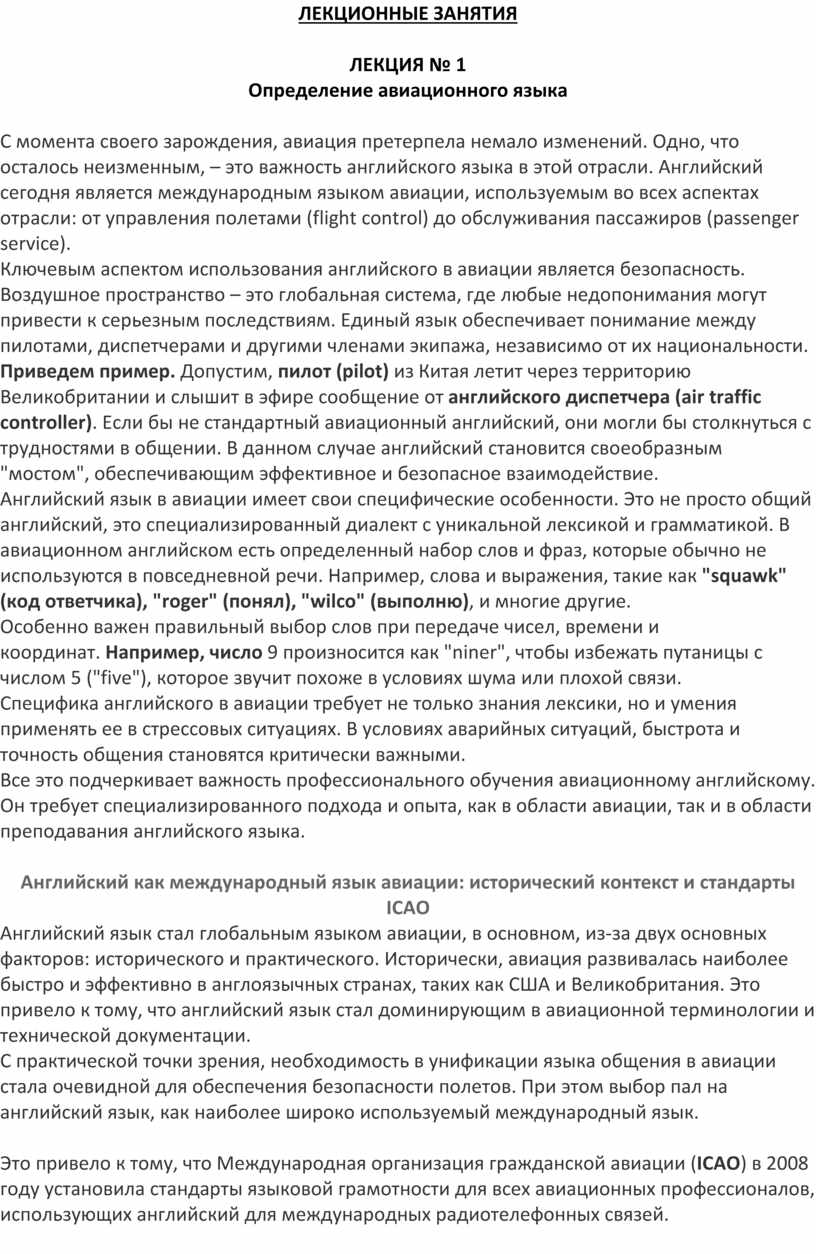
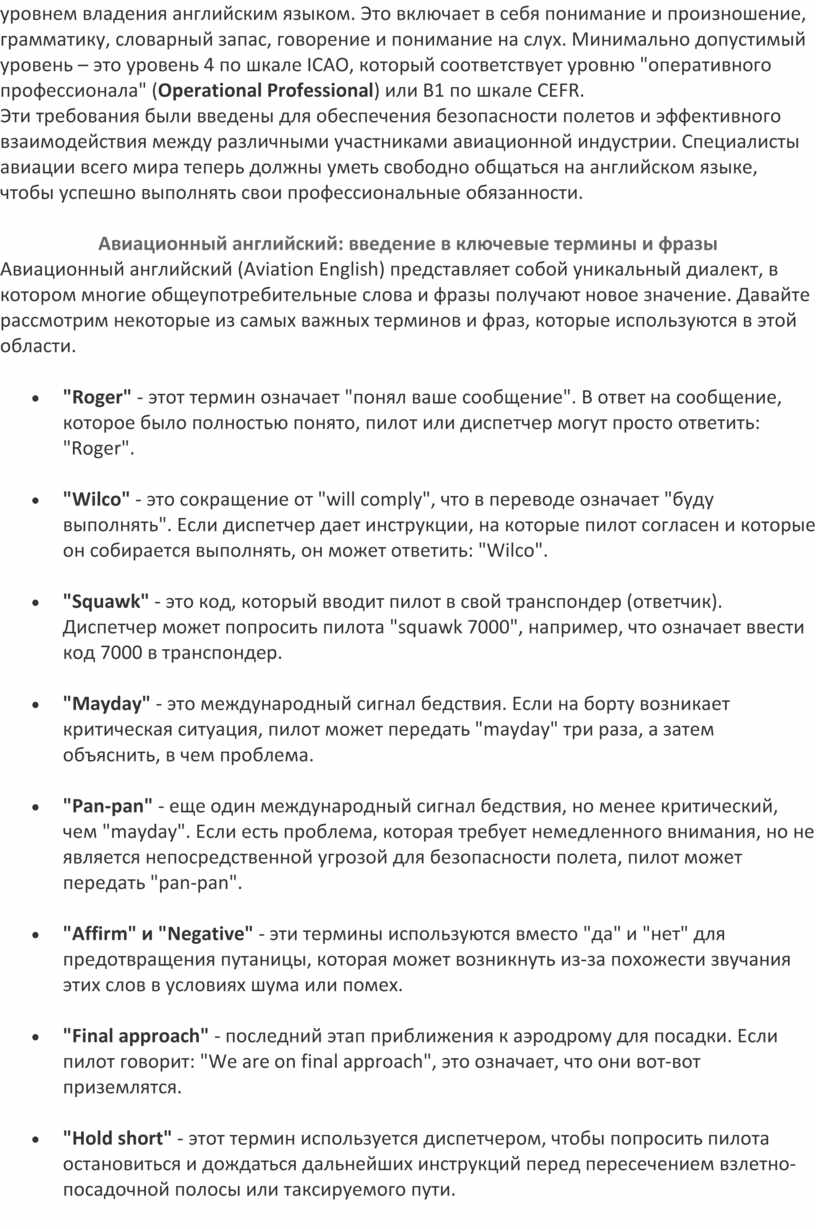
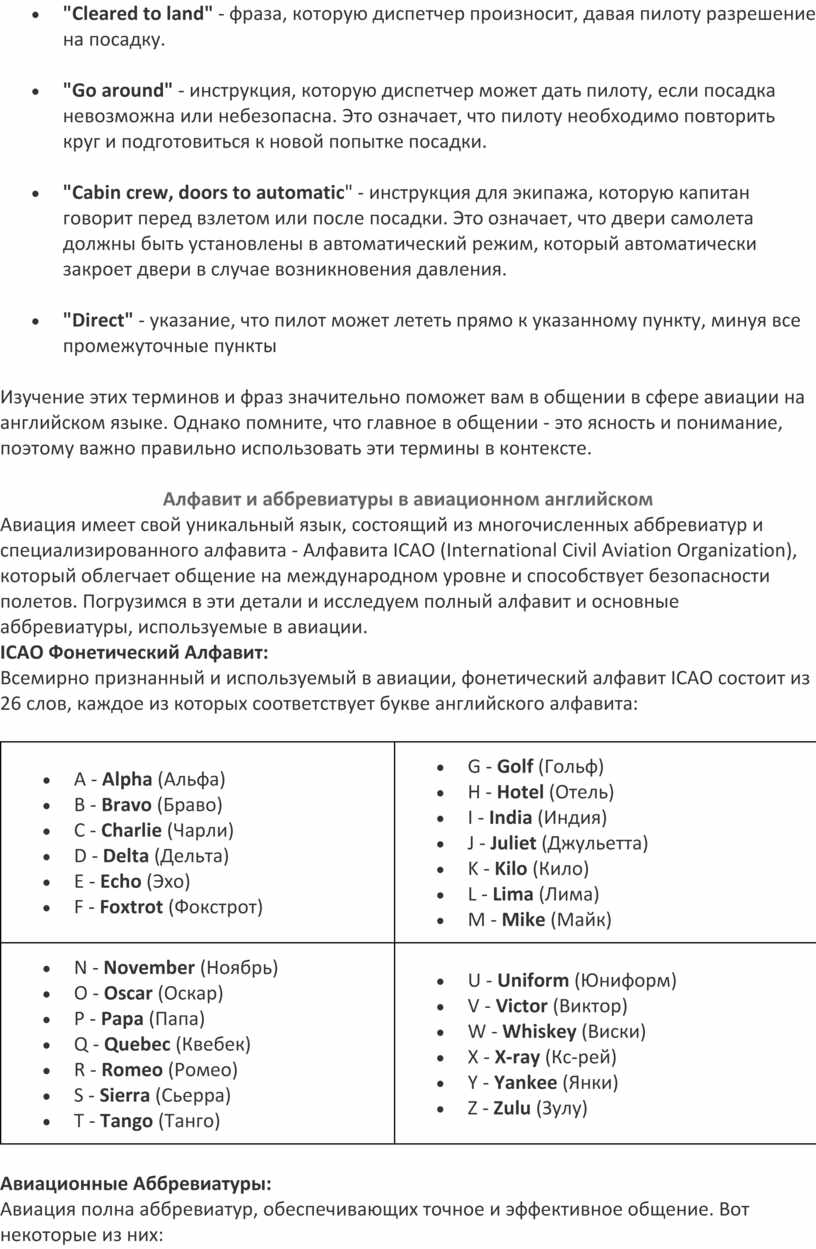
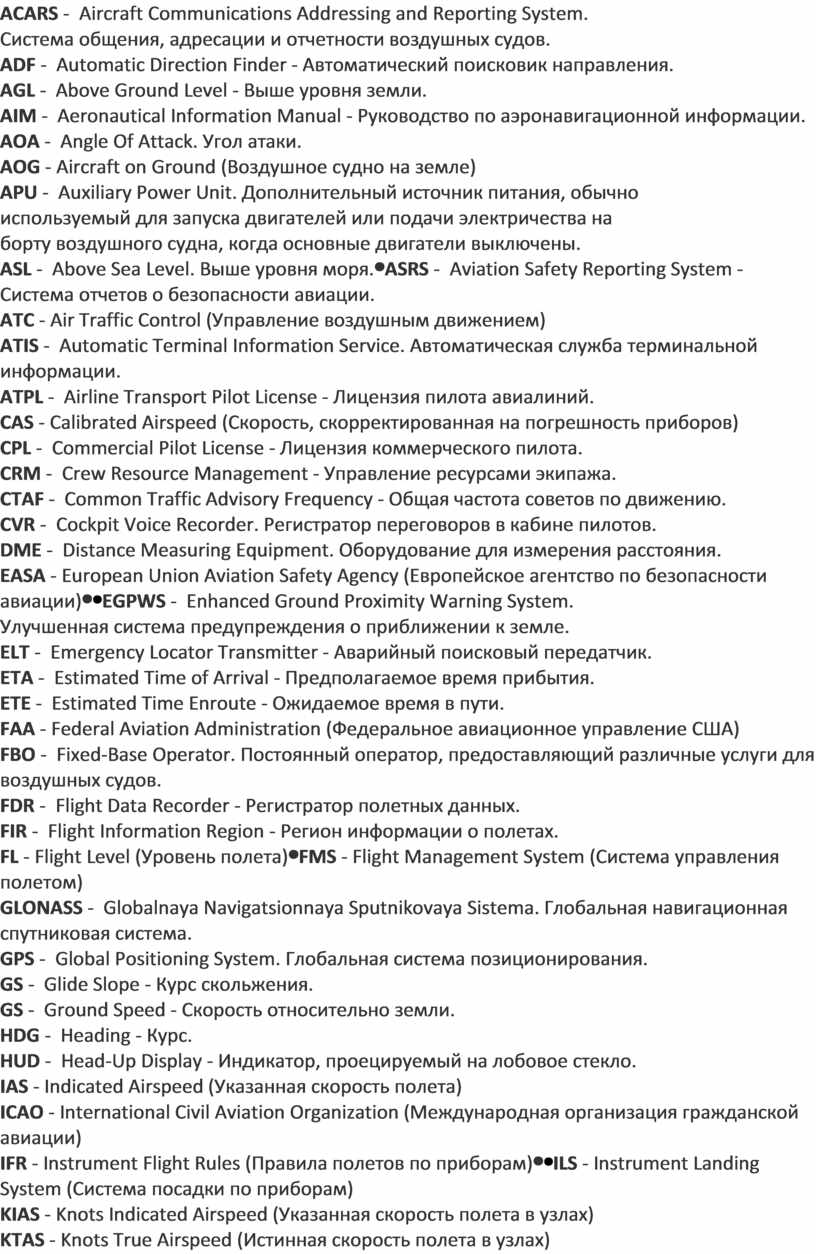
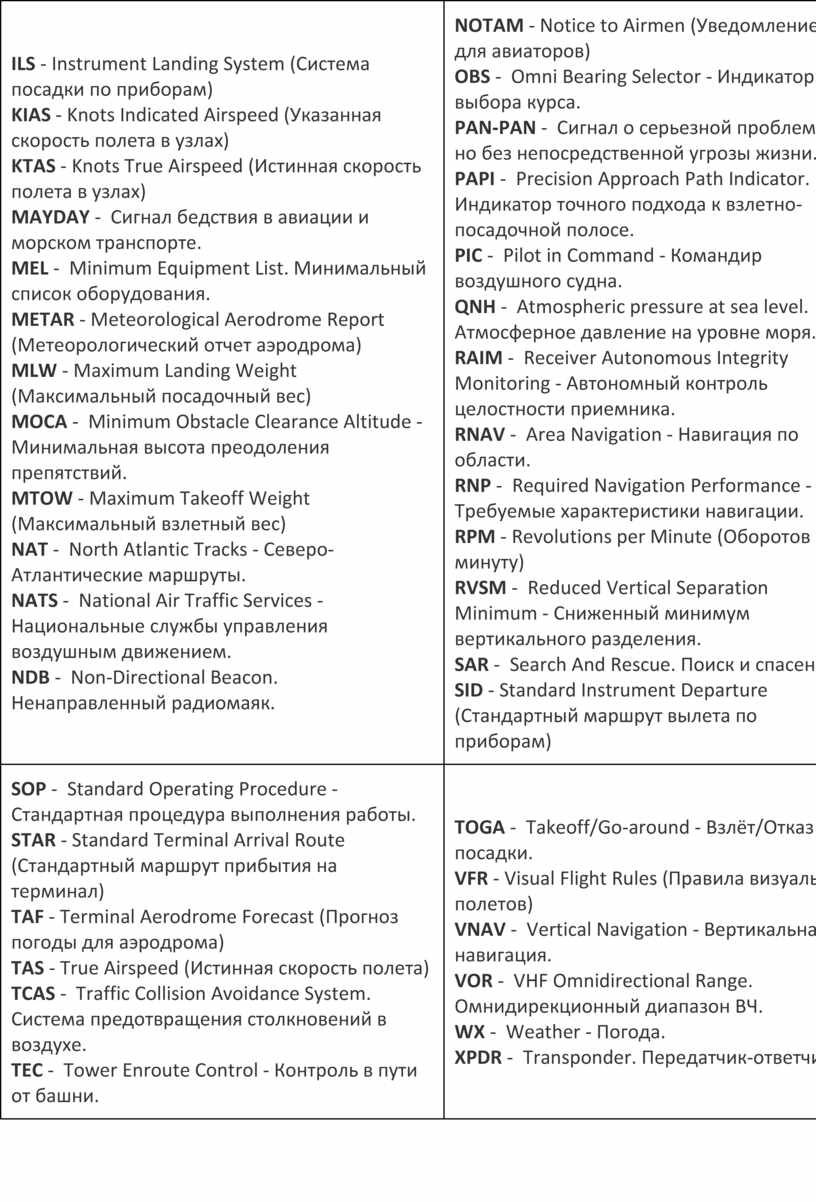
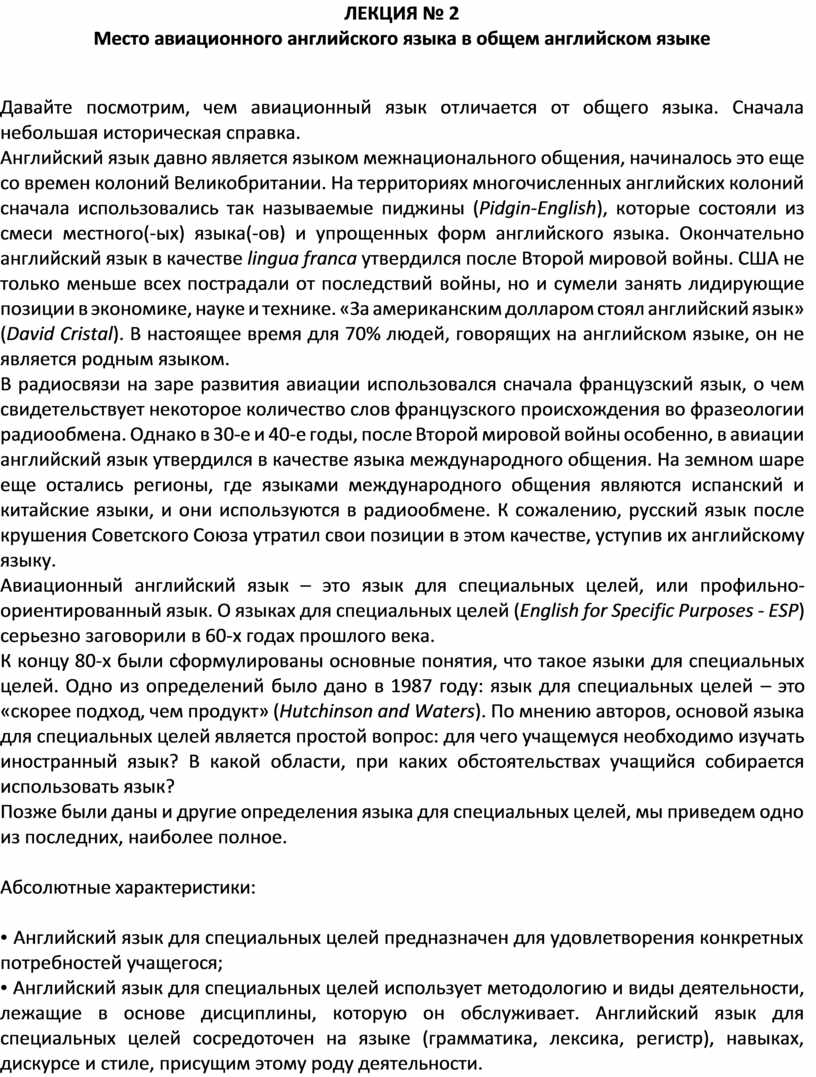
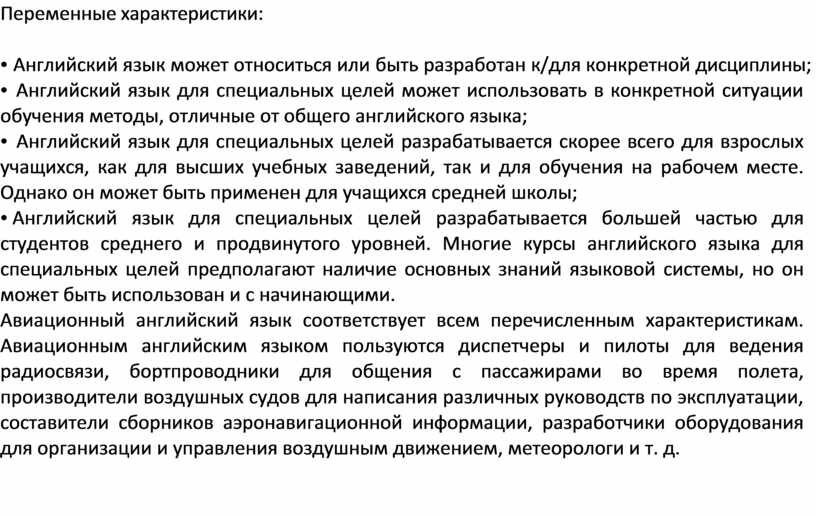
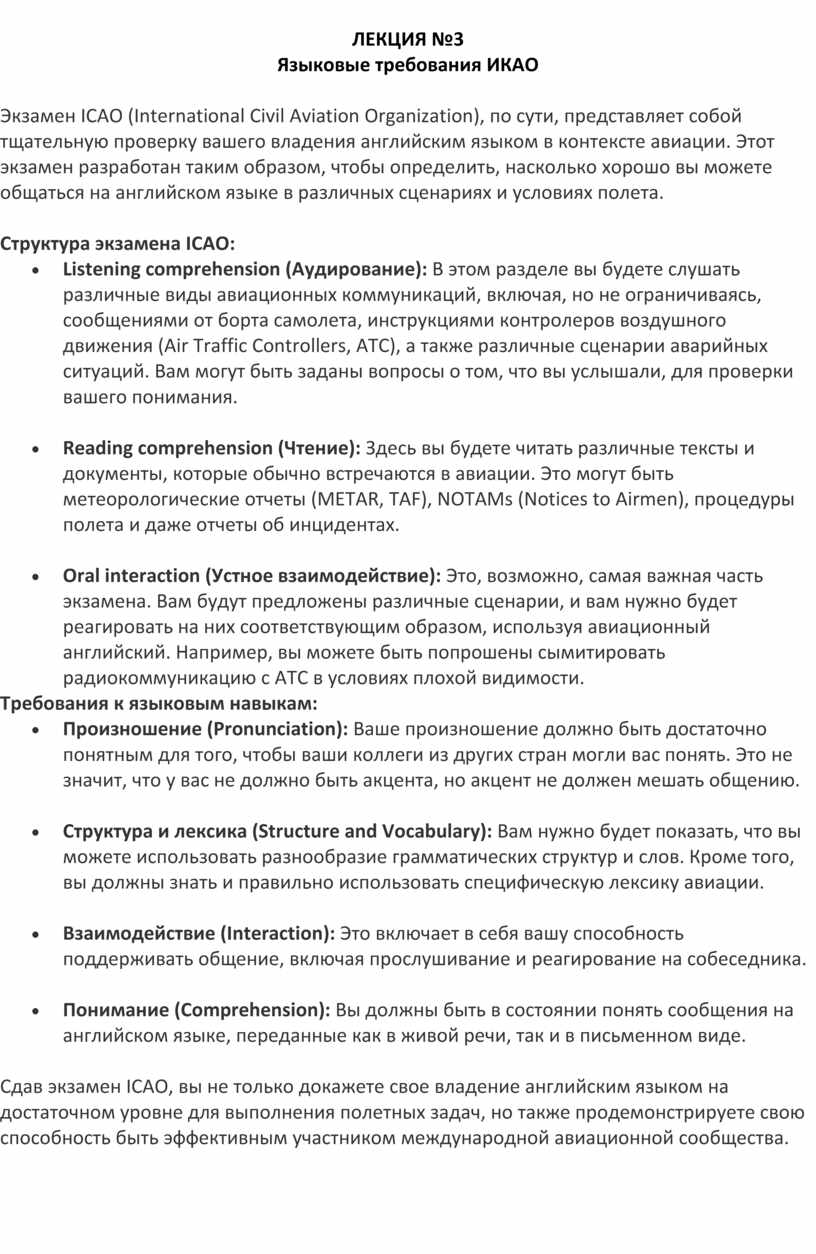
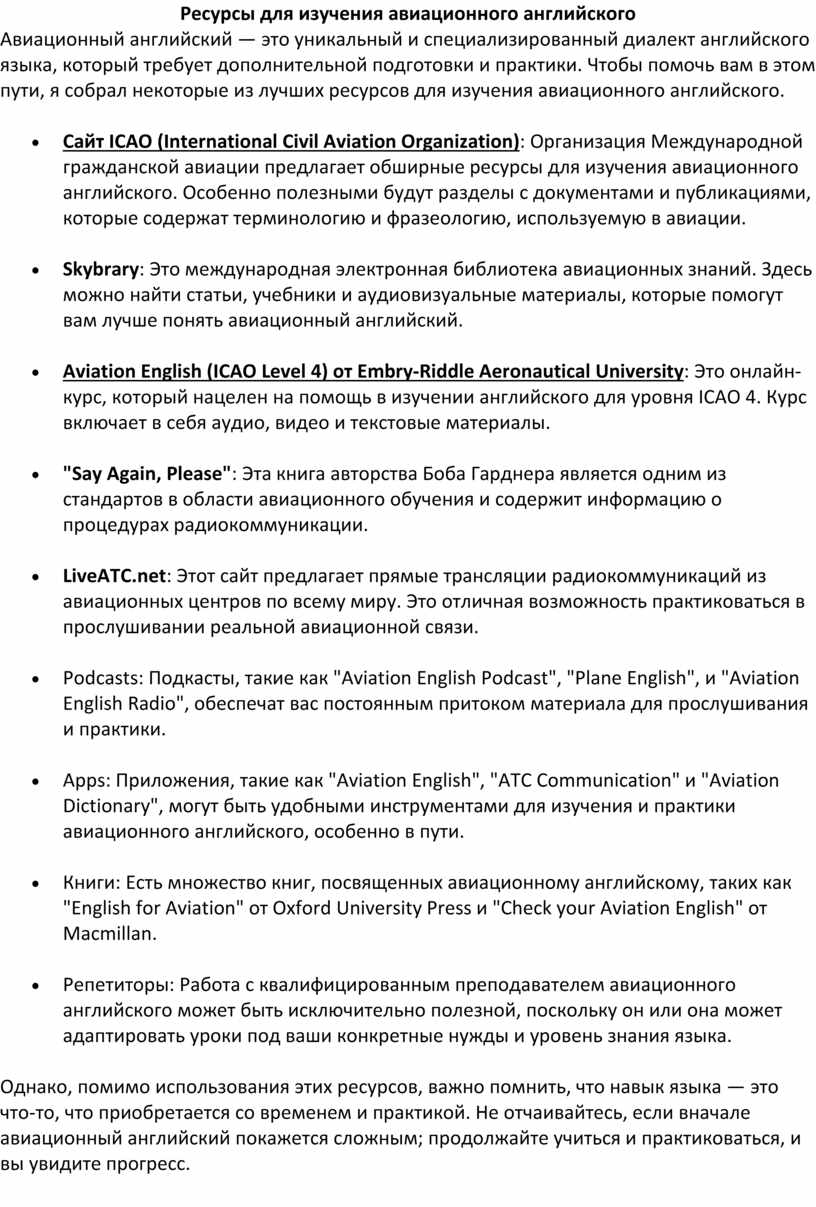
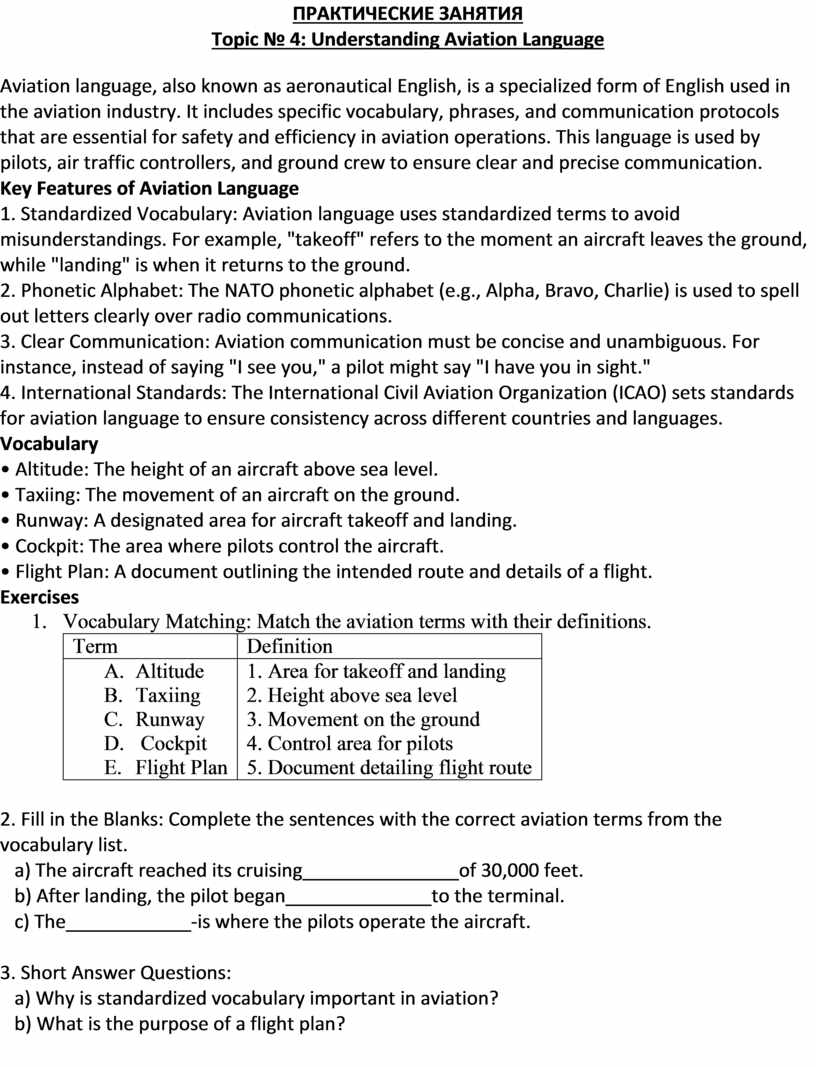
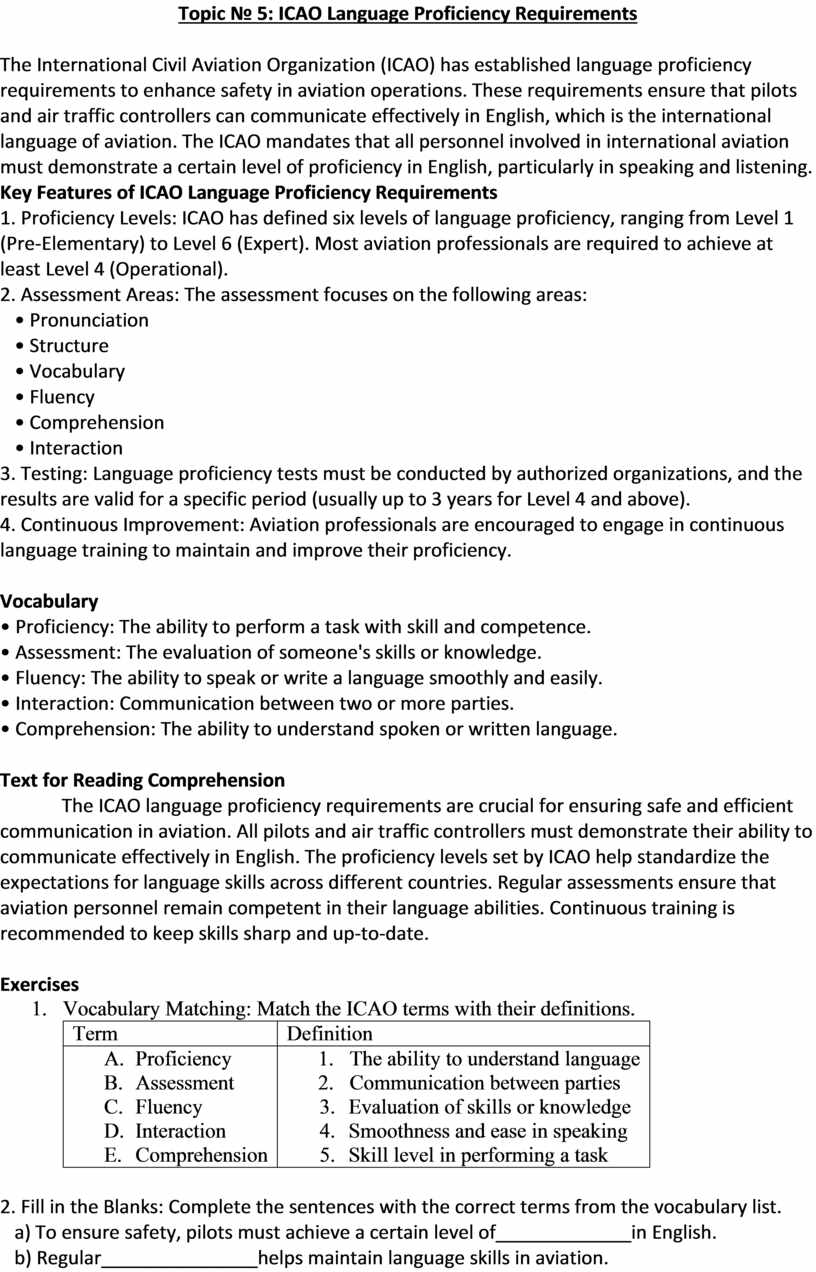
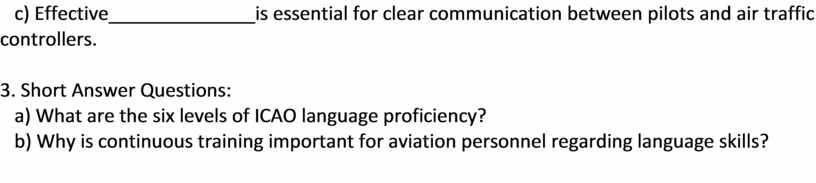
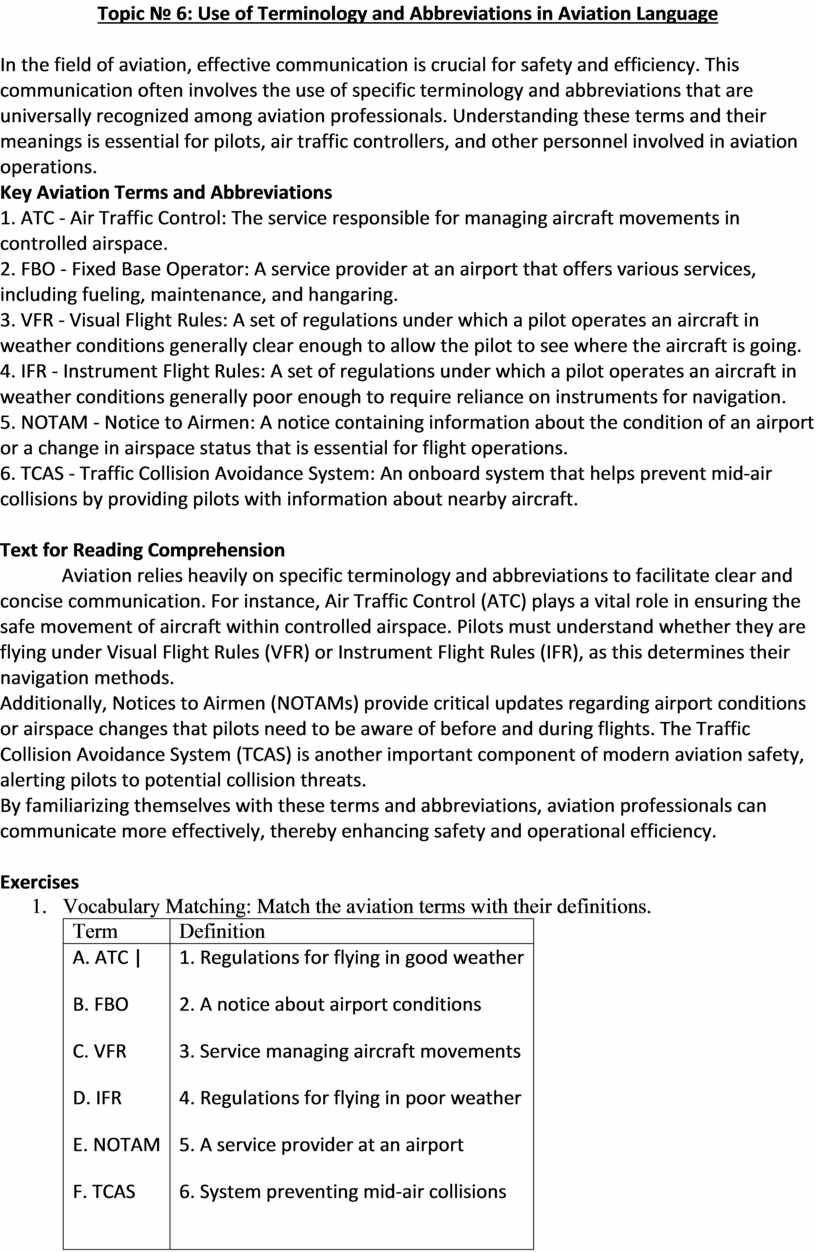
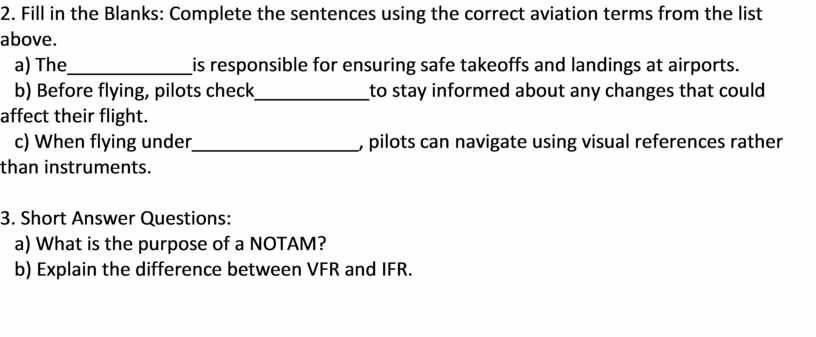
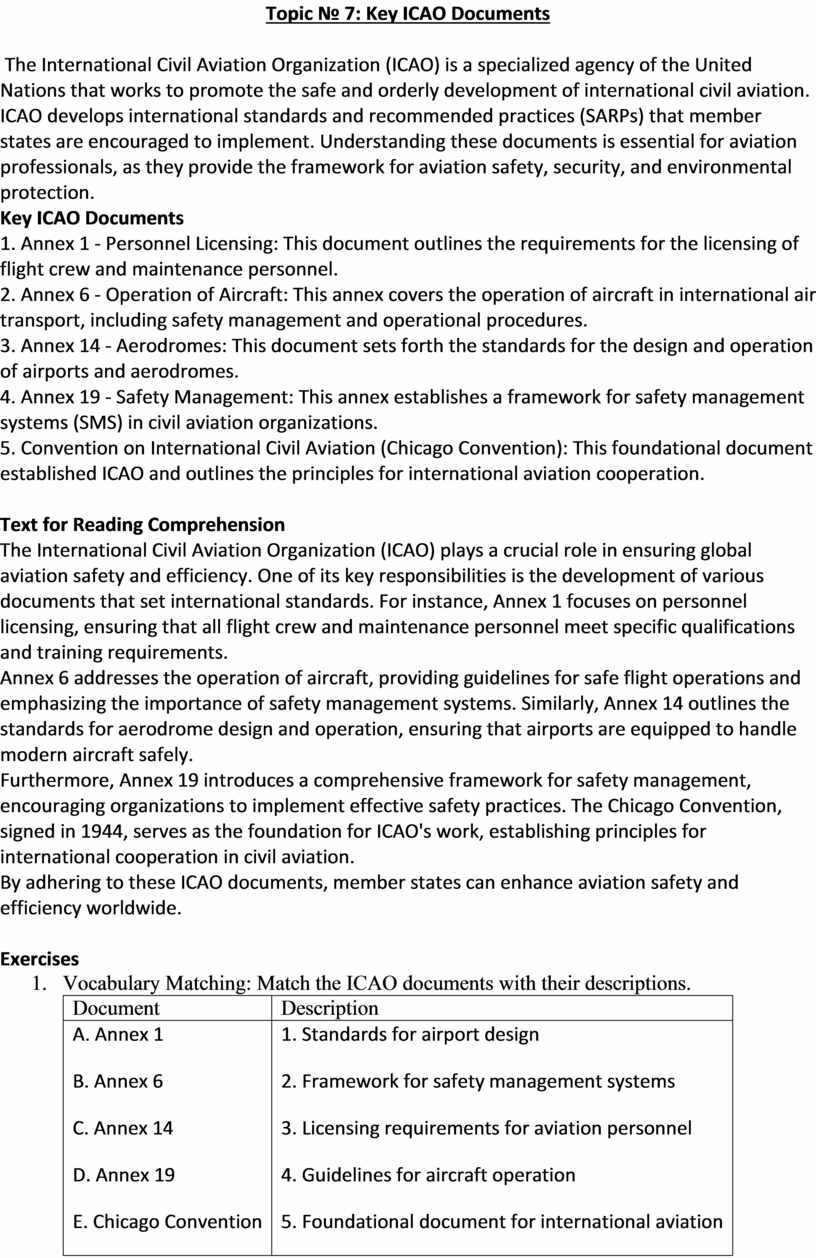
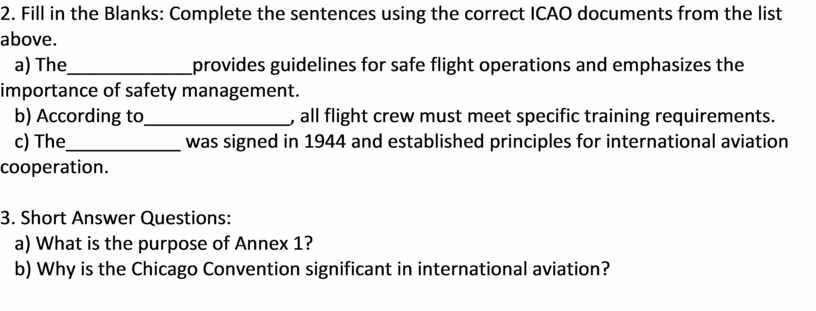
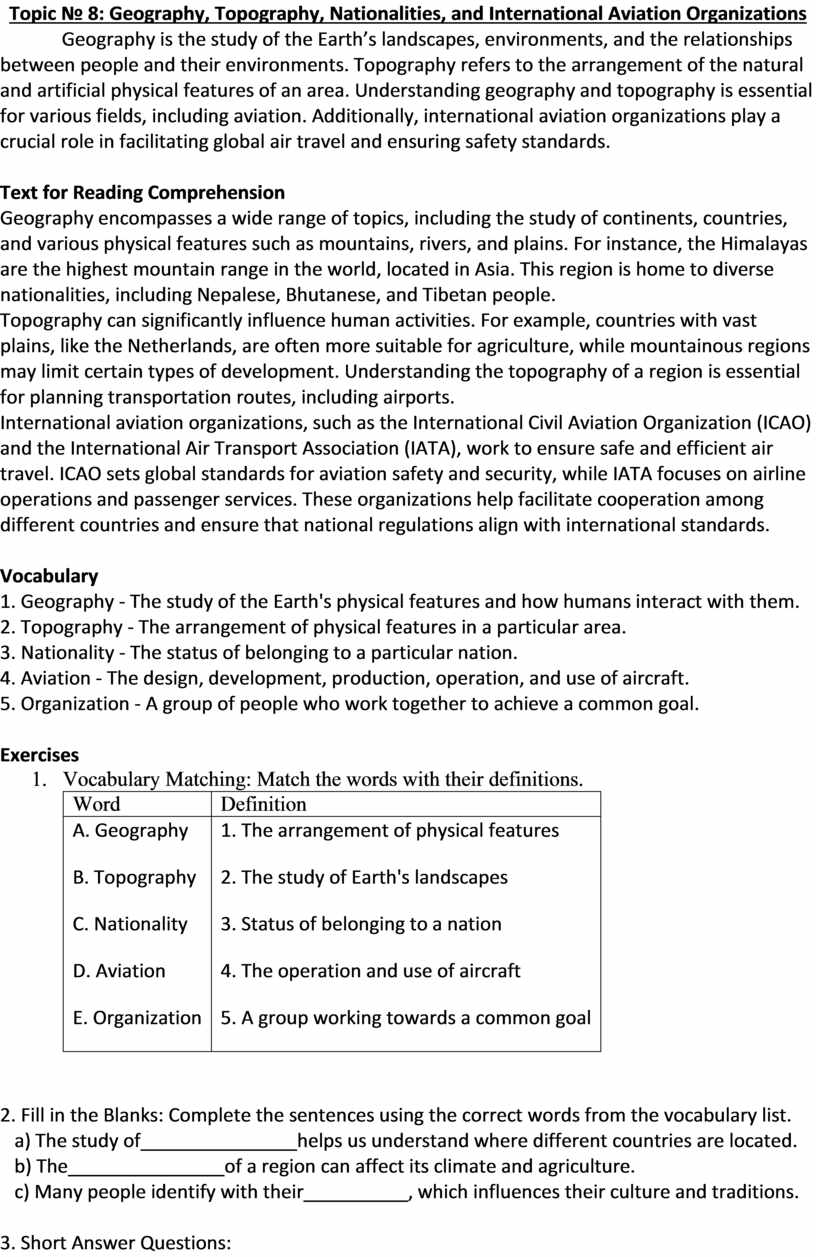
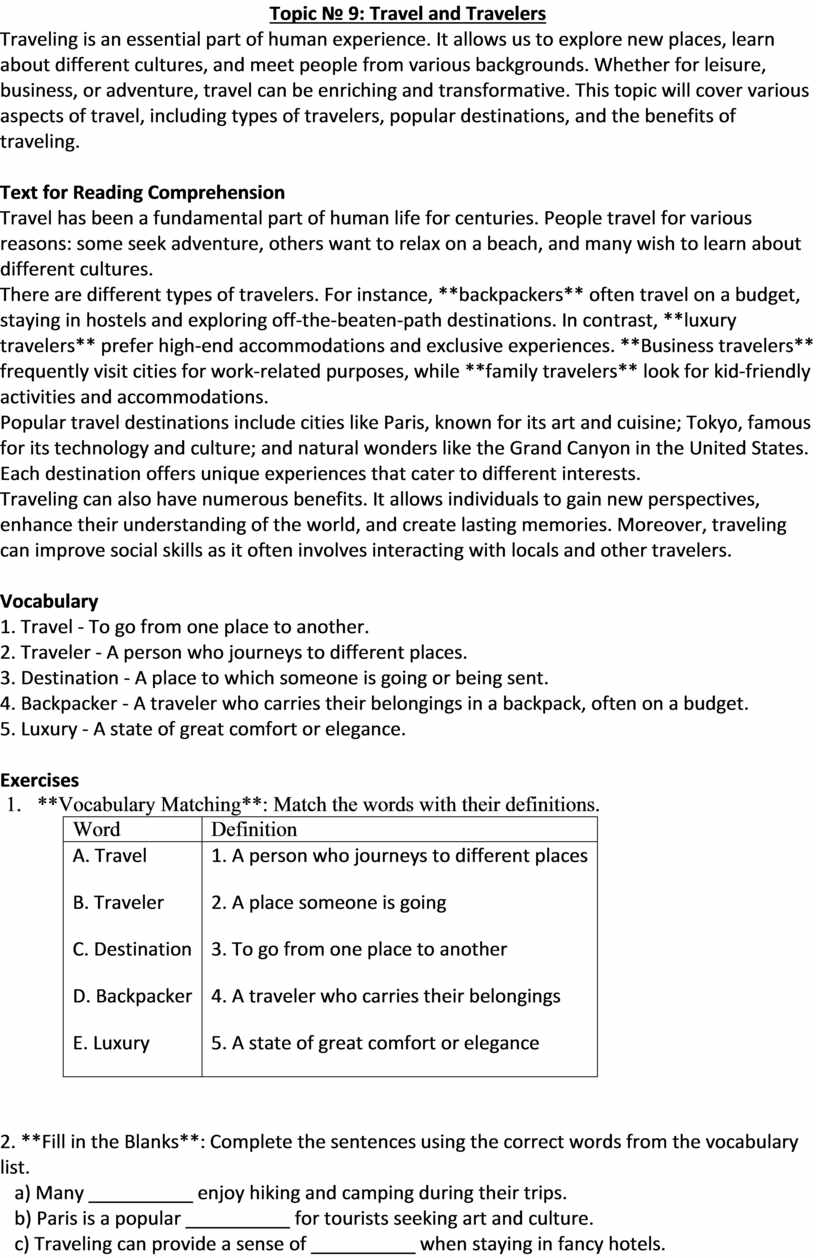

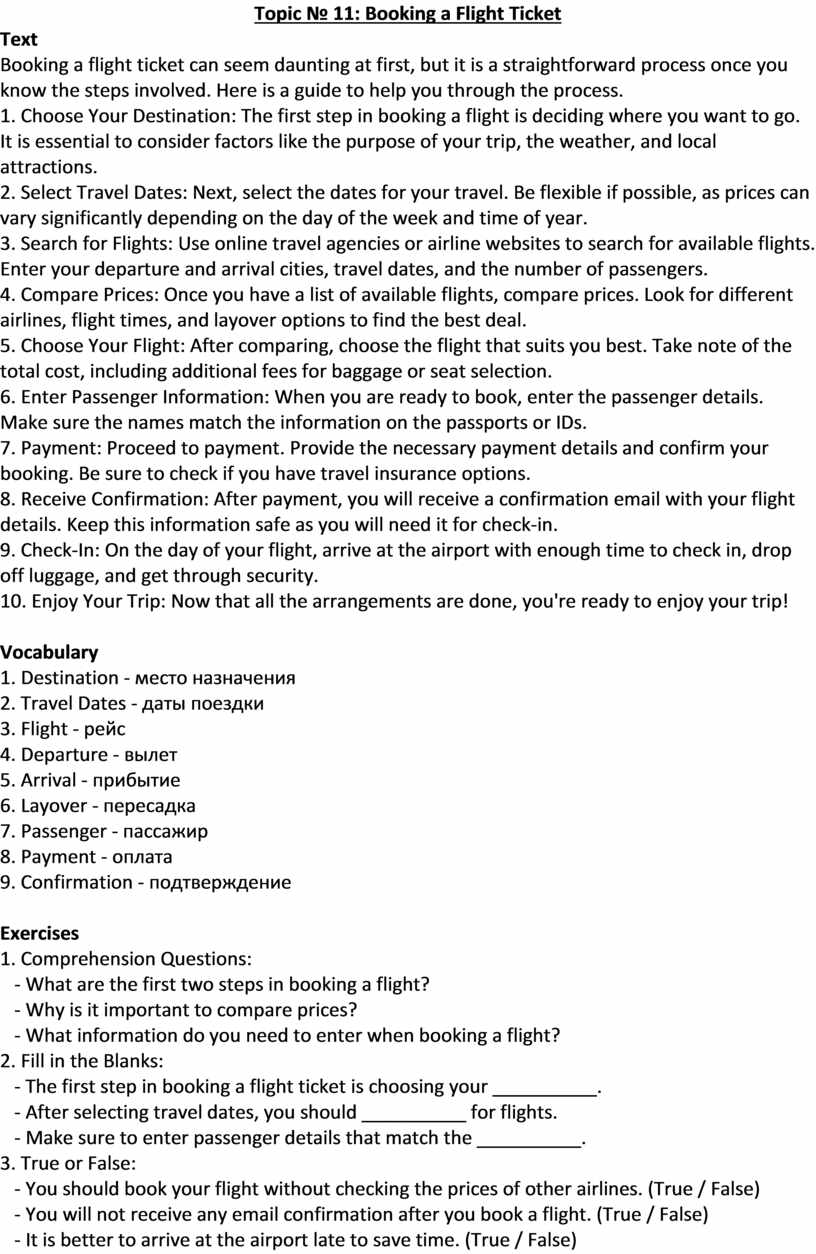
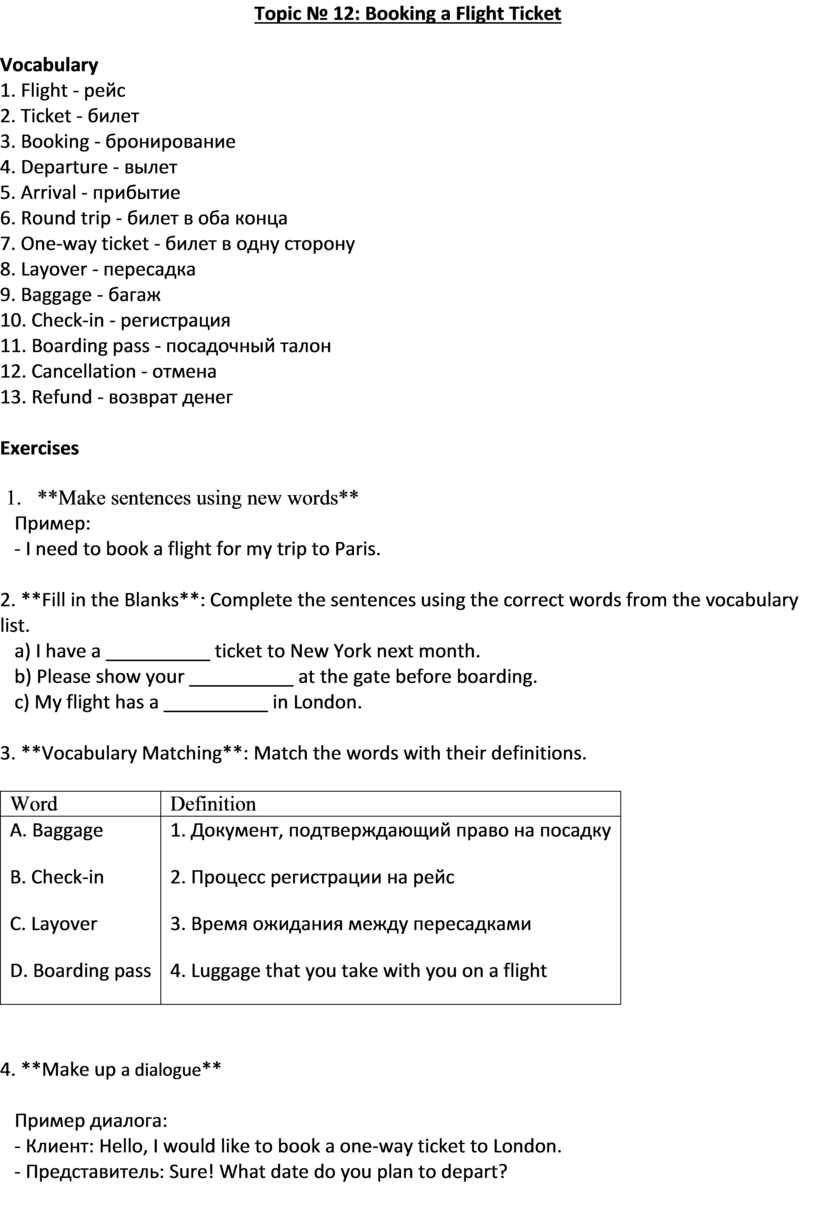
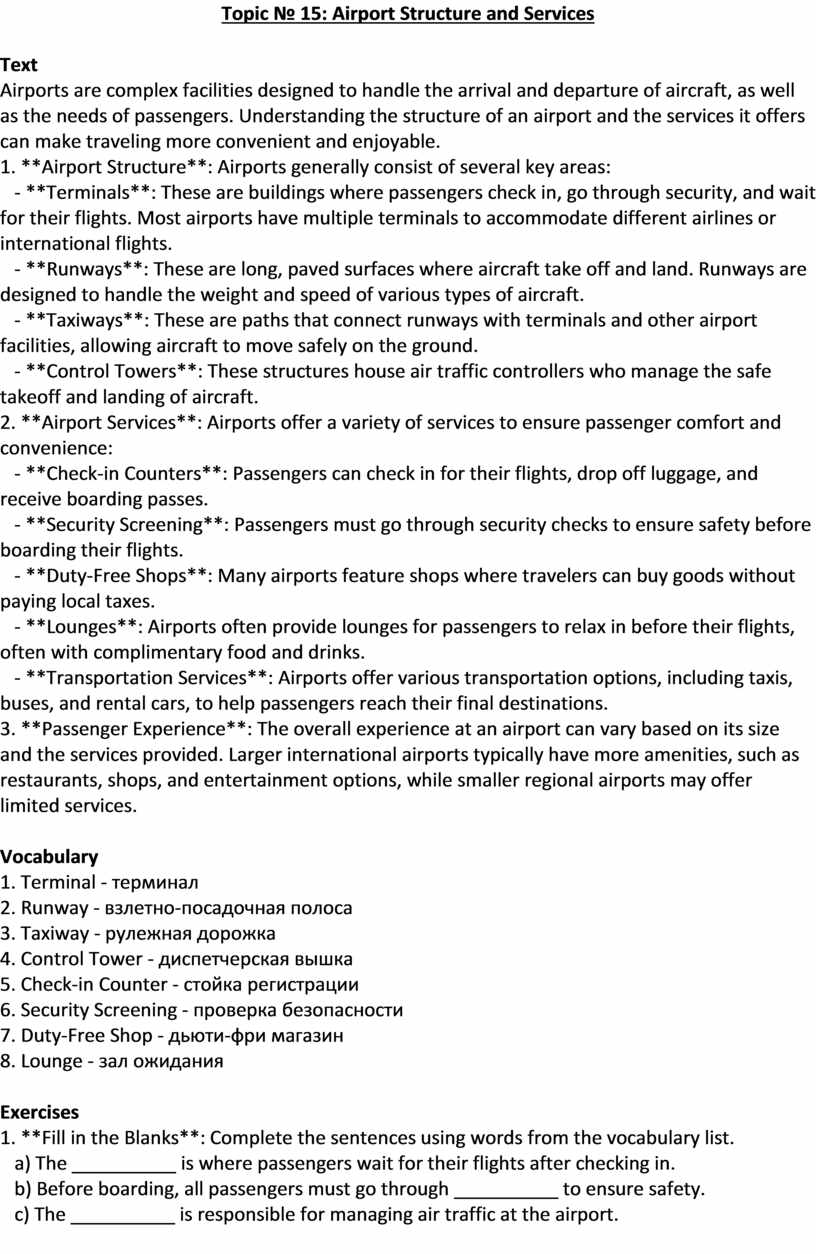
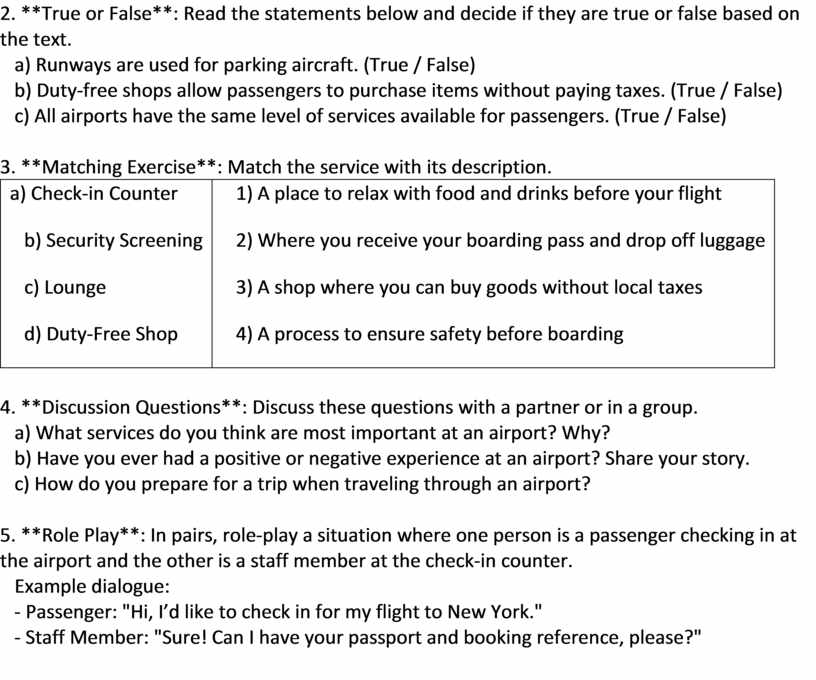
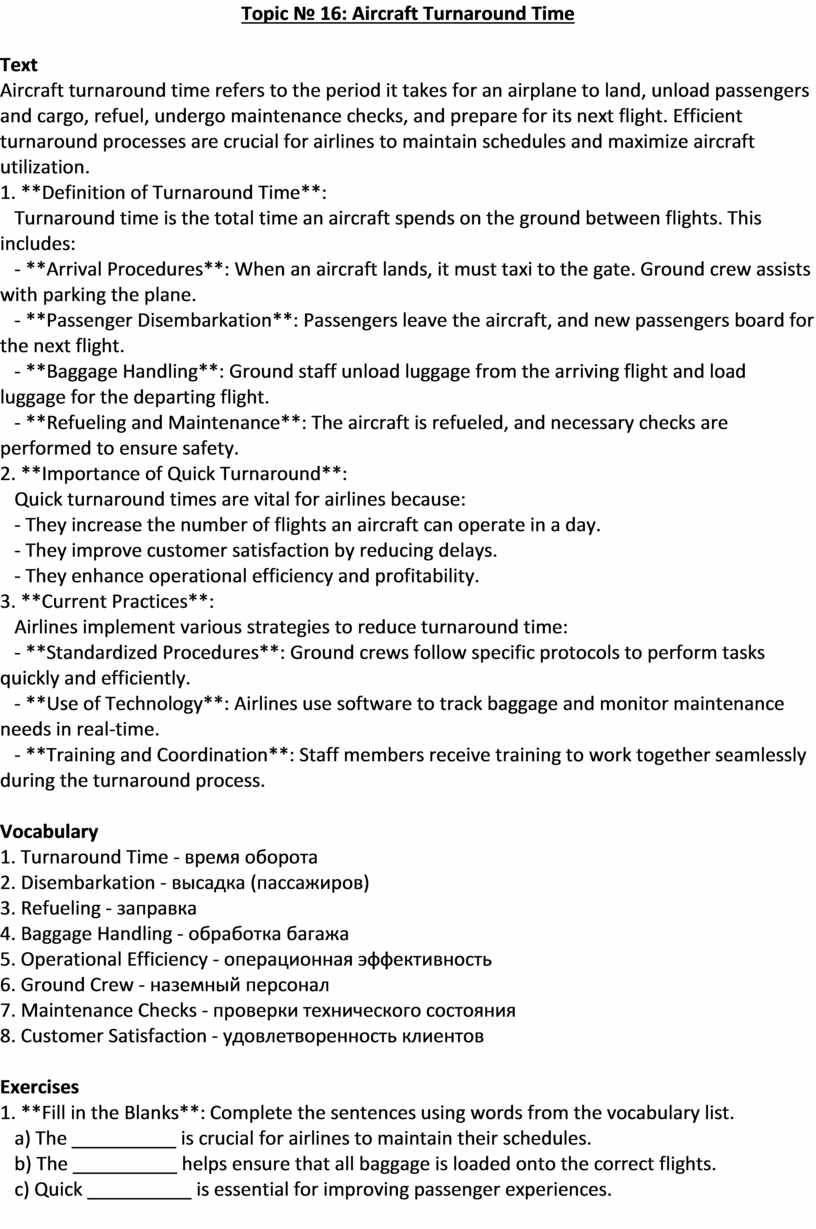
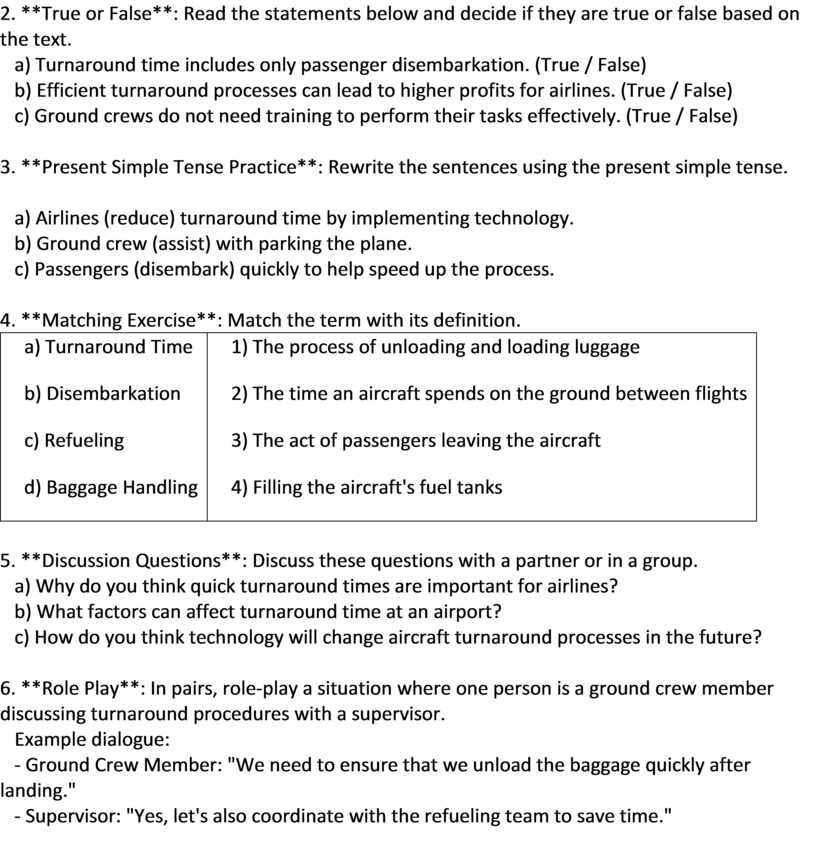
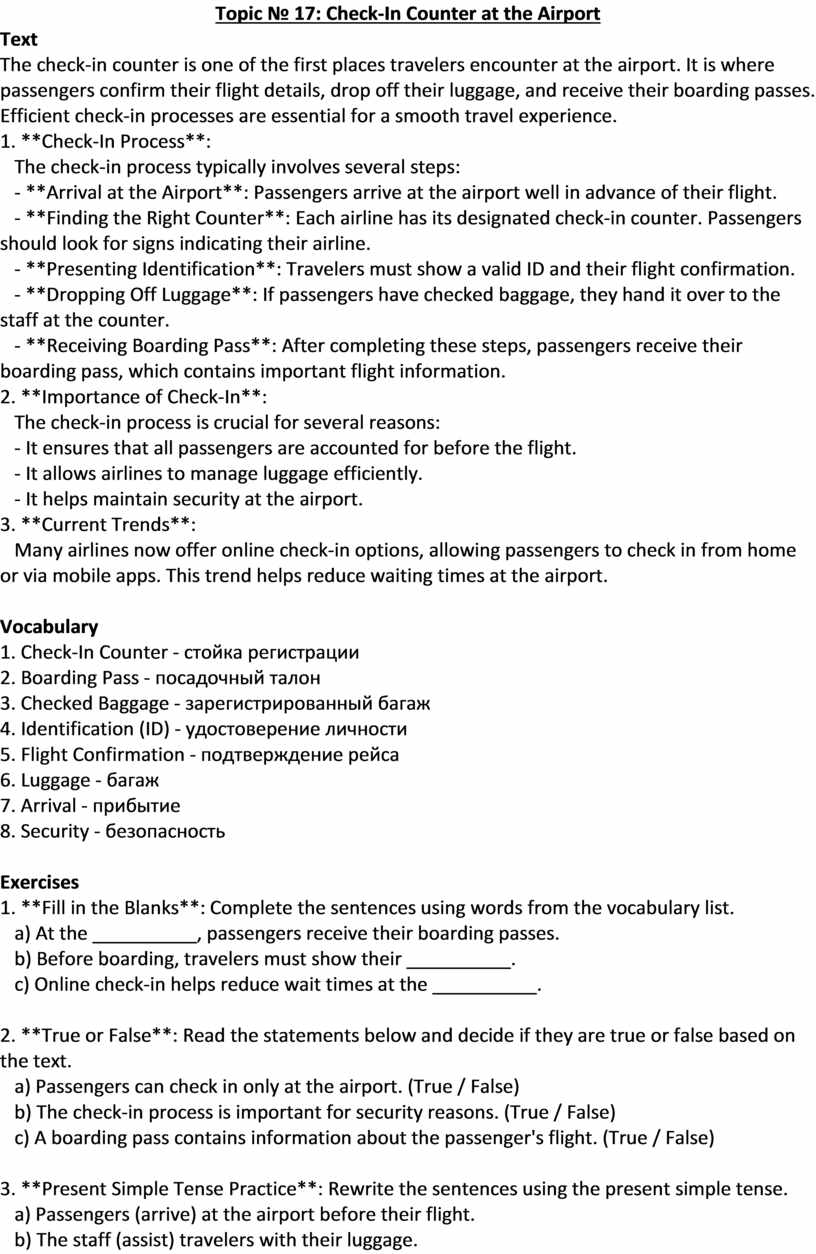
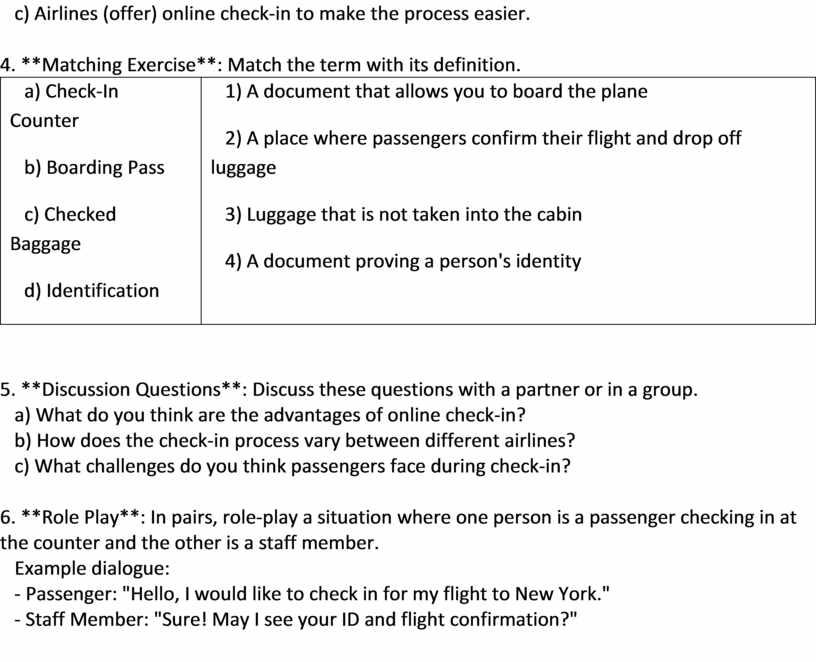
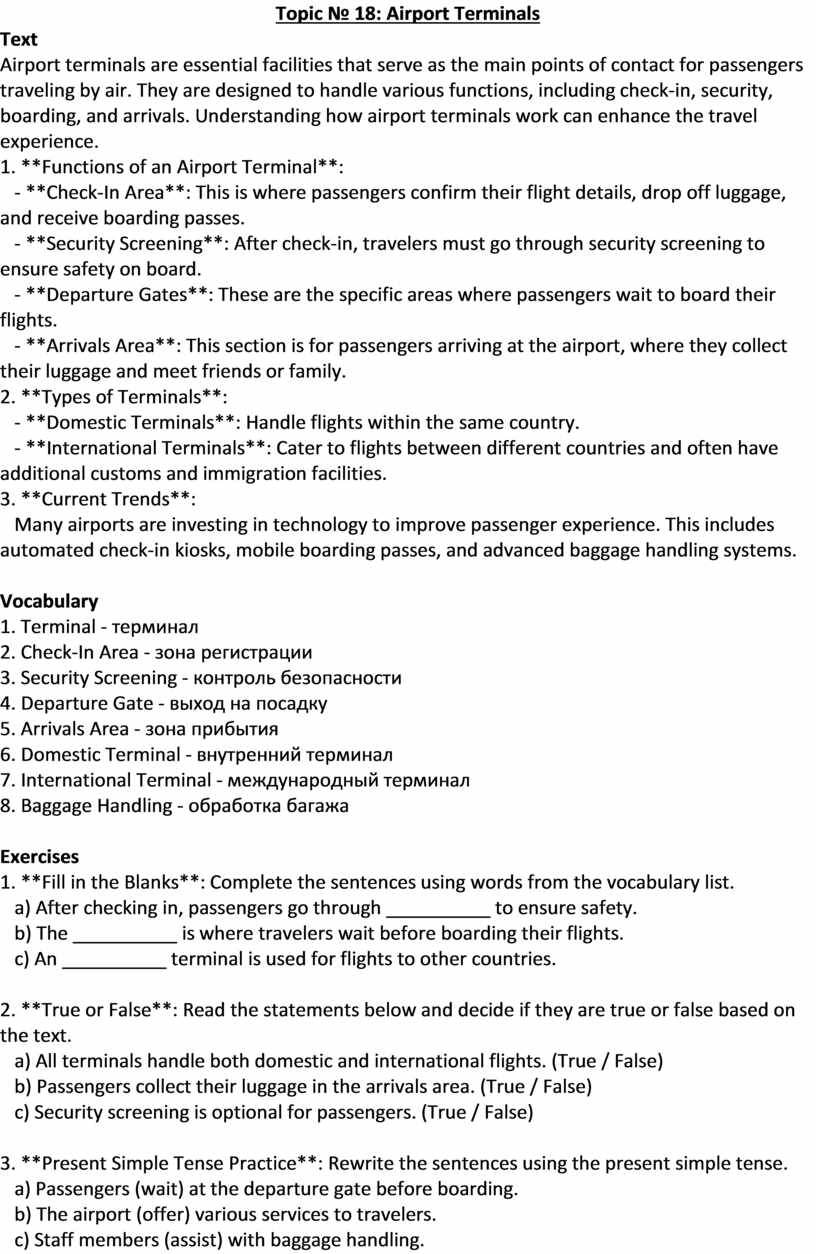
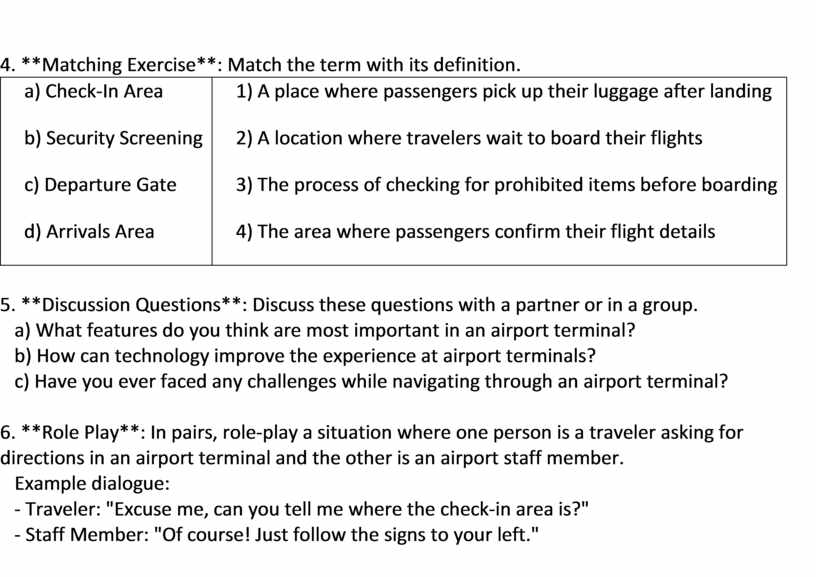
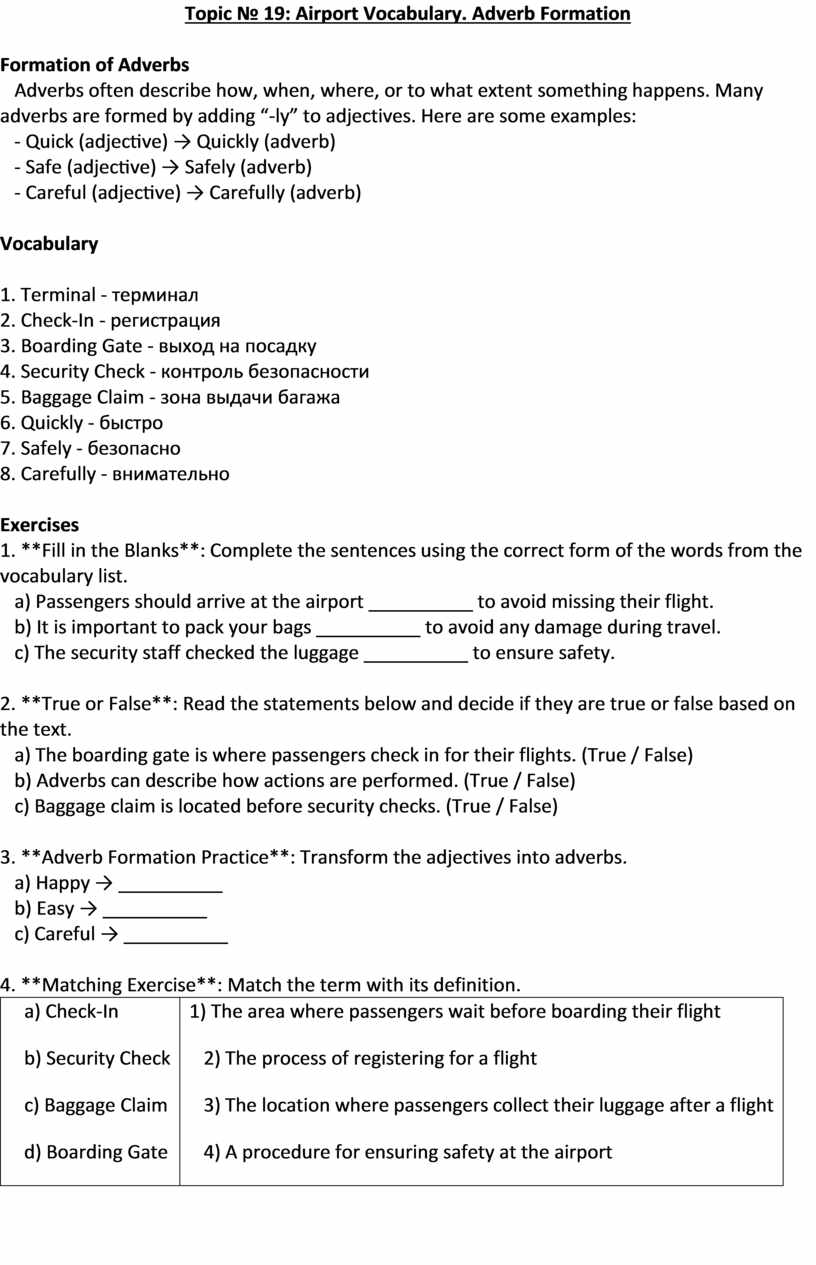
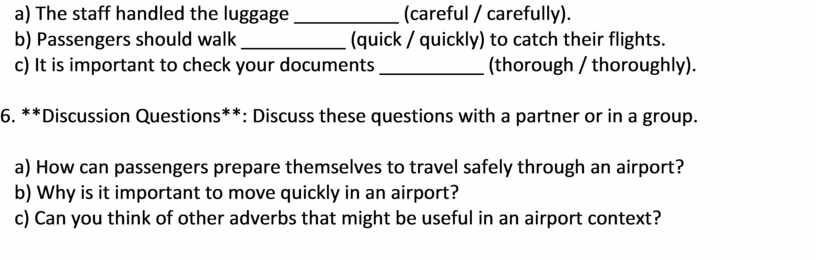
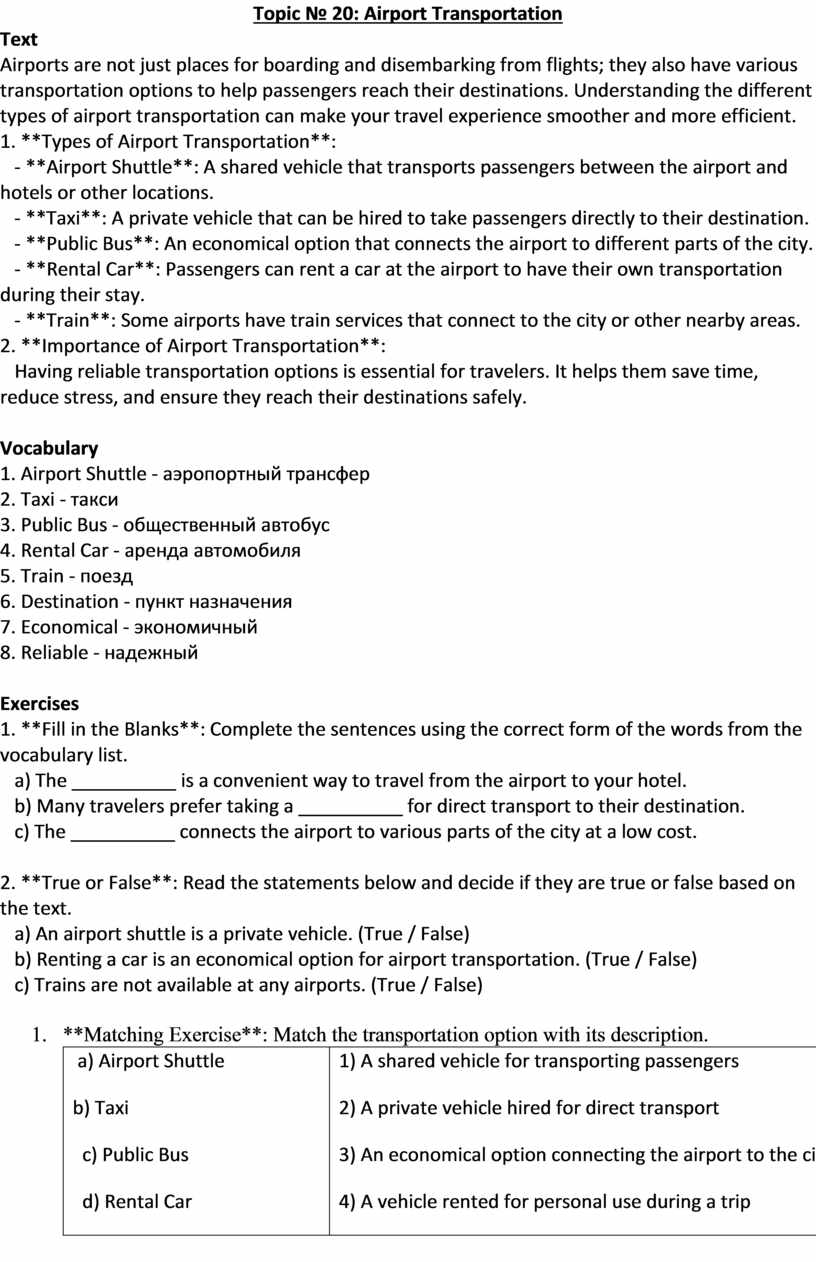
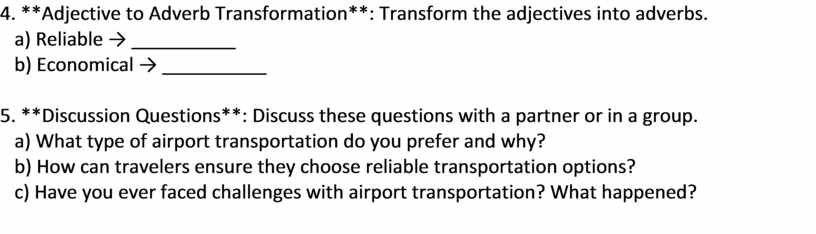
Материалы на данной страницы взяты из открытых источников либо размещены пользователем в соответствии с договором-офертой сайта. Вы можете сообщить о нарушении.