
Поделиться


 Native country-Russia.pptx
Native country: Russia
Nisenzon Miroslava, a 7th grade student
Scientific supervisor: Ruslan Gumerov
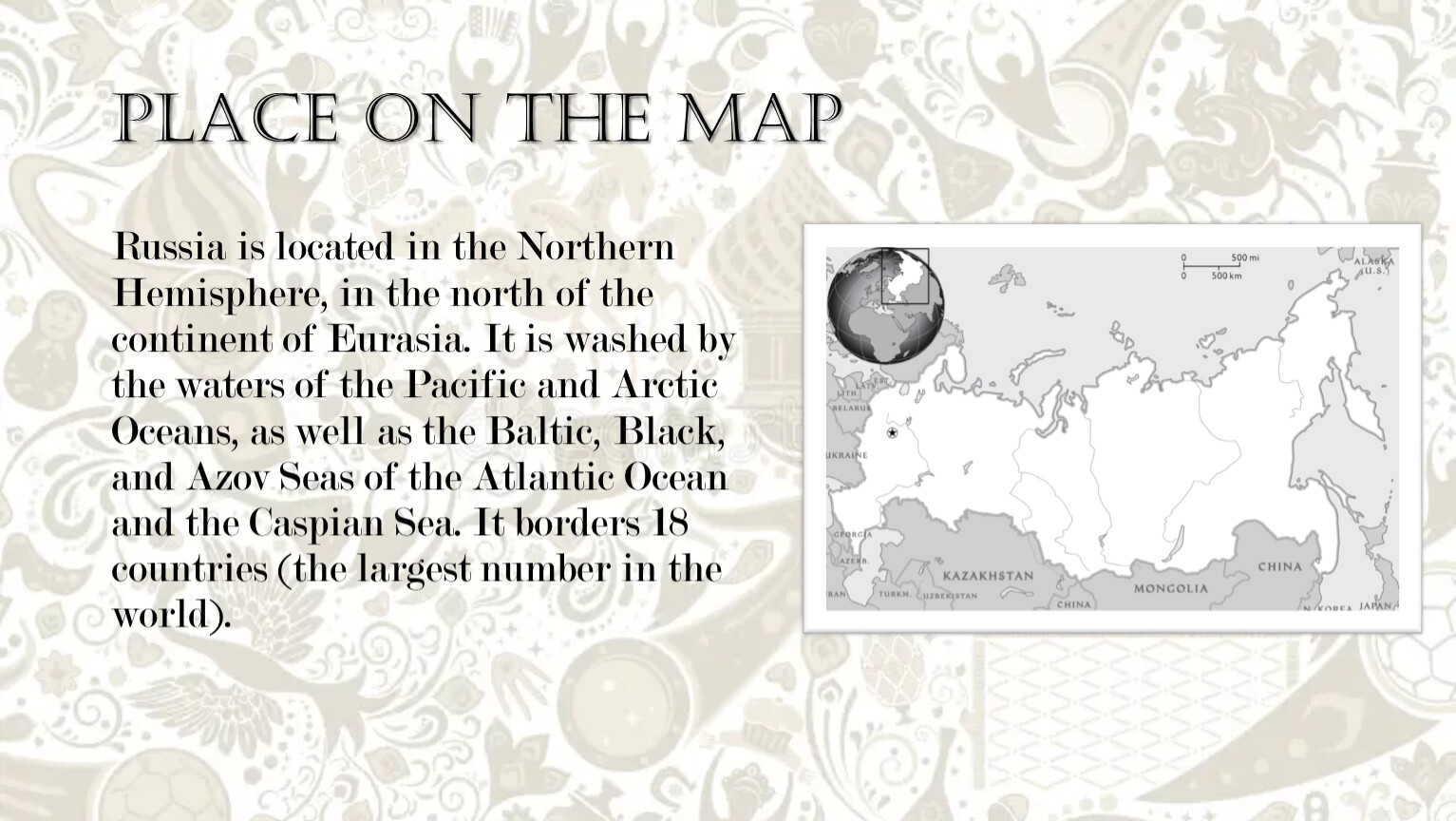
place on the map
Russia is located in the Northern Hemisphere, in the north of the continent of Eurasia. It is washed by the waters of the Pacific and Arctic Oceans, as well as the Baltic, Black, and Azov Seas of the Atlantic Ocean and the Caspian Sea. It borders 18 countries (the largest number in the world).
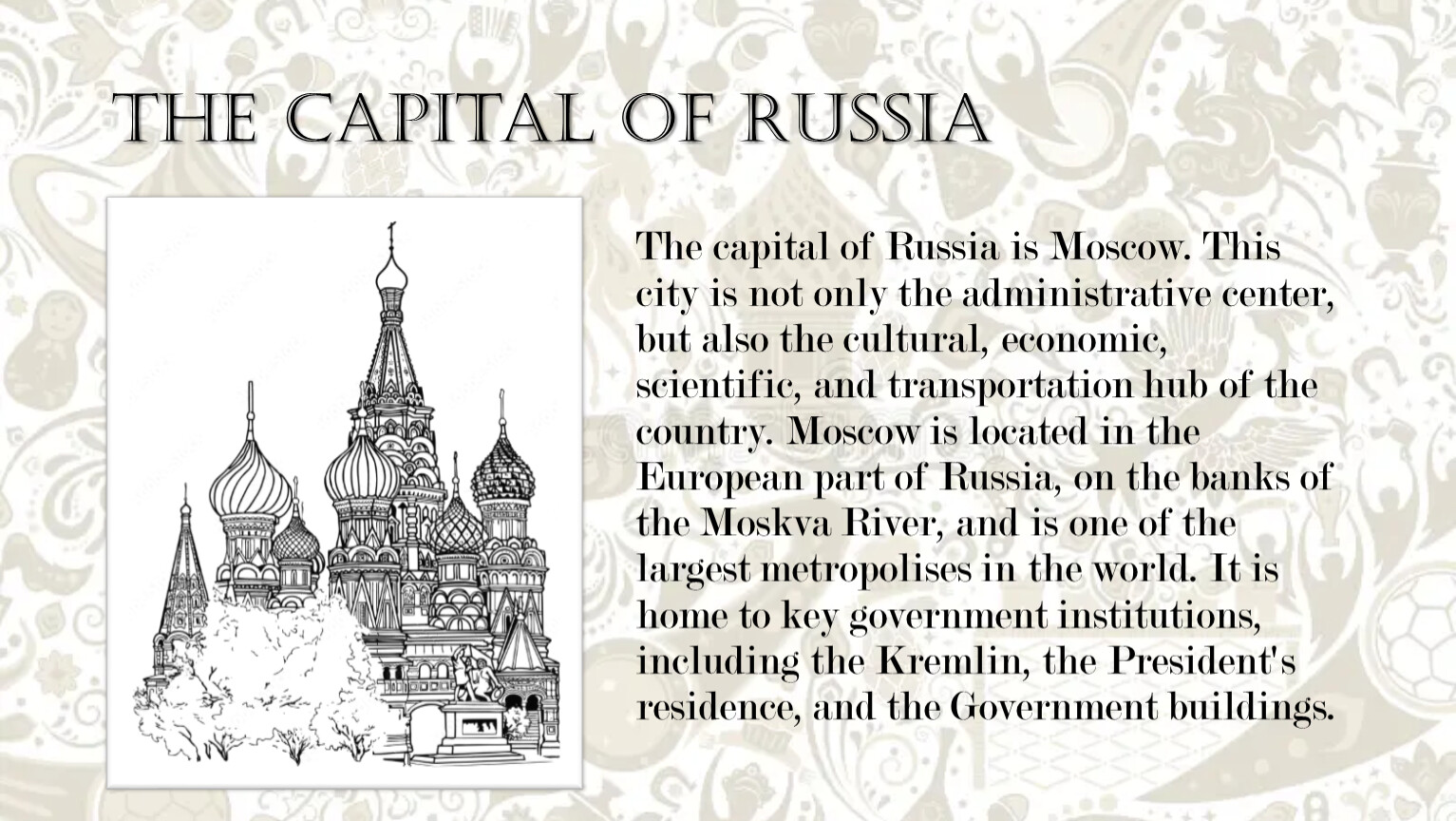
The capital of Russia
The capital of Russia is Moscow. This city is not only the administrative center, but also the cultural, economic, scientific, and transportation hub of the country. Moscow is located in the European part of Russia, on the banks of the Moskva River, and is one of the largest metropolises in the world. It is home to key government institutions, including the Kremlin, the President's residence, and the Government buildings.
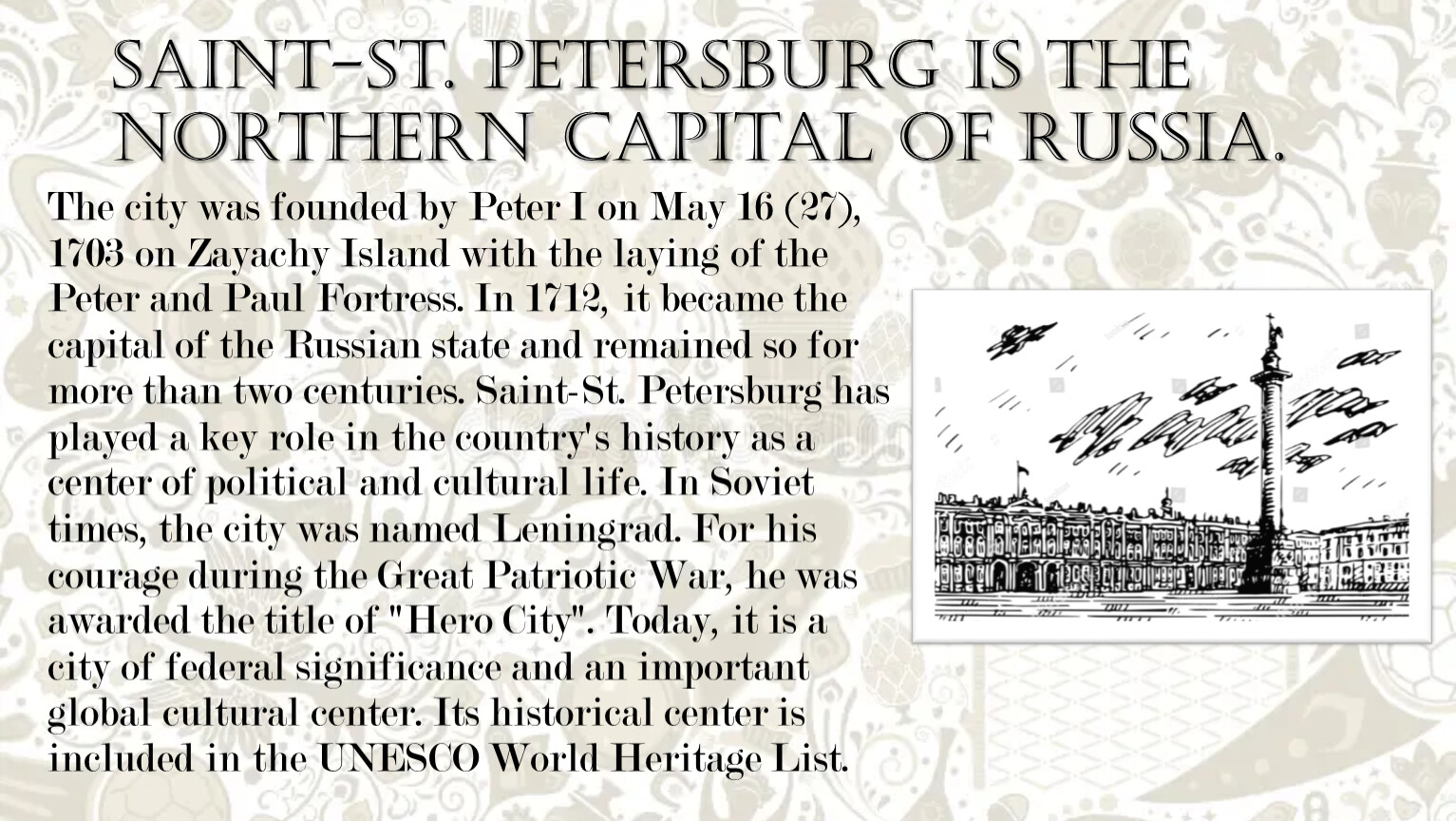
Saint‑St. Petersburg is the Northern capital of Russia.
The city was founded by Peter I on May 16 (27), 1703 on Zayachy Island with the laying of the Peter and Paul Fortress. In 1712, it became the capital of the Russian state and remained so for more than two centuries. Saint‑St. Petersburg has played a key role in the country's history as a center of political and cultural life. In Soviet times, the city was named Leningrad. For his courage during the Great Patriotic War, he was awarded the title of "Hero City". Today, it is a city of federal significance and an important global cultural center. Its historical center is included in the UNESCO World Heritage List.
the population of Russia
The population of Russia in 2025 is estimated to be around 146.1 million people. In recent years, there has been a decline in the population.
Russia has a diverse ethnic composition. According to various estimates, there are more than 190 ethnic groups in the country. Most of these groups are indigenous peoples who have been living in the country for generations.
The largest ethnic group is the Russian people. Other major ethnic groups, according to the 2021 census, include the Tatars, Chechens, Bashkirs, Chuvash, and Avars. Only six nations have a population of more than 1 million people.
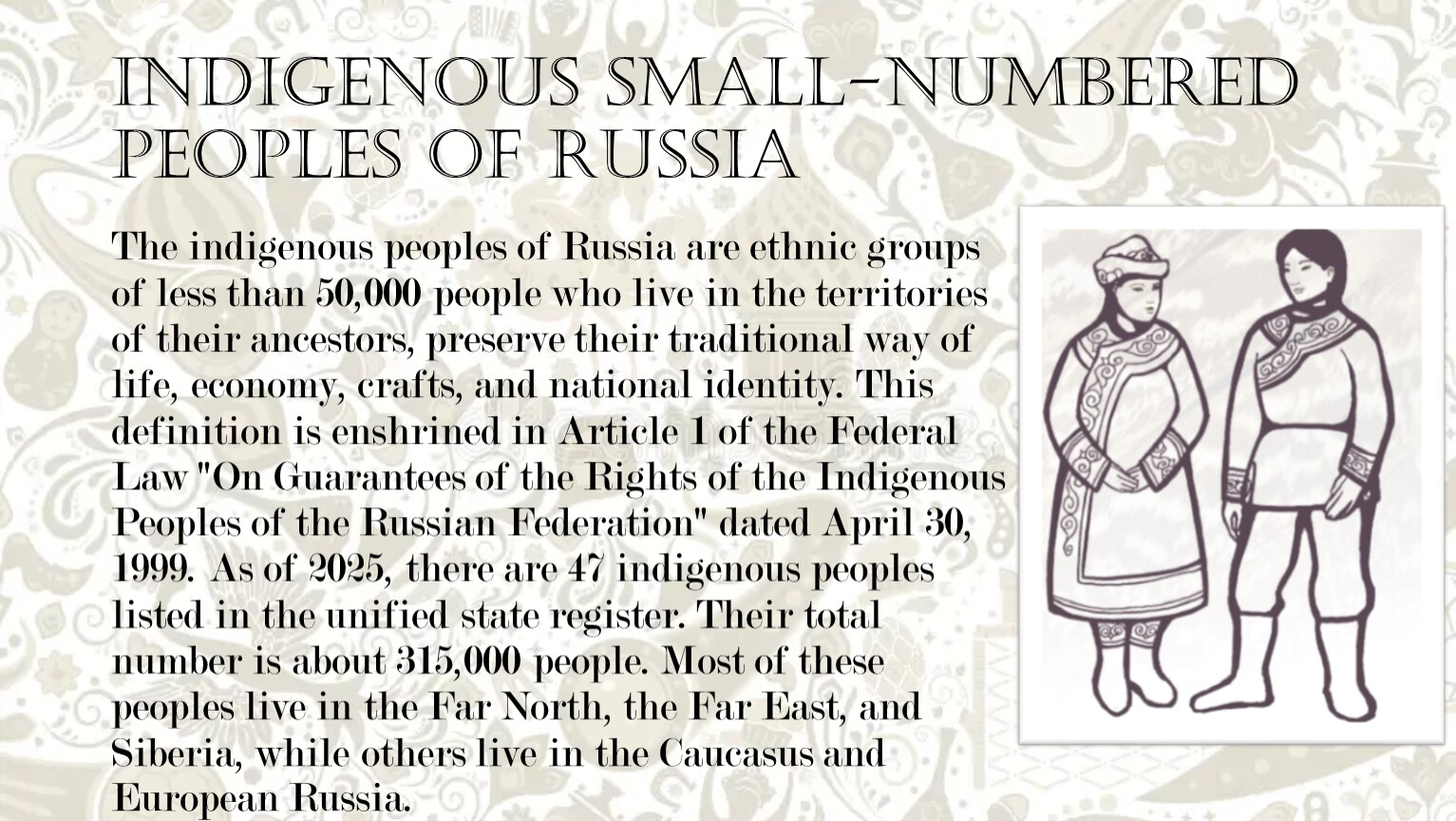
Indigenous small-numbered peoples of Russia
The indigenous peoples of Russia are ethnic groups of less than 50,000 people who live in the territories of their ancestors, preserve their traditional way of life, economy, crafts, and national identity. This definition is enshrined in Article 1 of the Federal Law "On Guarantees of the Rights of the Indigenous Peoples of the Russian Federation" dated April 30, 1999. As of 2025, there are 47 indigenous peoples listed in the unified state register. Their total number is about 315,000 people. Most of these peoples live in the Far North, the Far East, and Siberia, while others live in the Caucasus and European Russia.
Examples of small-numbered peoples
The Nivkhs are an indigenous minority people living in the Russian Far East. They are the autochthonous (indigenous) population of the Amur region, Sakhalin Island, and neighboring small islands. Historically, the Nivkhs have been divided into two groups based on their region of residence: the Amur Nivkhs and the Sakhalin Nivkhs. Both groups have distinct dialects and cultural characteristics. The Nivkhs are the direct descendants of the ancient inhabitants of Sakhalin and the lower reaches of the Amur River. They are identified with the archaeological Okhotsk culture, which occupied a wider area in ancient times than the modern territory of the Nivkhs.
language
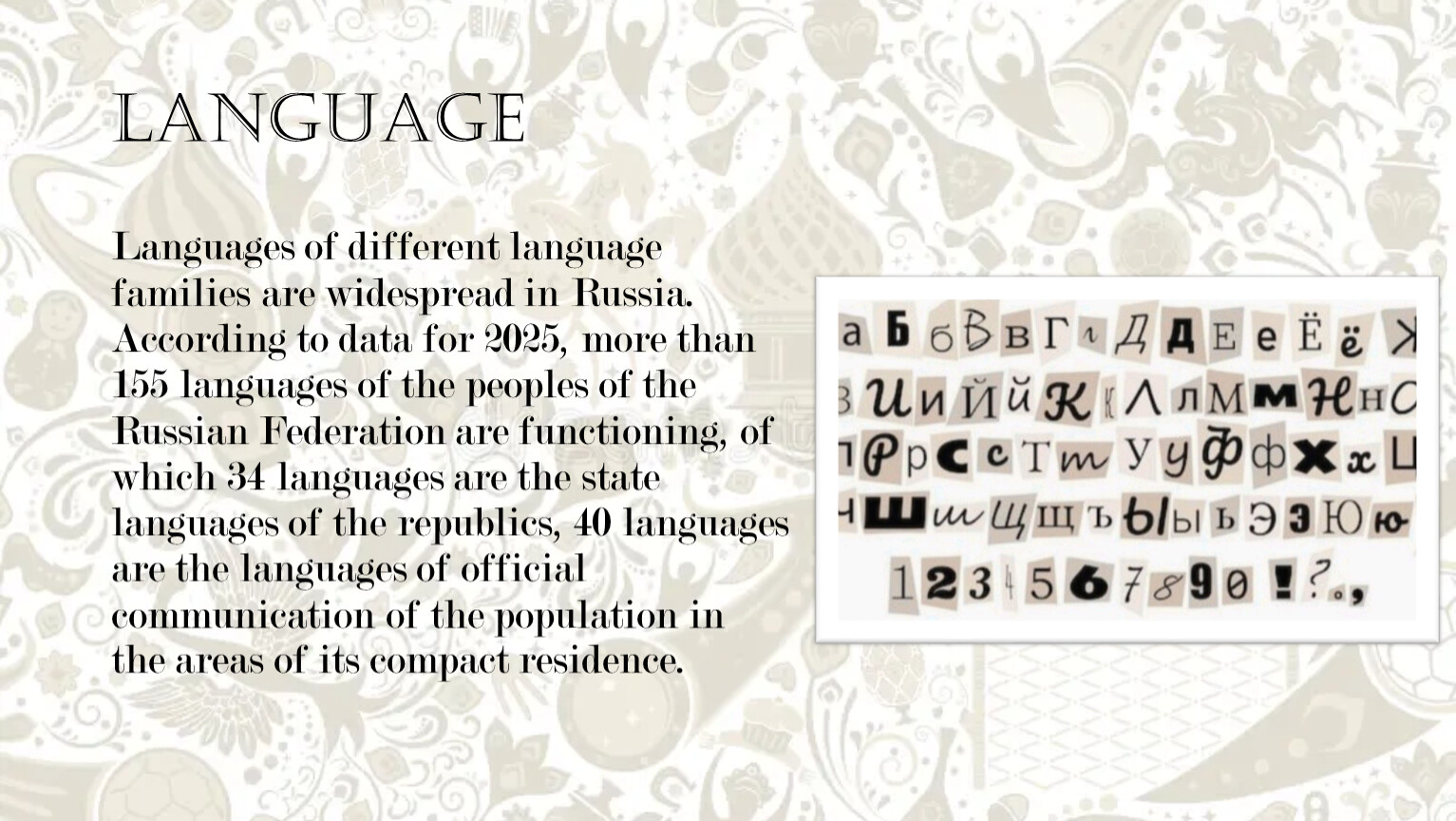
Languages of different language families are widespread in Russia. According to data for 2025, more than 155 languages of the peoples of the Russian Federation are functioning, of which 34 languages are the state languages of the republics, 40 languages are the languages of official communication of the population in the areas of its compact residence.
Sights of Russia
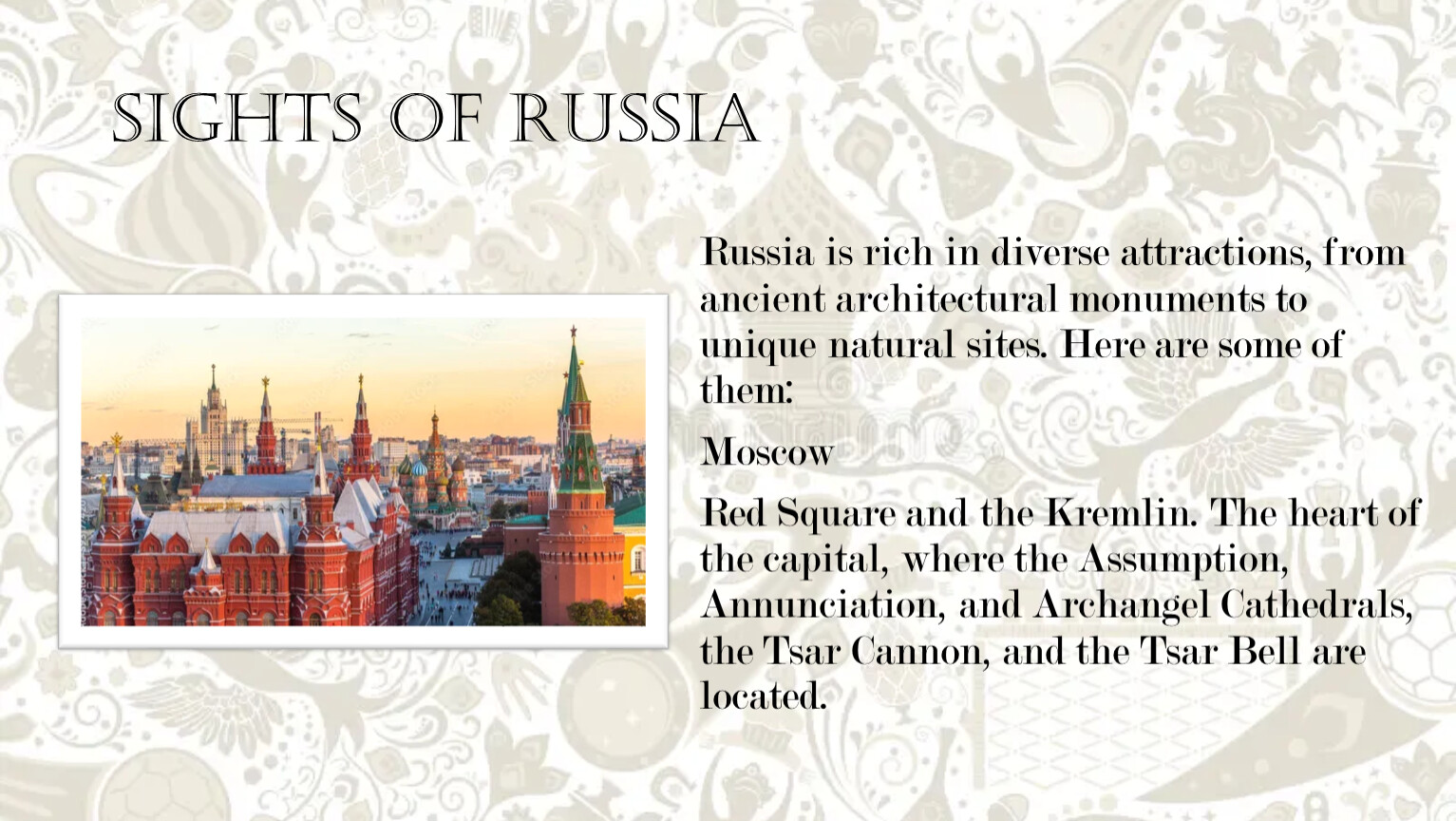
Russia is rich in diverse attractions, from ancient architectural monuments to unique natural sites. Here are some of them:
Moscow
Red Square and the Kremlin. The heart of the capital, where the Assumption, Annunciation, and Archangel Cathedrals, the Tsar Cannon, and the Tsar Bell are located.
St. Basil's Cathedral
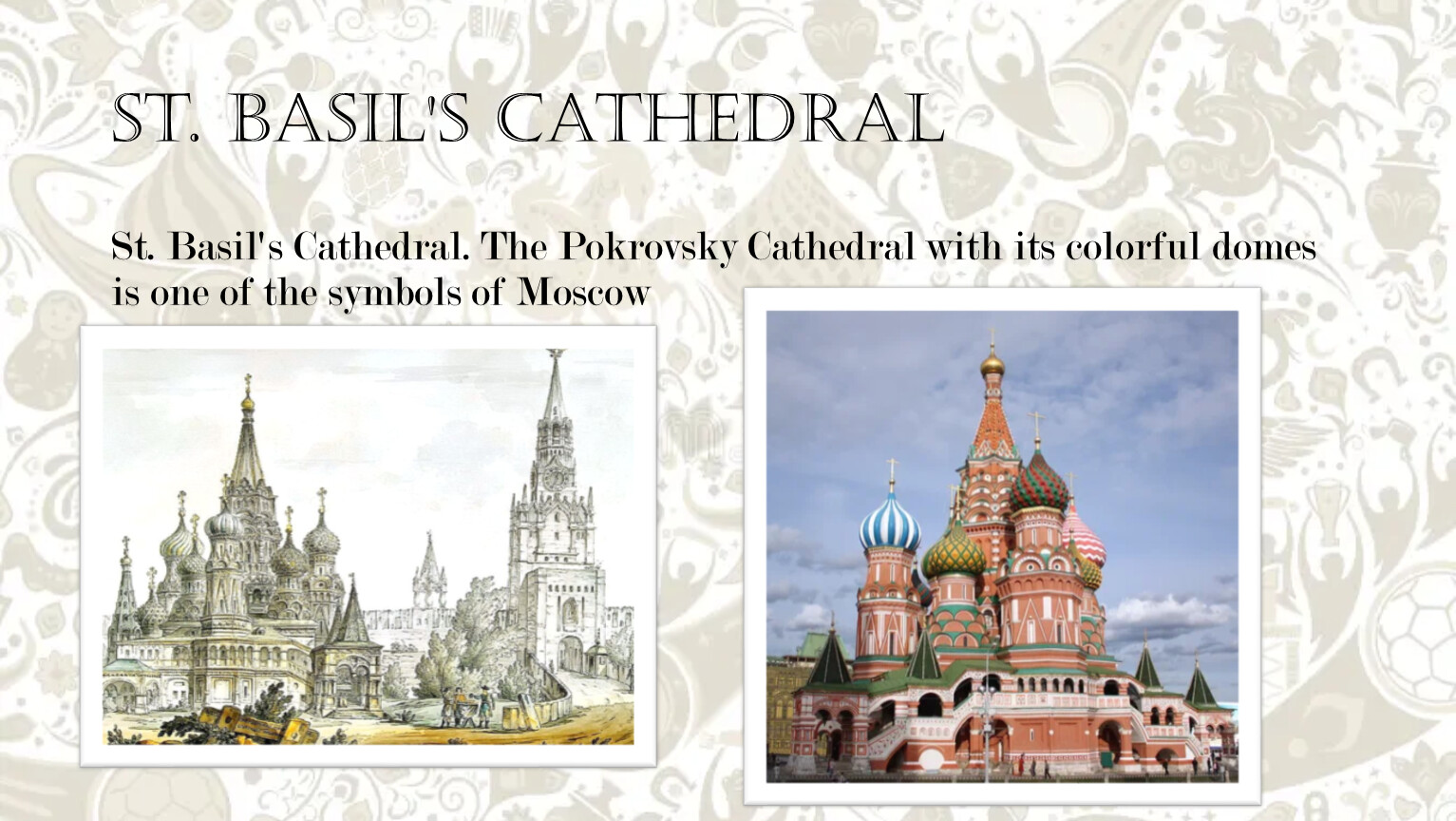
St. Basil's Cathedral. The Pokrovsky Cathedral with its colorful domes is one of the symbols of Moscow
Zaryadye Park
Zaryadye Park is a modern park in the center of Moscow, opened in 2017 on the site of the demolished Rossiya Hotel. It combines nature and technology, re-creating four landscape zones: tundra, steppe, mixed forest and flood meadows.
The Floating Bridge is a concrete boomerang-shaped console over 240 meters long with a panoramic view of the Kremlin, Moscow City, and St. Basil's Cathedral.
The Ice Cave is an art installation with temperatures ranging from -4 to -9°C.
The Underground Museum is an interactive archaeological complex around the base of the Kitai-Gorod Wall.
The Glass Bark is the world's first glass structure without load-bearing walls.
VDNKh
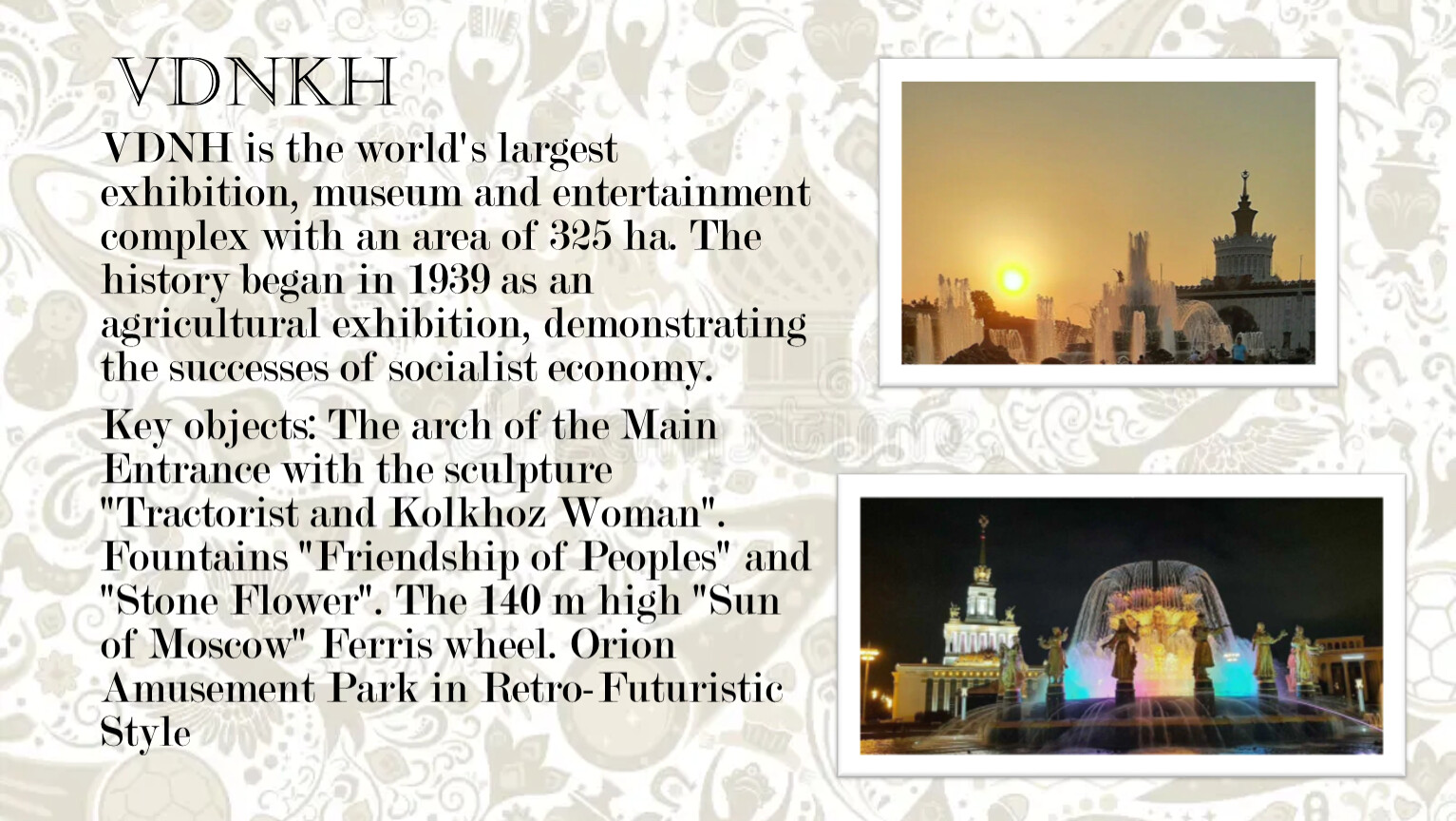
VDNH is the world's largest exhibition, museum and entertainment complex with an area of 325 ha. The history began in 1939 as an agricultural exhibition, demonstrating the successes of socialist economy.
Key objects: The arch of the Main Entrance with the sculpture "Tractorist and Kolkhoz Woman". Fountains "Friendship of Peoples" and "Stone Flower". The 140 m high "Sun of Moscow" Ferris wheel. Orion Amusement Park in Retro-Futuristic Style
Tretyakov Gallery
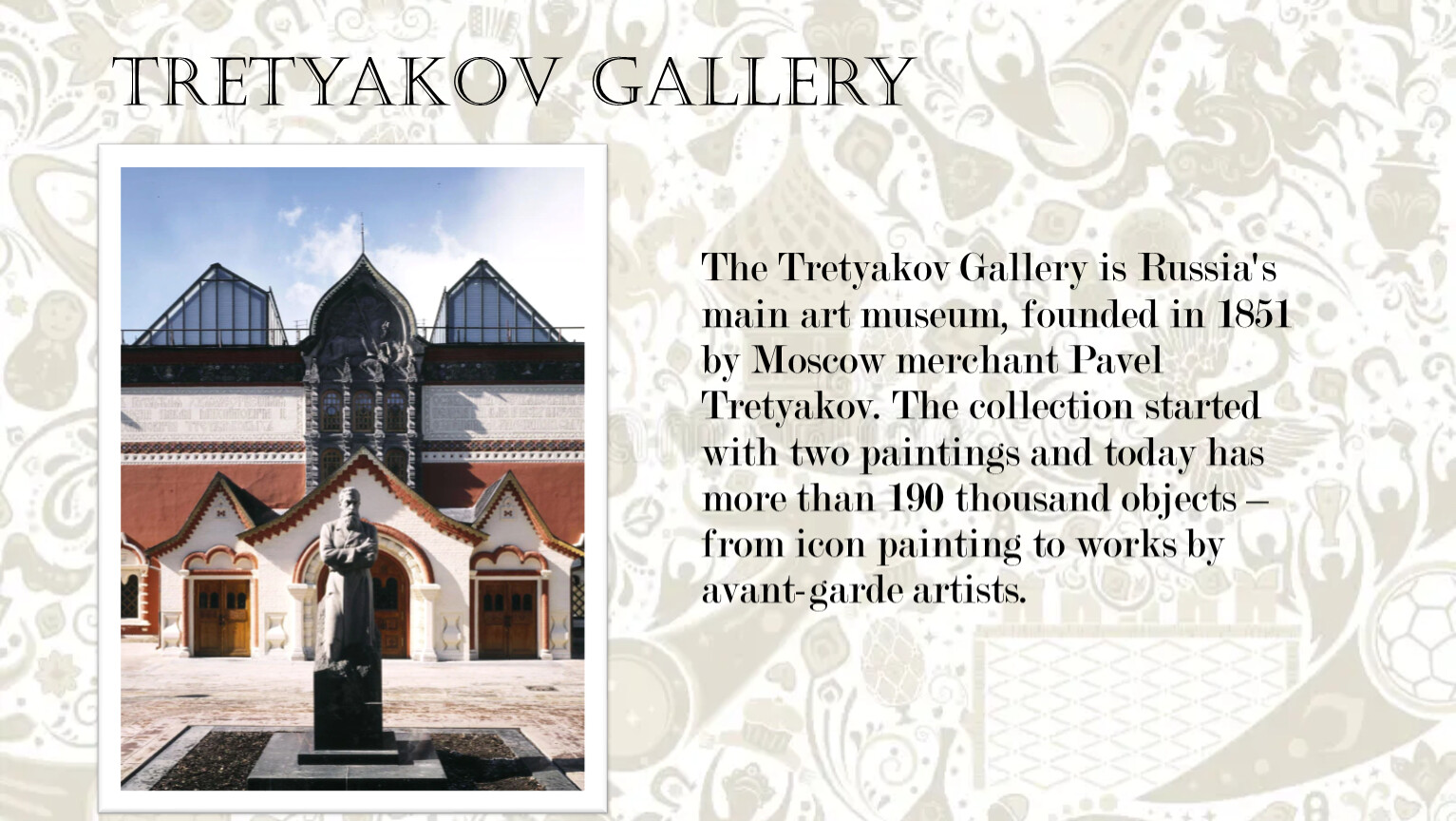
The Tretyakov Gallery is Russia's main art museum, founded in 1851 by Moscow merchant Pavel Tretyakov. The collection started with two paintings and today has more than 190 thousand objects – from icon painting to works by avant-garde artists.
The Hermitage
The Hermitage is one of the largest museums in the world, founded in 1764 by Catherine II as a private collection. The main museum complex includes six buildings: the Winter Palace, the Small Hermitage, the Great (Old) Hermitage, the New Hermitage, the Hermitage Theatre, and the Main Headquarters.
The collection includes about three million works of art and monuments of world culture, including paintings, sculptures, applied art, archaeological finds, and numismatic material.
Among the iconic sites are the Winter Palace, where most of the exhibitions are located, and the General Staff Building, which houses exhibitions of 19th- and 21st-century art.
The Peter and Paul Fortress
The Peter and Paul Fortress is the oldest monument of history, culture and architecture in St. Petersburg, founded on May 16 (27), 1703 by Peter the Great. It is located on Zayachy Island and is considered the historical core of the city.
On the territory are:
The Peter and Paul Cathedral - the burial place of the Russian imperial house of Romanov.
Grand Ducal burial place.
Boat House, Commandant's House, Engineering House, and Mint.
Since 1924, it has been a state museum, and since 1993, it has been a historical and cultural museum-reserve. The fortress and most of its facilities are included in the UNESCO World Heritage List.
Nevsky Prospekt
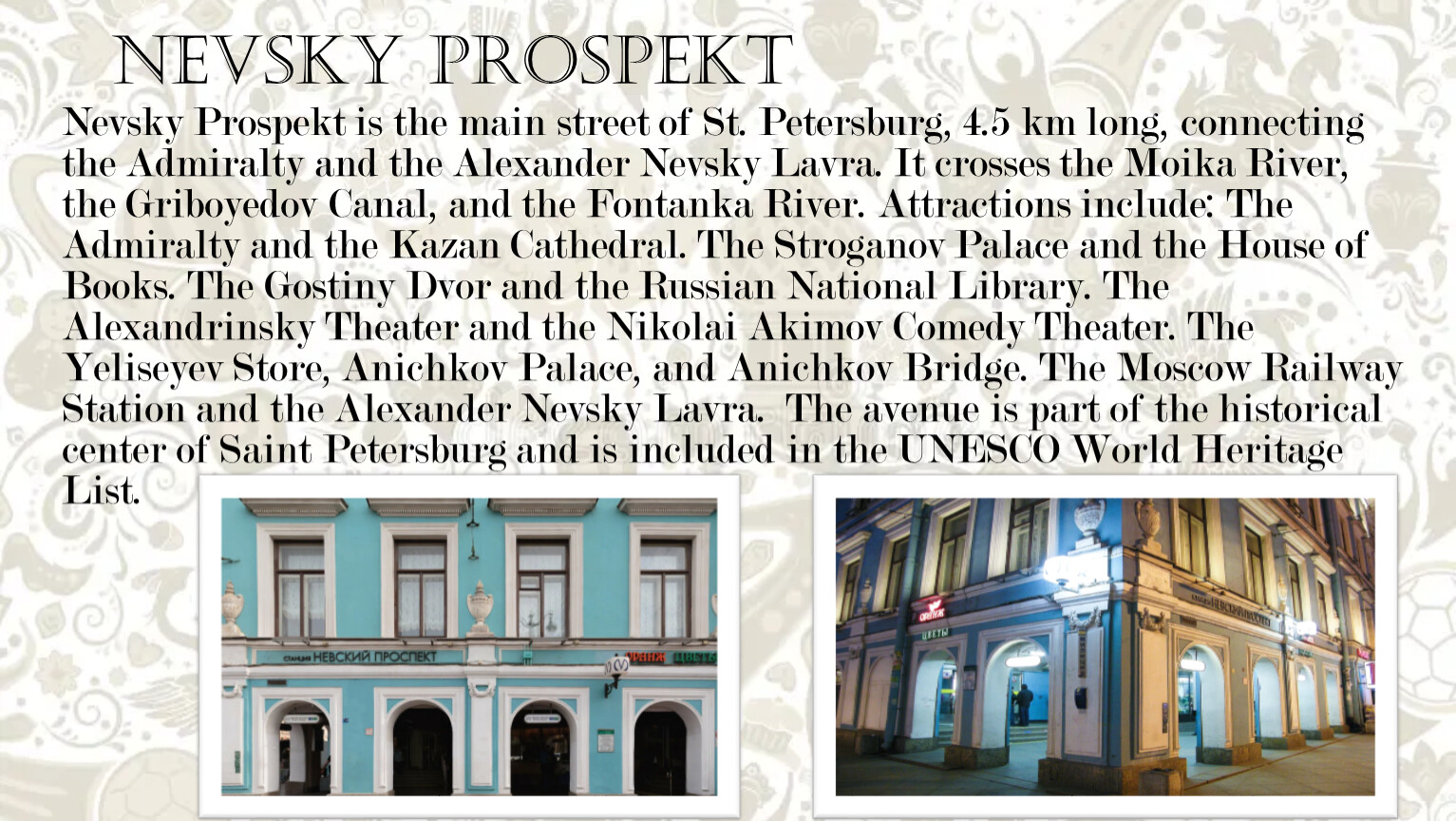
Nevsky Prospekt is the main street of St. Petersburg, 4.5 km long, connecting the Admiralty and the Alexander Nevsky Lavra. It crosses the Moika River, the Griboyedov Canal, and the Fontanka River. Attractions include: The Admiralty and the Kazan Cathedral. The Stroganov Palace and the House of Books. The Gostiny Dvor and the Russian National Library. The Alexandrinsky Theater and the Nikolai Akimov Comedy Theater. The Yeliseyev Store, Anichkov Palace, and Anichkov Bridge. The Moscow Railway Station and the Alexander Nevsky Lavra. The avenue is part of the historical center of Saint Petersburg and is included in the UNESCO World Heritage List.
The Summer Garden
The Summer Garden is the oldest park in St. Petersburg, founded by Peter the Great in 1704 as the emperor's summer residence. It is surrounded by water, including the Neva River, the Fontanka River, the Lebyazhya Kanavka, and the Moika River. Features: The layout consists of three parallel alleys intersected by perpendicular paths. It is adorned with fountains, ponds, green labyrinths, tunnels, flower beds, and marble sculptures. Most of the statues are works by Italian masters of the 18th and 19th centuries. The Summer Palace of Peter the Great has been preserved. Since 1934, the garden, along with the collection of sculptures and the palace of Peter the Great, has been a museum. During the Great Patriotic War, the area was severely damaged, but the sculptures were preserved by being hidden in dug-out shelters.
Vorobyovy Gory (Moscow)
Vorobyovy Gory is a natural area in the south-west of Moscow with an observation deck that offers a panoramic view of the city. The deck is located on the Teplostanskaya Upland, approximately 200 meters above sea level and 80 meters above the Moskva River. From the deck, you can see landmarks such as the Luzhniki Sports Complex, the Moscow State University building, the Moskva River, and other areas of the city. The site has free viewing binoculars, benches, and an interactive map of the city.
In 2018, a cable car was installed here, which connects the observation deck with the Luzhniki Stadium. The length of the aerial route is 720 meters.
Grand Layout
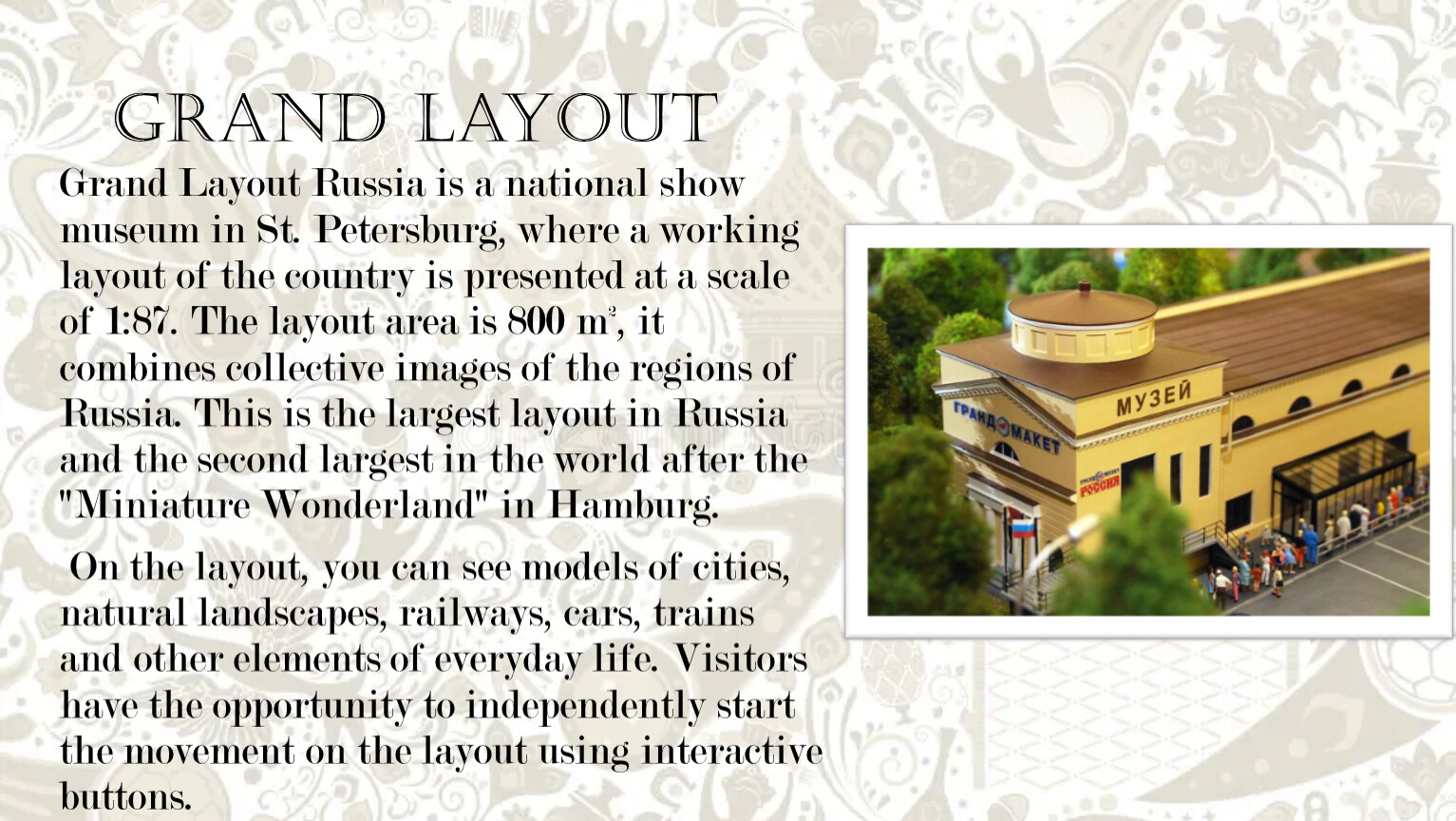
Grand Layout Russia is a national show museum in St. Petersburg, where a working layout of the country is presented at a scale of 1:87. The layout area is 800 m², it combines collective images of the regions of Russia. This is the largest layout in Russia and the second largest in the world after the "Miniature Wonderland" in Hamburg.
On the layout, you can see models of cities, natural landscapes, railways, cars, trains and other elements of everyday life. Visitors have the opportunity to independently start the movement on the layout using interactive buttons.
Russian culture
Russian culture is a living organism that constantly develops and enriches itself through the influx of new forces and creative competition. It is not closed off and constantly absorbs new phenomena, global trends, and innovations.
During the post-Soviet period, many non-Russian authors entered Russian and Soviet culture, and the counterculture of the Soviet era was integrated into the official culture of the 1990s.
Today, Russia is actively restoring its churches and religious customs, reviving the institution of patronage, and continuing the process of integrating traditions borrowed from Eastern and Western countries into Russian culture.
Russia's culture continues to influence global culture and shape the self-awareness of the Russian people.
Literature
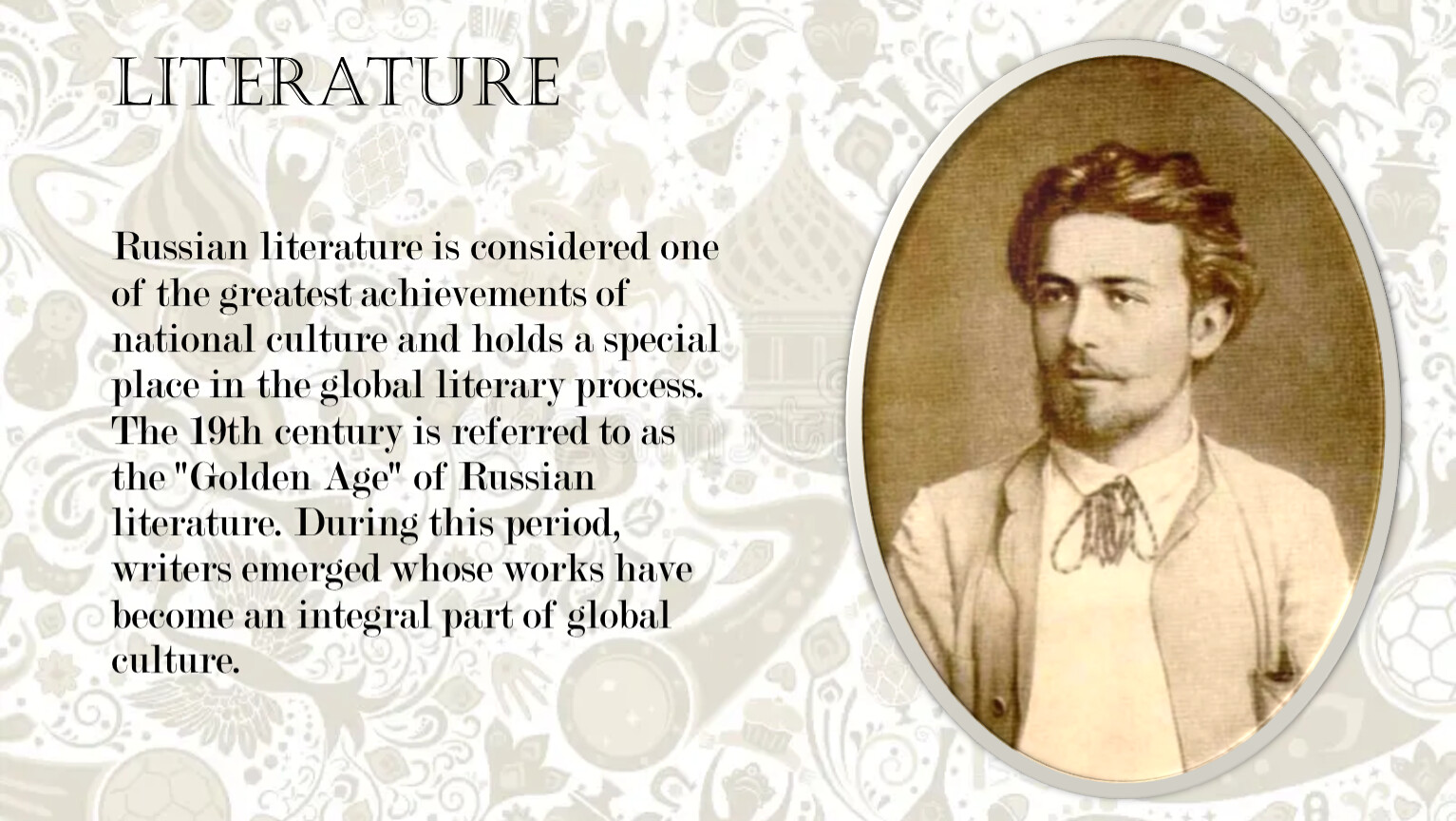
Russian literature is considered one of the greatest achievements of national culture and holds a special place in the global literary process. The 19th century is referred to as the "Golden Age" of Russian literature. During this period, writers emerged whose works have become an integral part of global culture.
Famous works
Alexander Pushkin is the founder of the modern Russian literary language, the author of Eugene Onegin, Boris Godunov, and The Captain's Daughter.
Fyodor Dostoevsky is a psychologist and philosopher, the author of Crime and Punishment, The Brothers Karamazov, and The Idiot.
Leo Tolstoy is the author of the epic novels War and Peace and Anna Karenina.
Anton Chekhov is a pioneering playwright, the author of The Seagull, Three Sisters, and The Cherry Orchard.
During the Soviet period
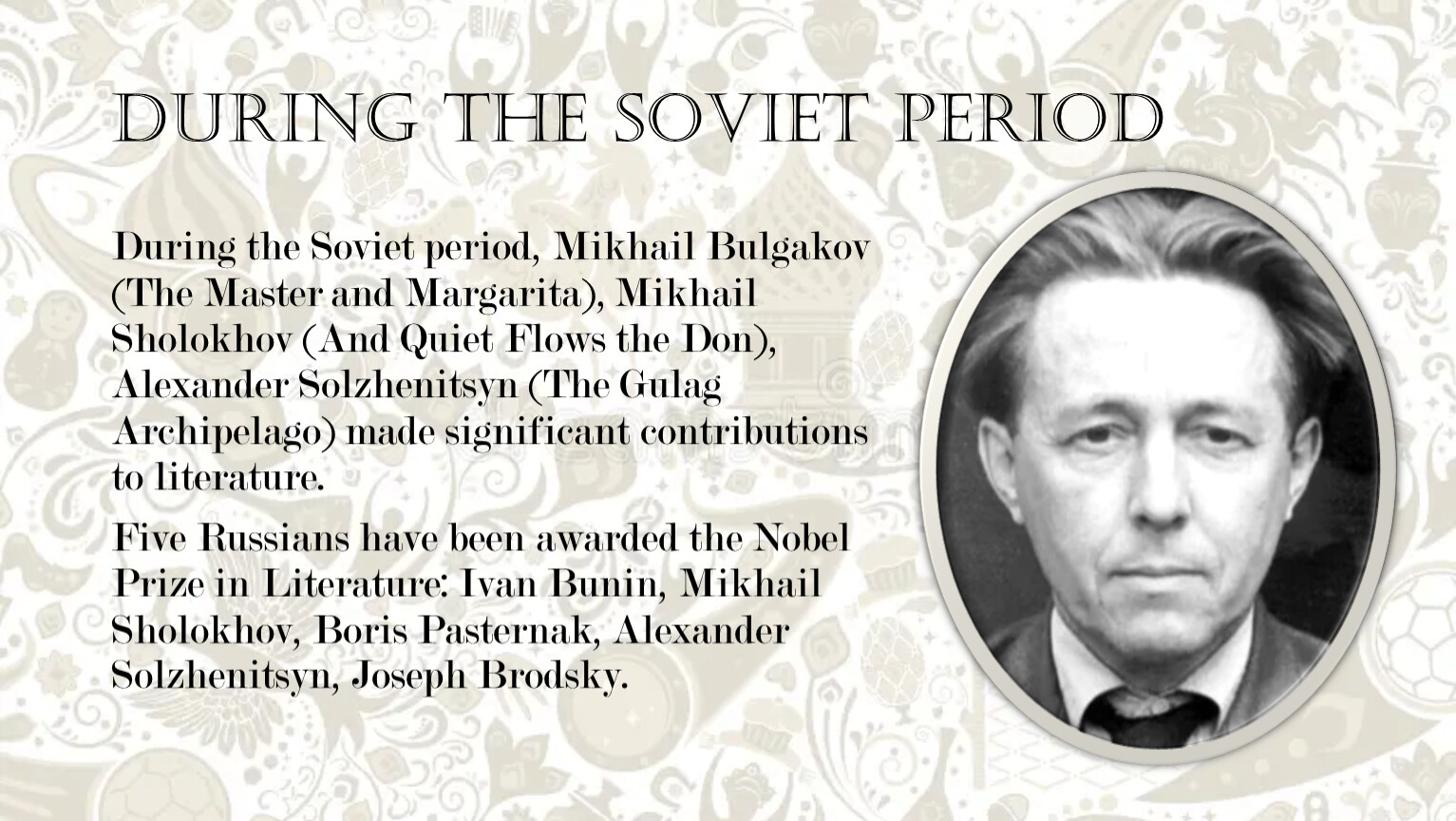
During the Soviet period, Mikhail Bulgakov (The Master and Margarita), Mikhail Sholokhov (And Quiet Flows the Don), Alexander Solzhenitsyn (The Gulag Archipelago) made significant contributions to literature.
Five Russians have been awarded the Nobel Prize in Literature: Ivan Bunin, Mikhail Sholokhov, Boris Pasternak, Alexander Solzhenitsyn, Joseph Brodsky.
Music
Russia's contribution to the world's musical culture is significant. Famous composers include:
Pyotr Tchaikovsky, the author of the ballets Swan Lake, The Sleeping Beauty, and The Nutcracker. Sergei Rachmaninoff, the author of the Second Piano Concerto, which ranked first in the Classic FM ranking in 2025. Igor Stravinsky, Dmitry Shostakovich, Alexander Scriabin, and Alfred Schnittke.
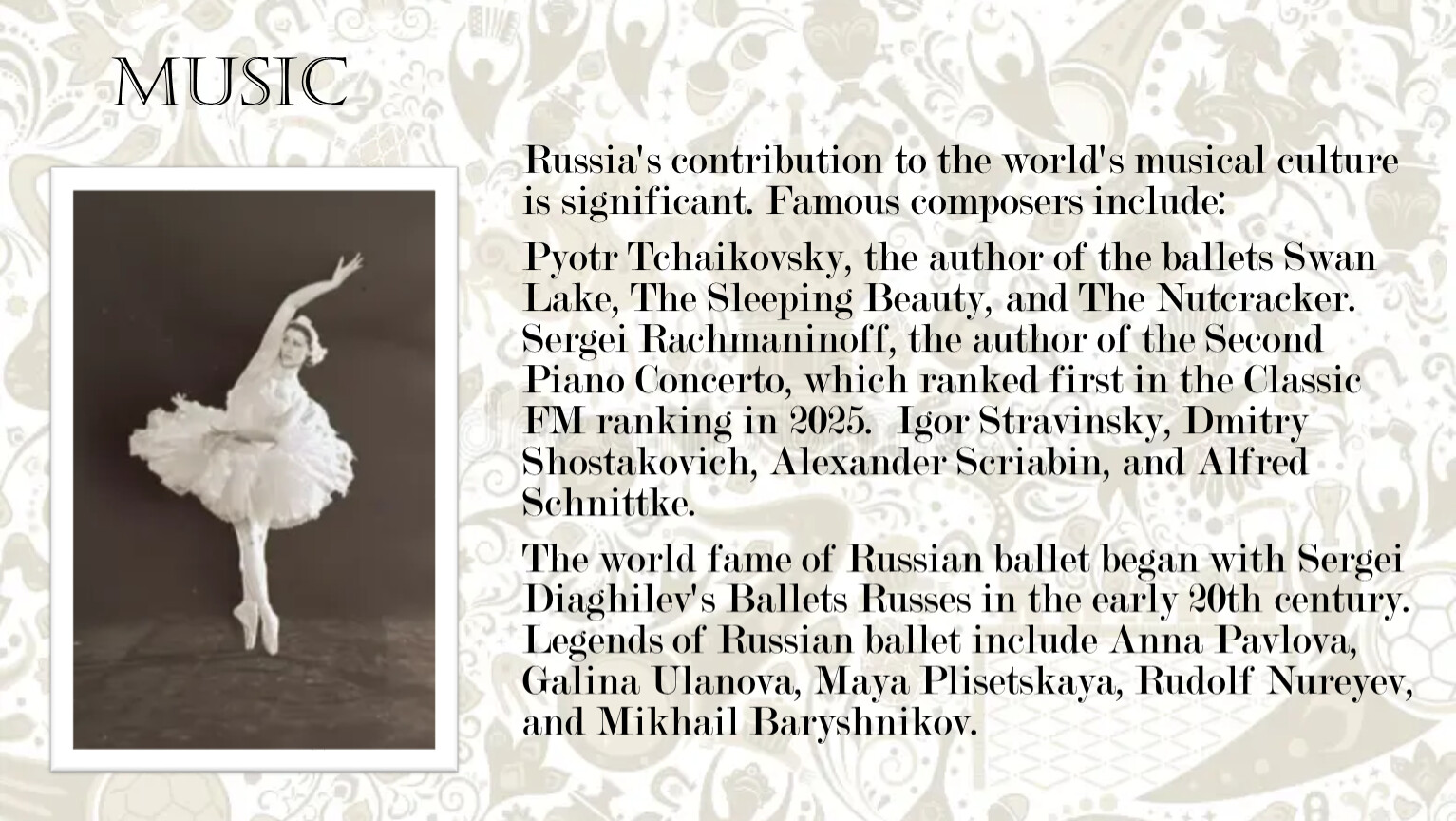
The world fame of Russian ballet began with Sergei Diaghilev's Ballets Russes in the early 20th century. Legends of Russian ballet include Anna Pavlova, Galina Ulanova, Maya Plisetskaya, Rudolf Nureyev, and Mikhail Baryshnikov.
Fine Arts
Among famous Russian artists:
Ilya Repin - the author of the painting "Barge haulers on the Volga".
Ivan Shishkin - the author of "Morning in a pine forest".
Mikhail Vrubel - the author of "The Demon sitting" and "The Swan Princess".
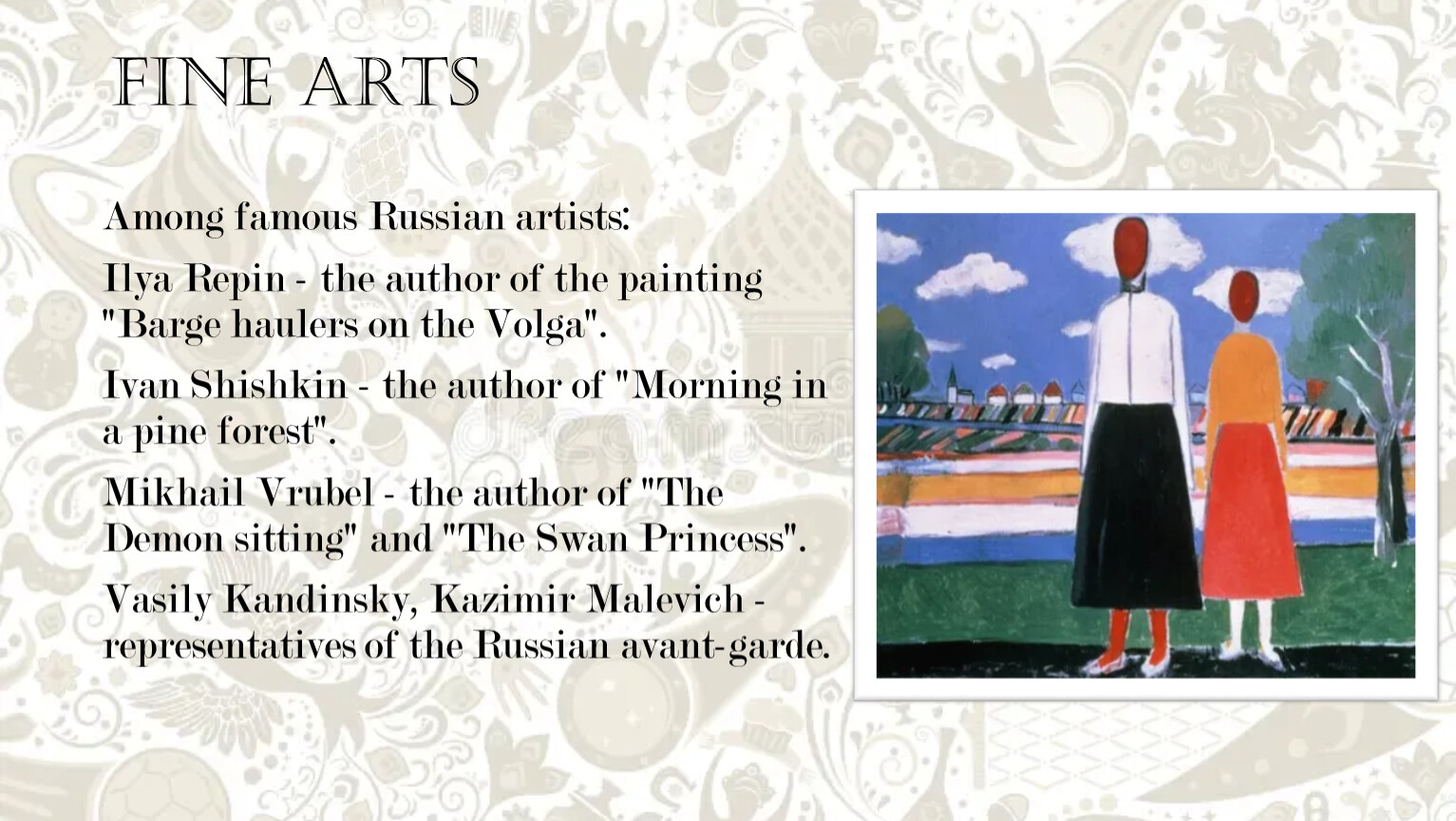
Vasily Kandinsky, Kazimir Malevich - representatives of the Russian avant-garde.
Architecture and Monuments
Some of Russia's architectural and historical-cultural monuments are listed as UNESCO World Heritage Sites, including:
The Moscow Kremlin and Red Square.
The Historic Centre of St. Petersburg.
The White Stone Monuments of Vladimir and Suzdal.
The Trinity Lavra of St. Sergius in Sergiyev Posad.
The Historic-Architectural Complex of the Kazan Kremlin
Folk Art
Folk art is a collective activity of the people that reflects their life, views, and ideals. It includes various types of art:
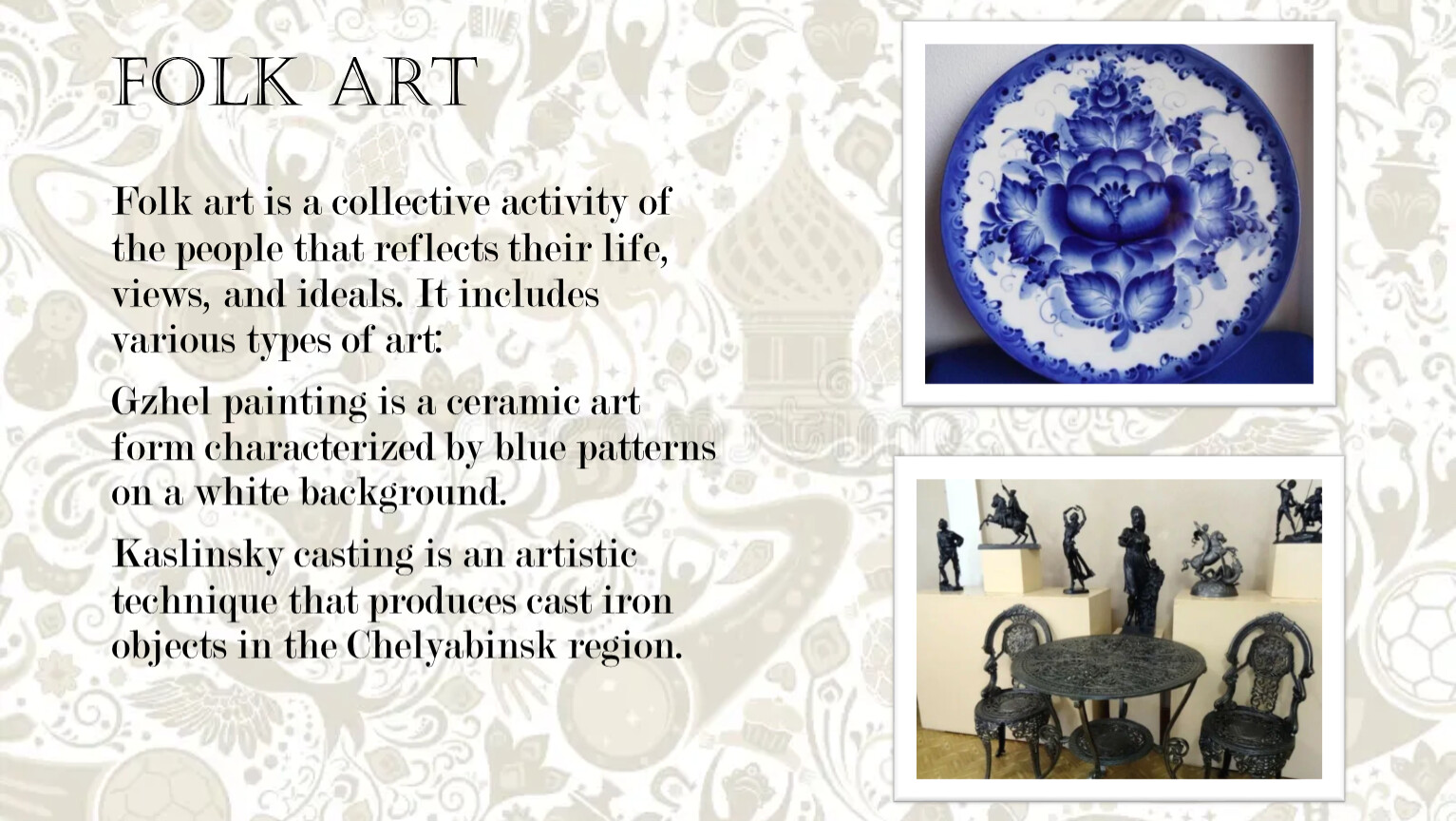
Gzhel painting is a ceramic art form characterized by blue patterns on a white background.
Kaslinsky casting is an artistic technique that produces cast iron objects in the Chelyabinsk region.
Folk holidays
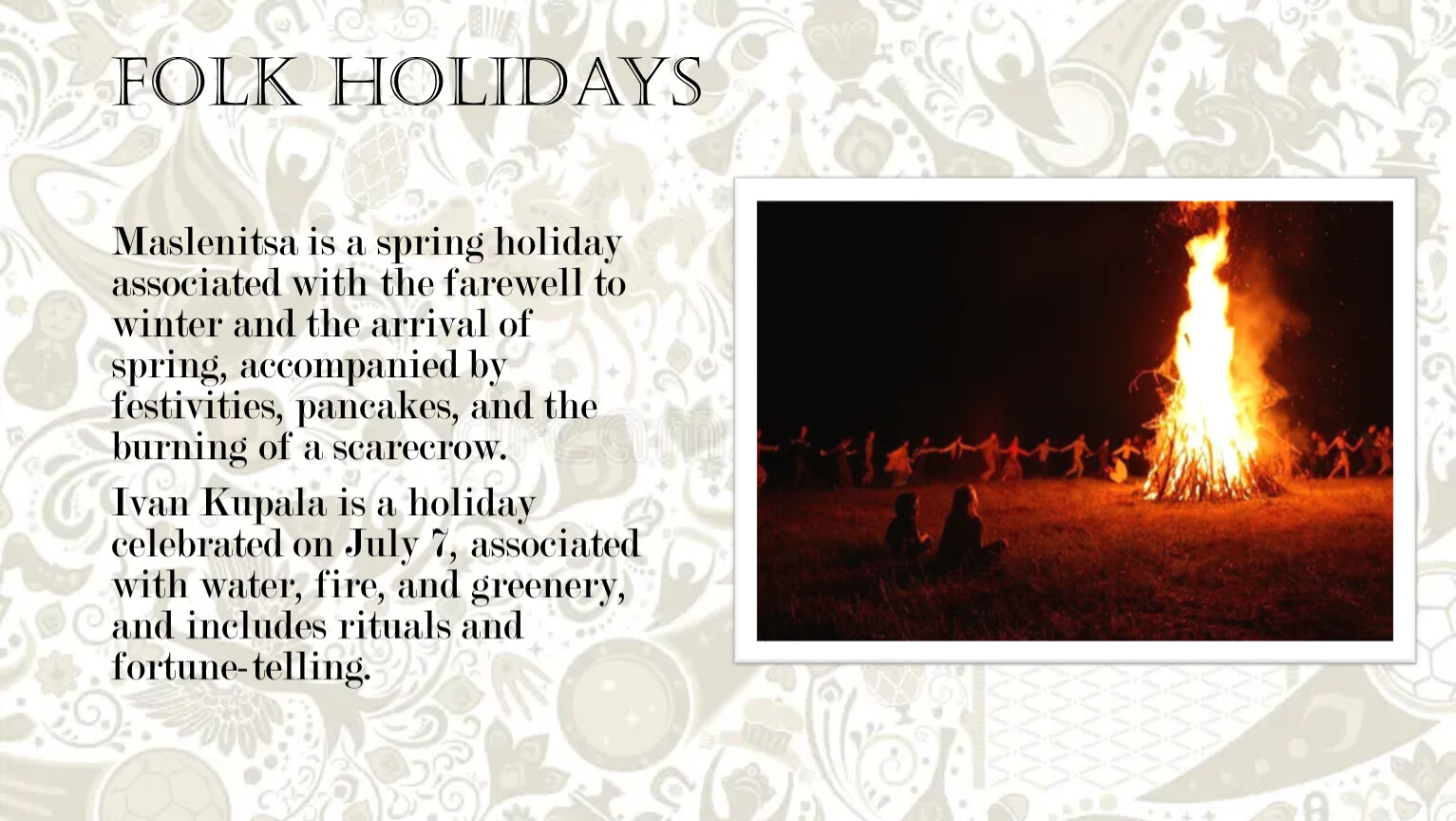
Maslenitsa is a spring holiday associated with the farewell to winter and the arrival of spring, accompanied by festivities, pancakes, and the burning of a scarecrow.
Ivan Kupala is a holiday celebrated on July 7, associated with water, fire, and greenery, and includes rituals and fortune-telling.
Result
Russia is the largest country in the world by area, spanning two continents: Europe and Asia.
Its diverse society is made up of over 190 ethnic groups, each contributing to the country's cultural richness.
Russian scientists such as Mikhail Lomonosov, Dmitry Mendeleev, and Konstantin Tsiolkovsky have made groundbreaking discoveries that have shaped the world of science.
Thank you for watching
Материалы на данной страницы взяты из открытых источников либо размещены пользователем в соответствии с договором-офертой сайта. Вы можете сообщить о нарушении.


