
Поделиться



 The whole world knows them.docx
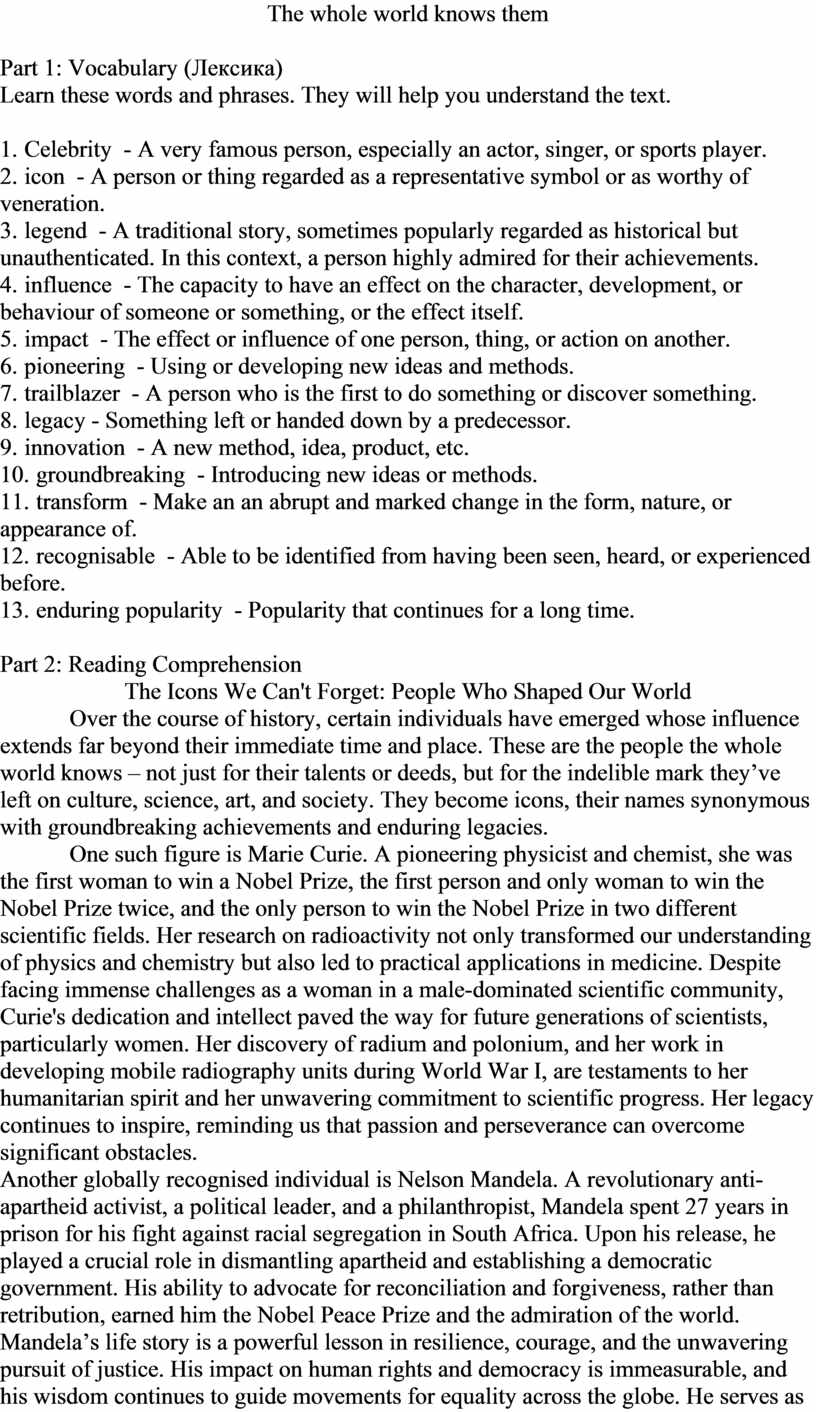
The whole world knows them
Part 1: Vocabulary (Лексика)
Learn these words and phrases. They will help you understand the text.
1. Celebrity - A very famous person, especially an actor, singer, or sports player.
2. icon - A person or thing regarded as a representative symbol or as worthy of veneration.
3. legend - A traditional story, sometimes popularly regarded as historical but unauthenticated. In this context, a person highly admired for their achievements.
4. influence - The capacity to have an effect on the character, development, or behaviour of someone or something, or the effect itself.
5. impact - The effect or influence of one person, thing, or action on another.
6. pioneering - Using or developing new ideas and methods.
7. trailblazer - A person who is the first to do something or discover something.
8. legacy - Something left or handed down by a predecessor.
9. innovation - A new method, idea, product, etc.
10. groundbreaking - Introducing new ideas or methods.
11. transform - Make an an abrupt and marked change in the form, nature, or appearance of.
12. recognisable - Able to be identified from having been seen, heard, or experienced before.
13. enduring popularity - Popularity that continues for a long time.
Part 2: Reading Comprehension
The Icons We Can't Forget: People Who Shaped Our World
Over the course of history, certain individuals have emerged whose influence extends far beyond their immediate time and place. These are the people the whole world knows – not just for their talents or deeds, but for the indelible mark they’ve left on culture, science, art, and society. They become icons, their names synonymous with groundbreaking achievements and enduring legacies.
One such figure is Marie Curie. A pioneering physicist and chemist, she was the first woman to win a Nobel Prize, the first person and only woman to win the Nobel Prize twice, and the only person to win the Nobel Prize in two different scientific fields. Her research on radioactivity not only transformed our understanding of physics and chemistry but also led to practical applications in medicine. Despite facing immense challenges as a woman in a male-dominated scientific community, Curie's dedication and intellect paved the way for future generations of scientists, particularly women. Her discovery of radium and polonium, and her work in developing mobile radiography units during World War I, are testaments to her humanitarian spirit and her unwavering commitment to scientific progress. Her legacy continues to inspire, reminding us that passion and perseverance can overcome significant obstacles.
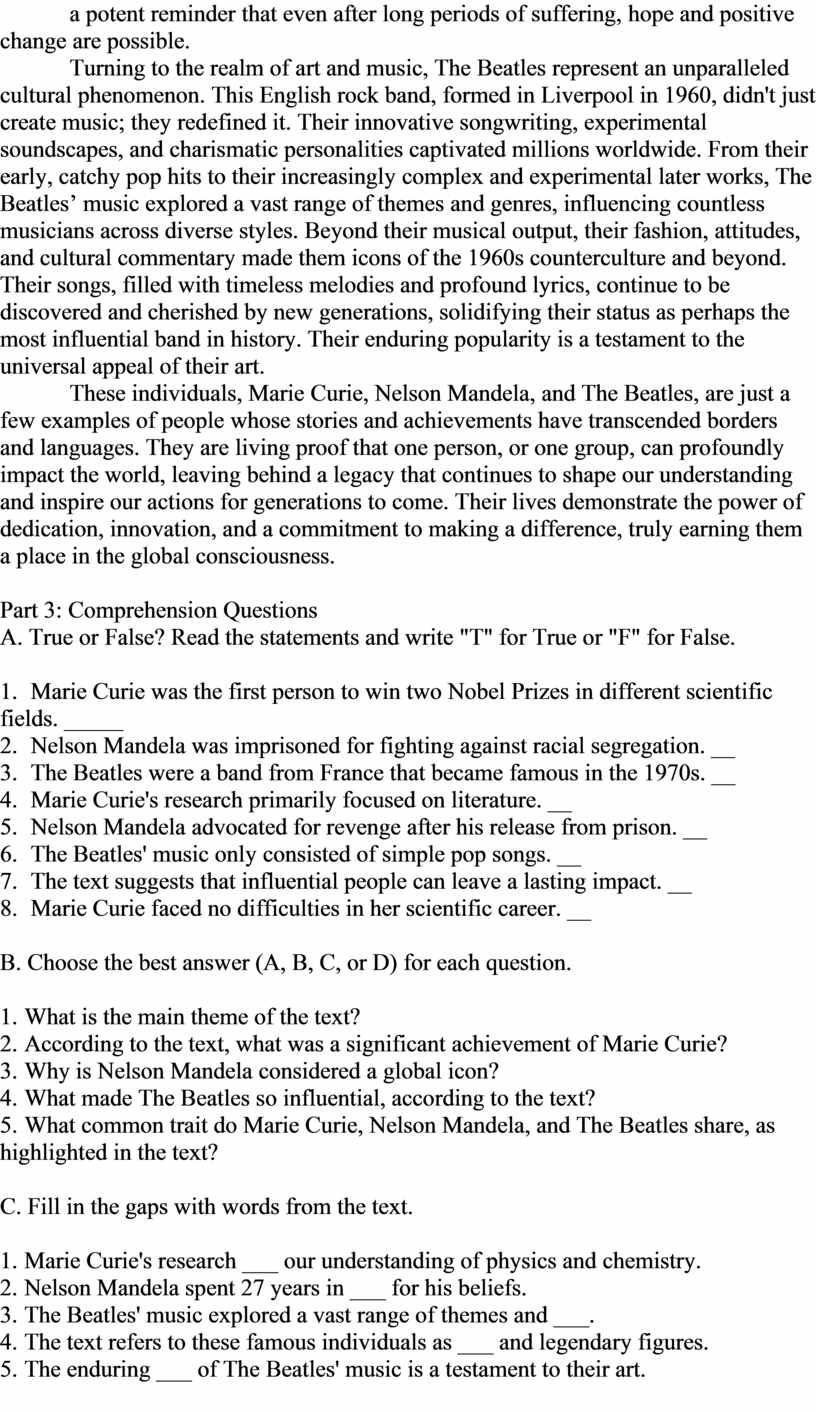
Another globally recognised individual is Nelson Mandela. A revolutionary anti-apartheid activist, a political leader, and a philanthropist, Mandela spent 27 years in prison for his fight against racial segregation in South Africa. Upon his release, he played a crucial role in dismantling apartheid and establishing a democratic government. His ability to advocate for reconciliation and forgiveness, rather than retribution, earned him the Nobel Peace Prize and the admiration of the world. Mandela’s life story is a powerful lesson in resilience, courage, and the unwavering pursuit of justice. His impact on human rights and democracy is immeasurable, and his wisdom continues to guide movements for equality across the globe. He serves as a potent reminder that even after long periods of suffering, hope and positive change are possible.
Turning to the realm of art and music, The Beatles represent an unparalleled cultural phenomenon. This English rock band, formed in Liverpool in 1960, didn't just create music; they redefined it. Their innovative songwriting, experimental soundscapes, and charismatic personalities captivated millions worldwide. From their early, catchy pop hits to their increasingly complex and experimental later works, The Beatles’ music explored a vast range of themes and genres, influencing countless musicians across diverse styles. Beyond their musical output, their fashion, attitudes, and cultural commentary made them icons of the 1960s counterculture and beyond. Their songs, filled with timeless melodies and profound lyrics, continue to be discovered and cherished by new generations, solidifying their status as perhaps the most influential band in history. Their enduring popularity is a testament to the universal appeal of their art.
These individuals, Marie Curie, Nelson Mandela, and The Beatles, are just a few examples of people whose stories and achievements have transcended borders and languages. They are living proof that one person, or one group, can profoundly impact the world, leaving behind a legacy that continues to shape our understanding and inspire our actions for generations to come. Their lives demonstrate the power of dedication, innovation, and a commitment to making a difference, truly earning them a place in the global consciousness.
Part 3: Comprehension Questions
A. True or False? Read the statements and write "T" for True or "F" for False.
1. Marie Curie was the first person to win two Nobel Prizes in different scientific fields. _____
2. Nelson Mandela was imprisoned for fighting against racial segregation. __
3. The Beatles were a band from France that became famous in the 1970s. __
4. Marie Curie's research primarily focused on literature. __
5. Nelson Mandela advocated for revenge after his release from prison. __
6. The Beatles' music only consisted of simple pop songs. __
7. The text suggests that influential people can leave a lasting impact. __
8. Marie Curie faced no difficulties in her scientific career. __
B. Choose the best answer (A, B, C, or D) for each question.
1. What is the main theme of the text?
2. According to the text, what was a significant achievement of Marie Curie?
3. Why is Nelson Mandela considered a global icon?
4. What made The Beatles so influential, according to the text?
5. What common trait do Marie Curie, Nelson Mandela, and The Beatles share, as highlighted in the text?
C. Fill in the gaps with words from the text.
1. Marie Curie's research ___ our understanding of physics and chemistry.
2. Nelson Mandela spent 27 years in ___ for his beliefs.
3. The Beatles' music explored a vast range of themes and ___.
4. The text refers to these famous individuals as ___ and legendary figures.
5. The enduring ___ of The Beatles' music is a testament to their art.
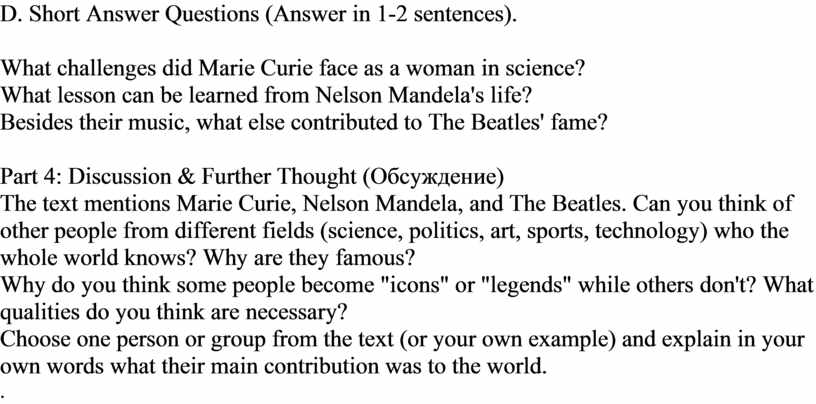
D. Short Answer Questions (Answer in 1-2 sentences).
What challenges did Marie Curie face as a woman in science?
What lesson can be learned from Nelson Mandela's life?
Besides their music, what else contributed to The Beatles' fame?
Part 4: Discussion & Further Thought (Обсуждение)
The text mentions Marie Curie, Nelson Mandela, and The Beatles. Can you think of other people from different fields (science, politics, art, sports, technology) who the whole world knows? Why are they famous?
Why do you think some people become "icons" or "legends" while others don't? What qualities do you think are necessary?
Choose one person or group from the text (or your own example) and explain in your own words what their main contribution was to the world.
.
Материалы на данной страницы взяты из открытых источников либо размещены пользователем в соответствии с договором-офертой сайта. Вы можете сообщить о нарушении.


