
Поделиться



 project.pptx
What are people from Russia like?
Completed by an 8th‑grade student, N. Miroslava. Scientific supervisor: G. Ruslan.
Note:
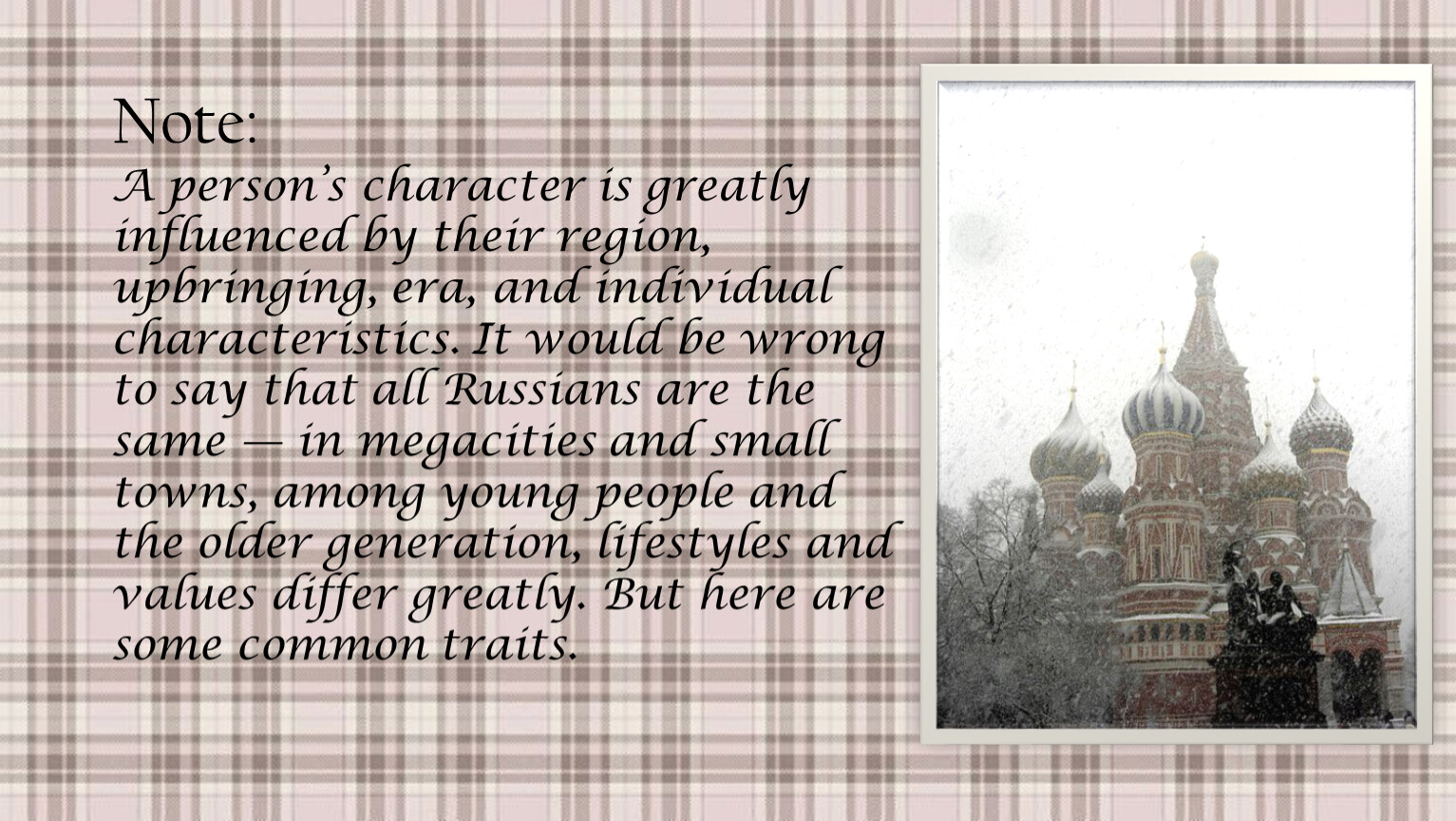
A person’s character is greatly influenced by their region, upbringing, era, and individual characteristics. It would be wrong to say that all Russians are the same — in megacities and small towns, among young people and the older generation, lifestyles and values differ greatly. But here are some common traits.
Kindness and warmth
Kindness and warmth. Empathy. The ability to understand and feel someone else’s pain or joy, to respond to others’ problems. This quality is often expressed in the willingness to help not only loved ones but also strangers.
Sincerity. Russian people usually show genuine concern, without ostentatious sympathy. This quality is highly valued in society and is considered an important aspect of interpersonal relationships. Hospitality. In Russian culture, it is customary to take care of guests, create comfortable conditions for them, and offer them the best that the home has to offer.
Openness and hospitalityThe openness of Russian people is evident in their relationships with friends and loved ones: Warmth in communication. When a person becomes a friend, Russians show great warmth and trust. They are ready to share their thoughts, feelings, and even their secrets.
The character of many Russians is marked by a combination of a love of life and resilience — even in difficult circumstances, they manage to maintain optimism and find joy in small things. The strength of spirit and the ability not to give in to difficulties are largely shaped by the country’s challenging history, while flexibility and the ability to adapt quickly help them cope with change.
The support of loved ones also plays an important role: in difficult moments, people rely on family and friends, drawing strength from this. Self‑irony and a particular sense of humour often become a way to relieve tension and look at problems more simply. At the same time, Russians value traditions and remember their roots — historical memory gives confidence and helps maintain inner strength
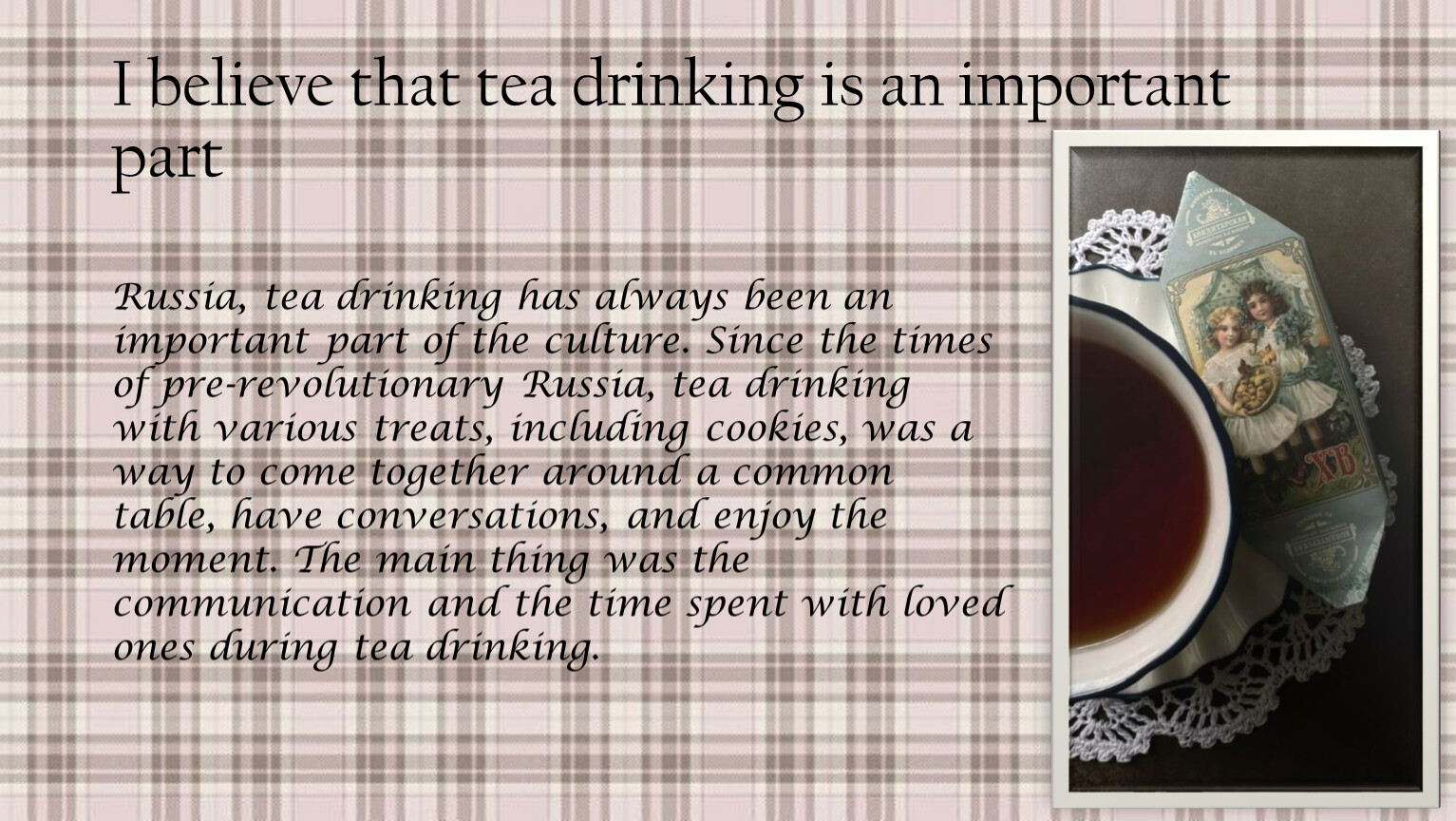
I believe that tea drinking is an important part
Russia, tea drinking has always been an important part of the culture. Since the times of pre‑revolutionary Russia, tea drinking with various treats, including cookies, was a way to come together around a common table, have conversations, and enjoy the moment. The main thing was the communication and the time spent with loved ones during tea drinking.
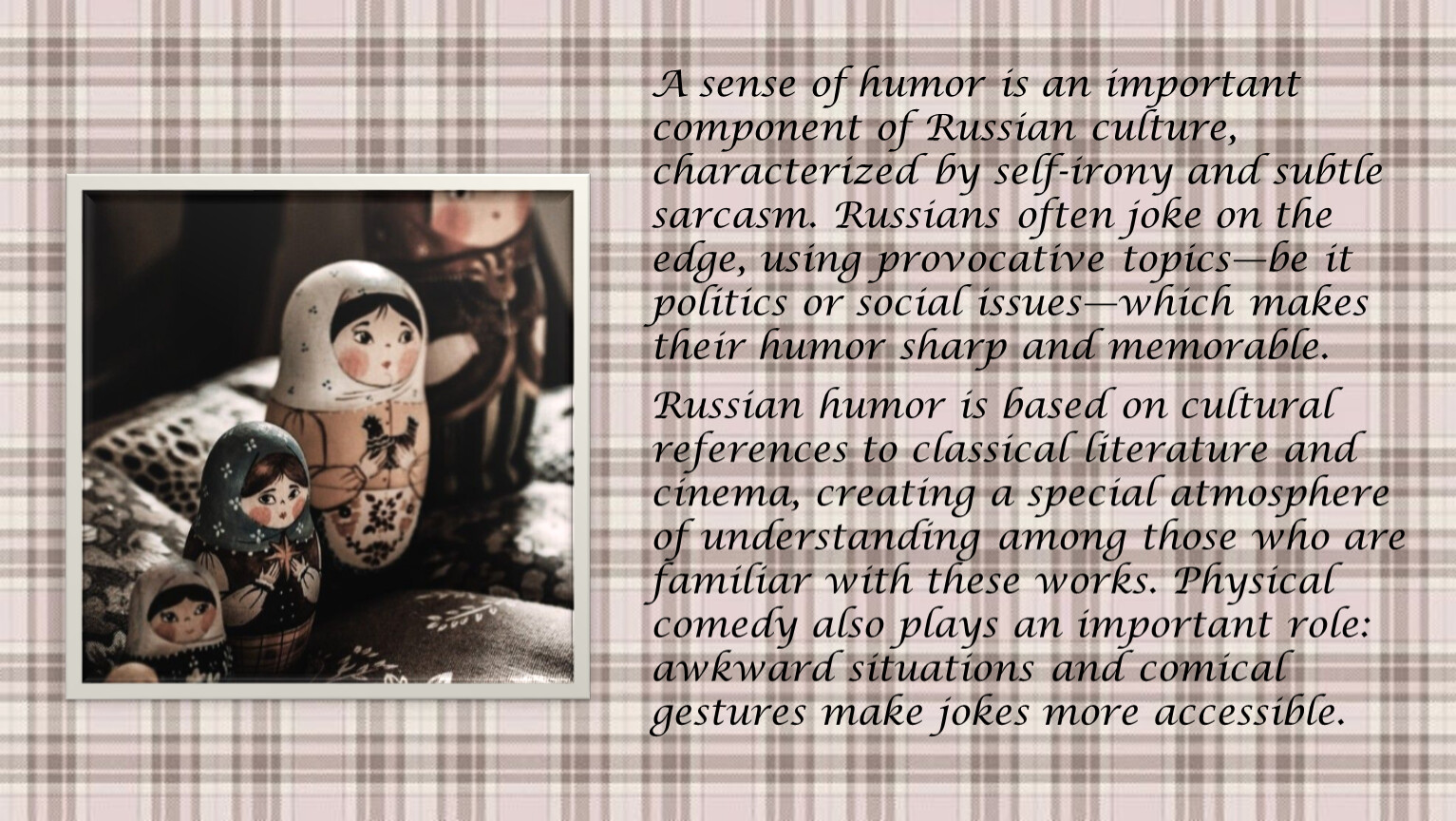
A sense of humor is an important component of Russian culture, characterized by self‑irony and subtle sarcasm. Russians often joke on the edge, using provocative topics—be it politics or social issues—which makes their humor sharp and memorable.
Russian humor is based on cultural references to classical literature and cinema, creating a special atmosphere of understanding among those who are familiar with these works. Physical comedy also plays an important role: awkward situations and comical gestures make jokes more accessible.
Respect for elders is a fundamental component of Russian culture, rooted in centuries‑old traditions. In this cultural paradigm, the older generation occupies a special, honoured place; their opinions are heeded, and their experience and wisdom are highly valued.
From childhood, children are instilled with respect for elders through upbringing and traditions. This is evident in the fact that younger people always give up their seats to elders on public transport, help them with everyday tasks, and show them attention and care. In Russian families, it is customary to show care for elderly relatives, visit them regularly, and help with everyday issues.

Perseverance and hard work are integral character traits of many Russians, who have long been known for their ability to persistently achieve their goals. These qualities are manifested in the willingness to put maximum effort into achieving the desired results, despite the difficulties that arise.
Russian people are distinguished by their amazing resilience and patience in overcoming life's obstacles. They are used to overcoming difficulties and not stopping in the face of challenges, which helps them achieve even the most ambitious goals.
At the beginning of a conversation, many Russians display restraint, which does not at all mean coldness or a lack of willingness to interact. Rather, it is a manifestation of attentiveness, when a person tries to understand who they are dealing with, assessing the interlocutor’s facial expressions, gestures, and manner of speech.
This caution is due to cultural characteristics, where restraint is often perceived as a sign of respect and politeness. By opening up gradually, people protect themselves from possible disappointment if the first impression turns out to be deceptive.

The tendency to “act according to one’s conscience,” rather than merely following instructions, is one of the distinctive traits common to many Russians. This feature reflects a deep inner need to adhere not only to established norms and rules but also to one’s own moral principles.
Often, decisions are made with the heart, based on internal notions of justice. In such situations, people are guided not so much by formal regulations as by an innate sense of truth and honesty. This ability to act according to conscience is especially evident at critical moments when it is necessary to make
a choice between personal gain and the
public good. Russians tend to trust
their inner feelings of justice, even
if they Contradict current
regulations or rules.
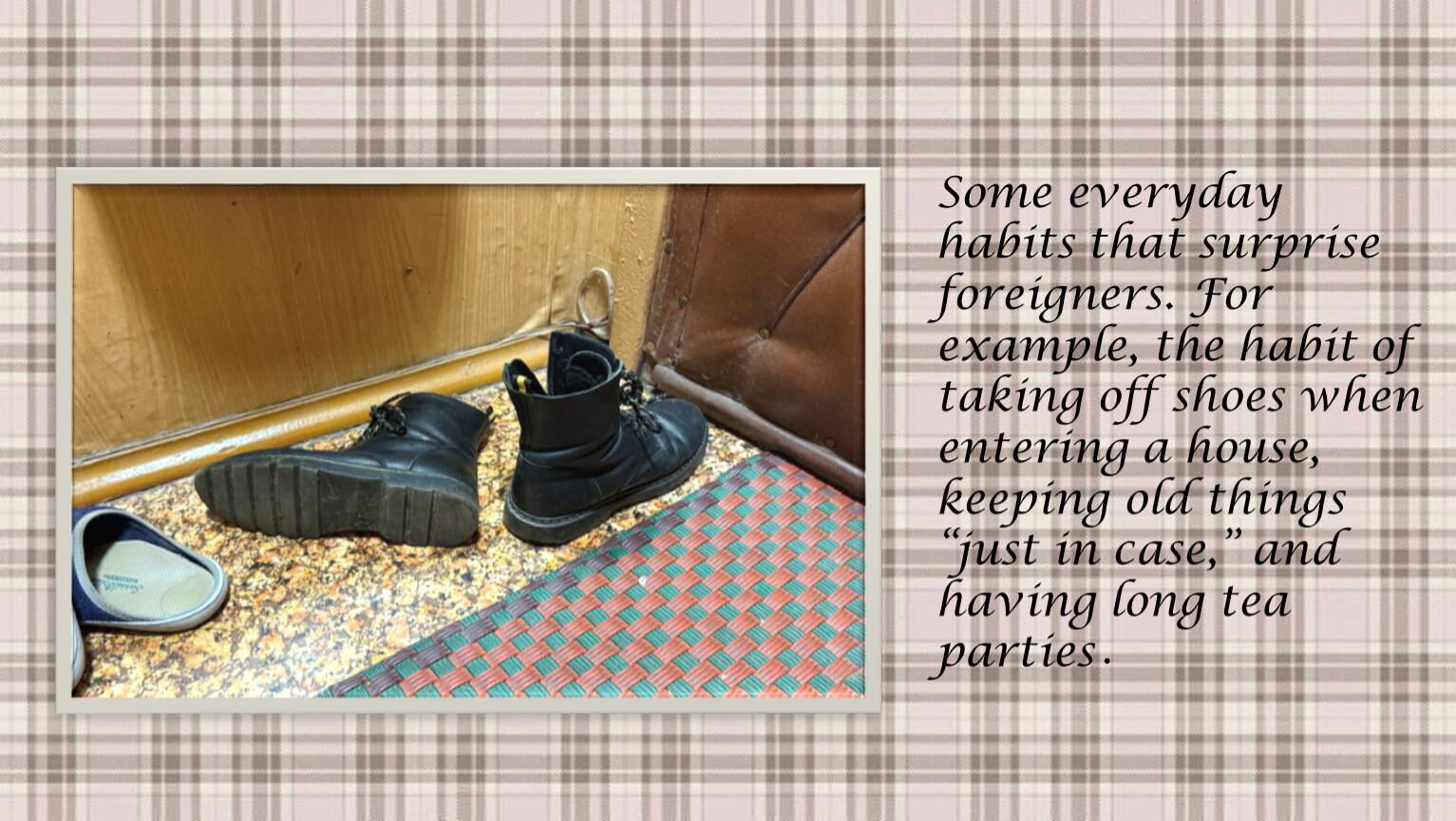
Some everyday habits that surprise foreigners. For example, the habit of taking off shoes when entering a house, keeping old things “just in case,” and having long tea parties.

Habits
Ventilation in winter. Many Russians regularly ventilate their apartments, even when it’s cold outside. Foreigners don’t understand why they should waste heat and reduce the efficiency of the heating if the room gets cool.
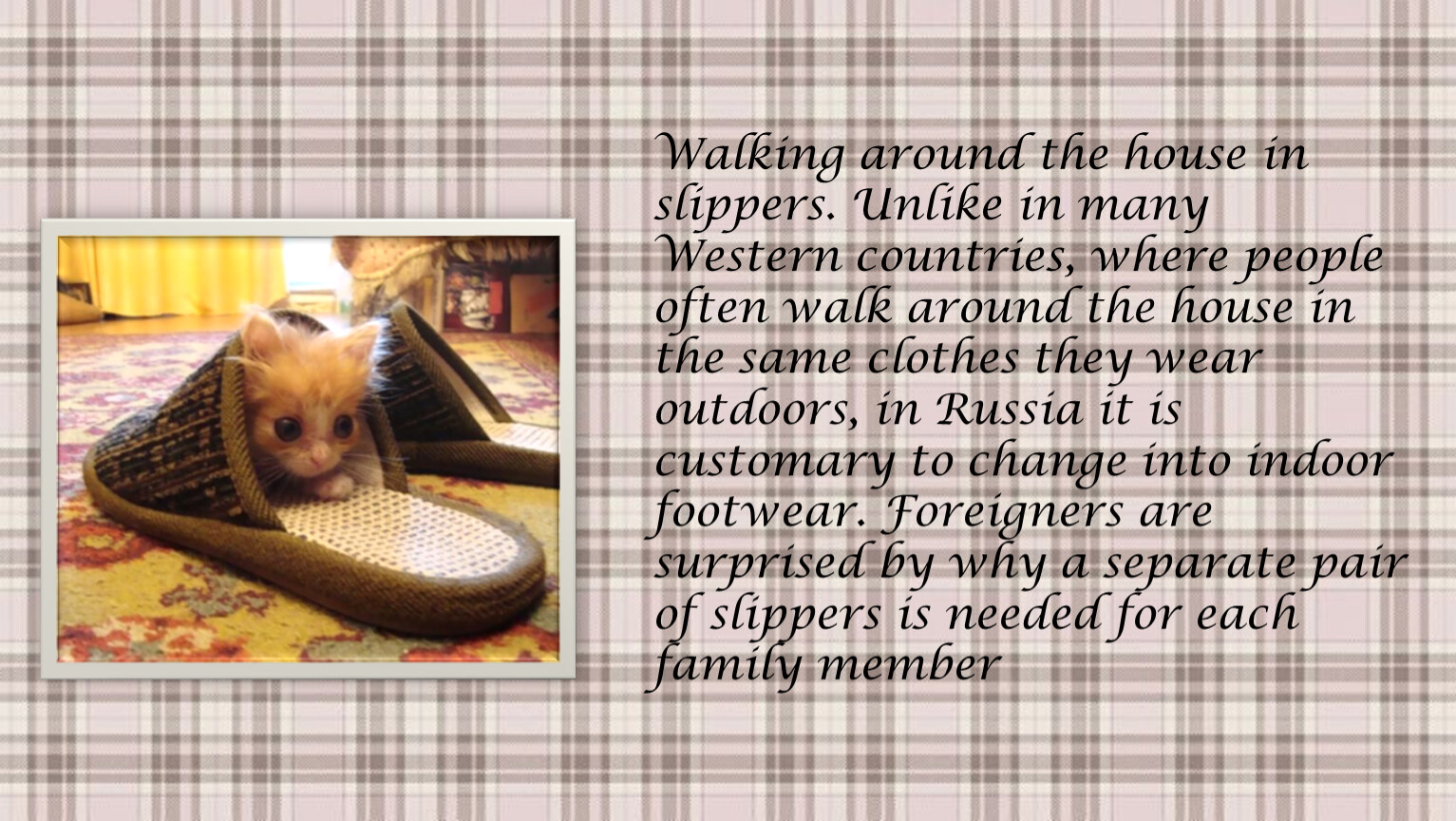
Walking around the house in slippers. Unlike in many Western countries, where people often walk around the house in the same clothes they wear outdoors, in Russia it is customary to change into indoor footwear. Foreigners are surprised by why a separate pair of slippers is needed for each family member

A package of bags. A neat stack of used plastic bags in a cabinet or on a shelf. They are not thrown away but reused — for shopping, as garbage bags, or for storing items.
Do not take out the trash in the evening. In some families, the rule of not taking out the trash after sunset is still observed. This is due to the belief that the evening is a time for rest, and it is better to leave household chores until the morning.
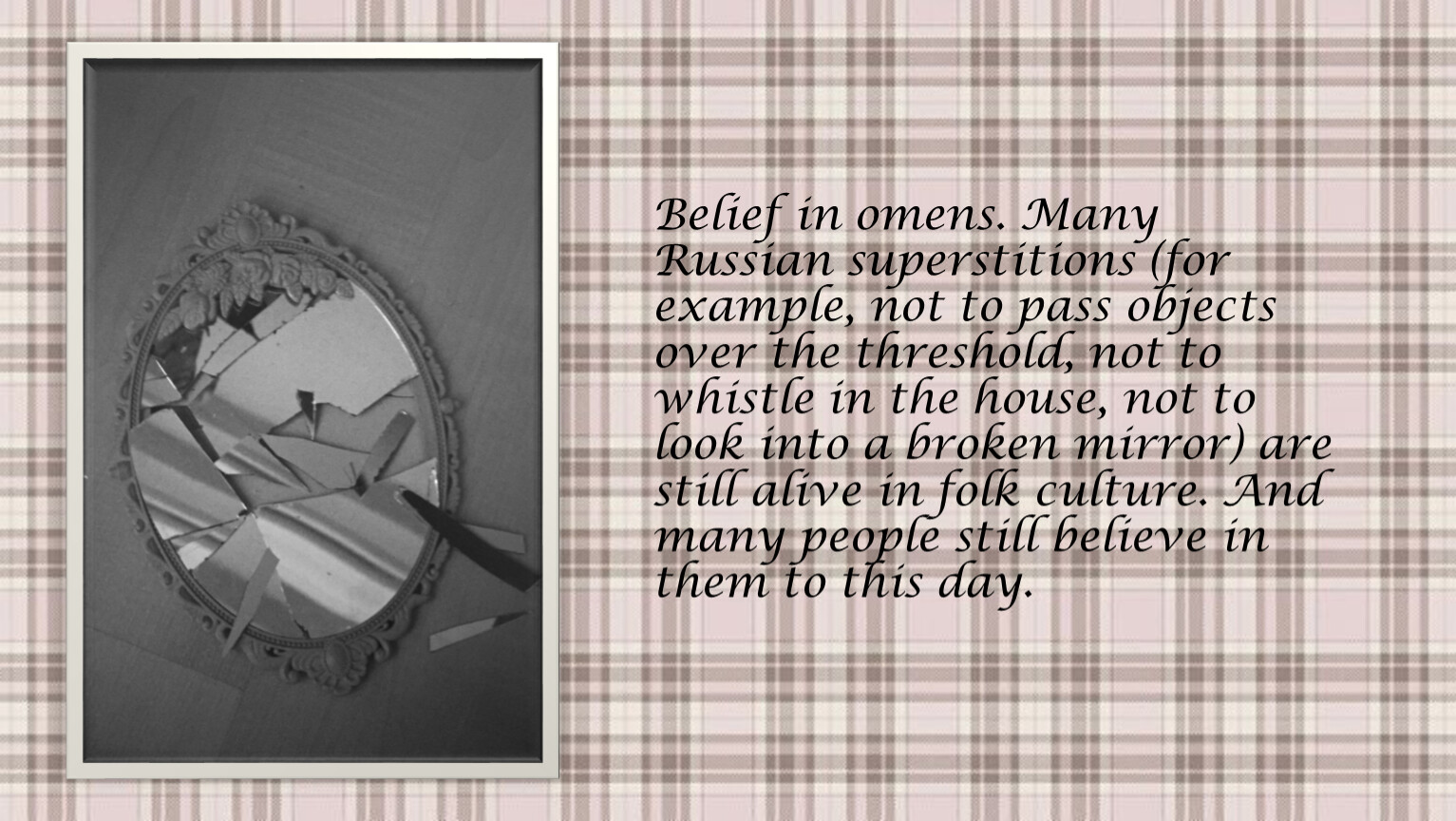
Belief in omens. Many Russian superstitions (for example, not to pass objects over the threshold, not to whistle in the house, not to look into a broken mirror) are still alive in folk culture. And many people still believe in them to this day.

Why is that?
These habits were shaped by the climate, historical way of life, religious traditions, and family values. Many of them are a way to preserve comfort, care for loved ones, and a connection to the past. Over time, some traditions change, but many continue to exist because they have become part of cultural memory.
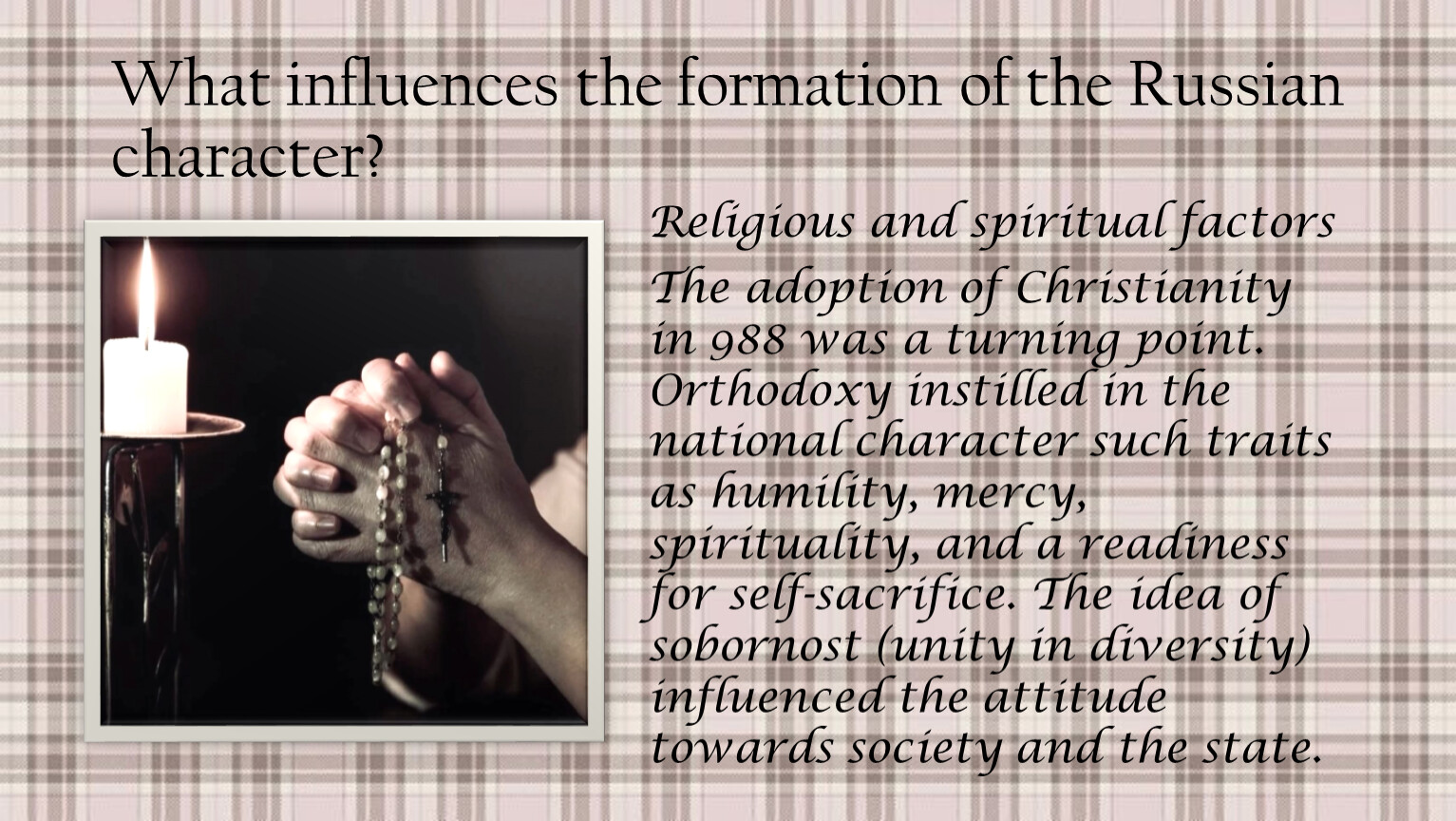
What influences the formation of the Russian character?
Religious and spiritual factors
The adoption of Christianity in 988 was a turning point. Orthodoxy instilled in the national character such traits as humility, mercy, spirituality, and a readiness for self‑sacrifice. The idea of sobornost (unity in diversity) influenced the attitude towards society and the state.
Historical events and challenges
Specific historical trials shaped specific traits.
The struggle against foreign invasions (for example, the Mongol yoke, the Time of Troubles) fostered resilience, the ability to self‑organize, and a readiness for self‑sacrifice for the common cause.
The development of new territories required openness to interaction with other peoples and cultures, which contributed to the formation of complementarity — the ability to find common ground with representatives of other ethnic groups.
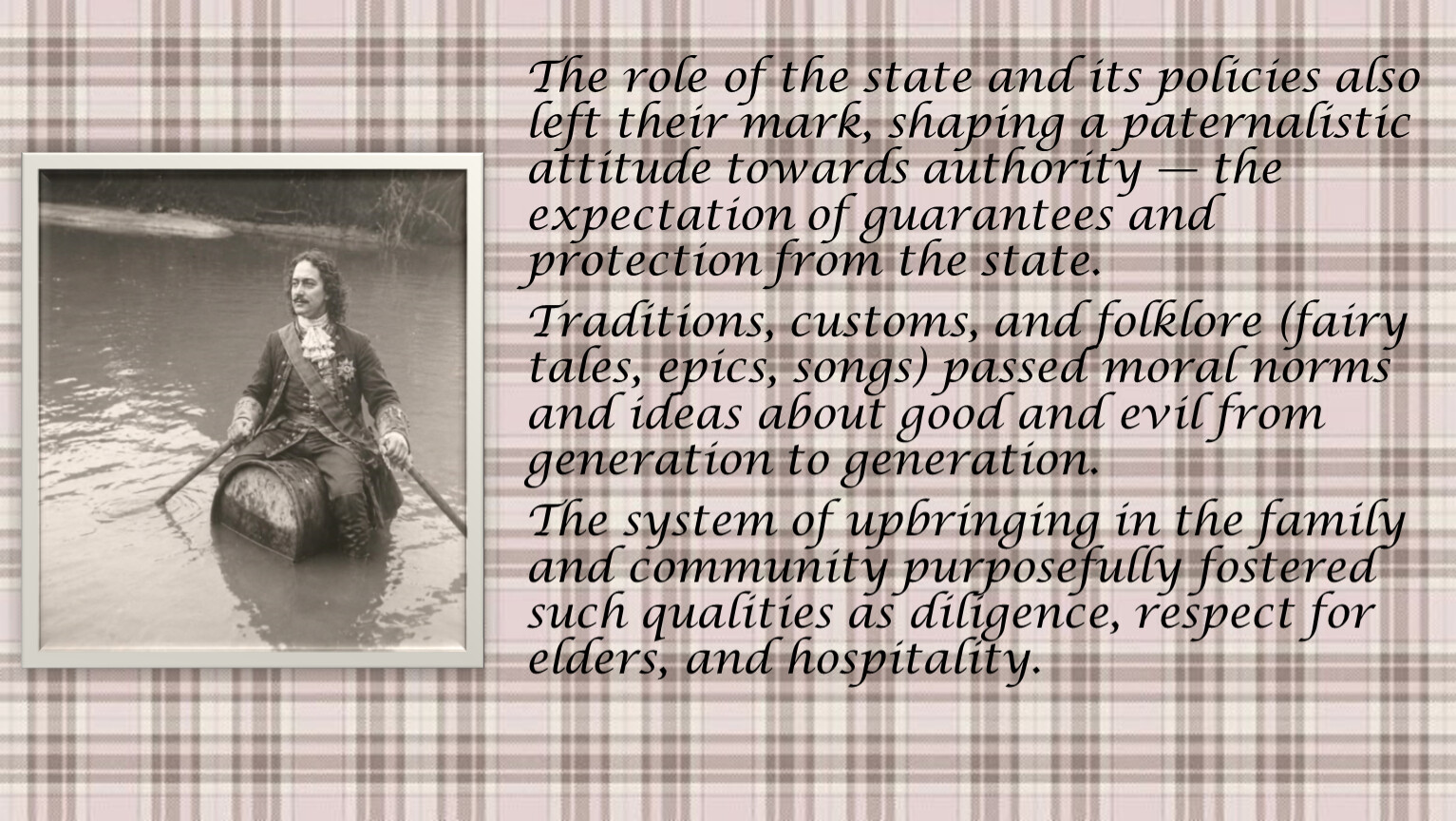
The role of the state and its policies also left their mark, shaping a paternalistic attitude towards authority — the expectation of guarantees and protection from the state.
Traditions, customs, and folklore (fairy tales, epics, songs) passed moral norms and ideas about good and evil from generation to generation.
The system of upbringing in the family and community purposefully fostered such qualities as diligence, respect for elders, and hospitality.

Материалы на данной страницы взяты из открытых источников либо размещены пользователем в соответствии с договором-офертой сайта. Вы можете сообщить о нарушении.


