В презентации представлены случаи употребления инфинитива или инговой формы с наиболее употребительными глаголами. Даются примеры употреблния инфинитива в конструкциях: сложное дополнение, сложное подлежащее. Также показана разница в значении отдельных глаголов в зависимости от употребления после них инфинитива или инговой формы.
Infinitive and
ing-forms
Учитель английского языка
МБОУ Гимназии № 16 «Интерес»
Аленчикова Светлана Андреевна
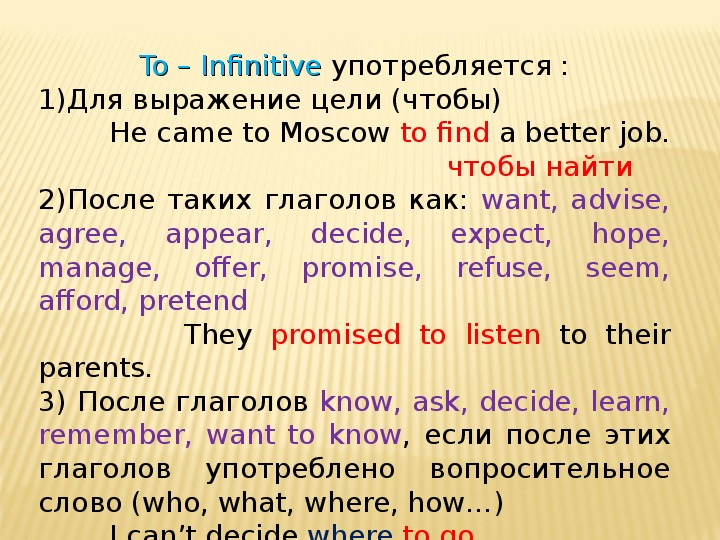
To – Infinitive употребляется :
To – Infinitive
1)Для выражение цели (чтобы)
He came to Moscow to find a better job.
чтобы найти
2)После таких глаголов как: want, advise,
agree, appear, decide, expect, hope,
manage, offer, promise,
refuse, seem,
afford, pretend
They promised to listen to their
parents.
3) После глаголов know, ask, decide, learn,
remember, want to know, если после этих
глаголов употреблено вопросительное
слово (who, what, where, how…)
I can’t decide where to go.
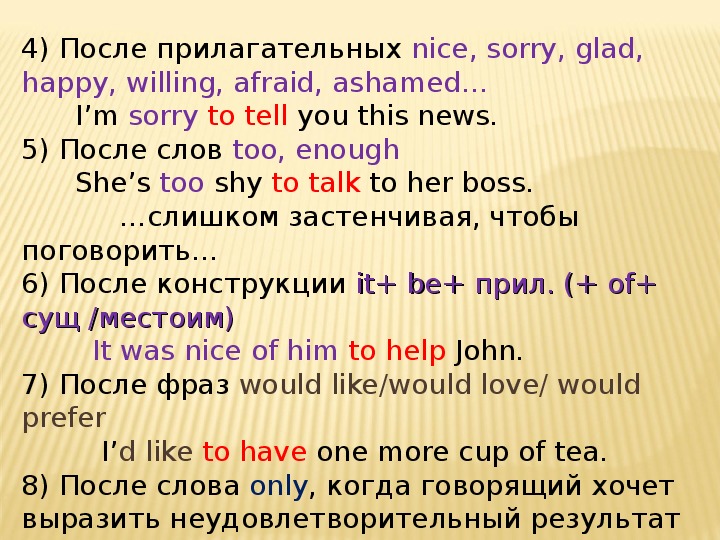
4) После прилагательных nice, sorry, glad,
happy, willing, afraid, ashamed…
I’m sorry to tell you this news.
5) После слов too, enough
She’s too shy to talk to her boss.
…слишком застенчивая, чтобы
поговорить…
6) После конструкции it+ be+
сущ /местоим))
сущ /местоим
It was nice of him to help John.
7) После фраз would like/would love/ would
prefer
I’d like to have one more cup of tea.
8) После слова only, когда говорящий хочет
выразить неудовлетворительный результат
He rushed to the door only to discover it
it+ be+ прил.
прил. (+ of+
(+ of+
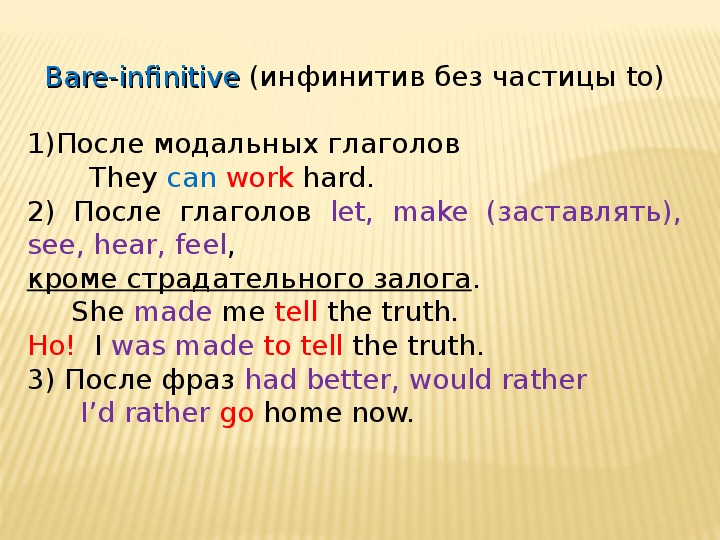
Bare-infinitive (инфинитив без частицы to)
Bare-infinitive
1)После модальных глаголов
They can work hard.
2) После глаголов let, make (заставлять),
see, hear, feel,
кроме страдательного залога.
She made me tell the truth.
Но! I was made to tell the truth.
3) После фраз had better, would rather
I’d rather go home now.
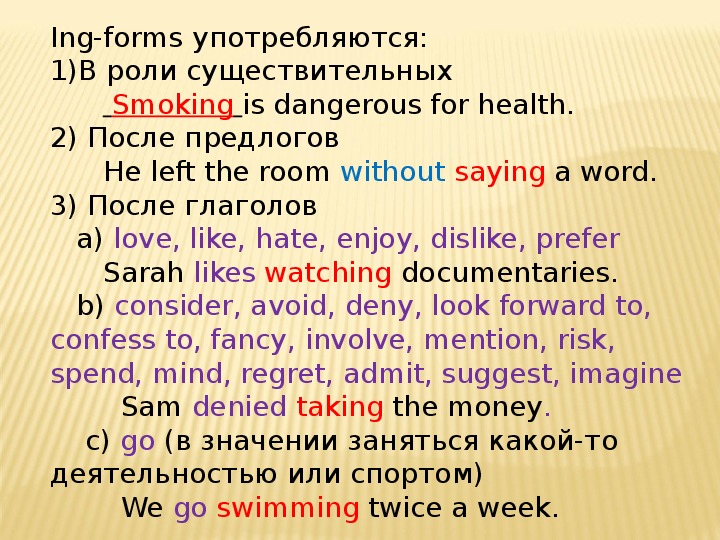
Ing-forms употребляются:
1)В роли существительных
Smoking is dangerous for health.
2) После предлогов
He left the room without saying a word.
3) После глаголов
а) love, like, hate, enjoy, dislike, prefer
Sarah likes watching documentaries.
b) consider, avoid, deny, look forward to,
confess to, fancy, involve, mention, risk,
spend, mind, regret, admit, suggest, imagine
Sam denied taking the money.
c) go (в значении заняться какой-то
деятельностью или спортом)
We go swimming twice a week.
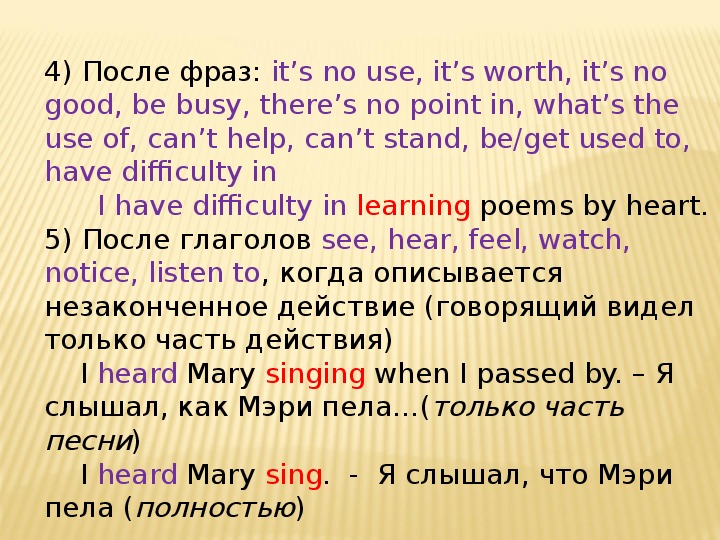
4) После фраз: it’s no use, it’s worth, it’s no
good, be busy, there’s no point in, what’s the
use of, can’t help, can’t stand, be/get used to,
have difficulty in
I have difficulty in learning poems by heart.
5) После глаголов see, hear, feel, watch,
notice, listen to, когда описывается
незаконченное действие (говорящий видел
только часть действия)
I heard Mary singing when I passed by. – Я
слышал, как Мэри пела…(только часть
песни)
I heard Mary sing. - Я слышал, что Мэри
пела (полностью)
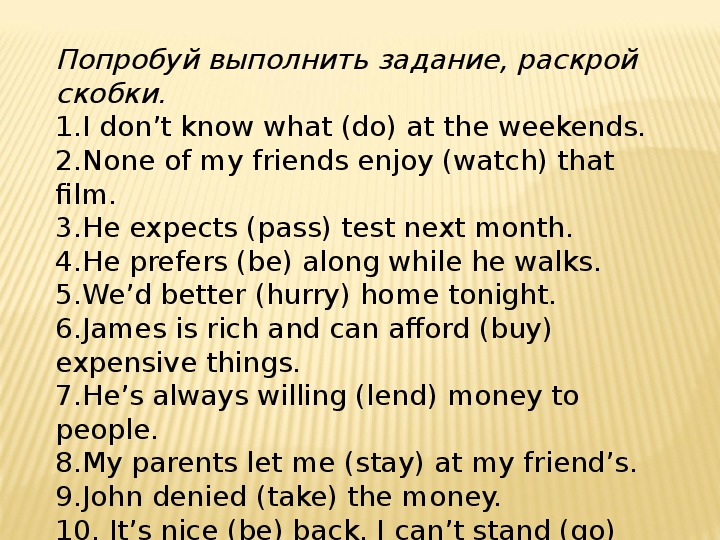
Попробуй выполнить задание, раскрой
скобки.
1.I don’t know what (do) at the weekends.
2.None of my friends enjoy (watch) that
film.
3.He expects (pass) test next month.
4.He prefers (be) along while he walks.
5.We’d better (hurry) home tonight.
6.James is rich and can afford (buy)
expensive things.
7.He’s always willing (lend) money to
people.
8.My parents let me (stay) at my friend’s.
9.John denied (take) the money.
10. It’s nice (be) back. I can’t stand (go)
away for a long time.
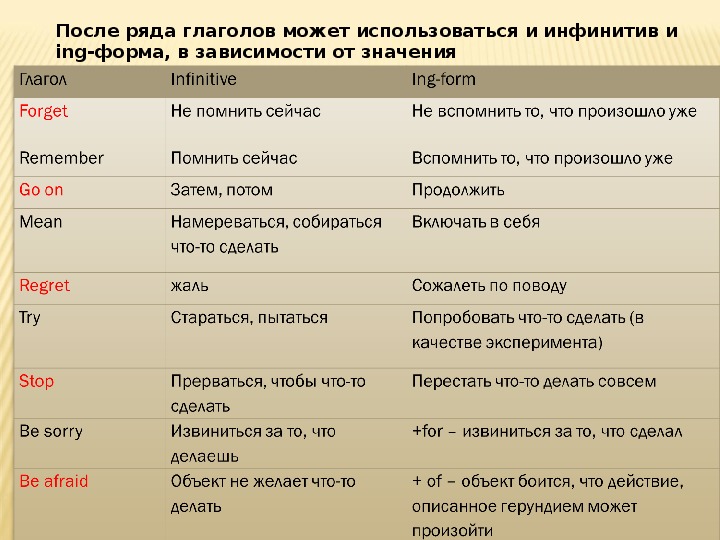
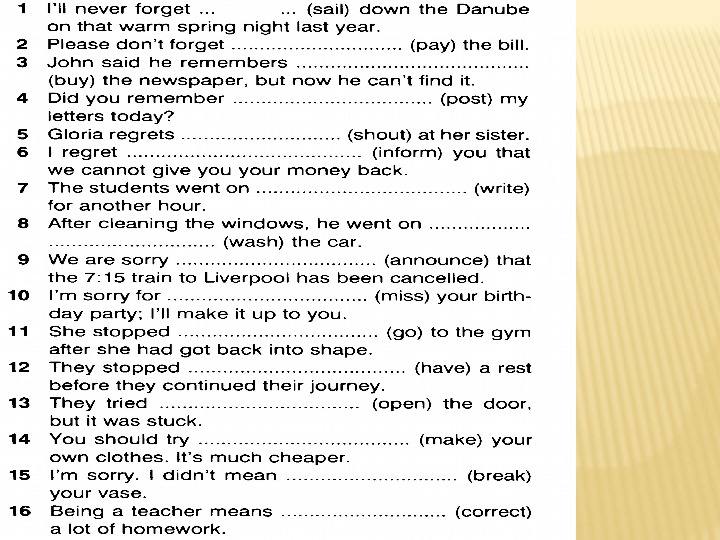
После ряда глаголов может использоваться и инфинитив и
ing-форма, в зависимости от значения



 infinitive_and_ing_1418813802_40144.ppt