
Поделиться



 Resperitory system disoders.docx
Министерство здравоохранения Запорожской области
Государственное бюджетное профессиональное образовательное учреждение
«Бердянский медицинский колледж»
РАССМОТРЕНА
На заседании ЦМК общеобразовательных,
общих гуманитарных,
социально-экономических дисциплин
Протокол заседания № __________________
От «________» ___________________ 20 ____г.
Председатель ЦМК ______________________
Методическая разработка занятия
по дисциплине
ОГСЭ.03 Иностранный язык
по теме
«Respiratory System Disorders»
для специальностей: 31.02.01 «Лечебное дело»,
34.02.01 «Сестринское дело»
Составитель
Денисова Марина Валериевна
Преподаватель 1 квалификационной категории
ОГСЭ.03 иностранный язык
Бердянск, 2026
ПОЯСНИТЕЛЬНАЯ ЗАПИСКА
к методической разработке практического занятия по дисциплине ОГСЭ.03 Иностранный язык
Данная методическая разработка предназначена для студентов средних специальных медицинских учебных заведений (колледжей) и составлена в соответствии с требованиями ФГОС СПО и рабочей программой по дисциплине «Иностранный язык в профессиональной деятельности» (английский).
Актуальность выбранной темы обусловлена ее непосредственной связью с будущей профессиональной деятельностью студентов. Знание медицинской терминологии на английском языке является неотъемлемой частью профессиональной компетенции современного медицинского работника. Тема «Болезни респираторной системы» занимает одно из ключевых мест в курсе, так как заболевания дыхательных путей (пневмония, бронхит, астма, ОРВИ) относятся к наиболее распространенным причинам обращения пациентов за медицинской помощью.
Цели и задачи методической разработки:
· Учебная цель: Формирование и систематизация лексических навыков и речевых умений по теме «Заболевания органов дыхания», обучение чтению и переводу профессионально-ориентированных текстов.
· Развивающая цель: Развитие аналитического мышления, способности сравнивать, обобщать и делать выводы, а также развитие языковой догадки.
· Воспитательная цель: Формирование устойчивого интереса к будущей профессии, ответственности за здоровье пациента и повышение общей культуры медицинского общения.
· Практическая цель: Отработка навыков аудирования, говорения и письма в рамках профессиональной тематики.
Межпредметная связь
Важнейшей особенностью данной разработки является интеграция английского языка с латинской терминологией и клиническими дисциплинами. Основой медицинской терминологии является латынь, в разработке особое внимание уделяется сопоставлению английских и латинских терминов. Студенты должны осознать, что, зная латинские корни, они могут легко понимать английские медицинские термины. Это способствует формированию единого терминологического поля у будущего специалиста.
Структура и содержание методической разработки
Разработка включает в себя следующие этапы занятия:
1. Организационный момент и фонетическая зарядка (отработка произношения сложных медицинских терминов).
2. Актуализация знаний (речевая разминка: вопросы о самочувствии, симптомах).
3. Введение нового материала (работа с текстом).
4. Первичное закрепление (выполнение тренировочных упражнений).
5. Развитие навыков монологической речи (описание клинической картины).
6. Рефлексия и подведение итогов.
Данная методическая разработка позволяет не только расширить словарный запас студентов, но и способствует формированию клинического мышления, что является важным шагом в подготовке квалифицированных медицинских специалистов, готовых к работе в условиях современной системы здравоохранения.
Respiratory System Disorders
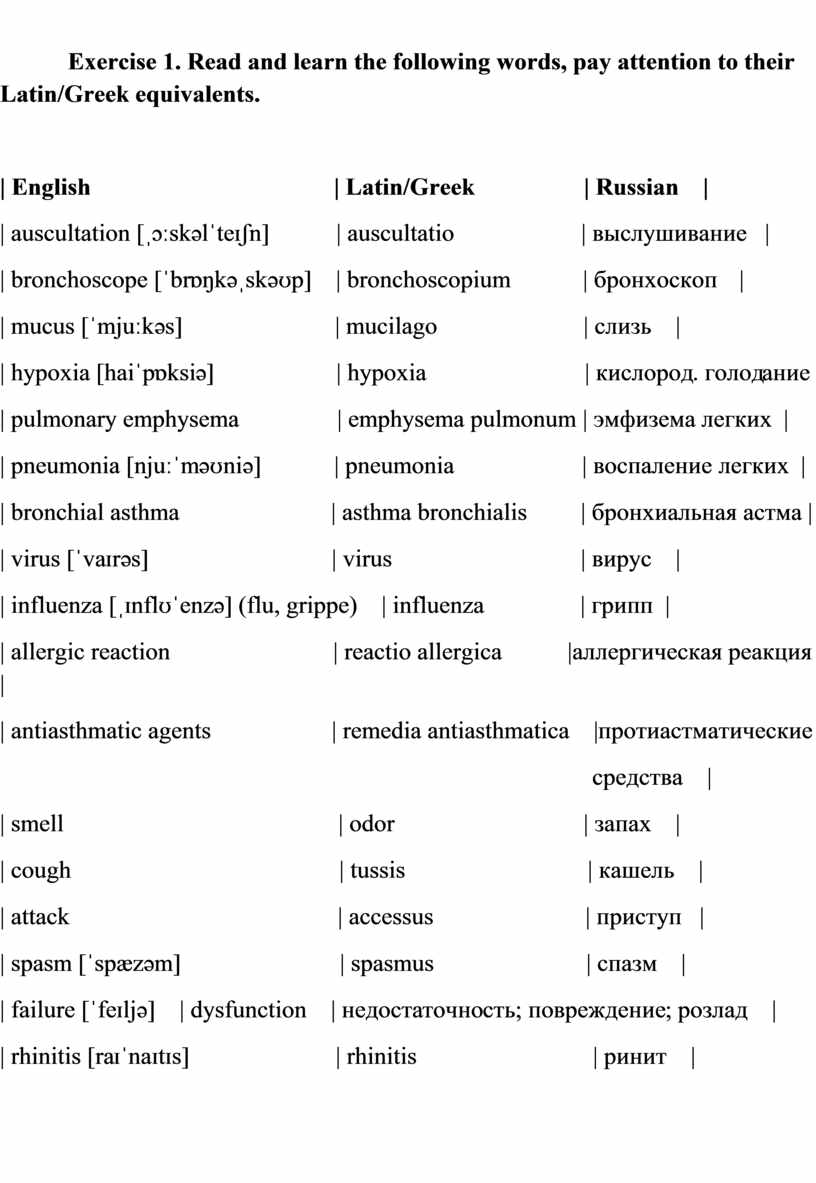
Exercise 1. Read and learn the following words, pay attention to their Latin/Greek equivalents.
| English | Latin/Greek | Russian |
| auscultation [ˌɔːskəlˈteɪʃn] | auscultatio | выслушивание |
| bronchoscope [ˈbrɒŋkəˌskəʊp] | bronchoscopium | бронхоскоп |
| mucus [ˈmjuːkəs] | mucilago | слизь |
| hypoxia [haiˈpɒksiə] | hypoxia | кислород. голодание
| pulmonary emphysema | emphysema pulmonum | эмфизема легких |
| pneumonia [njuːˈməʊniə] | pneumonia | воспаление легких |
| bronchial asthma | asthma bronchialis | бронхиальная астма |
| virus [ˈvaɪrəs] | virus | вирус |
| influenza [ˌɪnflʊˈenzə] (flu, grippe) | influenza | грипп |
| allergic reaction | reactio allergica |аллергическая реакция |
| antiasthmatic agents | remedia antiasthmatica |протиастматические
средства |
| smell | odor | запах |
| cough | tussis | кашель |
| attack | accessus | приступ |
| spasm [ˈspæzəm] | spasmus | спазм |
| failure [ˈfeɪljə] | dysfunction | недостаточность; повреждение; розлад |
| rhinitis [raɪˈnaɪtɪs] | rhinitis | ринит |
Exercise 2. Do you remember that inflammation of some organs is denoted with the Greek suffix -itis? Form terms using this suffix, translate the formed words. Eg. Larynx - laringitis
Larynx, pharynx, bronchus, trachea, pleura.
__________________________________________________________________
Exercise 3. You are a therapeutic and receive clinical patients. Talk with a patient who suffers from influenza. Use the phrases below.
- I am going to examine you.
- I will examine you.
- Don’t move your shoulders, please.
- Strip to the waist, please.
- Take your clothes off.
- Unbutton your outerwear, please.
- Would you breathe deeply?
- Breathe deeper.
- Hold your breath.
- Breathe in, breathe out, please.
- Turn your back on me, please.
- Cough, please.
- Cover your mouth, when coughing.
- You may dress.
- Is it more painful when you breathe?
- Is it more painful when you cough?
- How long have you been coughing?
- Are you running a temperature?
- Have you ever coughed up blood?
- You must give up smoking.
- You must not catch cold.
- What causes asthma attacks?
- What relieves asthma attacks?
- I want to listen to your lungs.
______________________________________________________________________________________________________________________________________________________________________________________________________________________________________________________________________________________________________________________________________________________________________________________________________________________________________________________________________________________________________________________________________________________________________________________________________________________________________________________________________________________________________________________________________________________
__________________________________________________________________
Exercise 4. Read and translate the text.
Respiratory System Disorders
Sinusitis is the inflammation of the sinuses, located close to the nasal cavities. Chronic sinus infection may cause changes or tumor formation, called polyps (полипы).
Rhinitis means a cold in the head or running nose. It’s an unpleasant symptom of the common cold. The mucosa of the respiratory tract is one of the most important portals of entry for disease-producing organisms. Droplets from one sneeze may be loaded with many billions of disease-producing organisms. Among the infections transmitted through the respiratory passages are the common cold, diphtheria, chickenpox, measles, influenza, pneumonia, and tuberculosis.
Sensitivity to plant pollens, smells, dust, certain foods, and other allergens may lead to hay fever or asthma, or both. Hay fever is characterized by a watery discharge from the eyes and nose. The symptoms of asthma are spasms of the bronchial tube walls.
Chronic obstructive pulmonary disease (COPD) involves emphysema and bronchitis. In chronic bronchitis, the linings of the airways are chronically inflamed and produce excessive secretions. Emphysema is characterized by dilation and finally destruction of the alveoli. In the popular press the word emphysema is used to mean COPD.
Lung cancer is a common disease in the person who smokes cigarettes. Smokers suffer from lung cancer ten times as often as nonsmokers.
Pneumothorax is an accumulation of air in the pleural space. Blood in it is called hemothorax.
Exercise 5. Answer the following questions based on the text.
1. What are the main symptoms of hay fever and asthma?
__________________________________________________________________
2. What does COPD stand for and which two main conditions does it involve?
__________________________________________________________________
3. According to the text, what is one of the most important portals of entry for disease-producing organisms? _______________________________________
4. How is chronic bronchitis characterized?
__________________________________________________________________
5. What is the purpose of a suction apparatus?
__________________________________________________________________
Exercise 6. Read the statements below and decide if they are True (T) or False (F) based on the text "Respiratory System Disorders".
1. Sinusitis is the inflammation of the sinuses located near the nasal cavities.
2. Rhinitis is a pleasant symptom of the common cold.
3. Hay fever is characterized by a watery discharge from the eyes and nose.
4. In emphysema, the alveoli are strengthened and become more efficient.
5. Smokers suffer from lung cancer twice as often as non-smokers.
6. Pneumothorax is an accumulation of fluid in the pleural space.
7. A bronchoscope is used for inspection of the bronchi.
8. Oxygen therapy cannot be delivered by a mask.
Exercise 7. Translate into Russian
1) a cold in the head or running nose__________________________________
2) unpleasant symptom ___________________________________________
3) watery discharge ______________________________________________
4) sensitivity to plant pollens _______________________________________
5) disease-producing organisms _____________________________________
6) suffer from lung cancer __________________________________________
7) spasms of the bronchial tube walls _________________________________
Exercise 7. Read the information about special equipment for respiratory tract treatment. Translate the text.
The bronchoscope is a flexible fiber optic tubular instrument for inspection of the bronchi and the larger bronchial tubes.
Oxygen therapy is used to sustain life when some condition interferes with adequate respiration; oxygen may be delivered to the patient by mask, catheter or nasal prongs.
A suction apparatus is used for removing mucus or other substances from the respiratory tract.
A tracheostomy tube is used when the pharynx or larynx is obstructed. A small metal or plastic tube is inserted through a cut made in the trachea, and it acts as an artificial airway for ventilation.
Artificial respiration is made when a patient has temporarily lost the capacity to perform the normal motions of respiration.
Материалы на данной страницы взяты из открытых источников либо размещены пользователем в соответствии с договором-офертой сайта. Вы можете сообщить о нарушении.


