Методическая разработка по английскому языку для студентов энергетических специальностей "Fuses" (Предохранители)

  • Работа в классе
  • Раздаточные материалы
  • Разработки уроков
  • docx
  • 16.12.2025
Публикация на сайте для учителей

Публикация педагогических разработок

Бесплатное участие. Свидетельство автора сразу.
Мгновенные 10 документов в портфолио.

Методическая разработка для студентов электро и энергетических специальностей "Fuses" (Предохранители)
Иконка файла материала Практическая работа № 66 Предохранители.docx

Практическая работа №67 «Предохранители»

Цель занятия

1.     Образовательная:

o    освоить ключевую англоязычную лексику по теме «Предохранители и защита цепей»;

o    научиться понимать и анализировать технический текст о принципах работы и типах предохранителей.

2.     Развивающая:

o    развить навыки чтения и извлечения ключевой информации из инженерного текста;

o    совершенствовать умения устной речи при обсуждении технических устройств.

3.     Практическая:

o    отработать использование технических терминов в контексте;

o    практиковать грамматические конструкции (Passive Voice, условные предложения) в технической речи.

4.     Воспитательная:

o    сформировать понимание важности защитных устройств в электротехнике;

o    развить культуру технической коммуникации на английском языке.

Оборудование и инструменты: текст материала, презентация, раздаточный материал.

Источник информации:

1.       Луговая, А. Л. Английский язык для студентов энергетических специальностей : учебное пособие для СПО, стр. 60-62

2.       Дополнительный материал https://www.geeksforgeeks.org/electrical-engineering/fuse/

3.       Раздаточный материал


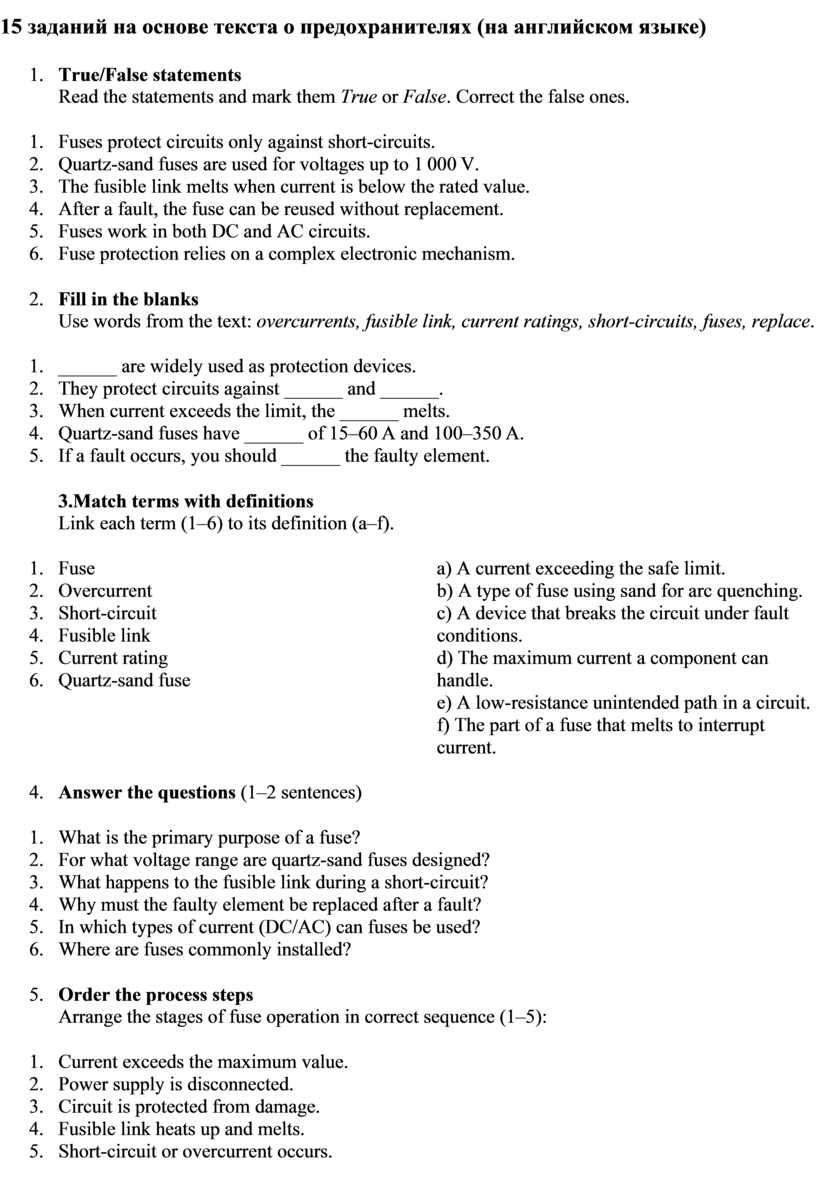
15 заданий на основе текста о предохранителях (на английском языке)

  1. True/False statements
    Read the statements and mark them True or False.
    Correct the false ones.
  1. Fuses protect circuits only against short‑circuits.
  2. Quartz‑sand fuses are used for voltages up to 1 000 V.
  3. The fusible link melts when current is below the rated value.
  4. After a fault, the fuse can be reused without replacement.
  5. Fuses work in both DC and AC circuits.
  6. Fuse protection relies on a complex electronic mechanism.
  1. Fill in the blanks
    Use words from the text: overcurrents, fusible link, current ratings, short‑circuits, fuses, replace.
  1. ______ are widely used as protection devices.
  2. They protect circuits against ______ and ______.
  3. When current exceeds the limit, the ______ melts.
  4. Quartz‑sand fuses have ______ of 15–60 A and 100–350 A.
  5. If a fault occurs, you should ______ the faulty element.

3.Match terms with definitions
Link each term (1–6) to its definition (a–f).


  1. Fuse
  2. Overcurrent
  3. Short‑circuit
  4. Fusible link
  5. Current rating
  6. Quartz‑sand fuse

a) A current exceeding the safe limit.
b) A type of fuse using sand for arc quenching.
c) A device that breaks the circuit under fault conditions.
d) The maximum current a component can handle.
e) A low‑resistance unintended path in a circuit.
f) The part of a fuse that melts to interrupt current.


  1. Answer the questions (1–2 sentences)
  1. What is the primary purpose of a fuse?
  2. For what voltage range are quartz‑sand fuses designed?
  3. What happens to the fusible link during a short‑circuit?
  4. Why must the faulty element be replaced after a fault?
  5. In which types of current (DC/AC) can fuses be used?
  6. Where are fuses commonly installed?
  1. Order the process steps
    Arrange the stages of fuse operation in correct sequence (1–5):
  1. Current exceeds the maximum value.
  2. Power supply is disconnected.
  3. Circuit is protected from damage.
  4. Fusible link heats up and melts.
  5. Short‑circuit or overcurrent occurs.
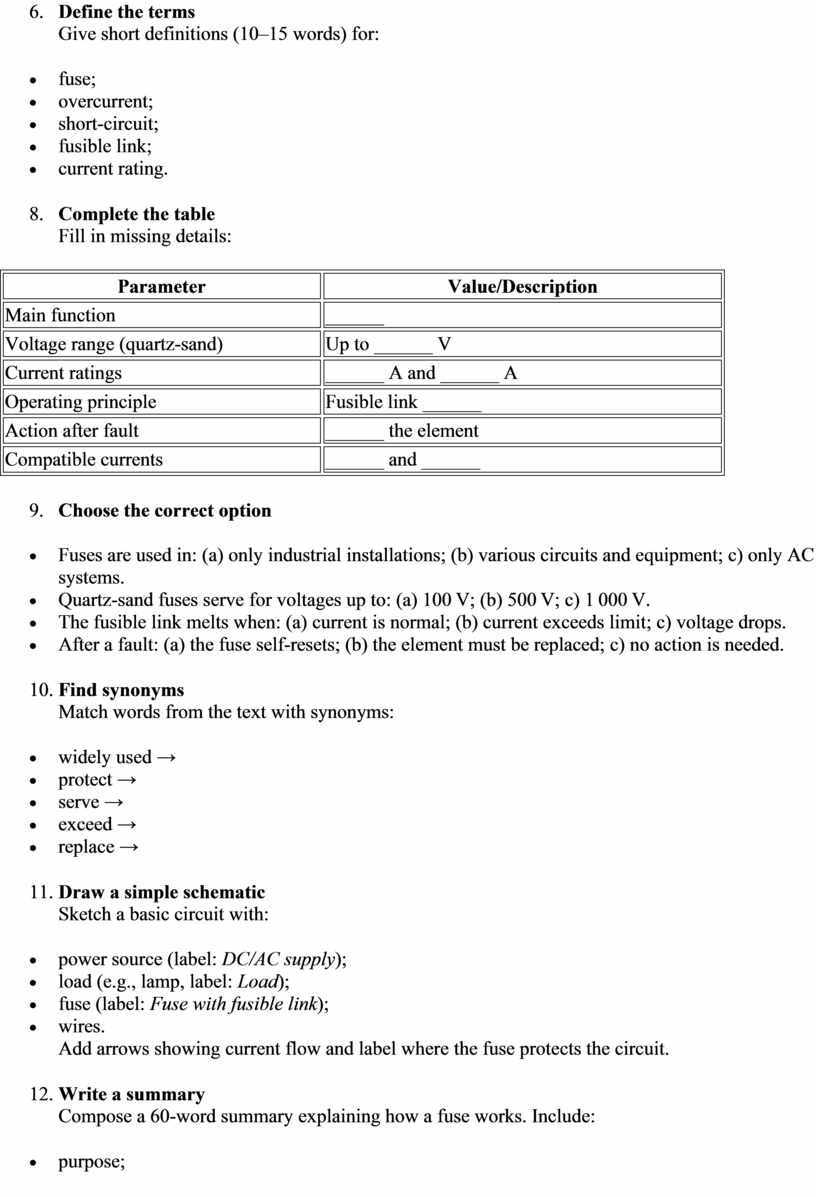
  1. Define the terms
    Give short definitions (10–15 words) for:
  • fuse;
  • overcurrent;
  • short‑circuit;
  • fusible link;
  • current rating.
  1. Complete the table
    Fill in missing details:

Parameter

Value/Description

Main function

______

Voltage range (quartz‑sand)

Up to ______ V

Current ratings

______ A and ______ A

Operating principle

Fusible link ______

Action after fault

______ the element

Compatible currents

______ and ______

  1. Choose the correct option
  • Fuses are used in: (a) only industrial installations; (b) various circuits and equipment; с) only AC systems.
  • Quartz‑sand fuses serve for voltages up to: (a) 100 V; (b) 500 V; с) 1 000 V.
  • The fusible link melts when: (a) current is normal; (b) current exceeds limit; с) voltage drops.
  • After a fault: (a) the fuse self‑resets; (b) the element must be replaced; с) no action is needed.
  1. Find synonyms
    Match words from the text with synonyms:
  • widely used →
  • protect →
  • serve →
  • exceed →
  • replace →
  1. Draw a simple schematic
    Sketch a basic circuit with:
  • power source (label: DC/AC supply);
  • load (e.g., lamp, label: Load);
  • fuse (label: Fuse with fusible link);
  • wires.
    Add arrows showing current flow and label where the fuse protects the circuit.
  1. Write a summary
    Compose a 60‑word summary explaining how a fuse works.
    Include:
  • purpose;
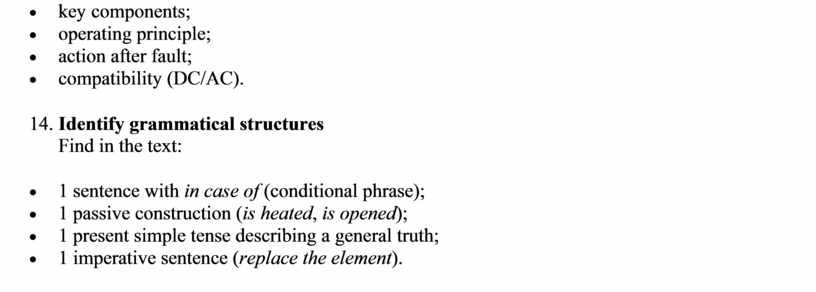
  • key components;
  • operating principle;
  • action after fault;
  • compatibility (DC/AC).
  1. Identify grammatical structures
    Find in the text:
  • 1 sentence with in case of (conditional phrase);
  • 1 passive construction (is heated, is opened);
  • 1 present simple tense describing a general truth;
  • 1 imperative sentence (replace the element).


Скачано с www.znanio.ru