Поделиться


 PHY_10_46_V2_LP_Current in dif.medium.docx
|
Long-term plan unit: Current in different medium |
School:
|
|||||||||||||||||||||||||||||||
|
Date: |
|
|||||||||||||||||||||||||||||||
|
Grade: 10 |
Number present: |
Absent: |
||||||||||||||||||||||||||||||
|
Theme of the lesson |
Electric current in metals, electrolytes, liquids, gases and vacuum. |
|||||||||||||||||||||||||||||||
|
Learning objectives at the lesson |
10.3.3.1 – to compare the principles of current in different medium; |
|||||||||||||||||||||||||||||||
|
Assessment criteria |
Students have achieved the objective if they are able to: · medium · Describes current voltage characteristics of metals, electrolytes, liquids, gases and vacuum; · Give examples of applications of current in metals, electrolytes, liquids, gases and vacuum; |
|||||||||||||||||||||||||||||||
|
Language objectives |
Learners can: Describe orally: The charge carries in metals, electrolytes, liquids, gases and vacuum; Volt-ampere characteristics of metals, electrolytes, liquids, gases and vacuum; Subject-specific vocabulary & terminology: Electrolysis, decomposition, cathode, anode, extraction, electroplating, welding |
|||||||||||||||||||||||||||||||
|
Values instilled at the lesson |
Mutual assistance in completing the table |
|||||||||||||||||||||||||||||||
|
Cross-curricular links |
Chemistry |
|||||||||||||||||||||||||||||||
|
ICT skills |
Students might use computers or laptops |
|||||||||||||||||||||||||||||||
|
Previous learning
|
Material in physics for class 8: electric current, the structure of substances of different states |
|||||||||||||||||||||||||||||||
|
Course of the lesson |
||||||||||||||||||||||||||||||||
|
Planned stages of the lesson |
Planned activities at the lesson |
Resources |
||||||||||||||||||||||||||||||
|
Beginning of Lesson 3 min
7 min |
Teacher: -Introduces the topic of day and spelling out the learning outcome they will possess after the study. 1. Organizational moment to acquaint students with the · The theme of the lesson · The objectives of the lesson · The criteria of success for the lesson · The plan of events for the lesson 2. Review What do you know about … · What is electric current? · What conditions does it arise and exist? · What are the substances that conduct current? Do not conduct electricity? · In what medium can there be an electric current? |
Presentation
|
||||||||||||||||||||||||||||||
|
Middle of Lesson 15 min
12 min |
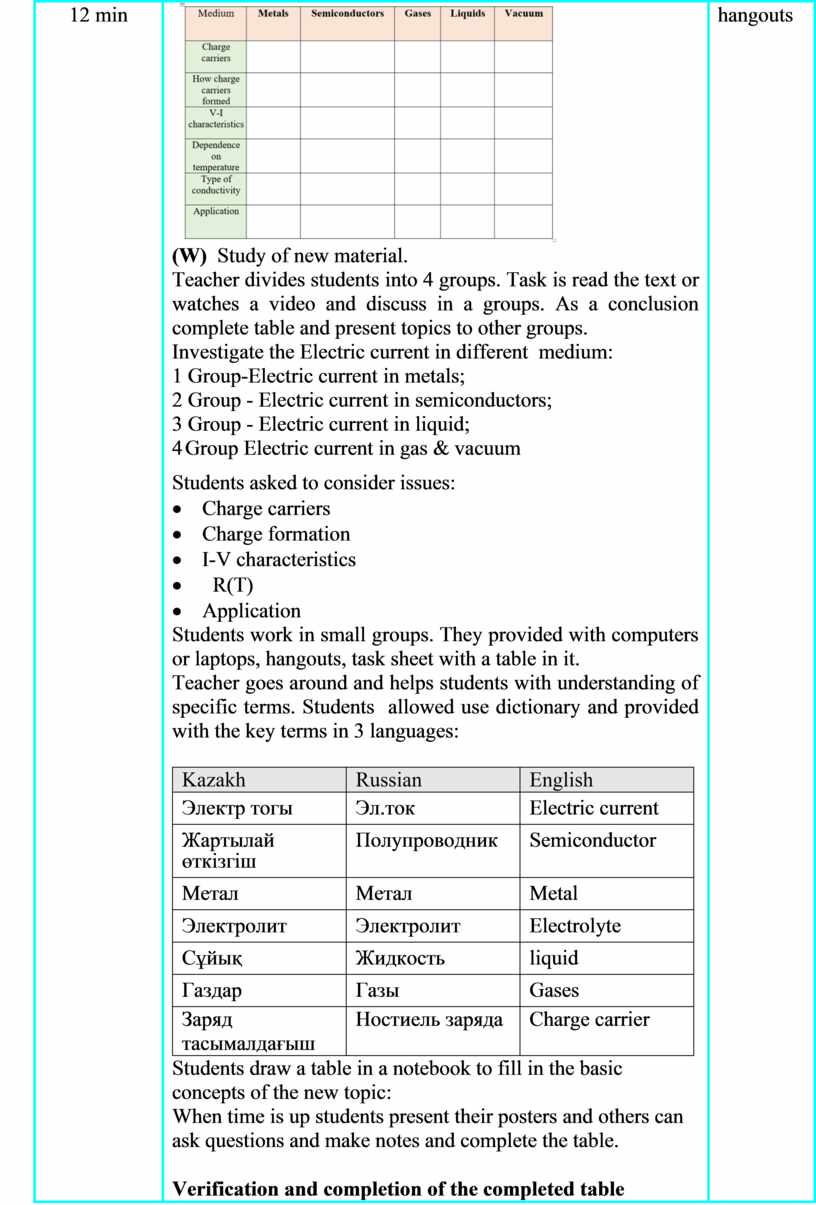
(W) Study of new material. Teacher divides students into 4 groups. Task is read the text or watches a video and discuss in a groups. As a conclusion complete table and present topics to other groups. Investigate the Electric current in different medium: 1 Group-Electric current in metals; 2 2 Group - Electric current in semiconductors; 3 3 Group - Electric current in liquid; 4 Group Electric current in gas & vacuum Students asked to consider issues: · Charge carriers · Charge formation · I-V characteristics · R(T) · Application Students work in small groups. They provided with computers or laptops, hangouts, task sheet with a table in it. Teacher goes around and helps students with understanding of specific terms. Students allowed use dictionary and provided with the key terms in 3 languages:
Students draw a table in a notebook to fill in the basic concepts of the new topic:
Verification and completion of the completed table
Review of the studied material: questions Feedback on questions that caused difficulties |
hangouts |
||||||||||||||||||||||||||||||
|
End of Lesson 3 min |
Homework: Review ppt and make notes if necessary Reflection: Students will answer the following questions. Ø What have understood in the lesson? Ø What will you learn in the next lesson? Ø What was not clear to me? |
|
||||||||||||||||||||||||||||||
|
Differentiation – how do you plan to give more support? How do you plan to challenge the more able learners? |
Assessment – how are you planning to check students’ learning? |
Health and safety regulations |
|
||||||||||||||||||||||||||||||
|
Investigation task includes as low order questions and high order questions as well. Students divided into group in such a way that in a small groups students with different abilities. Teacher ask directed questions to those students or provide an individual support for those students that have difficulty in understanding challenging questions. Teacher might ask additional higher order questions during a poster presentation |
Students assessed according to the Poster rubrics criteria |
Instruction in using laptops provided by teacher at the start of activity 2 |
|
||||||||||||||||||||||||||||||
|
Reflection
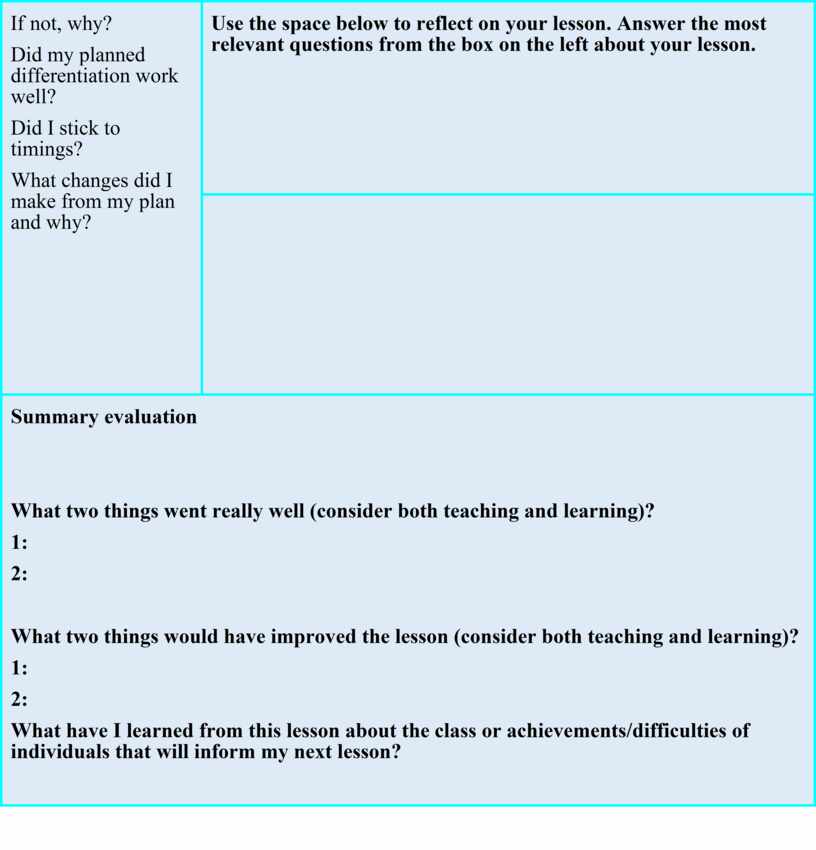
Were the lesson objectives/learning objectives realistic? Did all learners achieve the LO? If not, why? Did my planned differentiation work well? Did I stick to timings? What changes did I make from my plan and why?
|
Use the space below to reflect on your lesson. Answer the most relevant questions from the box on the left about your lesson. |
|
|||||||||||||||||||||||||||||||
|
|
|
||||||||||||||||||||||||||||||||
|
Summary evaluation
What two things went really well (consider both teaching and learning)? 1: 2:
What two things would have improved the lesson (consider both teaching and learning)? 1: 2: What have I learned from this lesson about the class or achievements/difficulties of individuals that will inform my next lesson?
|
|
||||||||||||||||||||||||||||||||

Материалы на данной страницы взяты из открытых источников либо размещены пользователем в соответствии с договором-офертой сайта. Вы можете сообщить о нарушении.