Поделиться


 PHY_10_46_V2_TG_Current in dif.medium.docx
RECOMMENDATIONS
On lesson Electric current in different environment
I strongly recommended use a strategy of Flipped classroom in this lesson. Because, lesson adapted on a large amount of theoretical/reading material, so it is better if students get familiar with it before. Teacher might spread each topic among students and ask them watch a video or read the text at home. In the classroom they can discuss it in small groups, ask any questions they have and complete the table. There is not much information about current in vacuum so teacher might complete students’ answers.
There is a useful link, where teachers can find information about Flipped Classroom.
The Definition Of The Flipped Classroom
As one of the most popular trends in education in recent memory, you’ve undoubtedly heard of the flipped classroom. But what is it about a classroom that’s been flipped that makes it unique?
A flipped classroom is one where students are introduced to content at home, and practice working through it at school.
In this blended learning approach, face-to-face interaction is mixed with independent study via technology. Students watch pre-recorded videos at home, then come to school to do the homework armed with questions and at least some background knowledge.
The concept behind the flipped classroom is rethink when students have access to the resources they need most. If the problem is that students need help doing the work rather than being introduced to the new thinking behind the work, than the solution the flipped classroom takes is to reverse that pattern.
This doubles student access to teachers–once with the videos at home, and again in the classroom, increasing the opportunity for personalization and more precise guiding of learning. In the flipped classroom model, students practice under the guidance of the teacher, while accessing content on their own.
A side benefit is that teachers can record lectures that emphasize critical ideas, power standards, and even the pace of a given curriculum map. It also has the side benefit of allowing students to pause, rewind, Google terms, rewatch, etc., as well as creating a ready-made library for student review, make-up work, etc.
Theoretical material: Current in differen mediums:
Current in metals
Electric current is the rate of flow of electric charge. No current can flow if the circuit is broken - for example, when a switch is open.
An electric current flows when electrons move through a conductor, such as a metal wire. Metals are good conductors of electricity.
Electricity passes through metallic conductors as a flow of negatively charged electrons. The electrons are free to move from one atom to another. We call them a sea of delocalised electrons.
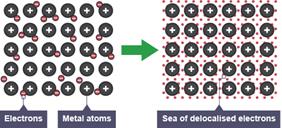
Current was originally defined as the flow of charges from positive to negative. Scientists later discovered that current is actually the flow of negatively charged electrons, from negative to positive. They termed the original definition ‘conventional current’ so as not to confuse it with the newer definition of current.
Passing an electric current through a liquid is called ELECTROLYSIS.
We are going to look carefully at what happens with two liquids, water and
copper sulphate, but first the general ideas.
The electric current enters the liquid at the positive plate (called the anode)
and leaves it at the negative plate (called the cathode).
In liquids the current is carried by ions. Ions are charged
particles (atoms or groups of atoms). Ions can either be positive or negative,
the positive ions being attracted to the negative plate and the negative ions
to the positive plate. A positive ion is a particle with some negative charge
taken away and a negative ion is a particle with some extra negative charge
added.
Some liquids conduct electricity – these contain ions and some do not – these
do not contain ions. Some conduct well, they have many ions per cubic metre,
others do not – they have fewer ions per cubic metre. The following list
separates some common liquids into conductors and non-conductors.Uses of
electrolysis:
Electrolysis has many uses in industry and we can only look at a few
here rather briefly.
1. Electroplating - this means coating one metal with another by electrolysis,
e.g. silver plating of cutlery, jewelry and sports cups; chromium plating of
car bumpers, kettles and taps; musical instruments such as flutes are silver
plated to prevent rusting by saliva; iron is zinc plated (galvanised) for use
as corrugated sheeting or nails; the stamper used in making CDs is made of
nickel, plated on an aluminium former; sweet wrappers and bottle tops are
plated for appearance and hygiene
2. Extraction and purification of some metals:
Copper is refined by electrolysis and aluminium is extracted from its ore by this method.
The conductivity of a liquid can be changed by adding some ions.
This is usually done by adding an impurity to the liquid. Distilled water
contains no ions and so will not conduct electricity but if you slowly add salt
to it the salt dissolves and the charged sodium and chloride ions in the salt
will move through the water so conducting electricity.
The size of the current can be used to measure the concentration of the salt
solution. (See the Salt meter in the Foundation experiments section).
Even rubbing your hands together in deionised water is sufficient to produce a
small amount of impurity and so allowing the water to conduct electricity.
The conductivity of the vacuum is not a very trivial issue. In fact, depending on how you look at it, it behaves in two different ways.
Firstly, there is no retarding force on any charged particle with constant velocity in vacuum. To this extent, no extra work is required in maintaining a constant current through any surface in vacuum. In stark contrast however, is the presence of free charges in conductors. Normally, when an electric field EE is applied across a conductor, we get a current density due to the 'internal' charge flow, given by:
J=σEJ=σE
where σσ is the conductivity. Clearly, σ=0σ=0 in a vacuum - electric fields do not spontaneously cause currents to flow. Thus, in this sense, the vacuum is not a conductor at all. Even everyday insulators have low but non-zero values of σσ.
Thus, the resistance of the vacuum is in fact, infinite, as long as we define resistance in terms of the response of the charge carriers of a material. In this sense, we might say that it is an insulator - there are no charge carriers.
Useful resources:
https://elearningindustry.com/flip-education-why-how-flipped-classrooms
http://www.schoolphysics.co.uk/age11-14/Electricity%20and%20magnetism/Current%20electricity/text/Electrolysis_/index.html
https://www.bbc.com/bitesize/guides/z9sb2p3/revision/1
https://www.britannica.com/science/electric-current
Скачано с www.znanio.ru
Материалы на данной страницы взяты из открытых источников либо размещены пользователем в соответствии с договором-офертой сайта. Вы можете сообщить о нарушении.