Поделиться



 PHY_10_50_V2_TG_Semicon.devices.docx
RECOMMENDATIONS
on lesson “Semiconductor devices”
Theoretical material on topic: Semiconductor Devices
These devices are said to be neither good insulators nor good conductors, hence the name ‘Semi Conductors’. The semiconductor examples include the following:
· op-amps
· resistors
· capacitors
· diodes
· transistors
These devices are widely used in many of the applications due to their reliability, compactness, low cost. As a discrete component, a semiconductor is used as optical sensors, power devices, light emitters, and also including the solid-state lasers. They also have a large range of current as well as voltage handling capacities, with the current ratings ranging from few nano-amperes i.e (10−9 ampere) up-to more than about 5,000 voltage and ampere ratings which extend above 100,000 volts.
Semiconductor devices supply themselves in integrating into complex and readily are manufacturable into microelectronic circuits. They also find a good scope in the future in forming key components for the majority of electrical and electronic instruments and systems in various fields such as communications, data-processing, consumer, and also in industrial-control equipments.
A diode is a semiconductor device that comprises of single p-n junction. P-n junctions are usually formed by joining up of p-type and n-type semiconductor materials. This formation is due to the reason that n-type region has the higher number of electron concentration whereas the p-type region has a higher number of hole concentration, hence the electrons get diffused from the n-type region to the p-type region. Hence this phenomenon is used in generating light.
Transistors are of two types bipolar junction transistor and field effect transistor. The bipolar junction transistor is achieved by the formation of two p-n junctions in two different configurations like n-p-n or p-n-p. In this type of transistor, the three regions formed are named as emitter, collector, and base or the middle region.
The field effect transistor works on the principle of conductivity and the conductivity can be altered by the presence of an electric field.
· They are used in the designing of logic gates and digital circuits.
· These are used in microprocessors
· They are used in analog circuits such as oscillators and amplifiers.
· Used in high voltage applications.
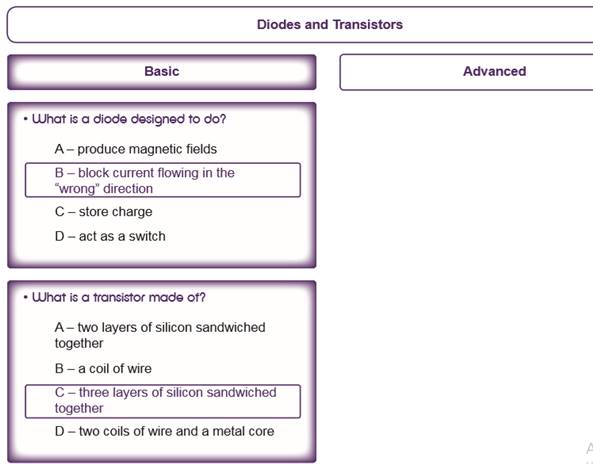
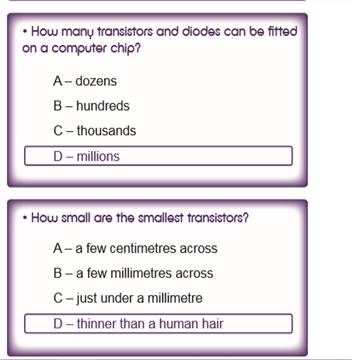
In this lesson student do multiple choice questions. For teacher it might be useful answers to them:
ADDITIONAL MULTIPLE CHOICE QUESTIONS:
|
11. |
Which statement best describes an insulator? |
||||||||||
|
|||||||||||
|
12. |
12. Effectively, how many valence electrons are there in each atom within a silicon crystal? |
||||||||||
|
|||||||||||
|
13. |
13. The boundary between p-type material and n-type material is called |
||||||||||
|
|||||||||||
|
14. |
14. You have an unknown type of diode in a circuit. You measure the voltage across it and find it to be 0.3 V. The diode might be |
||||||||||
|
|||||||||||
|
15. |
15. An ideal diode presents a(n) ________ when reversed-biased and a(n) ________ when forward-biased. |
||||||||||
|
|||||||||||
|
16. |
16. A reverse-biased diode has the ________ connected to the positive side of the source, and the ________ connected to the negative side of the source. |
||||||||||
|
|||||||||||
|
17. |
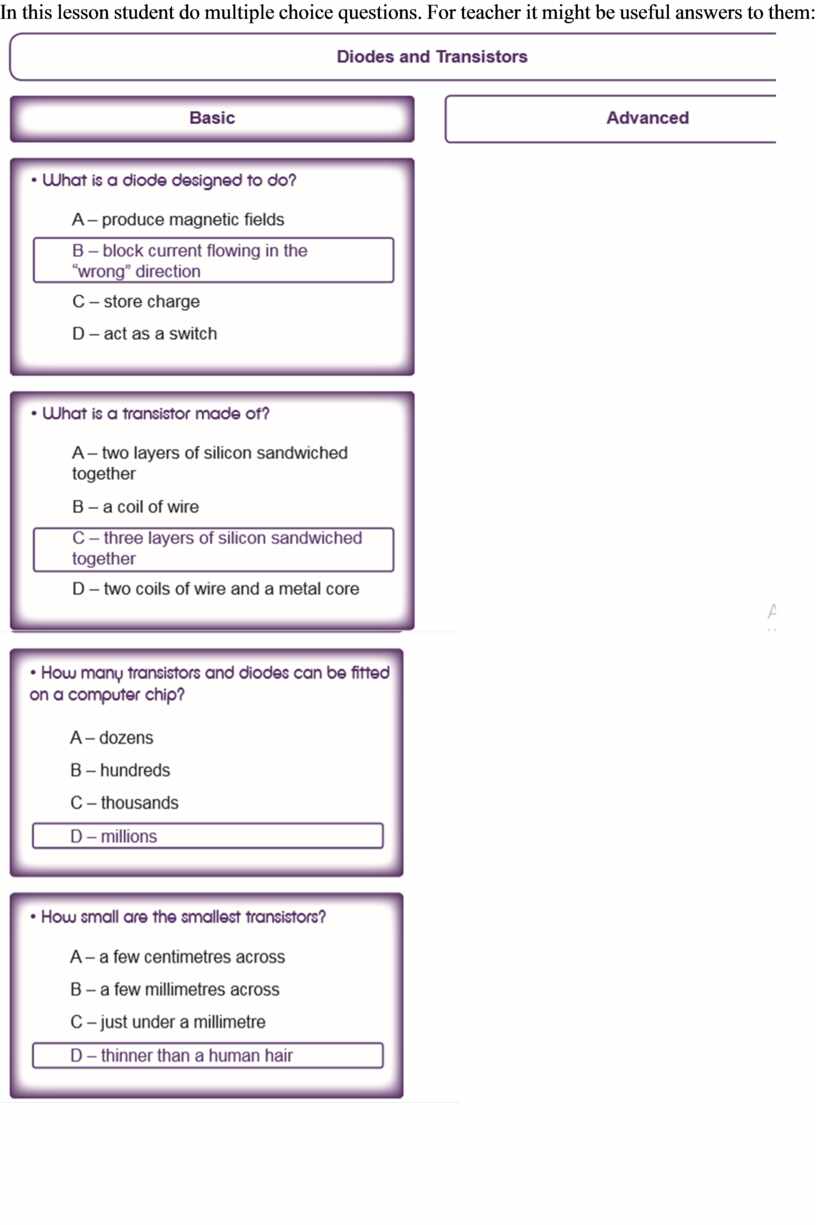
17. What types of impurity atoms are added to increase the number of conduction-band electrons in intrinsic silicon? |
||||||||||
|
|||||||||||
|
18. |
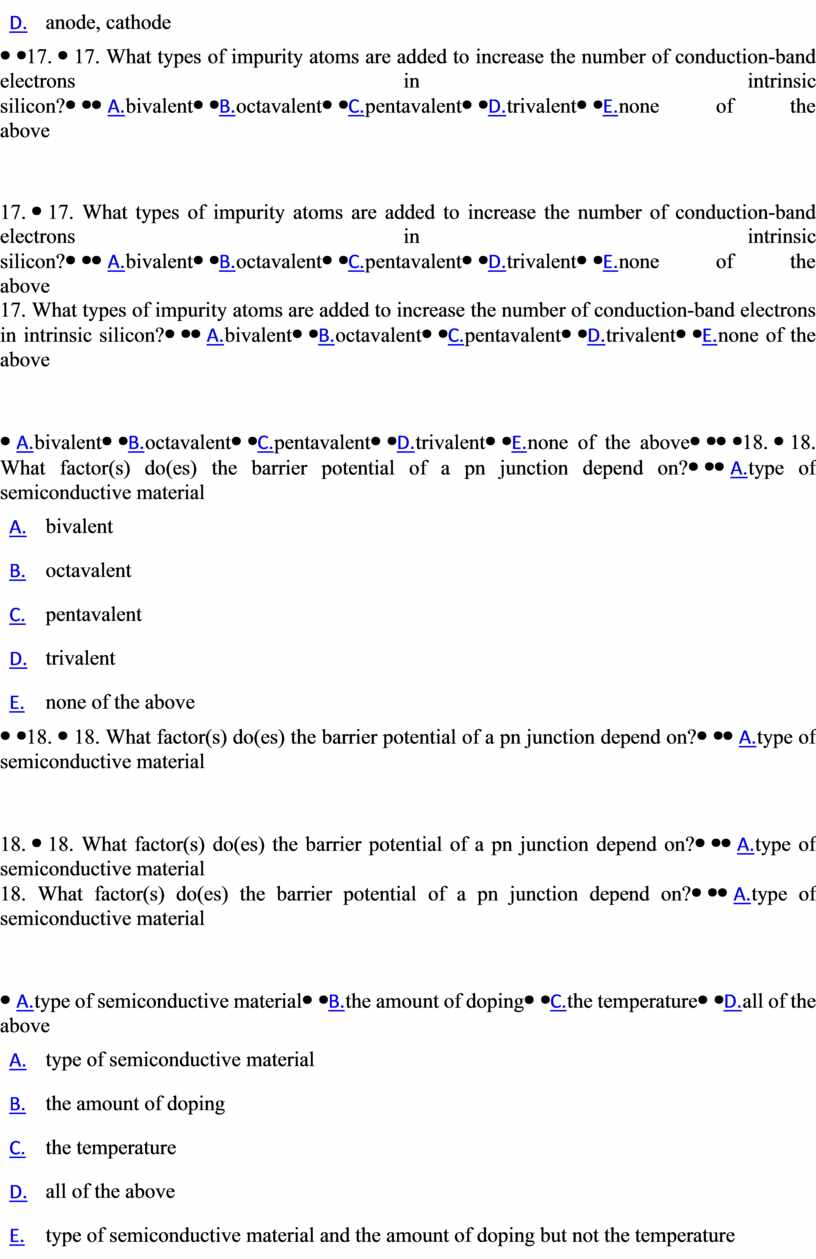
18. What factor(s) do(es) the barrier potential of a pn junction depend on? |
||||||||||
|
|||||||||||
|
19. |
An atom is made up of |
||||||||||
|
|||||||||||
| 20. Reverse breakdown is a condition in which a diode | |||||||||||
|
|||||||||||
| 21. There is a small amount of current across the barrier of a reverse-biased diode. This current is called | |||||||||||
|
|||||||||||
| 22. As the forward current through a silicon diode increases, the voltage across the diode | |||||||||||
|
|||||||||||
| 23. Doping of a semiconductor material means | |||||||||||
|
|||||||||||
| 24. The forward voltage across a conducting silicon diode is about | |||||||||||
|
|||||||||||
| 25. The most common type of diode failure is a(n) ________. | |||||||||||
|
|||||||||||
ANSWERS TO MCQ:
11. C
12. C
13. C
14.B
15. A
16. A
17. C
18.D
19.D
20. A
21.D
22.C
23.C
24.D
25.A
Useful resources:
https://www.indiabix.com/electronic-devices/semiconductors/201006
https://lampx.tugraz.at/~hadley/psd/problems/exams/6mar15/index.html
https://www.electronics-notes.com/articles/electronic_components/resistors/light-dependent-resistor-ldr.php
https://byjus.com/physics/semiconductor-devices/
Скачано с www.znanio.ru



Материалы на данной страницы взяты из открытых источников либо размещены пользователем в соответствии с договором-офертой сайта. Вы можете сообщить о нарушении.