Презентация: Метод мифореставрации

  • Презентации учебные
  • ppt
  • 29.12.2025
Публикация на сайте для учителей

Публикация педагогических разработок

Бесплатное участие. Свидетельство автора сразу.
Мгновенные 10 документов в портфолио.

Sergey Maratovich Telegin (born 1964) is a Russian literary scholar and philosopher known for developing the theory of mythorealism (or mythological realism) and the method of mythorestoration (miforestavratsiya). Key Concepts Mythorealism: Telegin defines this as a literary approach where reality is portrayed through the lens of eternal mythological structures. Unlike traditional realism, which focuses on social or historical determinism, mythorealism views events as manifestations of transcendent, archetypal "mythologems". Mythorestoration (Miforestavratsiya): This is Telegin's primary analytical method, introduced in 1990. It involves "restoring" or uncovering the underlying mythic layers within a literary text to reveal its deeper spiritual and ontological meaning. Mythological Revolution: Telegin argues for a "mythological revolution" in literature and culture to move away from secular materialism toward a more spiritual, myth-centered understanding of existence. Major Works Telegin has applied his theories extensively to 19th and 20th-century Russian literature, particularly the works of Dostoevsky, Leskov, and Tolstoy. His notable books include: Philosophy of Myth: Introduction to the Method of Mythorestoration (1994). The Life of Myth in the Artistic World of Dostoevsky and Leskov (1995). Literature and the Mythological Revolution (2005). The Russian Mythological Novel (2008). Academic Background He is a Doctor of Philological Sciences and a professor who has taught at institutions such as the Gerasimov Institute of Cinematography (VGIK) since 2010. His work often bridges the gap between literary criticism, theology (specifically Christian socialism in Dostoevsky), and esoteric studies like alchemy. Mythorestoration (or myth-restoration) is an interdisciplinary literary and philological method used to identify and reconstruct underlying mythological structures, motifs, and archetypes within a literary text. Core Principles Reconstruction of Meaning: It goes beyond simple identification of myths to "restore" the mythological consciousness of a character or narrator, revealing deep-seated associations with folklore and ancient traditions. Analytical Depth: The method allows scholars to view modern texts through the lens of ancient "texts" (such as the Book of the Dead or specific ethnic geographies of the afterlife) to uncover hidden thematic layers. Interdisciplinary Framework: It is frequently used alongside mythopoetics, structural semiotics, and hermeneutics to model historical or cultural worldviews within artistic works. Notable Applications Classical Prose: Analyzed in V. Korolenko's story "Makar's Dream" to map images of the "Kingdom of Death". Contemporary Media: Applied in modern research to graphic novels, such as Neil Gaiman’s The Sandman, to track how contemporary stories reconstruct ancient mythic systems. Ethnic Culture: Used to study the "concept of the road" in Russian village prose (e.g., works by Vasily Shukshin) to restore the cultural consciousness of the bearer. Mythorestoration (Мифореставрация) is a philological and philosophical method for analyzing literary texts developed by Sergey Maratovich Teleguin (born 1964), a Russian literary scholar and professor. Key Principles of the Method The method treats myth not as an outdated fiction, but as an ongoing revelation of "Logos" that can be "restored" from within artistic works. Definition: Mythorestoration involves identifying elements of mythic consciousness, myth-making laws, and myth-motifs within a text to reconstruct its underlying mythic plot. Goal: To uncover the sacred or archetypal foundations hidden beneath the material or natural imagery of a story. Application: Teleguin has applied this method to classical Russian literature (Dostoevsky, Leskov, Tolstoy) and folk tales, such as analyzing "Kurochka Ryaba" (The Speckled Hen) as a myth of world creation. Background and Context Origin: Teleguin introduced the method in 1990 and detailed it in his 1994 work, Philosophy of Myth: Introduction to the Method of Mythorestoration. 2025 marks the 35th anniversary of the method's inception. Philosophical Stance: He views myth as essential to national identity and has argued for the creation of a modern "heroic myth" to guide the Russian state in the 21st century in his book The Rise of Myth. Esoteric Interests: His work often bridges academic philology with mysticism, exploring topics like alchemy and the "Hyperborean" origins of humanity. Major Works on Mythorestoration Philosophy of Myth: Introduction to the Method of Mythorestoration (1994) Steps of Mythorestoration: From Lectures on the Theory of Literature (2006) Myth – Literature – Mythorestoration (2000)
Иконка файла материала Презентация- мифореставрация.ppt

Сергей Телегин Метод мифореставрации

Словарь
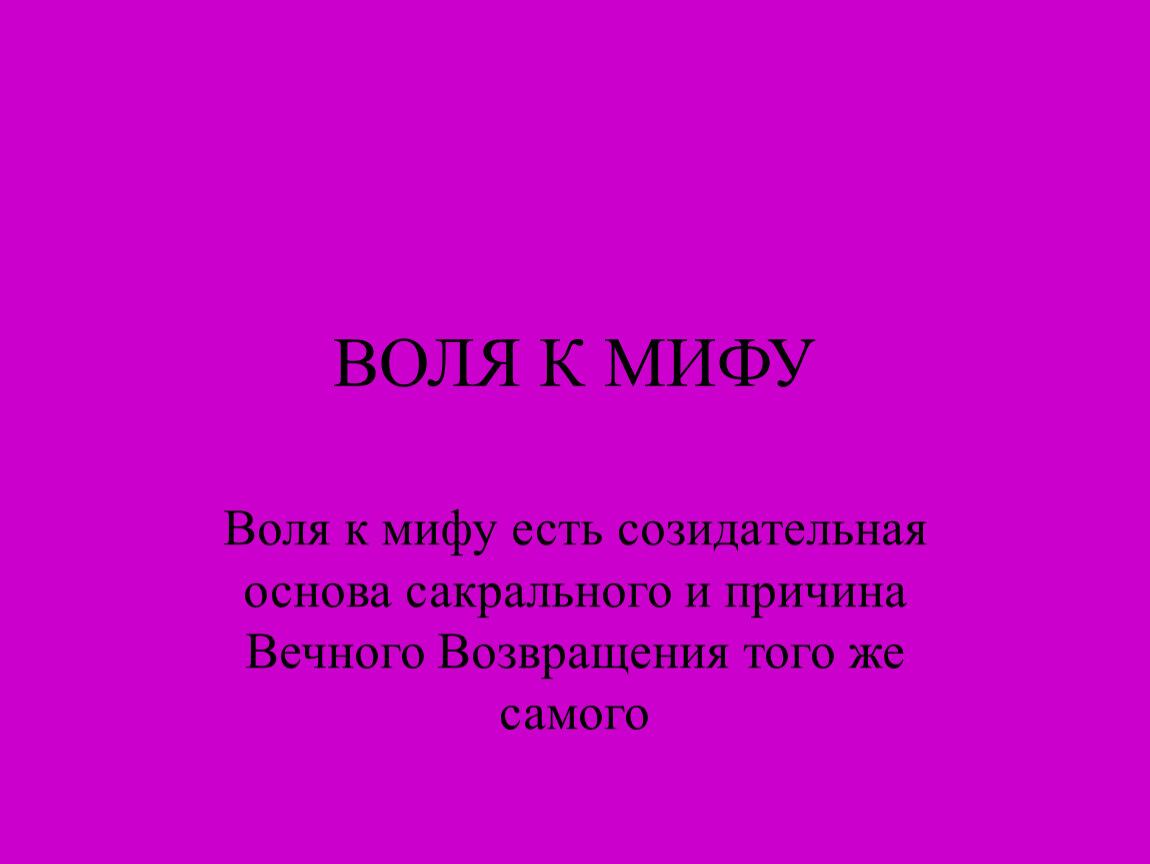
ВОЛЯ К МИФУ

Воля к мифу есть созидательная основа сакрального и причина Вечного Возвращения того же самого
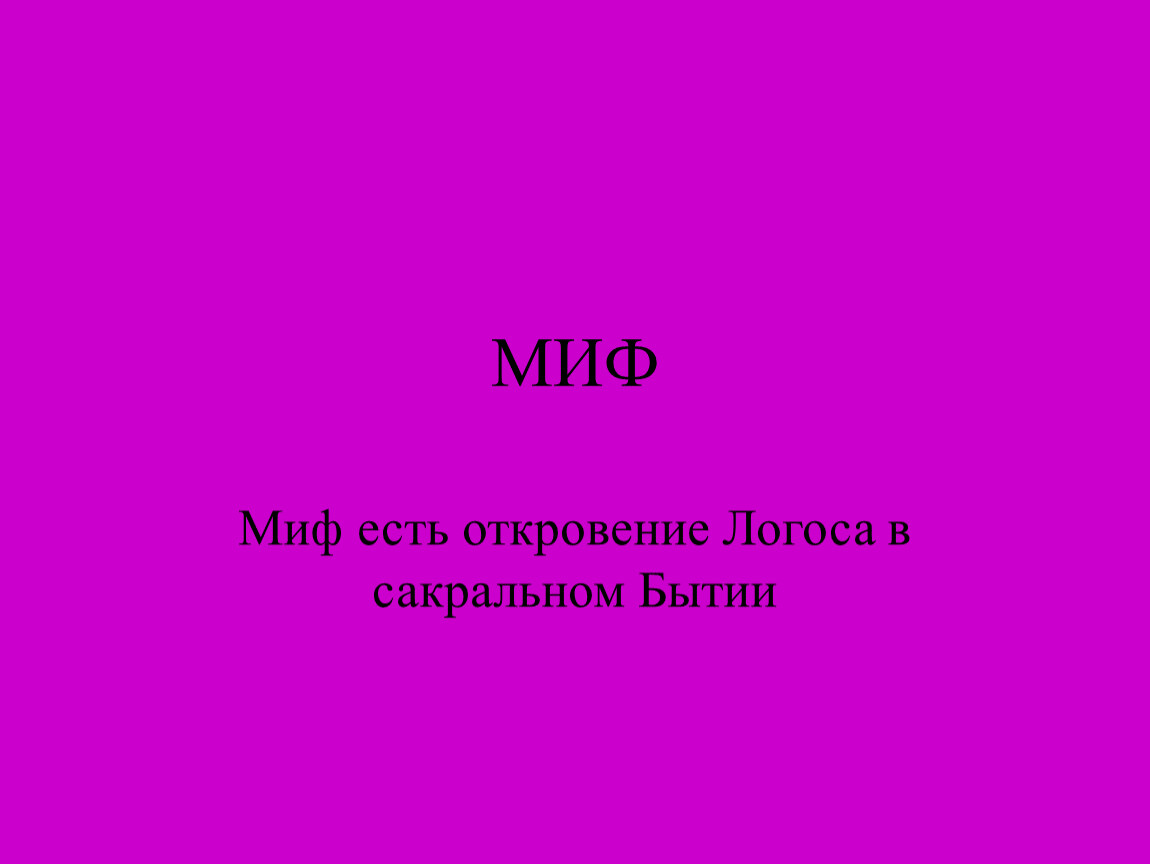
МИФ

Миф есть откровение Логоса в сакральном Бытии
МИФОЛОГЕМА

Мифологема есть первое проявление значения, обладающего творческой, формирующей силой, несущей в себе энергию божественного Логоса
МИФОЛОГИЧЕСКАЯ РЕВОЛЮЦИЯ

Мифологическая революция есть реализация воли к мифу в процессе вторжения мифологических образов в наш профанный мир с целью его сакрализации

МИФОПОЛИТИКА

Мифополитика есть развернутый во времени и воплощенный в истории сакральный миф данного народа
МИФОРЕАЛИЗМ

Миф не показывает истину, а открывает ее как сакральную реальность в бытии
МИФОРЕСТАВРАЦИЯ

Мифореставрация – это особая техника экстатического погружения в миф
МИФОСОЗНАНИЕ

Миф есть особая форма сознания, главными чертами которого являются сакральность и недвойственность
МИФОТВОРЧЕСТВО

Мифотворчество делает миф живым опытом, фактом реальности и повседневного бытия человека

САКРАЛЬНОЕ

Сакральное есть реализовавшаяся воля к мифу; оно представляется как замкнутое в себе Сверх-Бытие
ТРАНСЦЕНДЕНТАЛЬНАЯ ФИЛОЛОГИЯ

Трансцендентальная филология – это способ благоговения перед истиной Логоса – в мифе, в религии, в литературе
Литература к слайдам

С.М. Телегин. Миф, мифореставрация и трансцендентальная филология // Миф – Литература – Мифореставрация. Сб. статей. М.-Рязань, 2000
Он же:
Миф // Литература. 1994. № 14
Мифологема // Литература. 1996. № 37
Мифореализм // Литература. 1995. № 31
Мифореставрация // Литература. 1994. № 28
Мифотворчество // Литература. 1996. № 34
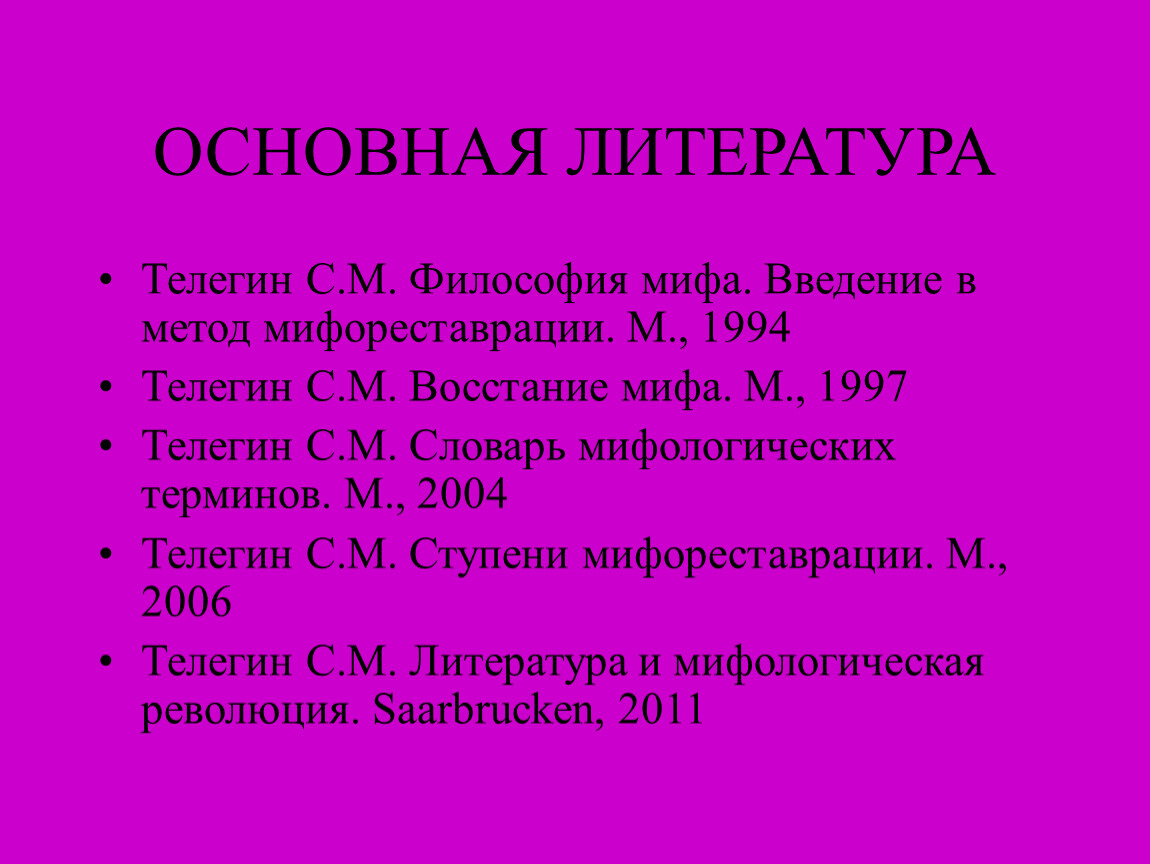
ОСНОВНАЯ ЛИТЕРАТУРА

Телегин С.М. Философия мифа. Введение в метод мифореставрации. М., 1994
Телегин С.М. Восстание мифа. М., 1997
Телегин С.М. Словарь мифологических терминов. М., 2004
Телегин С.М. Ступени мифореставрации. М., 2006
Телегин С.М. Литература и мифологическая революция. Saarbrucken, 2011