
Поделиться



 British detective authors.pptx
English detective fiction writers
What do Sherlock Holmes, Hercule Poirot and Miss Marple have in common? They're all detectives, of course!
What is detective fiction?
A mystery novel “The Woman in White” (1859) and “The Moonstone” (1868) by William Wilkie Collins, an English novelist, were the first modern English detective novels.
In 1887 Sir Arthur Conan Doyle created Sherlock Holmes, the most famous of all fictional detectives.
The period from 1920 to 1930 is called the Golden Age of Detective Fiction. During this period four female novelists known as "Queens of Crime“ were writing their masterpieces. They are Agatha Christie, Dorothy L. Sayers, Margery Allingham, and Ngaio Marsh (new zealander).
Two types of the detective story were extremely popular these days: the "locked-room" and a “whodunit” (from "Who [has] done it?" or "Who did it?").
Actually, the list of detective story writers is not limited to the mentioned names.
Detective fiction remains a widely-read genre today. Plots become more complicated and sophisticated. Detective stories are a kind of intellectual game for readers. They invites audience to solve crimes by piecing together clues of puzzles and offering the thrill of decoding a mystery.
Detective fiction tales can often be combined with other genres, such as supernatural or fantastical narratives, to deliver an exciting experience.
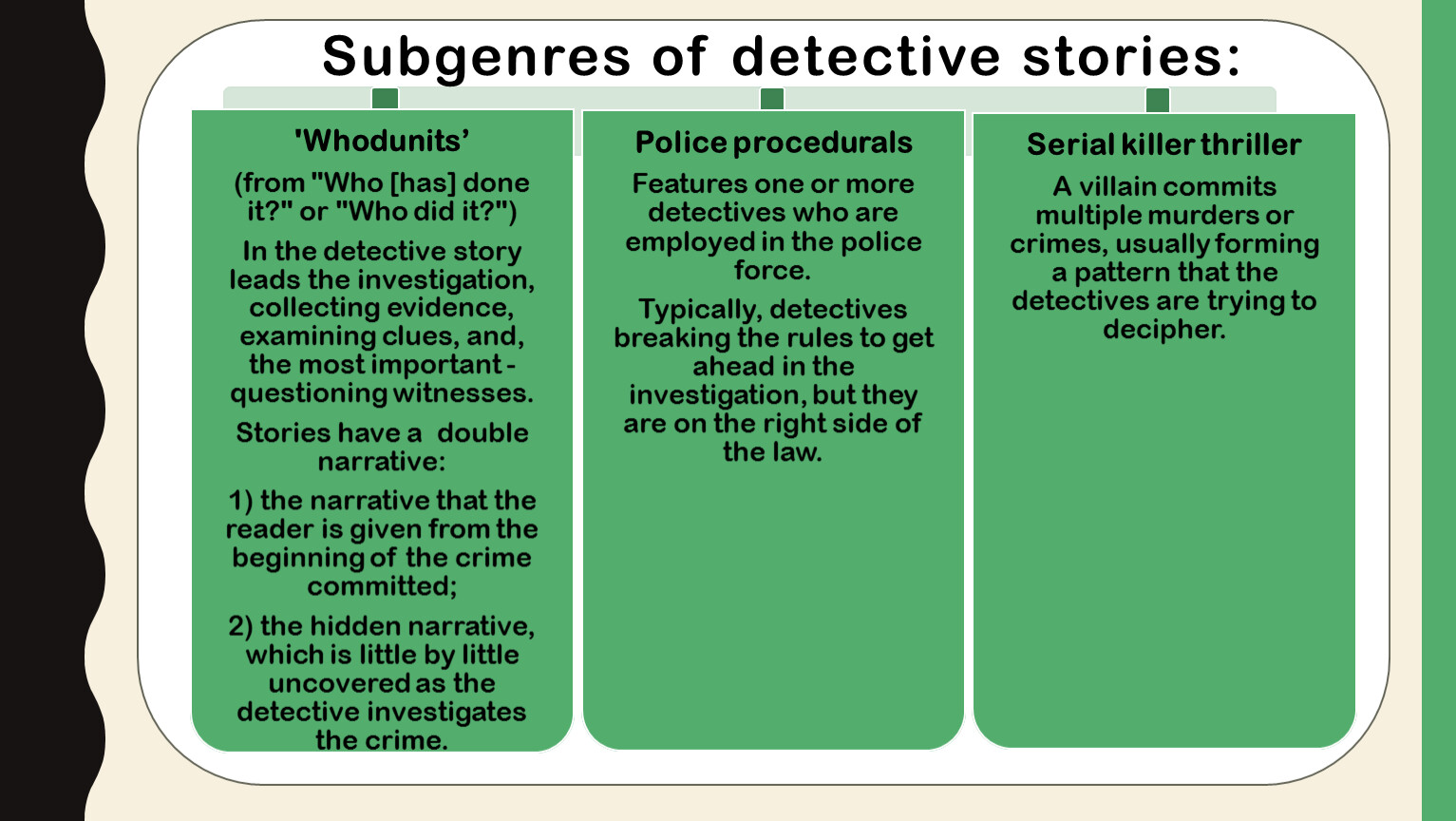
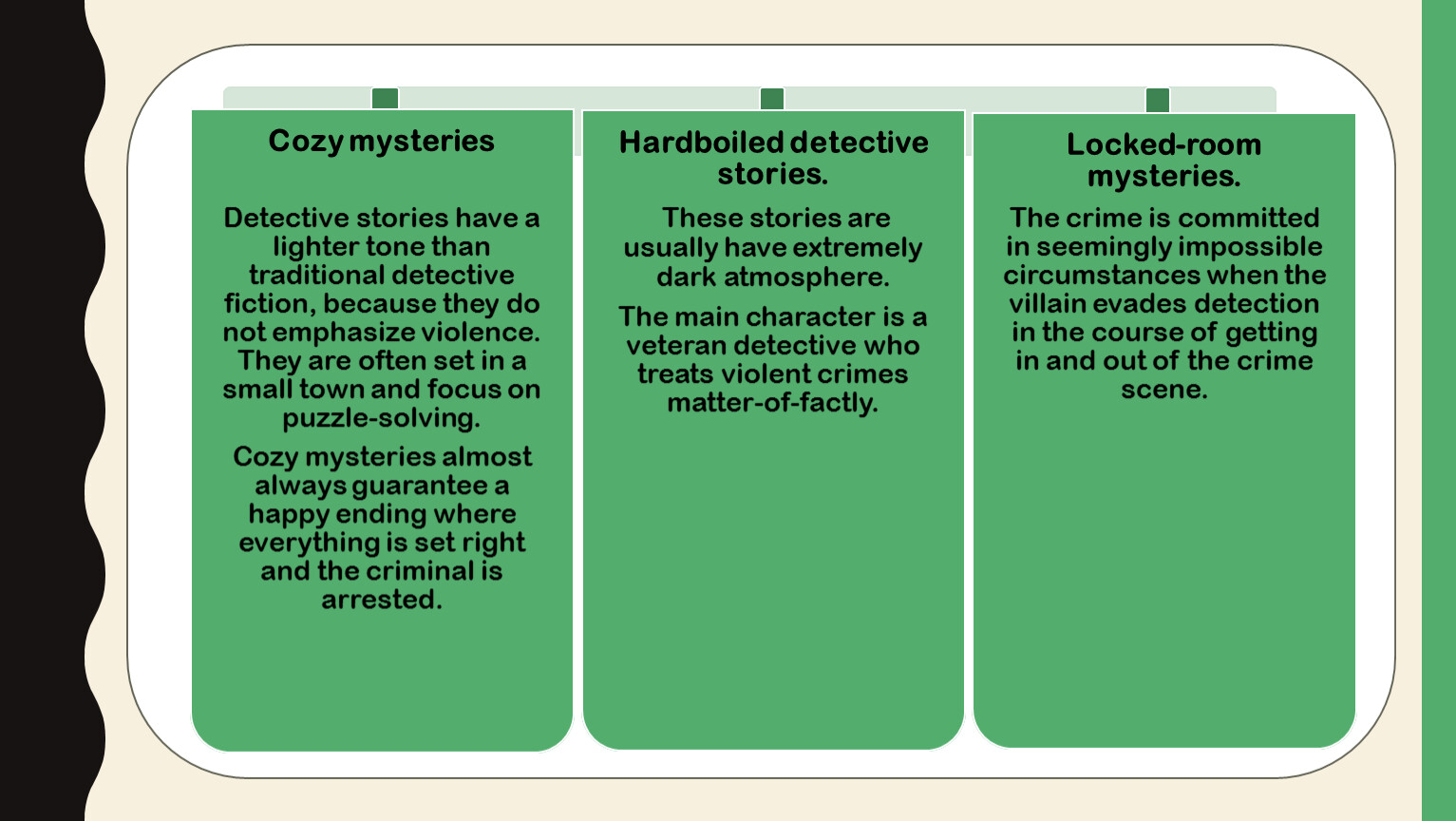
Subgenres of detective stories:
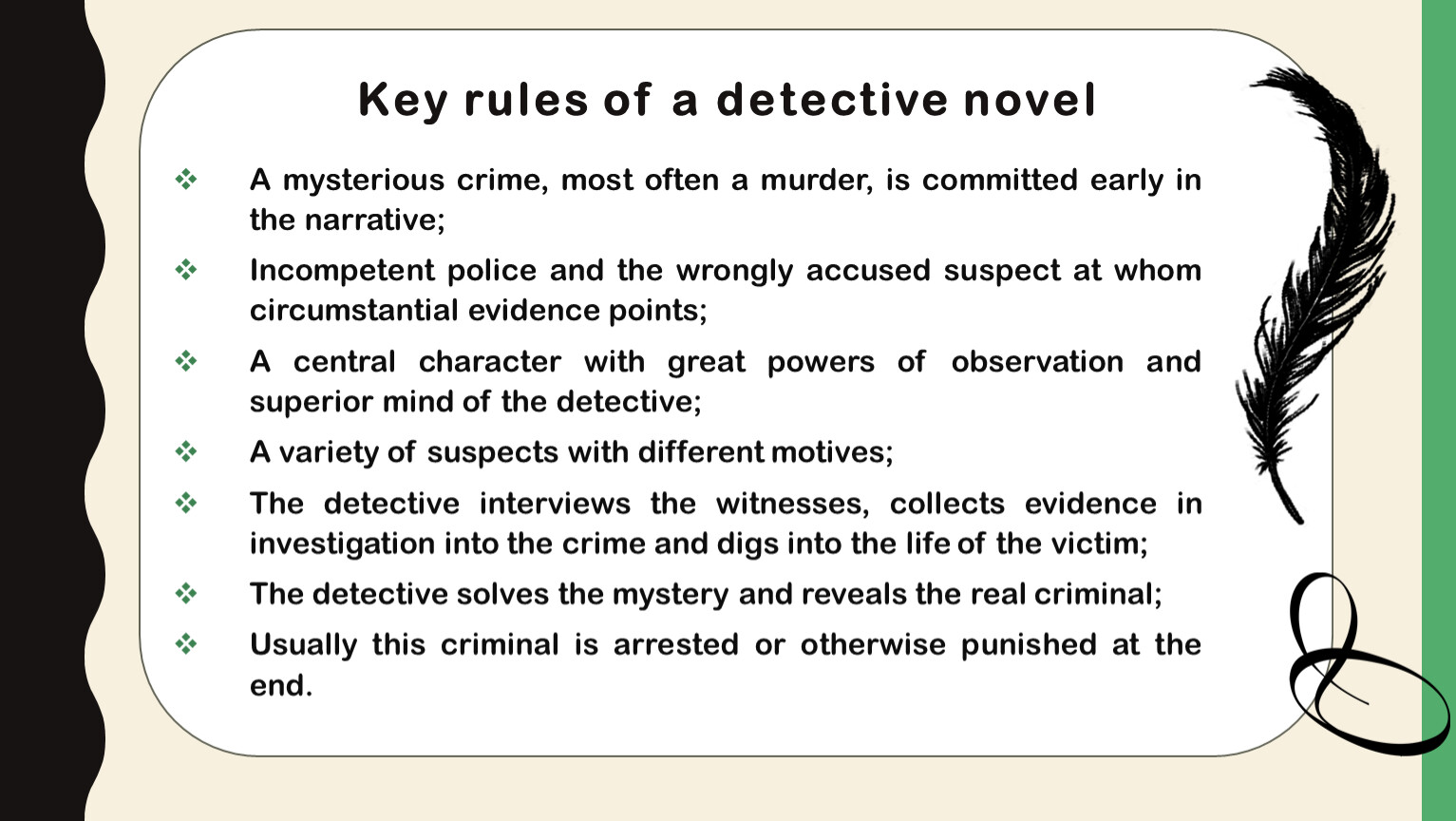
Key rules of a detective novel
A mysterious crime, most often a murder, is committed early in the narrative;
Incompetent police and the wrongly accused suspect at whom circumstantial evidence points;
A central character with great powers of observation and superior mind of the detective;
A variety of suspects with different motives;
The detective interviews the witnesses, collects evidence in investigation into the crime and digs into the life of the victim;
The detective solves the mystery and reveals the real criminal;
Usually this criminal is arrested or otherwise punished at the end.
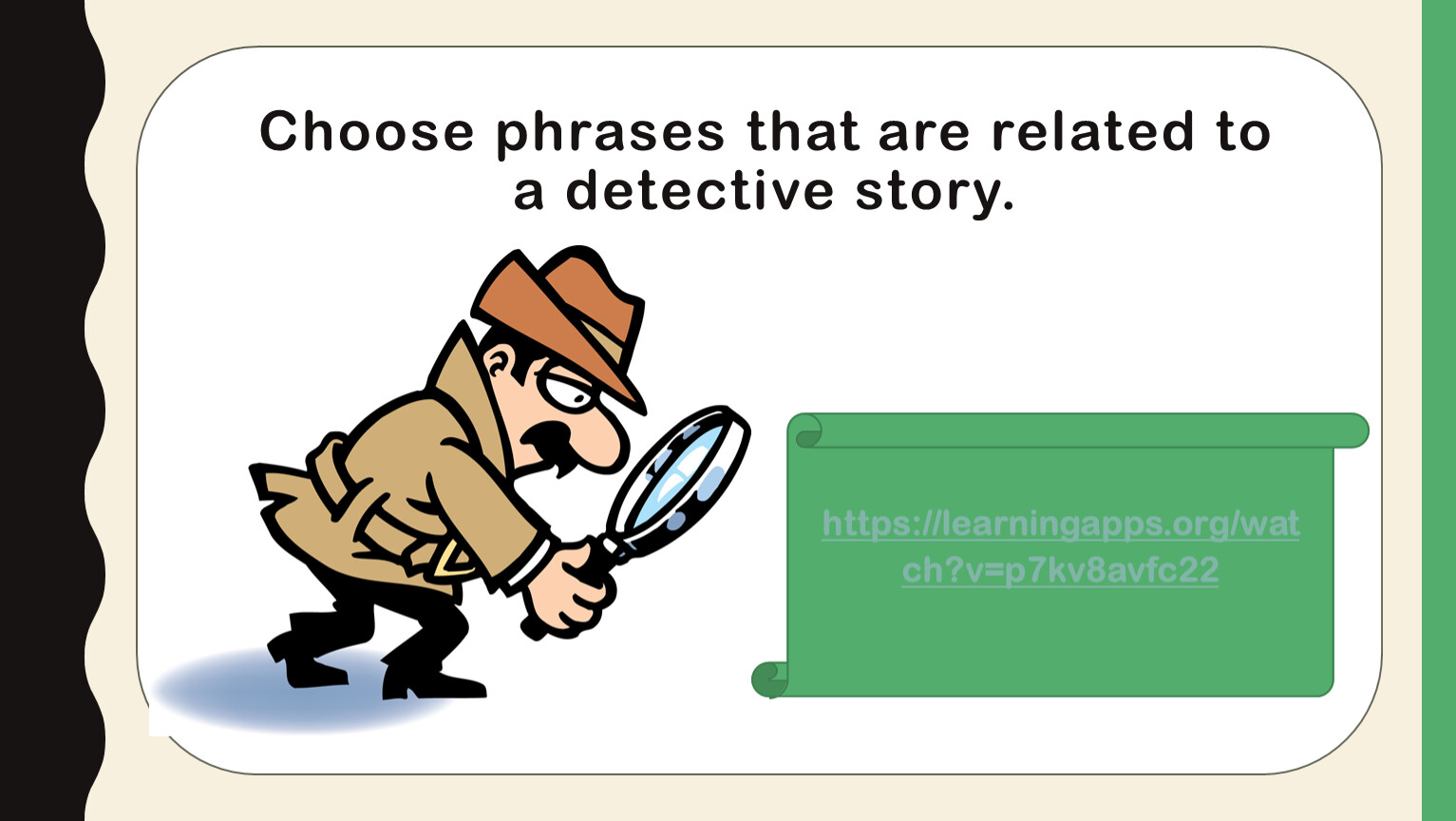
Choose phrases that are related to a detective story.
https://learningapps.org/watch?v=p7kv8avfc22
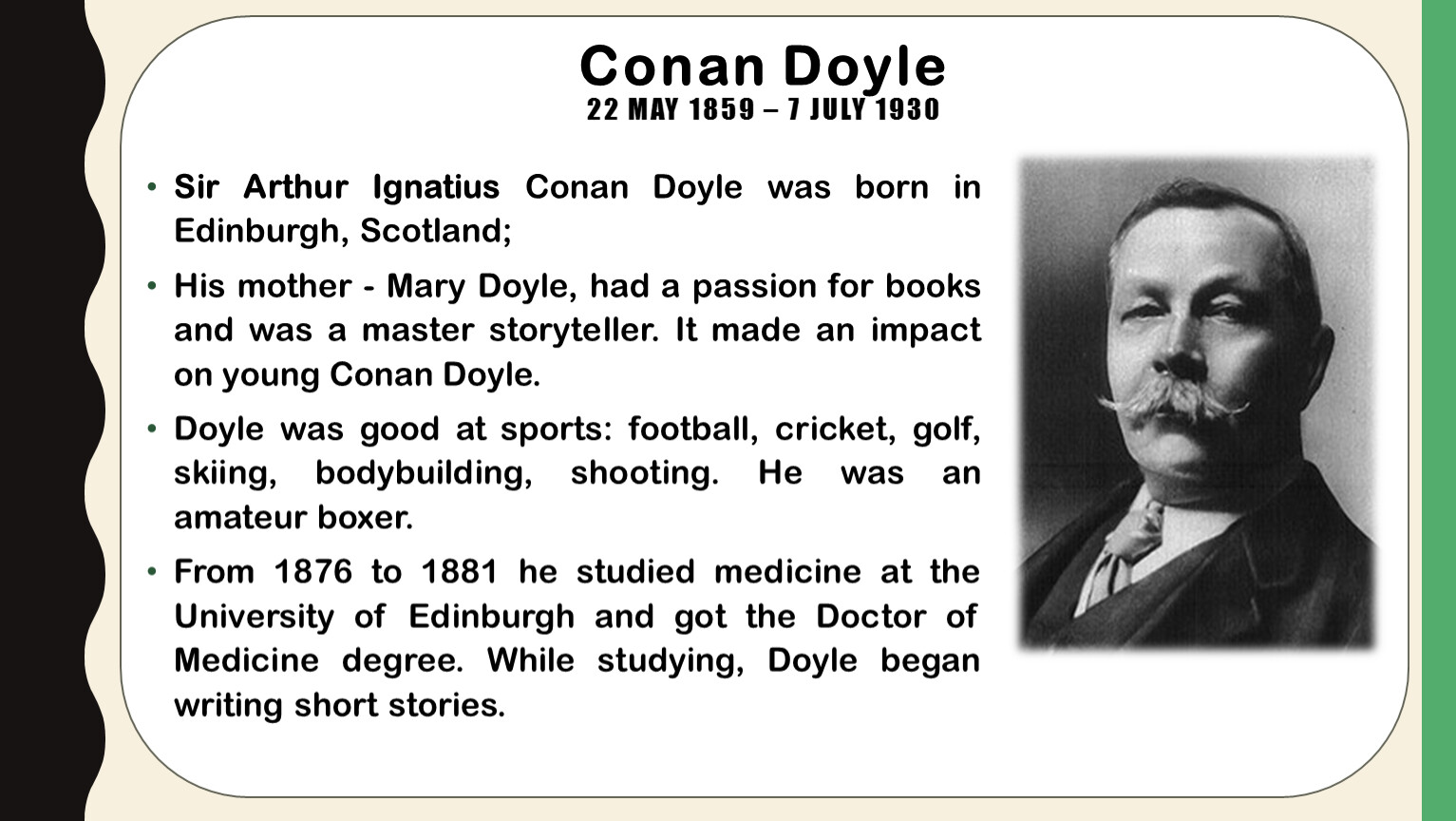
Conan Doyle 22 May 1859 – 7 July 1930
Sir Arthur Ignatius Conan Doyle was born in Edinburgh, Scotland;
His mother - Mary Doyle, had a passion for books and was a master storyteller. It made an impact on young Conan Doyle.
Doyle was good at sports: football, cricket, golf, skiing, bodybuilding, shooting. He was an amateur boxer.
From 1876 to 1881 he studied medicine at the University of Edinburgh and got the Doctor of Medicine degree. While studying, Doyle began writing short stories.
In his twenties he travelled to the Arctic Circle and the West African coast as the ship's surgeon.
In 1886, when Doyle was 27, he wrote “A Study in Scarlet”, his first work featuring Sherlock Holmes and Dr. Watson in three weeks. It was a great success.
He wrote more than 300 fictions (including 24 novels) of all genres like history, fantasy, adventure, science-fiction, crimes, drama, war. Between 1888 and 1906, Doyle wrote 7 historical novels, which he and many critics regarded as his best work.
Sherlock Holmes very quickly became world famous fictional detective. Conan Doyle expected to be recognized as a serious author for a number of serious historical novels, poems and plays, but unfortunately readers were only interested in stories about Sherlock Holmes. Doyle raised his price “for more Holmes stories” to discourage publishers, but found out they were willing to pay the large sums. As a result, he became one of the best-paid authors of his time.
Doyle got tired from Sherlock Holmes and decided to get rid of him. During a trip to Switzerland, he found the spot where his hero was to come to his end. In “The Final Problem” (1893) Sherlock Holmes and Professor Moriarty plunged to their deaths at The Reichenbach Falls. As a result, twenty thousand readers cancelled their subscriptions to The Strand Magazine. However, 8 years later, under family and editor pressure, he "resurrected" the detective and wrote 34 more stories between 1901 and 1927.
Conan Doyle wrote a play about Sherlock Holmes (1897). The play opened in London at the Lyceum Theatre in the fall of 1901 with a huge success.
Doyle had an interest in mystical subjects and was fascinated by the idea of paranormal phenomena.
In 1902 King Edward VII knighted Conan Doyle for services rendered to the Crown during the Boer War.
The most popular detective stories:
A Study in Scarlet,
The Sign of the Four
The Hound of the Baskervilles.
The Adventures of Sherlock Holmes is a collection of twelve short stories: “A Scandal in Bohemia”, “The Red-Headed League”, “A Case of Identity”, “The Boscombe Valley Mystery”, “The Five Orange Pips”, “The Man with the Twisted Lip”, “The Adventure of the Blue Carbuncle”, “The Adventure of the Speckled Band”, "The Adventure of the Engineer’s Thumb”, “The Adventure of the Noble Bachelor”, “The Adventure of the Beryl Coronet”, “The Adventure of the Copper Beeches”.
Sherlock Holmes
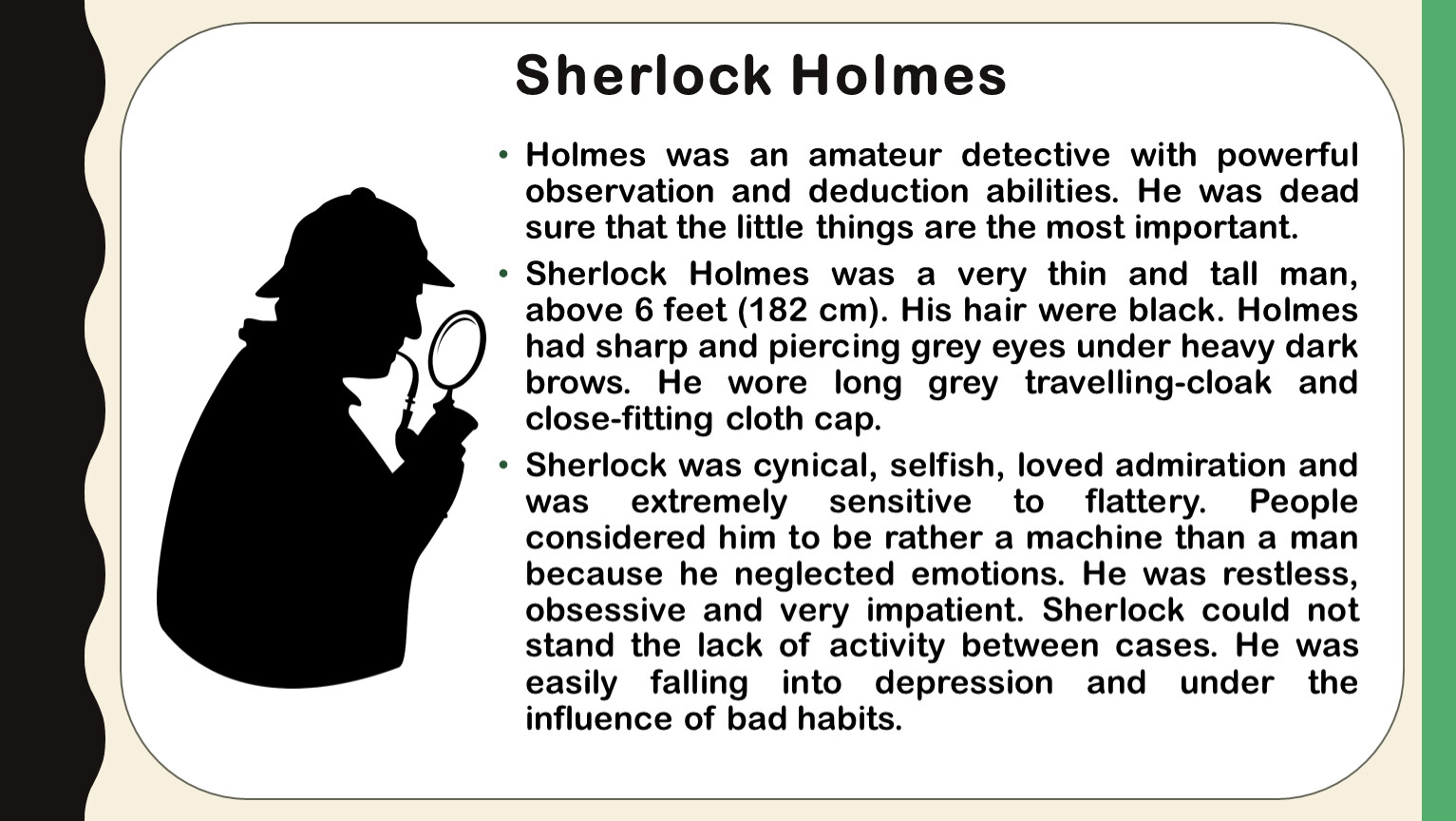
Holmes was an amateur detective with powerful observation and deduction abilities. He was dead sure that the little things are the most important.
Sherlock Holmes was a very thin and tall man, above 6 feet (182 cm). His hair were black. Holmes had sharp and piercing grey eyes under heavy dark brows. He wore long grey travelling-cloak and close-fitting cloth cap.
Sherlock was cynical, selfish, loved admiration and was extremely sensitive to flattery. People considered him to be rather a machine than a man because he neglected emotions. He was restless, obsessive and very impatient. Sherlock could not stand the lack of activity between cases. He was easily falling into depression and under the influence of bad habits.
Holmes was able to change his personality completely, he was a born actor.
Sherlock took only unusual or fantastic cases. He considered his work being an Art and completely addicted himself to investigation and took little care for his own safety, he even could stop eating. He did not hesitate to use illegal methods.
Holmes was an eccentric person, he performed weird scientific experiments, shot from his revolver at home, played music at night. He was incredible untidy.
He wasn't married and had a brother Mycroft, a civil servant, who was seven years older than Holmes.
He lived in London at 221B Baker Street and shared rooms with Dr. Watson.
Holmes played the violin well and was fond of music.
He was a swordsman and one of the finest boxers.
Holmes worked as a detective for 23 years and retired in the Sussex Downs shortly before 1904. The details of his death are unknown.
In 1887 Sherlock Holmes was introduced to the world in “A Study in Scarlet”.
Between 1887 and 1927 appeared in 62 cases (4 novels and 58 short stories).
Holmes was partially modelled on Doyle’s university teacher doctor Joseph Bell, a master at observation, logic, deduction, and diagnosis.
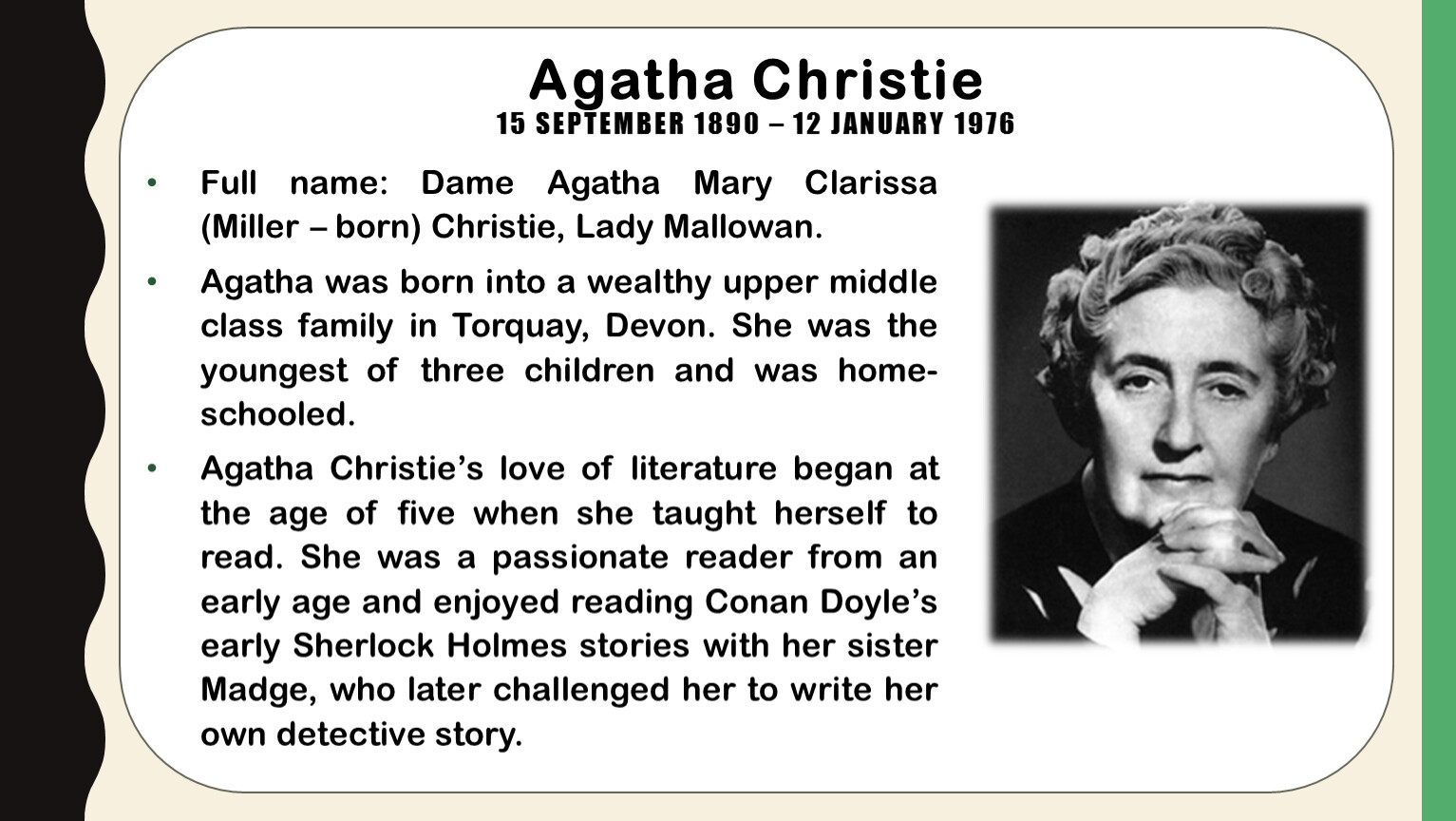
Full name: Dame Agatha Mary Clarissa (Miller – born) Christie, Lady Mallowan.
Agatha was born into a wealthy upper middle class family in Torquay, Devon. She was the youngest of three children and was home-schooled.
Agatha Christie’s love of literature began at the age of five when she taught herself to read. She was a passionate reader from an early age and enjoyed reading Conan Doyle’s early Sherlock Holmes stories with her sister Madge, who later challenged her to write her own detective story.
Agatha Christie 15 SEPTEMBER 1890 – 12 JANUARY 1976
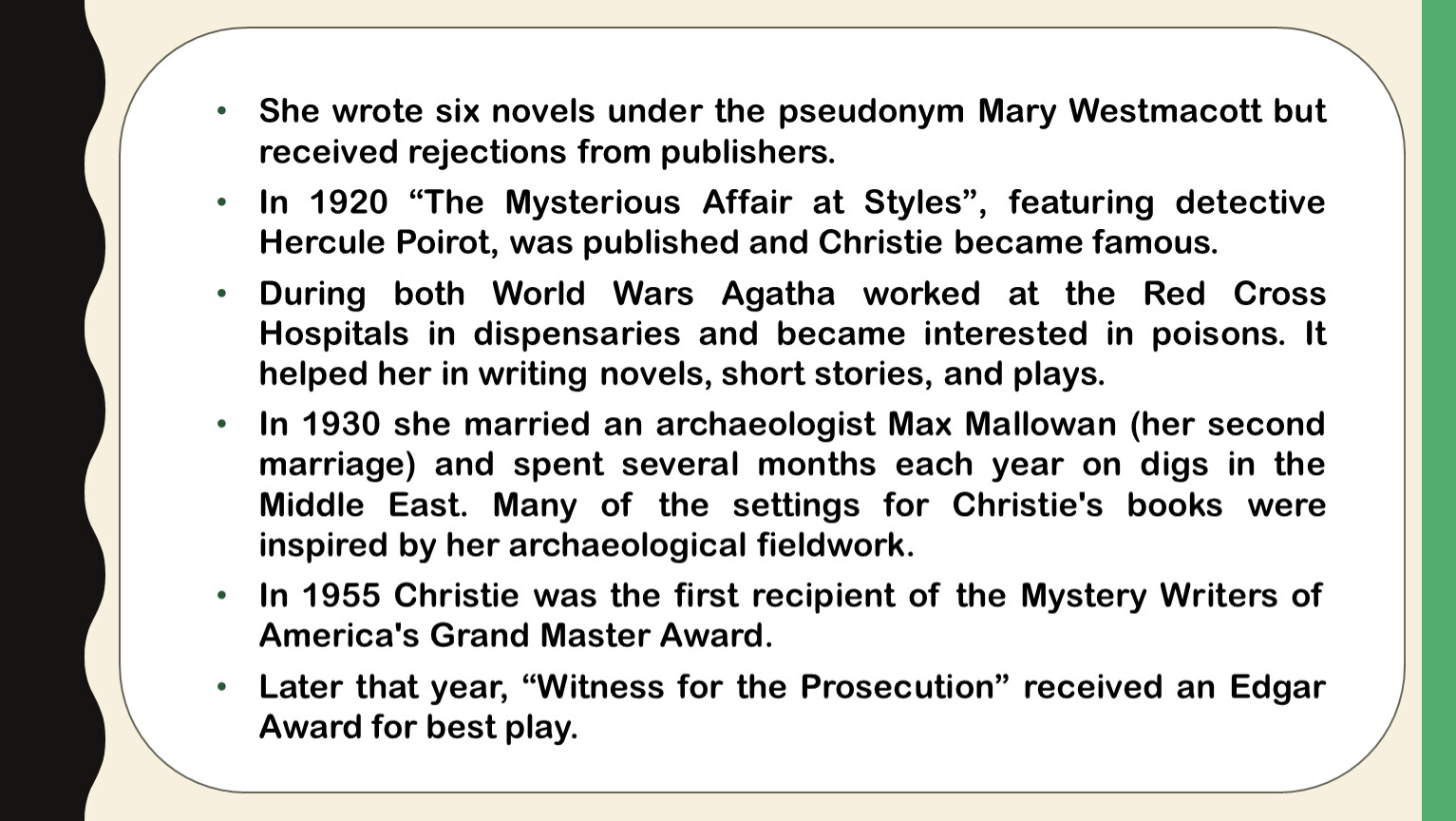
She wrote six novels under the pseudonym Mary Westmacott but received rejections from publishers.
In 1920 “The Mysterious Affair at Styles”, featuring detective Hercule Poirot, was published and Christie became famous.
During both World Wars Agatha worked at the Red Cross Hospitals in dispensaries and became interested in poisons. It helped her in writing novels, short stories, and plays.
In 1930 she married an archaeologist Max Mallowan (her second marriage) and spent several months each year on digs in the Middle East. Many of the settings for Christie's books were inspired by her archaeological fieldwork.
In 1955 Christie was the first recipient of the Mystery Writers of America's Grand Master Award.
Later that year, “Witness for the Prosecution” received an Edgar Award for best play.
Agatha Christie was called the “Queen of Crime”.
In 1971 for her contributions to literature was made a Dame by Queen Elizabeth II.
Many of Christie's books and short stories have been adapted for television, radio, video games, and graphic novels. More than 30 feature films are based on her work.
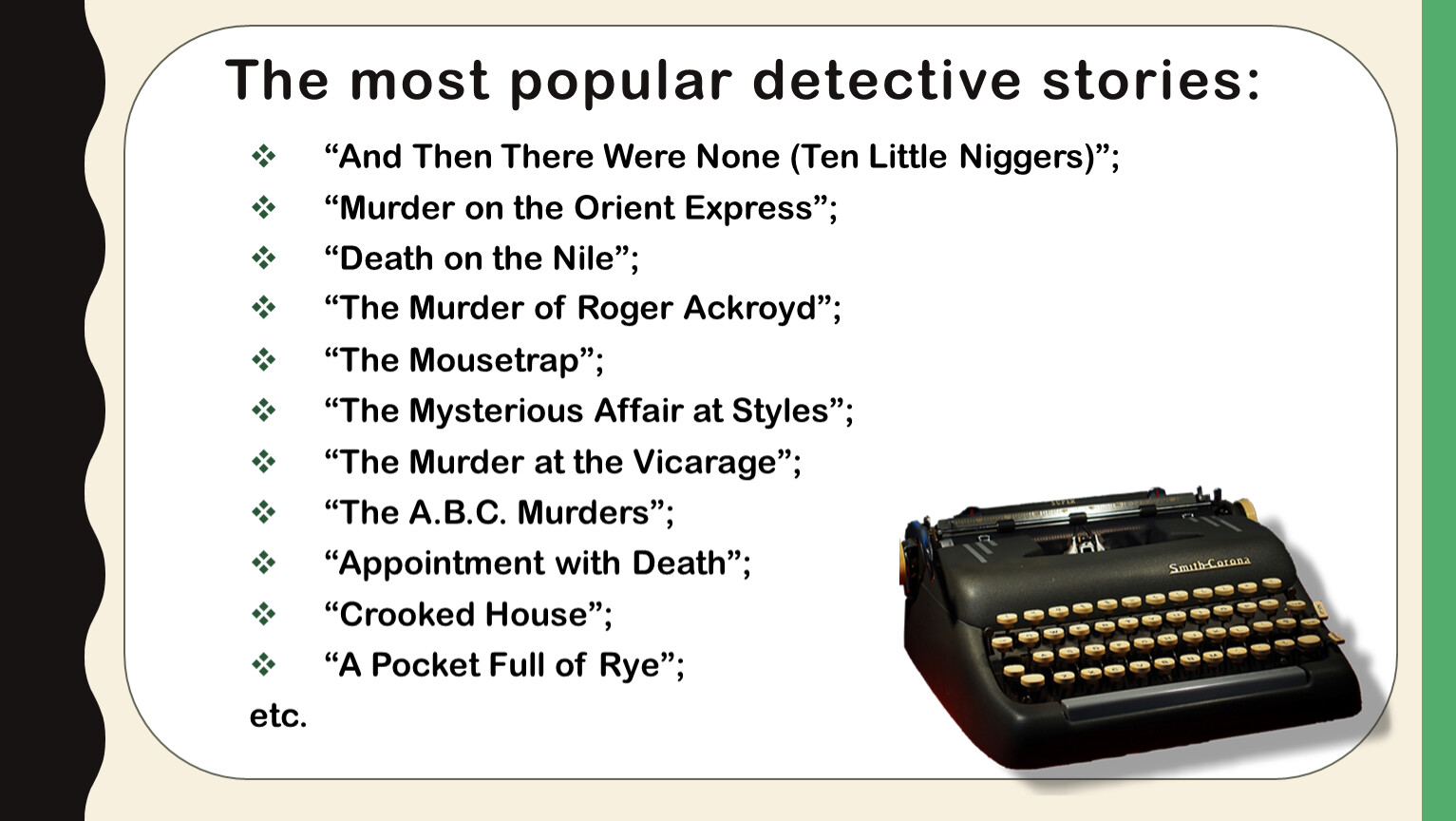
The most popular detective stories:
“And Then There Were None (Ten Little Niggers)”;
“Murder on the Orient Express”;
“Death on the Nile”;
“The Murder of Roger Ackroyd”;
“The Mousetrap”;
“The Mysterious Affair at Styles”;
“The Murder at the Vicarage”;
“The A.B.C. Murders”;
“Appointment with Death”;
“Crooked House”;
“A Pocket Full of Rye”;
etc.
Hercule Poirot
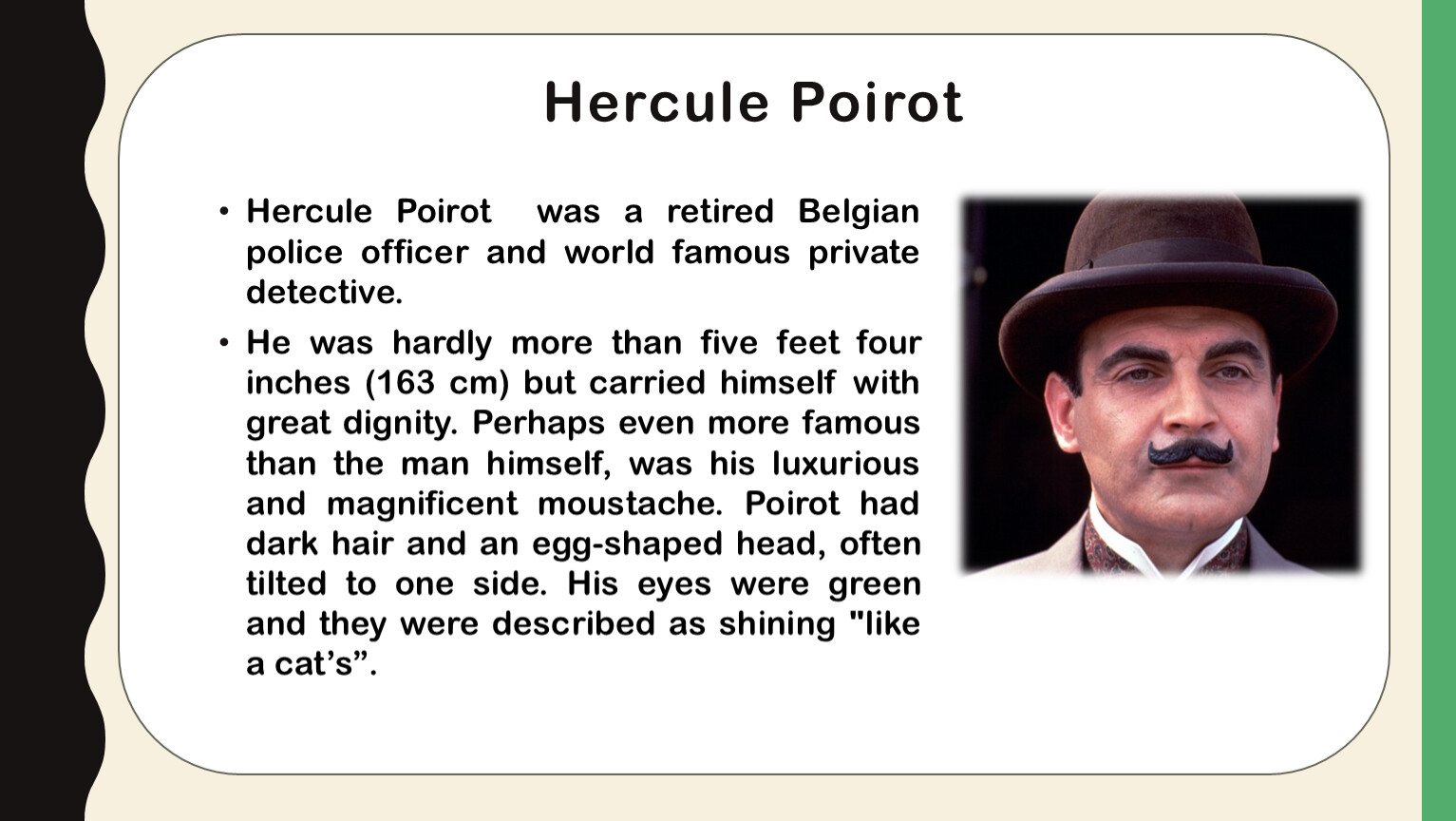
Hercule Poirot was a retired Belgian police officer and world famous private detective.
He was hardly more than five feet four inches (163 cm) but carried himself with great dignity. Perhaps even more famous than the man himself, was his luxurious and magnificent moustache. Poirot had dark hair and an egg-shaped head, often tilted to one side. His eyes were green and they were described as shining "like a cat’s”.
Poirot was an eccentric detective with excessive attention to detail and perfectionism. He was extremely punctual and carried a pocket watch. His clothes were out of fashion, but the neatness of his attire was incredible.
He was fond of classical music, particularly Mozart and Bach.
Poirot used psychology and his extensive knowledge of human nature in his investigations. He interviewed witnesses, took physical evidence into account, but more often he relied on “his little grey cells”.
Poirot revealed the criminals with some kind of elegance and a dramatic outcome, satisfying his own ego and confirming to all that he was truly "the greatest mind in Europe”.
He was respected and admired by police forces and heads of state across the globe.
Poirot’s favourite quote was ‘If the little grey cells are not exercised, they grow the rust.’
Hercule Poirot first appeared in Agatha Christie’s first published novel “The Mysterious Affair at Styles”, which debuted in 1920.
Poirot featured in 33 novels and 59 short stories and 1 original full-length play by Agatha Christie
Agatha Christie declared that “Murder on the Orient Express” was the best Poirot novel.
Since the late 1920’s, Agatha Christie’s famous fictional creation Hercule Poirot has been depicted on stage, screen, radio and in games by over 40 actors. Poirot was played by Charles Laughton, Albert Finney, Peter Ustinov, David Suchet, John Malkovich and Kenneth Branagh and others.
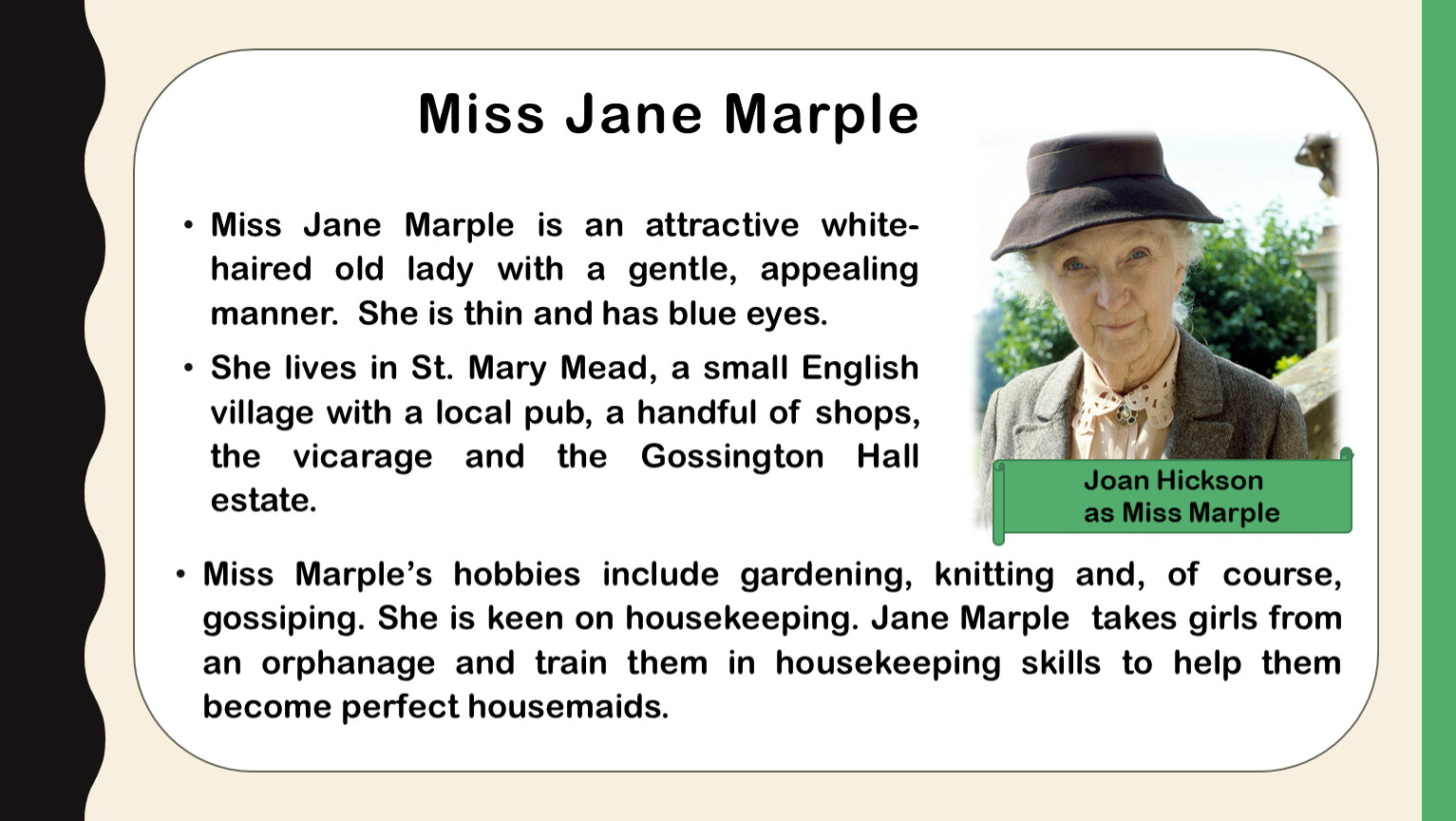
Miss Jane Marple
Miss Jane Marple is an attractive white-haired old lady with a gentle, appealing manner. She is thin and has blue eyes.
She lives in St. Mary Mead, a small English village with a local pub, a handful of shops, the vicarage and the Gossington Hall estate.
Miss Marple’s hobbies include gardening, knitting and, of course, gossiping. She is keen on housekeeping. Jane Marple takes girls from an orphanage and train them in housekeeping skills to help them become perfect housemaids.
Joan Hickson
as Miss Marple
She was never married and her closest living relatives are her nephews and nieces. Her nephew is the well-known writer Raymond West.
Miss Marple is an independent and restless woman with a passion for justice.
She is not an optimist, she expects the worst from everything and everyone.
Miss Marple’s unique understanding of human nature comes from her careful observance of village life.
She doesn’t look like a detective at all, but looks can be deceiving. Criminals and murderers always underestimate her.
Miss Marple has no background in criminology or the police force.
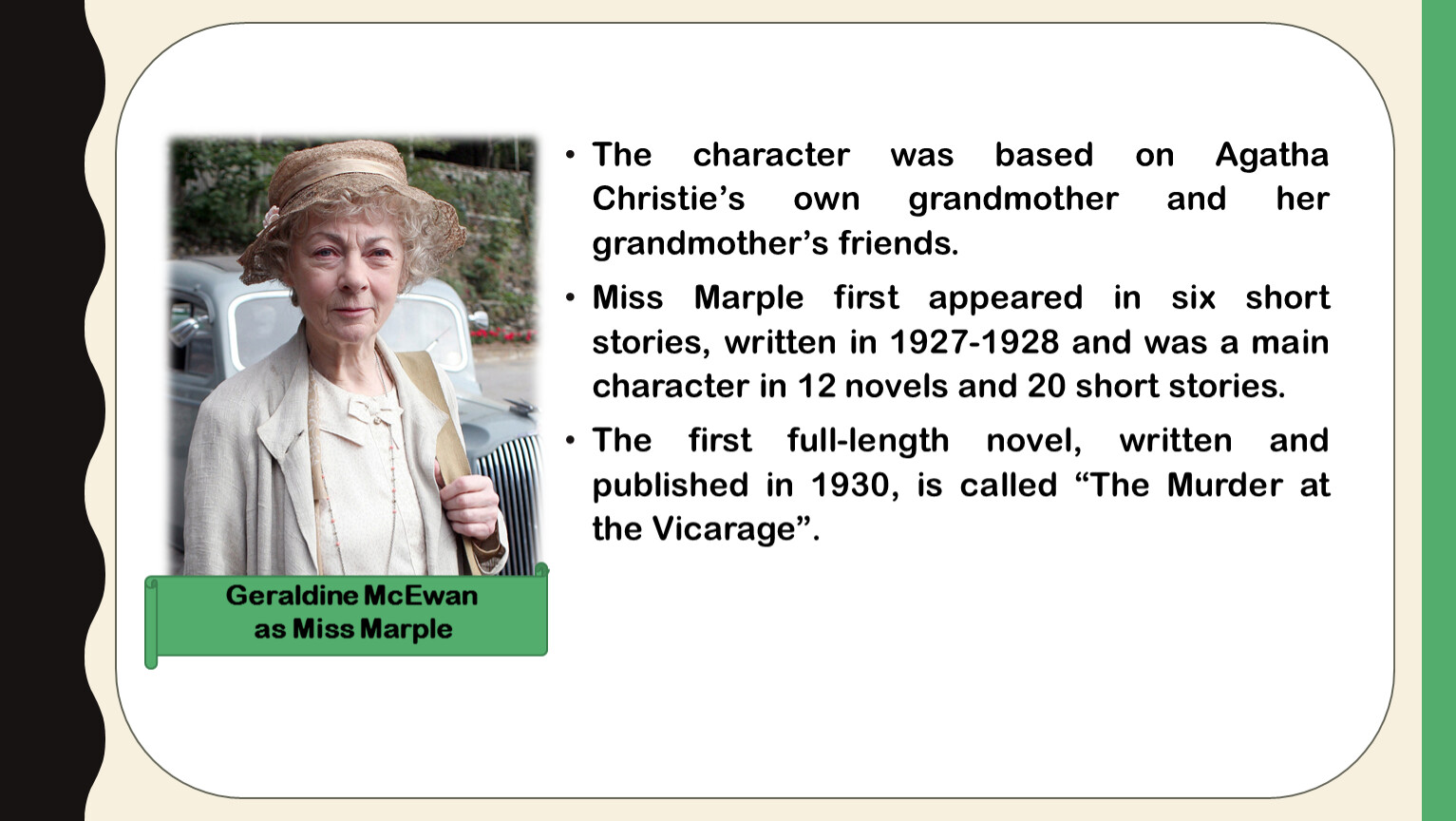
The character was based on Agatha Christie’s own grandmother and her grandmother’s friends.
Miss Marple first appeared in six short stories, written in 1927-1928 and was a main character in 12 novels and 20 short stories.
The first full-length novel, written and published in 1930, is called “The Murder at the Vicarage”.
Geraldine McEwan
as Miss Marple
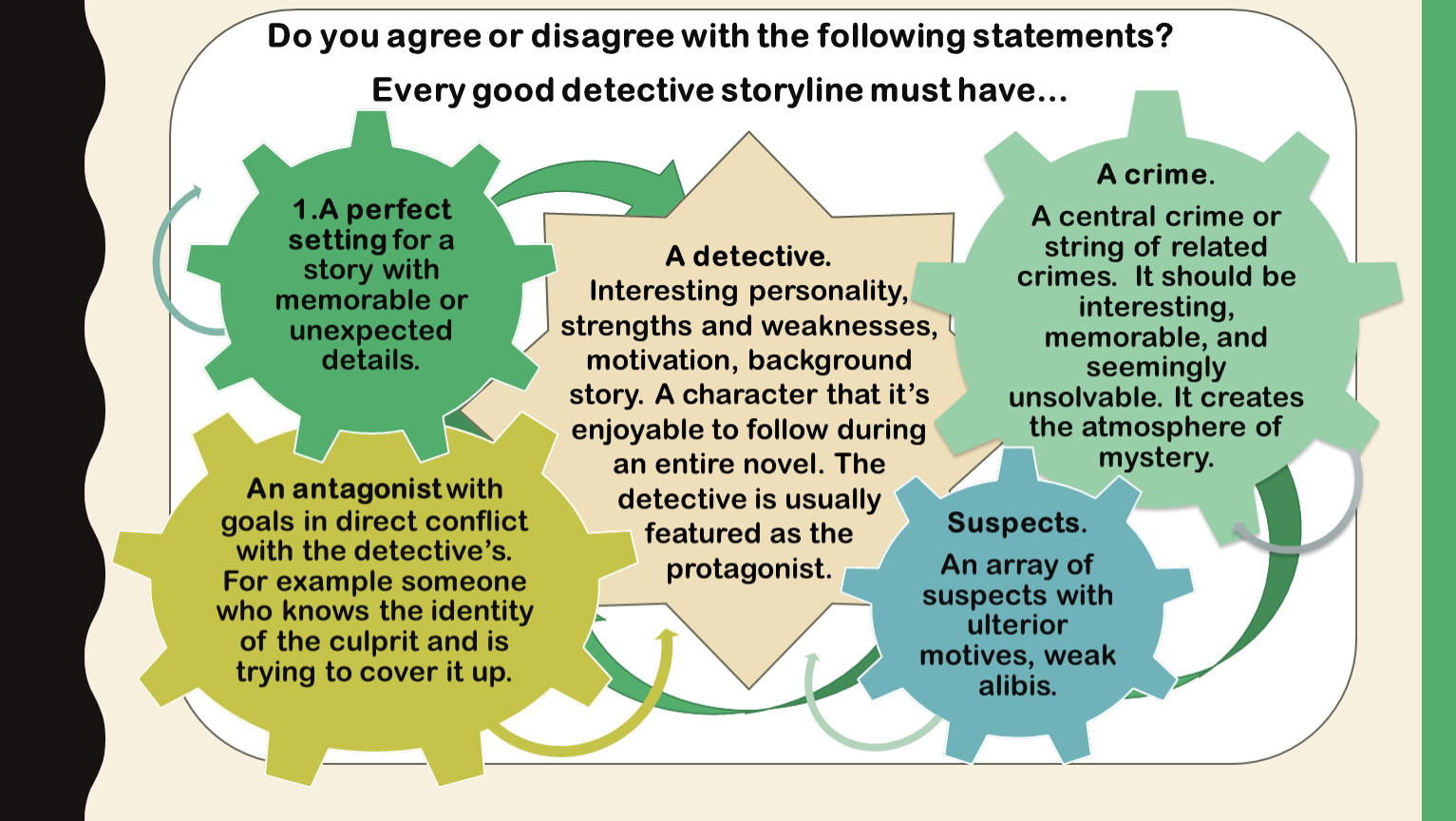
Do you agree or disagree with the following statements?
Every good detective storyline must have…
A detective.
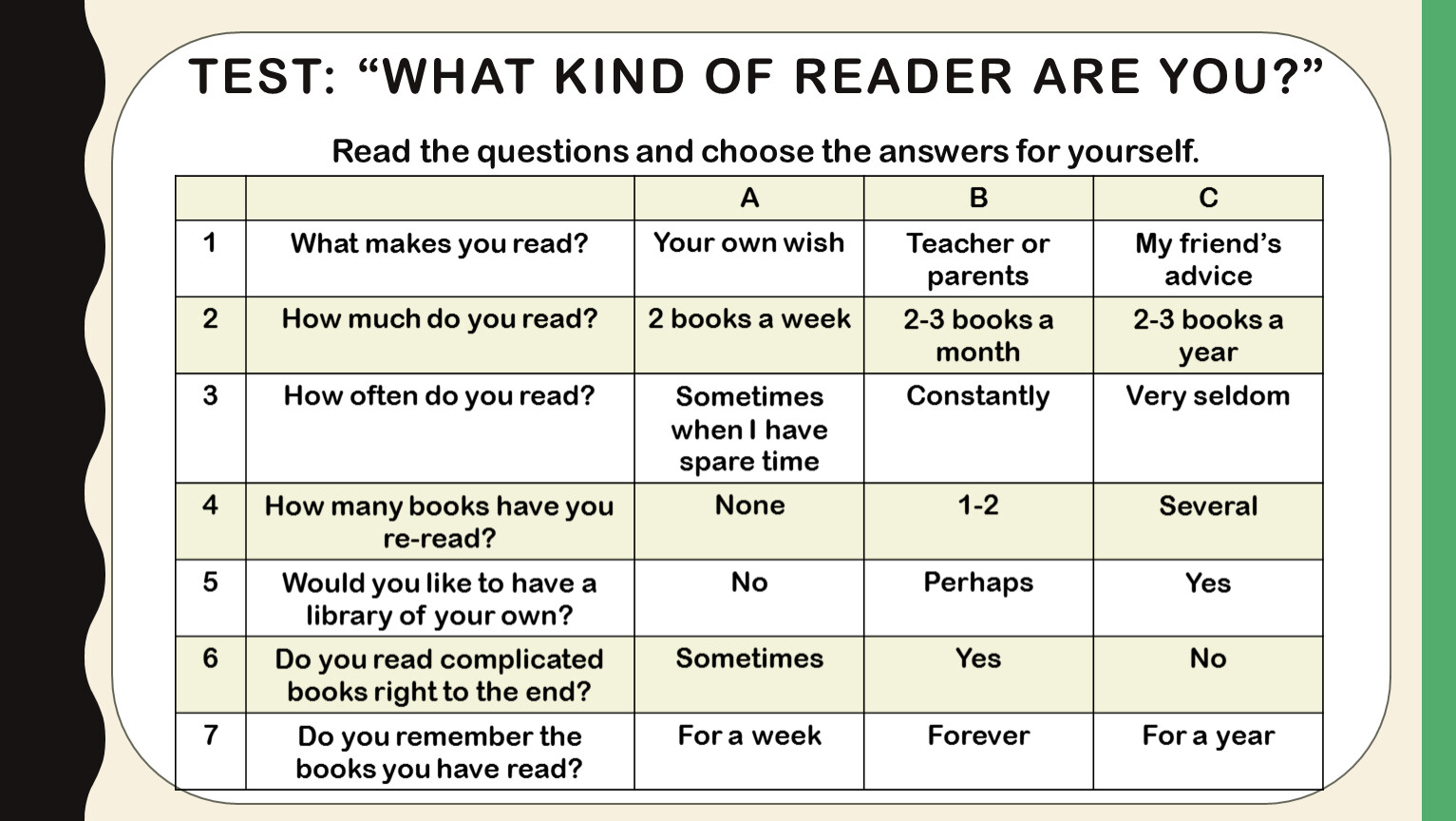
Test: “What kind of reader are you?”
Read the questions and choose the answers for yourself.
A | B | C | ||
1 | What makes you read? | Your own wish | Teacher or parents | My friend’s advice |
2 | How much do you read? | 2 books a week | 2-3 books a month | 2-3 books a year |
3 | How often do you read? | Sometimes when I have spare time | Constantly | Very seldom |
4 | How many books have you re-read? | None | 1-2 | Several |
5 | Would you like to have a library of your own? | No | Perhaps | Yes |
6 | Do you read complicated books right to the end? | Sometimes | Yes | No |
7 | Do you remember the books you have read? | For a week | Forever | For a year |
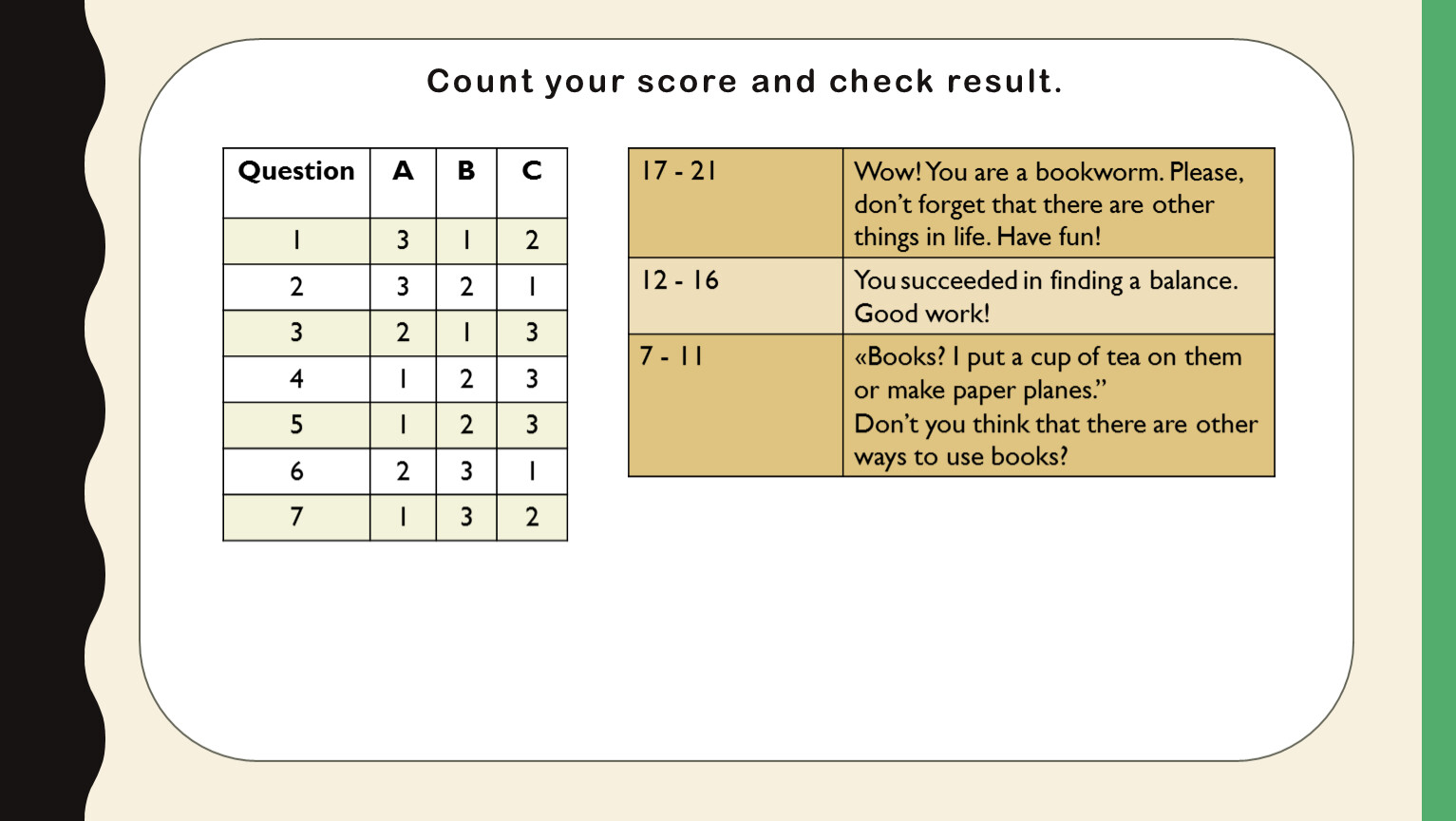
Count your score and check result.
Question | A | B | C |
1 | 3 | 1 | 2 |
2 | 2 | 1 | |
3 | 2 | 1 | 3 |
4 | 1 | 2 | |
5 | |||
6 | 2 | 3 | 1 |
7 | 1 | 2 |
17 - 21 | Wow! You are a bookworm. Please, don’t forget that there are other things in life. Have fun! |
12 - 16 | You succeeded in finding a balance. Good work! |
7 - 11 | «Books? I put a cup of tea on them or make paper planes.” |
Материалы на данной страницы взяты из открытых источников либо размещены пользователем в соответствии с договором-офертой сайта. Вы можете сообщить о нарушении.


