Поделиться


 THE OLYMPIC GAMES.docx
ХОД ЗАНЯТИЯ
1. Начало занятия
1.1. Организационный момент
Teacher: Good morning, students! I am glad to see you here. How are you? Are you fine? / Are you ok? We have today an unusual lesson. We have guests today. I hope our lesson will be interesting for you and you will be active today and will work hard! Are you ready for the lesson?
1.2. Постановка цели и задач занятия.
Мотивация учебной деятельности обучающихся.
Teacher: Let’s start! Before we start our lesson, I would like to suggest you to watch a short video. You should watch it and tell me please what we are speaking about today.
Студенты просматривают короткое видео с церемонии открытия Олимпийских Игр.
https://vk.com/video-23482909_456259087
Teacher: So, can you tell me, what did you see in this video? What is it about?
Students: Stadium, athletes, sport uniform, stars, fire (flame), joy, smile, the athletes run ….
Teacher: Right! And what is the theme of our lesson? What do you think?
Students: The Olympic Games.
Teacher: Yes, you are right! The theme of our lesson is “The Olympic Games”. We will speak today about The Olympic Games and the Olympic Champions. And the main aims of our lesson are to learn about the Olympic Games, to practice new words and expressions about sports and to talk about the famous athletes! Everybody has some work papers! You may use them during our lesson.
2. Актуализация знаний.
2.1. Brainstorm.
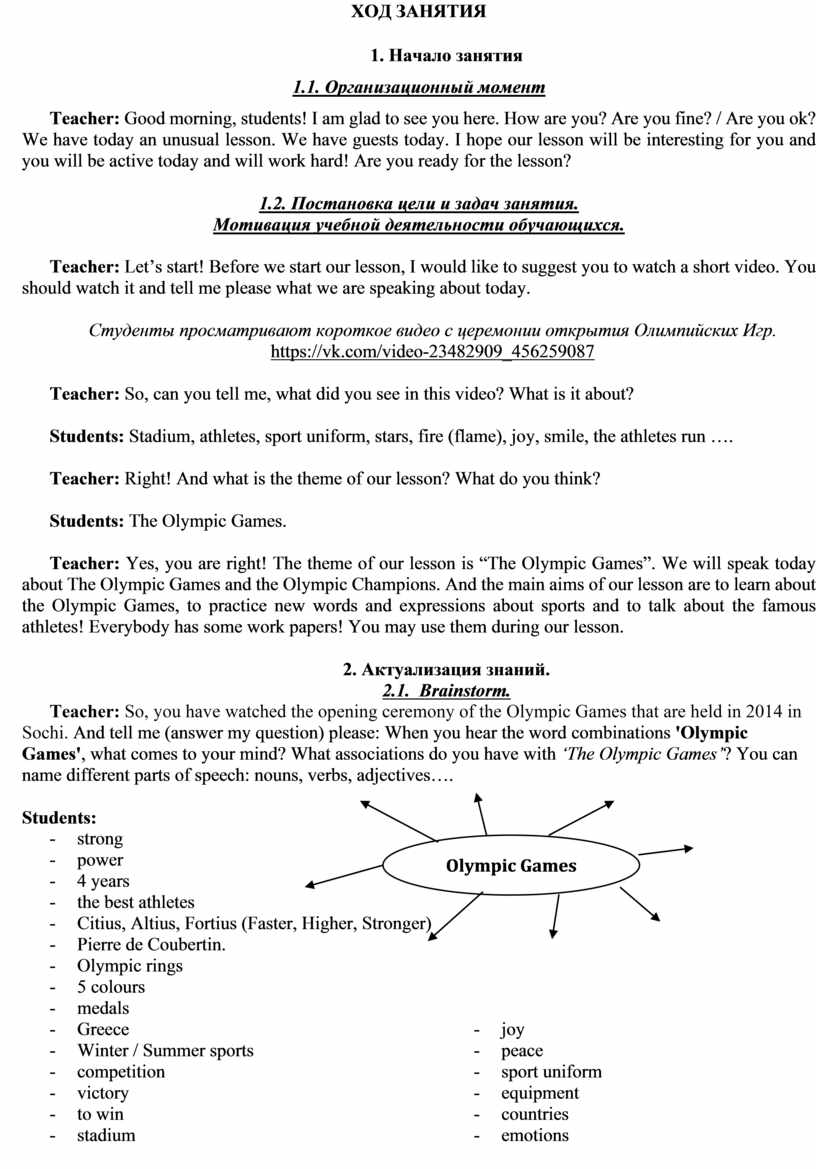
Teacher: So, you have watched the opening ceremony of the Olympic Games that are held in 2014 in Sochi. And tell me (answer my question) please: When you hear the word combinations 'Olympic Games', what comes to your mind? What associations do you have with ‘The Olympic Games’? You can name different parts of speech: nouns, verbs, adjectives….
 |
|||||
 |
 |
||||
Students:
-

 strong
-
 power
power
-
 4 years
-

 the best athletes
- Citius, Altius, Fortius (Faster, Higher, Stronger)
- Pierre de Coubertin.
- Olympic rings
- 5 colours
- medals
- Greece
- Winter / Summer sports
- competition
- victory
- to win
- stadium
- joy
- peace
- sport uniform
- equipment
- countries
- emotions
Teacher: Great job! You have collected so many ideas and words about the Olympic Games. It is really a great event in athletes’ life! And it shows how much meaning the Olympic Games have for people all over the world!
2.2. Лексическая разминка
Teacher: Now let’s continue with our next task. You can see two sets of cards on your desks:
– on some cards, you have names of sports,
– and on the others — descriptions of these sports.
Your task is to find the correct pairs — match each sport with its description!
Teacher: But first, read the words from the right column with the correct pronunciation. Read the words one by one.
(на слайде задание отображено в виде таблицы.
Студенты зачитывают слова с правильным произношением)
Teacher: And now match please sports with their descriptions. Work in pairs! You have some minutes. And then we will check up together!
(Задание студенты выполняют в парах, соединяя части пазла.
Затем зачитывают свои результаты)
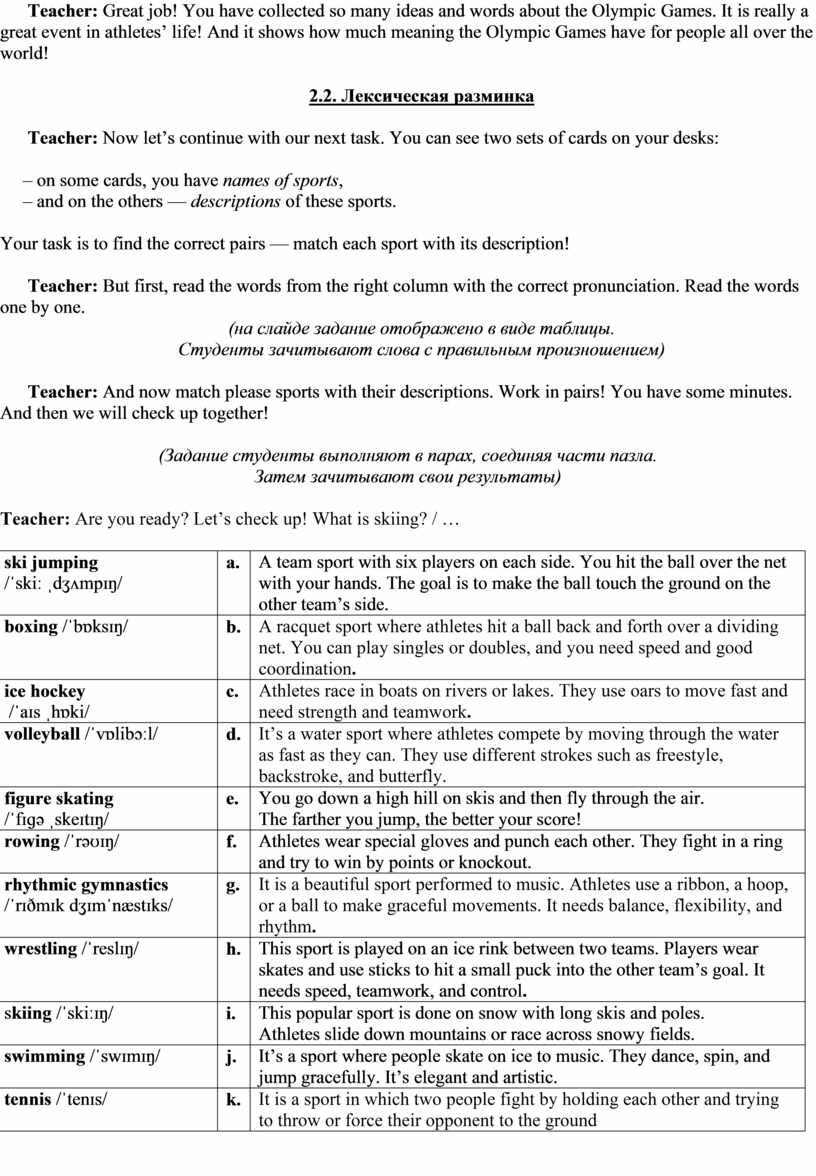
Teacher: Are you ready? Let’s check up! What is skiing? / …
|
1. |
ski jumping /ˈskiː ˌdʒʌmpɪŋ/ |
a. |
A team sport with six players on each side. You hit the ball over the net with your hands. The goal is to make the ball touch the ground on the other team’s side. |
|
2. |
boxing /ˈbɒksɪŋ/ |
b. |
A racquet sport where athletes hit a ball back and forth over a dividing net. You can play singles or doubles, and you need speed and good coordination. |
|
3. |
ice hockey /ˈaɪs ˌhɒki/ |
c. |
Athletes race in boats on rivers or lakes. They use oars to move fast and need strength and teamwork. |
|
4. |
volleyball /ˈvɒlibɔːl/ |
d. |
It’s a water sport where athletes compete by moving through the water as fast as they can. They use different strokes such as freestyle, backstroke, and butterfly. |
|
5. |
figure skating /ˈfɪɡə ˌskeɪtɪŋ/ |
e. |
You go
down a high hill on skis and then fly through the air. |
|
6. |
rowing /ˈrəʊɪŋ/ |
f. |
Athletes wear special gloves and punch each other. They fight in a ring and try to win by points or knockout. |
|
7. |
rhythmic gymnastics /ˈrɪðmɪk dʒɪmˈnæstɪks/ |
g. |
It is a beautiful sport performed to music. Athletes use a ribbon, a hoop, or a ball to make graceful movements. It needs balance, flexibility, and rhythm. |
|
8. |
wrestling /ˈreslɪŋ/ |
h. |
This sport is played on an ice rink between two teams. Players wear skates and use sticks to hit a small puck into the other team’s goal. It needs speed, teamwork, and control. |
|
9. |
skiing /ˈskiːɪŋ/ |
i. |
This
popular sport is done on snow with long skis and poles. |
|
10. |
swimming /ˈswɪmɪŋ/ |
j. |
It’s a sport where people skate on ice to music. They dance, spin, and jump gracefully. It’s elegant and artistic. |
|
11. |
tennis /ˈtenɪs/ |
k. |
It is a sport in which two people fight by holding each other and trying to throw or force their opponent to the ground |
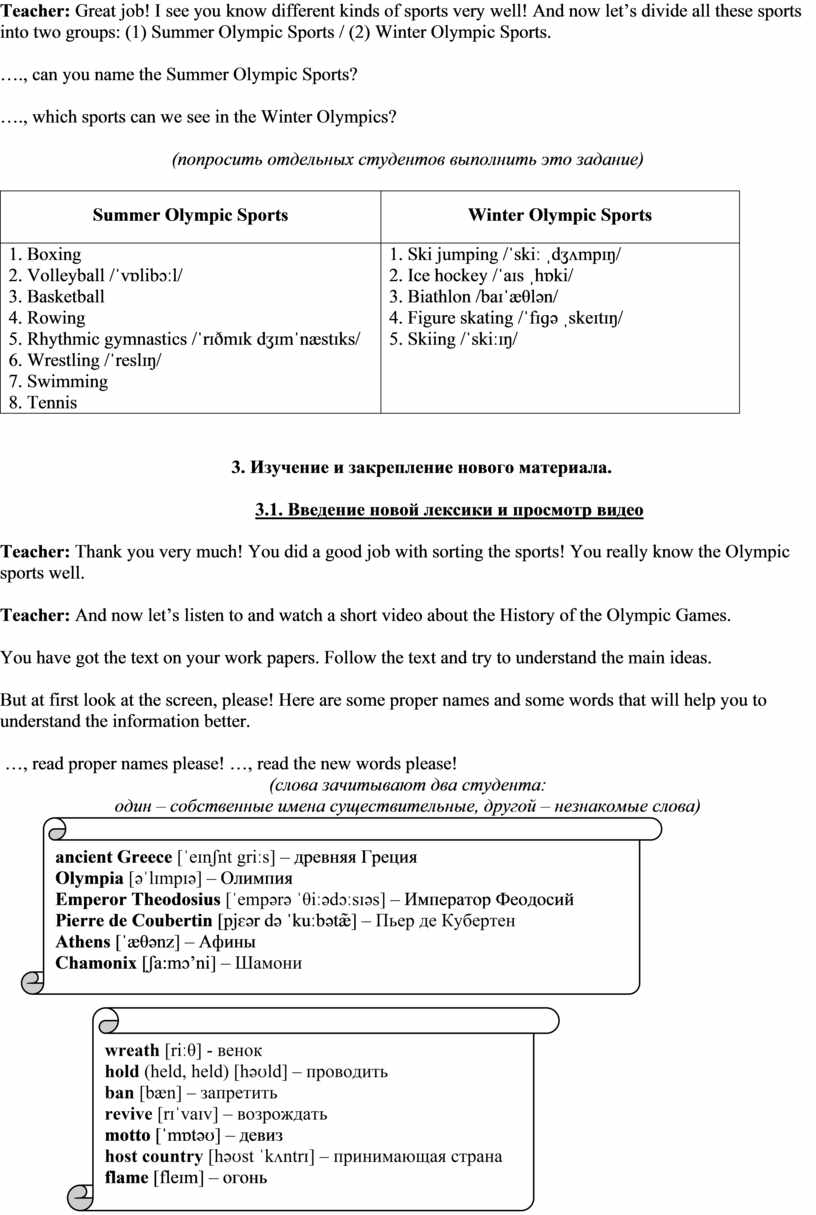
Teacher: Great job! I see you know different kinds of sports very well! And now let’s divide all these sports into two groups: (1) Summer Olympic Sports / (2) Winter Olympic Sports.
…., can you name the Summer Olympic Sports?
…., which sports can we see in the Winter Olympics?
(попросить отдельных студентов выполнить это задание)
Summer Olympic Sports |
Winter Olympic Sports |
|
1. Boxing 2. Volleyball /ˈvɒlibɔːl/ 3. Basketball 4. Rowing 5. Rhythmic gymnastics /ˈrɪðmɪk dʒɪmˈnæstɪks/ 6. Wrestling /ˈreslɪŋ/ 7. Swimming 8. Tennis |
1. Ski jumping /ˈskiː ˌdʒʌmpɪŋ/ 2. Ice hockey /ˈaɪs ˌhɒki/ 3. Biathlon /baɪˈæθlən/ 4. Figure skating /ˈfɪɡə ˌskeɪtɪŋ/ 5. Skiing /ˈskiːɪŋ/
|
3. Изучение и закрепление нового материала.
3.1. Введение новой лексики и просмотр видео
Teacher: Thank you very much! You did a good job with sorting the sports! You really know the Olympic sports well.
Teacher: And now let’s listen to and watch a short video about the History of the Olympic Games.
You have got the text on your work papers. Follow the text and try to understand the main ideas.
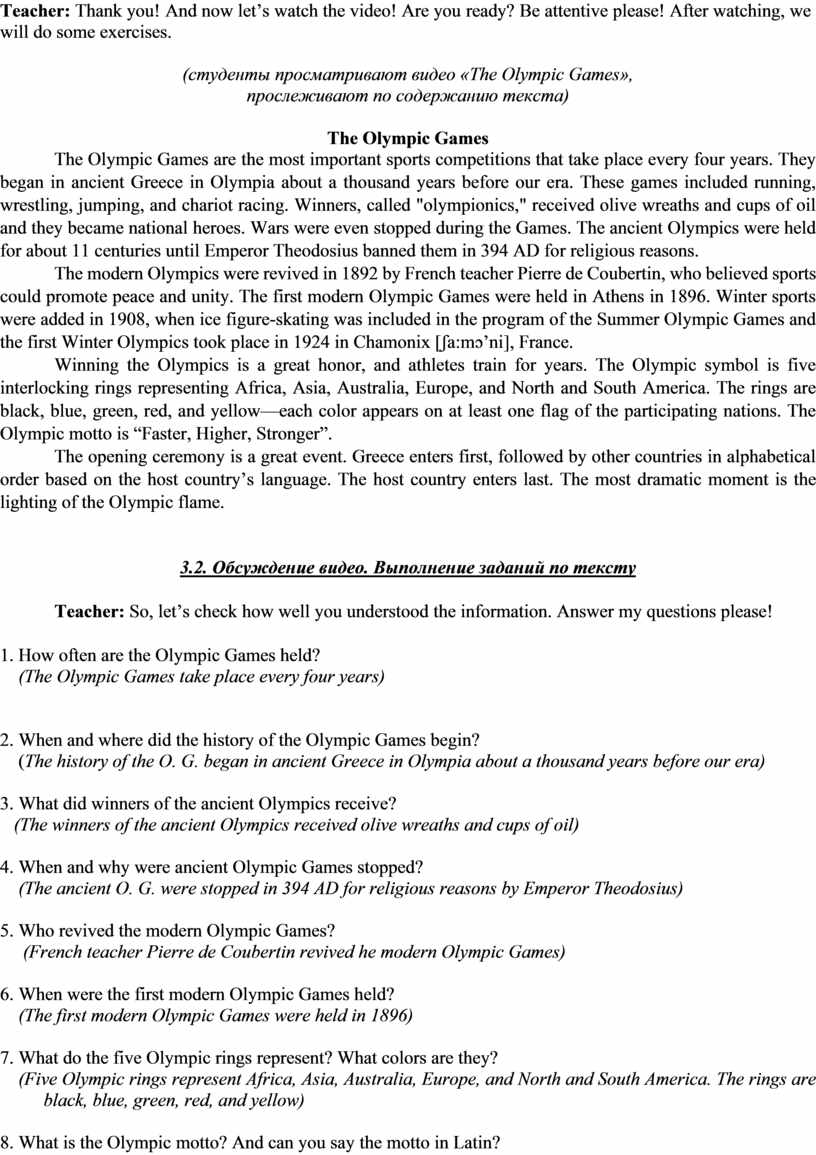
But at first look at the screen, please! Here are some proper names and some words that will help you to understand the information better.
…, read proper names please! …, read the new words please!
(слова зачитывают два студента:
один – собственные имена существительные, другой – незнакомые слова)
![ancient Greece [ˈeɪnʃnt griːs] – древняя Греция
Olympia [əˈlɪmpɪə] – Олимпия
Emperor Theodosius [ˈempərə ˈθiːədɔːsɪəs] – Император Феодосий
Pierre de Coubertin [pjɛər də ˈkuːbətæ̃] – Пьер де Кубертен
Athens [ˈæθənz] – Афины
Chamonix [ʃa:mɔ’ni] – Шамони](https://fs.znanio.ru/8c0997/a9/8c/22510ea8079371c5e32be1e0e2fcc3427a.png)
![wreath [riːθ] - венок
hold (held, held) [həʊld] – проводить
ban [bæn] – запретить
revive [rɪˈvaɪv] – возрождать
motto [ˈmɒtəʊ] – девиз
host country [həʊst ˈkʌntrɪ] – принимающая страна
flame [fleɪm] – огонь](https://fs.znanio.ru/8c0997/ec/90/43dc3bee4e9c53369cc7c0ba492690bd03.png)
Teacher: Thank you! And now let’s watch the video! Are you ready? Be attentive please! After watching, we will do some exercises.
(студенты просматривают видео «The Olympic Games»,
прослеживают по содержанию текста)
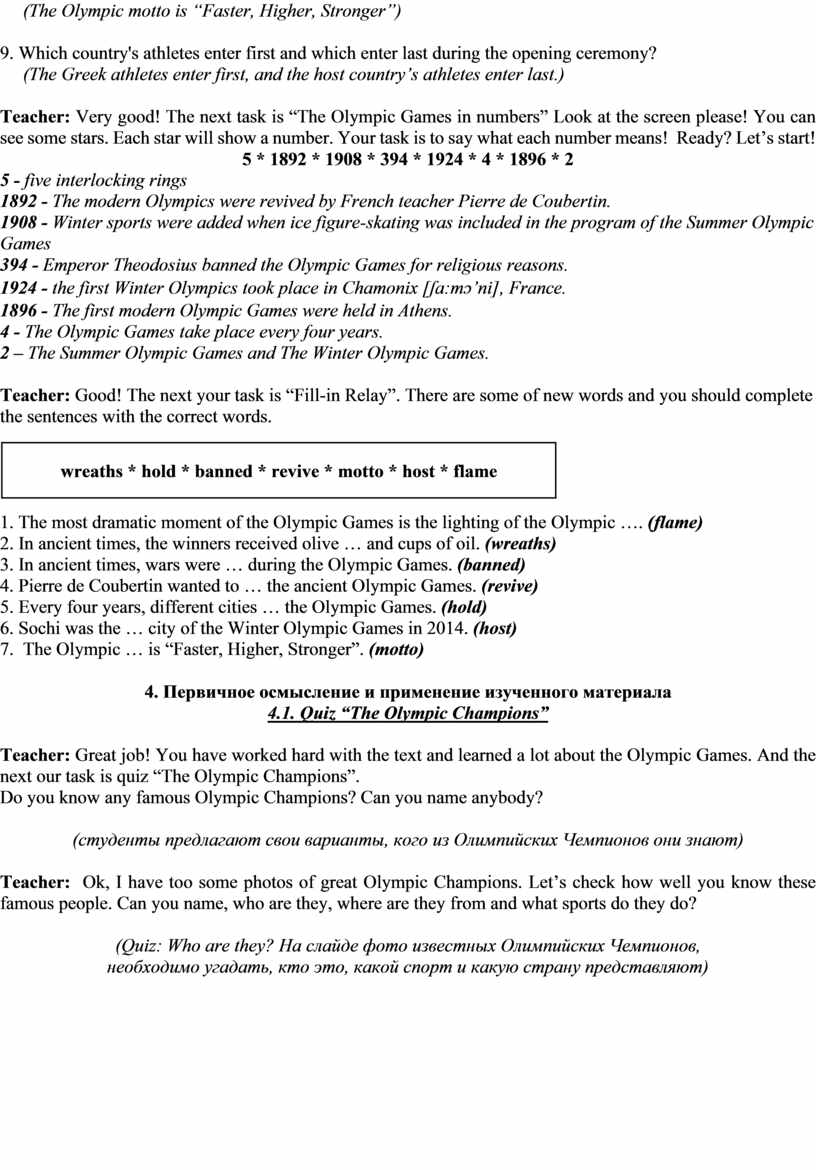
The Olympic Games
The Olympic Games are the most important sports competitions that take place every four years. They began in ancient Greece in Olympia about a thousand years before our era. These games included running, wrestling, jumping, and chariot racing. Winners, called "olympionics," received olive wreaths and cups of oil and they became national heroes. Wars were even stopped during the Games. The ancient Olympics were held for about 11 centuries until Emperor Theodosius banned them in 394 AD for religious reasons.
The modern Olympics were revived in 1892 by French teacher Pierre de Coubertin, who believed sports could promote peace and unity. The first modern Olympic Games were held in Athens in 1896. Winter sports were added in 1908, when ice figure-skating was included in the program of the Summer Olympic Games and the first Winter Olympics took place in 1924 in Chamonix [ʃa:mɔ’ni], France.
Winning the Olympics is a great honor, and athletes train for years. The Olympic symbol is five interlocking rings representing Africa, Asia, Australia, Europe, and North and South America. The rings are black, blue, green, red, and yellow—each color appears on at least one flag of the participating nations. The Olympic motto is “Faster, Higher, Stronger”.
The opening ceremony is a great event. Greece enters first, followed by other countries in alphabetical order based on the host country’s language. The host country enters last. The most dramatic moment is the lighting of the Olympic flame.
3.2. Обсуждение видео. Выполнение заданий по тексту
Teacher: So, let’s check how well you understood the information. Answer my questions please!
1. How often are the Olympic Games held?
(The Olympic Games take place every four years)
2. When and where did the history of the Olympic Games begin?
(The history of the O. G. began in ancient Greece in Olympia about a thousand years before our era)
3. What did winners of the ancient Olympics receive?
(The winners of the ancient Olympics received olive wreaths and cups of oil)
4. When and why were ancient Olympic Games stopped?
(The ancient O. G. were stopped in 394 AD for religious reasons by Emperor Theodosius)
5. Who revived the modern Olympic Games?
(French teacher Pierre de Coubertin revived he modern Olympic Games)
6. When were the first modern Olympic Games held?
(The first modern Olympic Games were held in 1896)
7. What do the five Olympic rings represent? What colors are they?
(Five Olympic rings represent Africa, Asia, Australia, Europe, and North and South America. The rings are black, blue, green, red, and yellow)
8. What is the Olympic motto? And сan you say the motto in Latin?
(The Olympic motto is “Faster, Higher, Stronger”)
9. Which country's athletes enter first and which enter last during the opening ceremony?
(The Greek athletes enter first, and the host country’s athletes enter last.)
Teacher: Very good! The next task is “The Olympic Games in numbers” Look at the screen please! You can see some stars. Each star will show a number. Your task is to say what each number means! Ready? Let’s start!
5 * 1892 * 1908 * 394 * 1924 * 4 * 1896 * 2
5 - five interlocking rings
1892 - The modern Olympics were revived by French teacher Pierre de Coubertin.
1908 - Winter sports were added when ice figure-skating was included in the program of the Summer Olympic Games
394 - Emperor Theodosius banned the Olympic Games for religious reasons.
1924 - the first Winter Olympics took place in Chamonix [ʃa:mɔ’ni], France.
1896 - The first modern Olympic Games were held in Athens.
4 - The Olympic Games take place every four years.
2 – The Summer Olympic Games and The Winter Olympic Games.
Teacher: Good! The next your task is “Fill-in Relay”. There are some of new words and you should complete the sentences with the correct words.
 |
1. The most dramatic moment of the Olympic Games is the lighting of the Olympic …. (flame)
2. In ancient times, the winners received olive … and cups of oil. (wreaths)
3. In ancient times, wars were … during the Olympic Games. (banned)
4. Pierre de Coubertin wanted to … the ancient Olympic Games. (revive)
5. Every four years, different cities … the Olympic Games. (hold)
6. Sochi was the … city of the Winter Olympic Games in 2014. (host)
7. The Olympic … is “Faster, Higher, Stronger”. (motto)
4. Первичное осмысление и применение изученного материала
4.1. Quiz “The Olympic Champions”
Teacher: Great job! You have worked hard with the text and learned a lot about the Olympic Games. And the next our task is quiz “The Olympic Champions”.
Do you know any famous Olympic Champions? Can you name anybody?
(студенты предлагают свои варианты, кого из Олимпийских Чемпионов они знают)
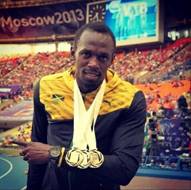
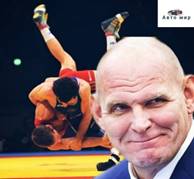
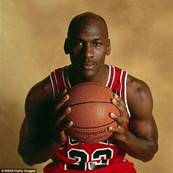
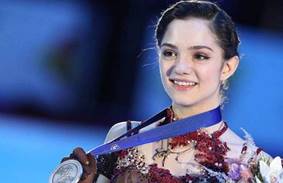
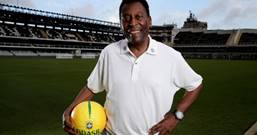
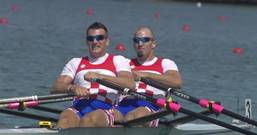
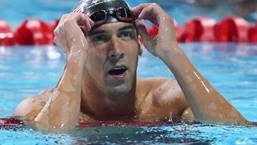
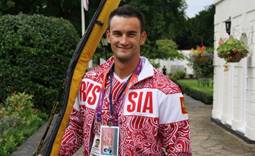
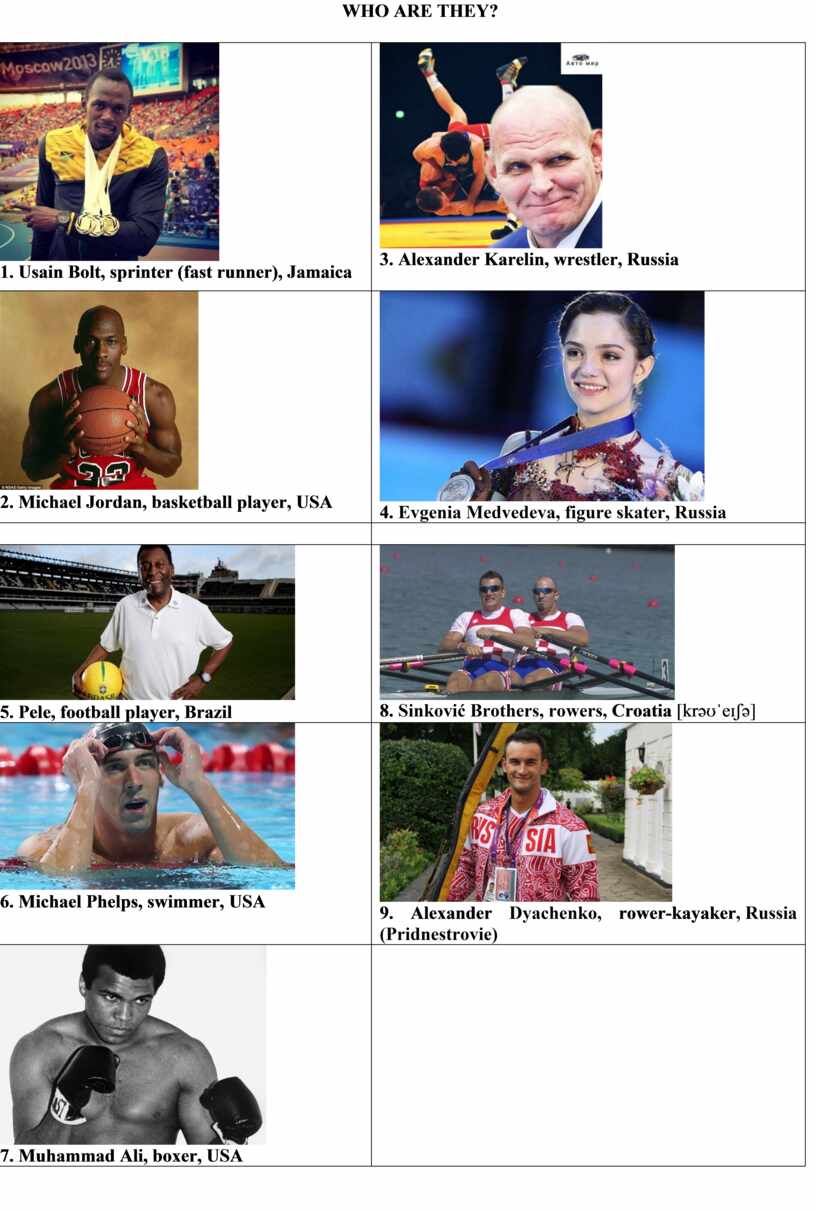
Teacher: Ok, I have too some photos of great Olympic Champions. Let’s check how well you know these famous people. Can you name, who are they, where are they from and what sports do they do?
(Quiz: Who are they? На слайде фото известных Олимпийских Чемпионов,
необходимо угадать, кто это, какой спорт и какую страну представляют)
WHO ARE THEY?
|
1. Usain Bolt, sprinter (fast runner), Jamaica |
3. Alexander Karelin, wrestler, Russia
|
|
2. Michael Jordan, basketball player, USA |
4. Evgenia Medvedevа, figure skater, Russia |
|
|
|
|
5. Pele, football player, Brazil |
8. Sinković Brothers, rowers, Croatia [krəʊˈeɪʃə] |
|
6. Michael Phelps, swimmer, USA |
9. Alexander Dyachenko, rower-kayaker, Russia (Pridnestrovie) |
|
7. Muhammad Ali, boxer, USA |
|
5. Контроль самостоятельной работы.
Teacher: Thank you very much! I see you are real experts in the Olympic Games and you know very well the famous Olympic champions!
I know that you have achieved a lot in your sports career too, and your task for today was to prepare presentations of your achievements.
So, who would like to start? Who would like to be the first / the next?
(Контроль самостоятельной работы.
Представление презентаций студентов)
Teacher: Thank you very much! That was wonderful! Each presentation was great! I can see the Olympic spirit in each your presentation!
6. Дополнительное задание.
Teacher: But can you tell me please: Can every athlete become a champion or an Olympic champion? What do you think?
I have some cards. Choose please only those that describe a true champion and put them to the board.
(студенты выбирают из предложенных выражений только правильные
и прикрепляют на доску)
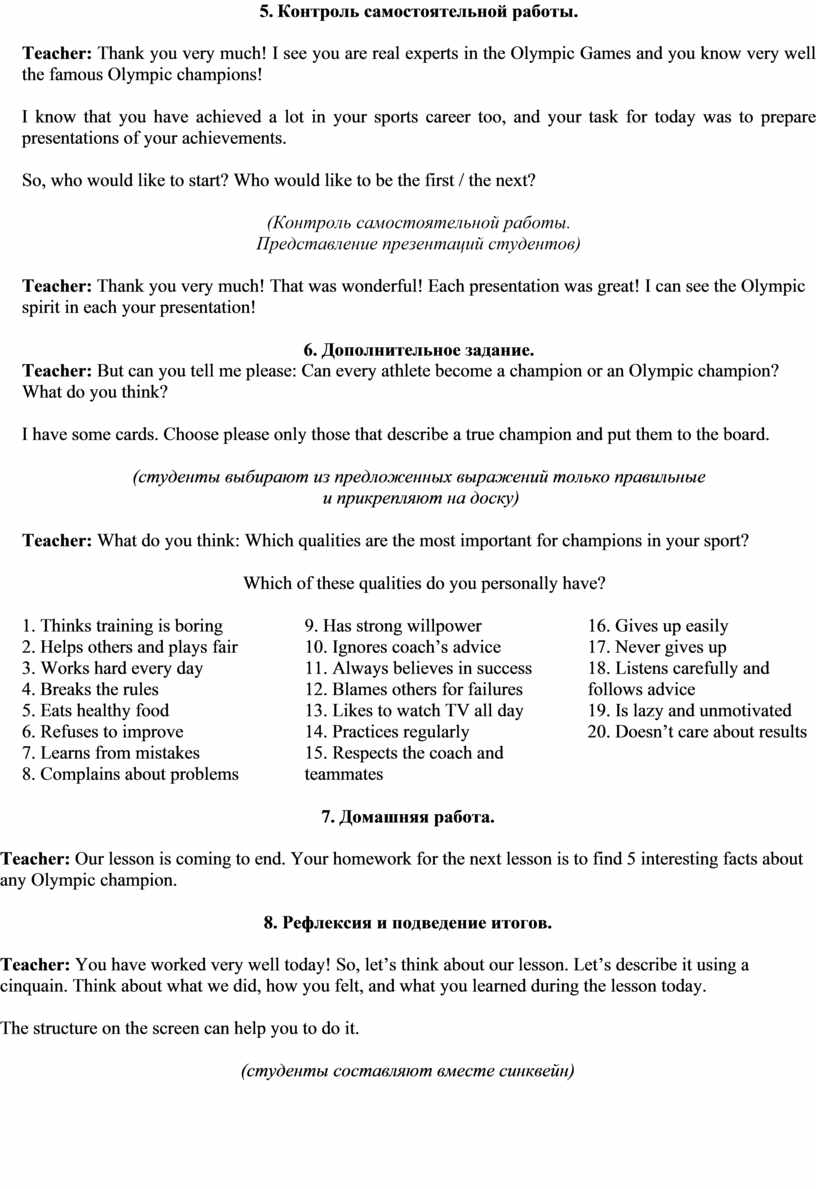
Teacher: What do you think: Which qualities are the most important for champions in your sport?
Which of these qualities do you personally have?
1. Thinks training is boring
2. Helps others and plays fair
3. Works hard every day
4. Breaks the rules
5. Eats healthy food
6. Refuses to improve
7. Learns from mistakes
8. Complains about problems
9. Has strong willpower
10. Ignores coach’s advice
11. Always believes in success
12. Blames others for failures
13. Likes to watch TV all day
14. Practices regularly
15. Respects the coach and teammates
16. Gives up easily
17. Never gives up
18. Listens carefully and follows advice
19. Is lazy and unmotivated
20. Doesn’t care about results
7. Домашняя работа.
Teacher: Our lesson is coming to end. Your homework for the next lesson is to find 5 interesting facts about any Olympic champion.
8. Рефлексия и подведение итогов.
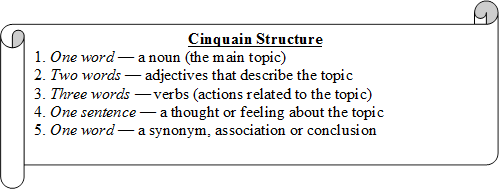
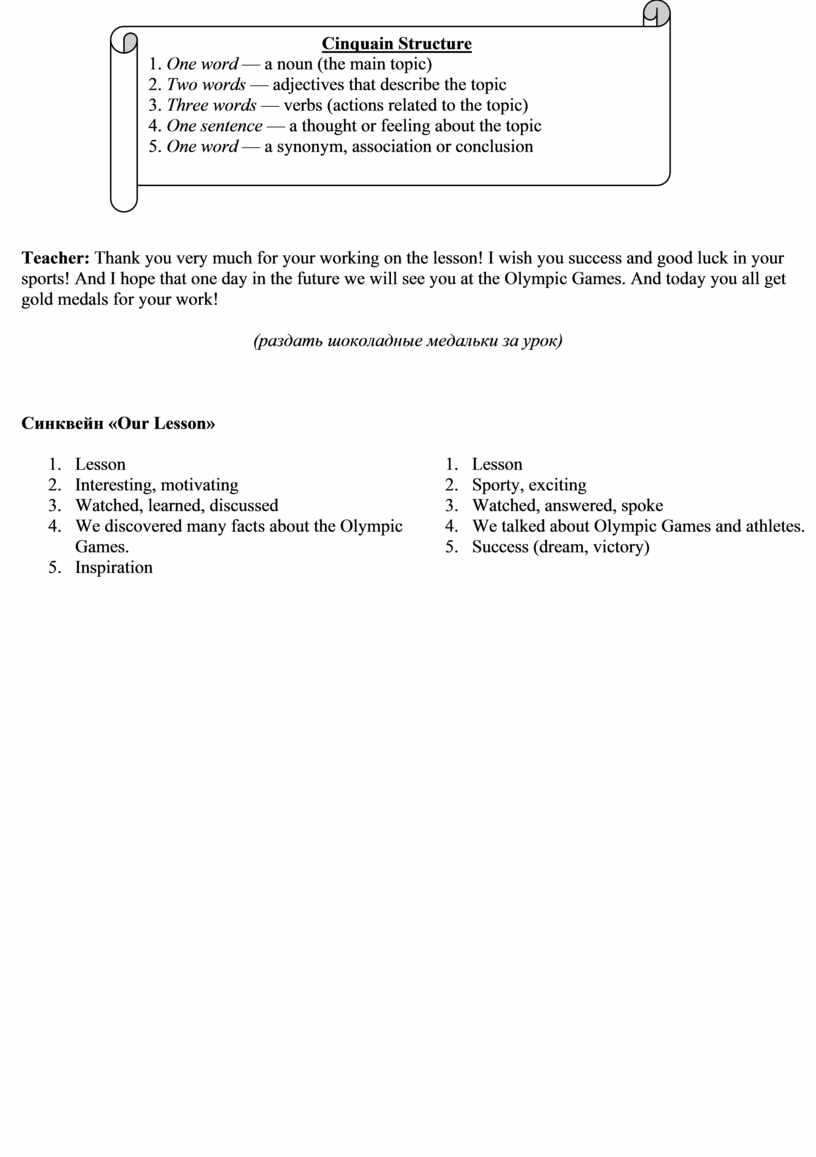
Teacher: You have worked very well today! So, let’s think about our lesson. Let’s describe it using a cinquain. Think about what we did, how you felt, and what you learned during the lesson today.
The structure on the screen can help you to do it.
(студенты составляют вместе синквейн)
Teacher: Thank you very much for your working on the lesson! I wish you success and good luck in your sports! And I hope that one day in the future we will see you at the Olympic Games. And today you all get gold medals for your work!
(раздать шоколадные медальки за урок)
Синквейн «Our Lesson»
1. Lesson
2. Sporty, exciting
3. Watched, answered, spoke
4. We talked about Olympic Games and athletes.
5. Success (dream, victory)
Скачано с www.znanio.ru
Материалы на данной страницы взяты из открытых источников либо размещены пользователем в соответствии с договором-офертой сайта. Вы можете сообщить о нарушении.