
Поделиться



 Roots-of-Foreign-Languages-and-The-International-Language-of-Communication.pptx
Roots of Foreign Languages & The International Language of Communication
Insights inspired by Kороткова Г.Е.
The Family Tree of Languages: Where It All Begins
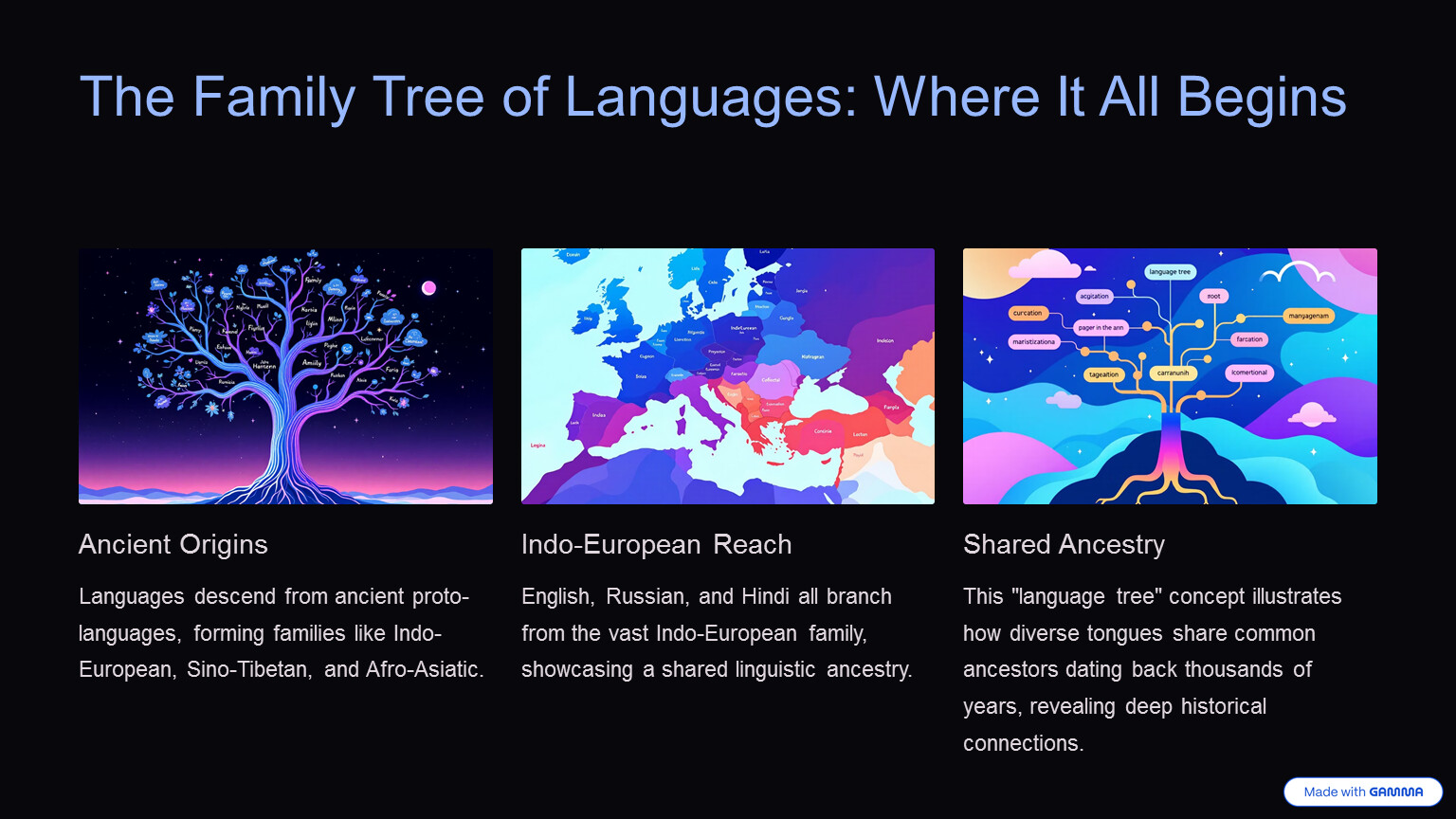
Ancient Origins
Languages descend from ancient proto-languages, forming families like Indo-European, Sino-Tibetan, and Afro-Asiatic.
Indo-European Reach
English, Russian, and Hindi all branch from the vast Indo-European family, showcasing a shared linguistic ancestry.
Shared Ancestry
This "language tree" concept illustrates how diverse tongues share common ancestors dating back thousands of years, revealing deep historical connections.
Indo-European Roots: The Mother of Many
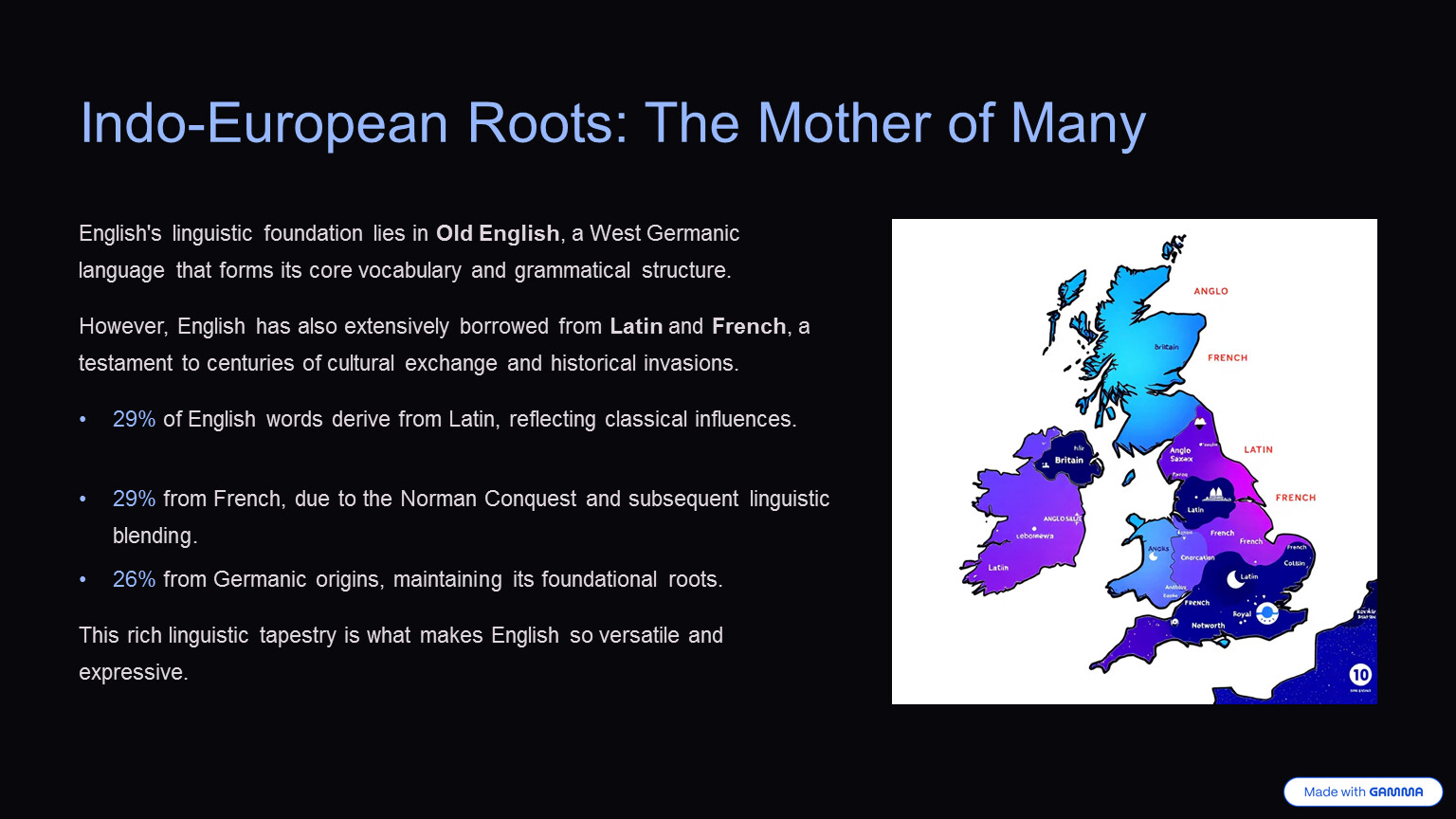
English's linguistic foundation lies in Old English, a West Germanic language that forms its core vocabulary and grammatical structure.
However, English has also extensively borrowed from Latin and French, a testament to centuries of cultural exchange and historical invasions.
29% of English words derive from Latin, reflecting classical influences.
29% from French, due to the Norman Conquest and subsequent linguistic blending.
26% from Germanic origins, maintaining its foundational roots.
This rich linguistic tapestry is what makes English so versatile and expressive.
Language Evolution: Borrowing and Blending
1
Viking Influence
English absorbed words from Old Norse during the Viking invasions, introducing terms like "sky," "skin," and "take."
2
Norman Conquest (1066)
The arrival of Norman French speakers after 1066 profoundly shaped English vocabulary, leading to words like "government" and "justice."
3
A Rich Lexicon
This historical blending created a uniquely rich and flexible vocabulary, which significantly contributed to English's global adaptability.
The Concept of a World Language
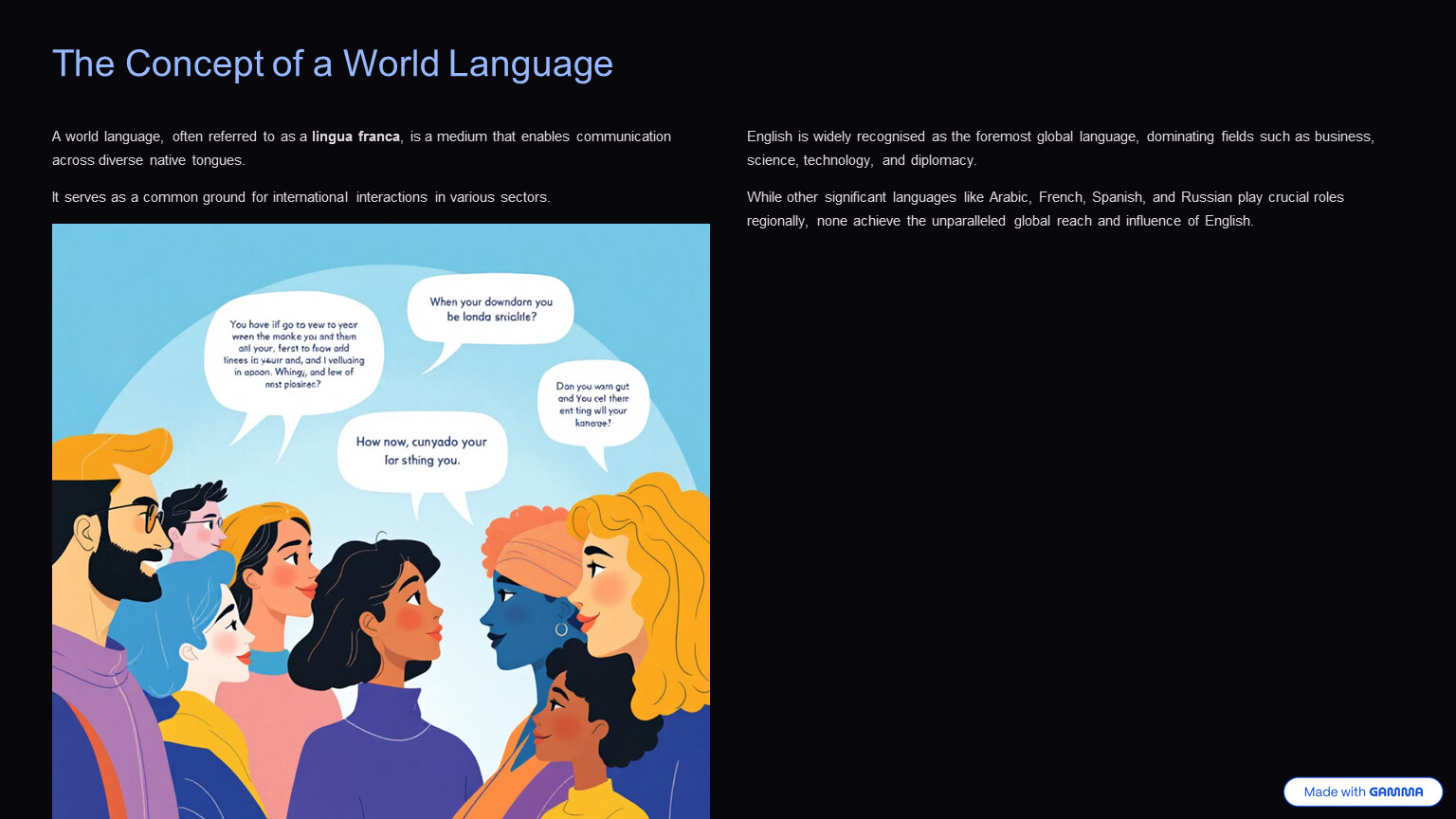
A world language, often referred to as a lingua franca, is a medium that enables communication across diverse native tongues.
It serves as a common ground for international interactions in various sectors.
English is widely recognised as the foremost global language, dominating fields such as business, science, technology, and diplomacy.
While other significant languages like Arabic, French, Spanish, and Russian play crucial roles regionally, none achieve the unparalleled global reach and influence of English.
Why English? The Global Function of a Lingua Franca
Historical Dominance
The legacy of the British Empire and the economic and cultural influence of the USA propelled English to global prominence.
Economic Power
English is the language of international trade, finance, and major industries, making it essential for global commerce.
Technological Advancement
It dominates the internet, scientific research, and technological innovation, further solidifying its status.
Universal Application
English is the primary or secondary language in over 100 countries and the mandatory language for international aviation, fostering global safety and cooperation.
With over 1.5 billion speakers worldwide, including a vast number of non-native speakers, English serves as the indispensable bridge for international communication.
Roots IVY Schools: Embracing Linguistic Diversity
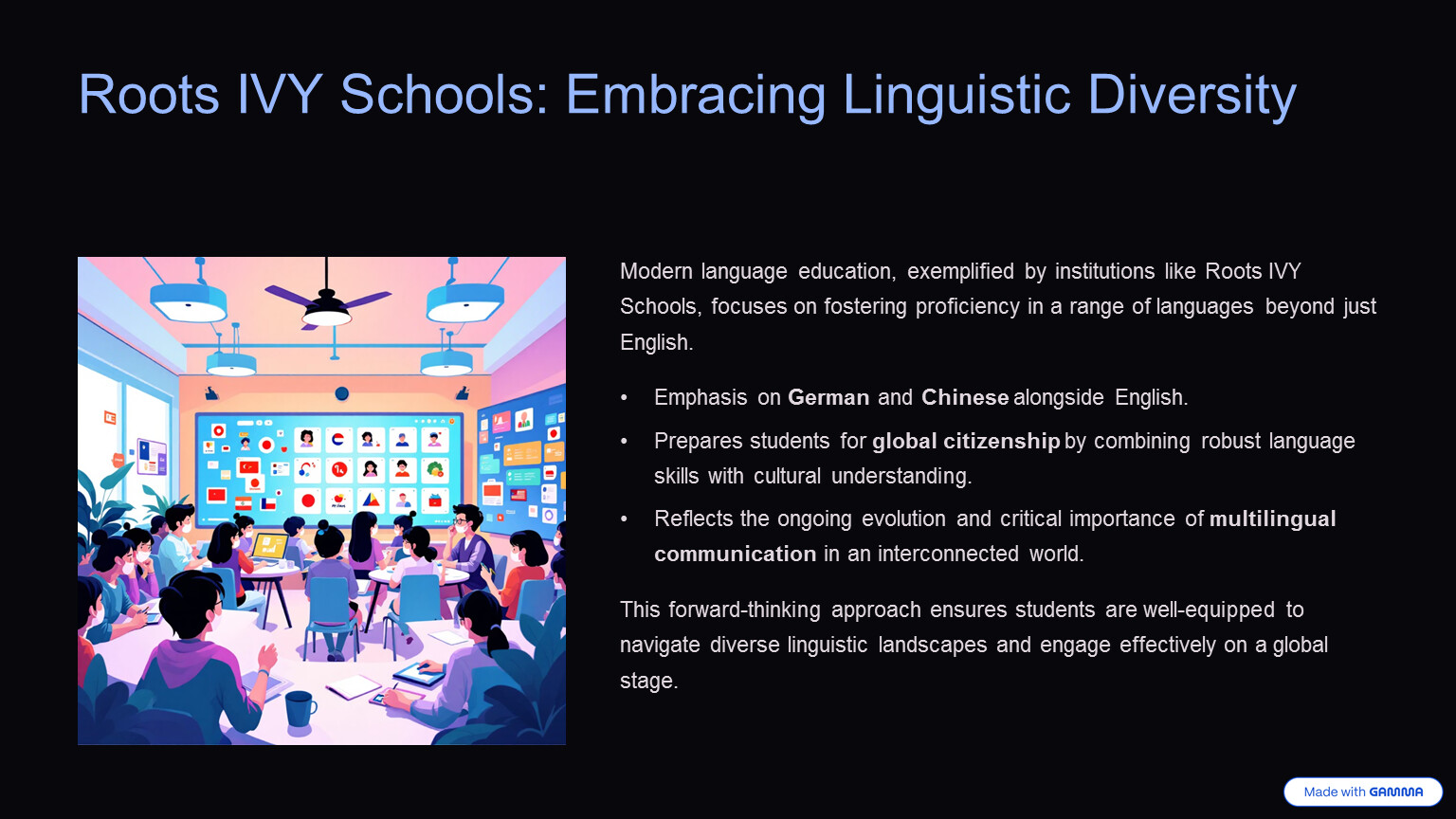
Modern language education, exemplified by institutions like Roots IVY Schools, focuses on fostering proficiency in a range of languages beyond just English.
Emphasis on German and Chinese alongside English.
Prepares students for global citizenship by combining robust language skills with cultural understanding.
Reflects the ongoing evolution and critical importance of multilingual communication in an interconnected world.
This forward-thinking approach ensures students are well-equipped to navigate diverse linguistic landscapes and engage effectively on a global stage.
The Future of International Communication
English's Continued Dominance
While robust, English faces emerging competition from languages like Mandarin Chinese, driven by economic shifts.
Digital Impact
Digital communication and increasing globalisation continuously reshape language spread and mutual influence, accelerating linguistic evolution.
Constructed Languages
Languages such as Esperanto are designed as neutral international communication tools, though their adoption remains limited.
Kороткова Г.Е.’s Perspective: Language as a Bridge
Kороткова Г.Е. underscores that the study of language roots offers profound insights into human history and illuminates the intricate web of cultural connections that bind us.
International languages are not merely tools; they are vital bridges that facilitate cooperation, foster peace, and enable the global sharing of knowledge, transcending geographical and cultural boundaries.
A deeper understanding of language origins enriches our appreciation for the inherent complexity and crucial role of global communication in our interconnected world.
Conclusion: From Ancient Roots to Global Voices
The fascinating story of foreign languages is an eloquent narrative of human migration, cultural contact, and boundless creativity.
English's preeminent role as an international language stands as a prime example of how linguistic systems dynamically evolve to meet the ever-changing demands of global interaction.
Embracing both linguistic diversity and the rich tapestry of language history empowers us to communicate more effectively and foster deeper understanding in our increasingly interconnected world.
Материалы на данной страницы взяты из открытых источников либо размещены пользователем в соответствии с договором-офертой сайта. Вы можете сообщить о нарушении.


